Summary
Editor's rating
Value for money: who should actually buy this size and price point
Design: looks high-end enough without screaming for attention
Materials and build: better than cheap units, not luxury but solid
Durability so far and what worries me long term
Performance: cooling, noise and real capacity
What this Tylza fridge actually offers on paper vs real life
Pros
- Quiet operation with stable dual-zone cooling suitable for mixed red and white storage
- Solid build quality for the price, with sturdy beech wood shelves on proper metal rails
- Large practical capacity (around 150–165 mixed bottles) and decent customer service support
Cons
- Real-world capacity is noticeably lower than the advertised 180 bottles with varied bottle shapes
- Touch controls and light button are not very intuitive to use in the dark

Specifications
View full product page →| Brand | Tylza |
| Brand Name | Tylza |
| Model Info | TYWC408 |
| Item Weight | 120 pounds |
| Product Dimensions | 27.16 x 23.54 x 65.74 inches |
| Item model number | TYWC408 |
| Capacity | 14.41 Cubic Feet |
| Freezer Capacity | 14.41 Cubic Feet |
A big wine fridge for people who are actually running out of space
I’ve been using this Tylza 24" dual zone wine fridge for a little while now, and it’s the first time I’ve gone for a unit this big (180-bottle rated). Before this, I had a smaller 40–50 bottle cooler that was constantly packed and half my bottles ended up lying around in random cupboards. So I wanted to see if this thing actually solves the storage problem and if it’s decent to live with day to day, not just on paper.
In practice, I set it up in a basement bar area, plugged into a standard 115V outlet, freestanding, not built-in. I followed their advice and let it sit for more than 24 hours before turning it on, just to avoid compressor issues. I loaded it gradually over a few evenings with a mix of Bordeaux-style bottles, some chunky Pinot bottles, and a handful of Champagne and odd-shaped stuff. So this is not a lab test, it’s just regular use by someone who likes wine and hates clutter.
What stood out pretty quickly is that it really is quiet for the size. The compressor kicks in, but it’s more of a soft background hum, way less intrusive than my full-size kitchen fridge. The temperatures on both zones settle fairly fast and stay within a couple degrees of the target, which is basically what I expect from any decent wine fridge. Nothing magical, just normal, stable cooling that doesn’t draw attention to itself.
It’s not perfect though. The claimed 180-bottle capacity is optimistic unless all your bottles are standard Bordeaux shapes. Once you start adding Pinot, Champagne, and chunky New World reds, that number drops. The shelves are good quality and slide well, but you’ll have to play Tetris a bit. Overall, my first impression is that it’s a pretty solid, quiet, large-capacity unit with a few compromises, mostly around real-world capacity and the usual bottle size headaches.
Value for money: who should actually buy this size and price point
On the value side, this Tylza sits in that middle zone: not cheap, not ultra-premium. For a 24" dual-zone unit with a claimed 180-bottle capacity, stainless steel, wooden shelves, and a quiet compressor, the price is fair. You can definitely find cheaper 24" fridges, but they usually have weaker build, noisier fans, and fewer shelves. On the other hand, you can easily pay a lot more for a big-name brand and get pretty similar real-world performance if you’re just storing wine at home.
What makes it feel like good value is the combo of: solid shelving, low noise, decent temperature stability, and responsive customer service. Reading through other buyers’ experiences, people got help when Amazon delivered units on their side or when a fan was loud. One even mentioned Tylza honoring a credit after a price drop. That kind of support matters because shipping back a 120 lb fridge is a pain, and having someone send parts instead is way easier. So you’re not just paying for hardware, you’re also paying for less headache if something small goes wrong.
That said, if your collection is under, say, 60–80 bottles and you don’t plan to grow it much, this is probably overkill. It takes a lot of space and you’re paying for capacity you won’t use. A smaller dual-zone unit would be cheaper and easier to place. Also, if you’re extremely picky about precise temps and want zero gradients, you might end up looking at more expensive cellar brands. This one is good, but not perfect to the degree of a high-end, pro-level cabinet.
For someone who has a growing collection, wants dual zones, cares about noise, and doesn’t want to pay luxury-brand prices, this Tylza is pretty solid value for money. Just go in knowing the real capacity is lower than 180 if you have mixed bottle shapes, and budget your space and expectations accordingly.
Design: looks high-end enough without screaming for attention
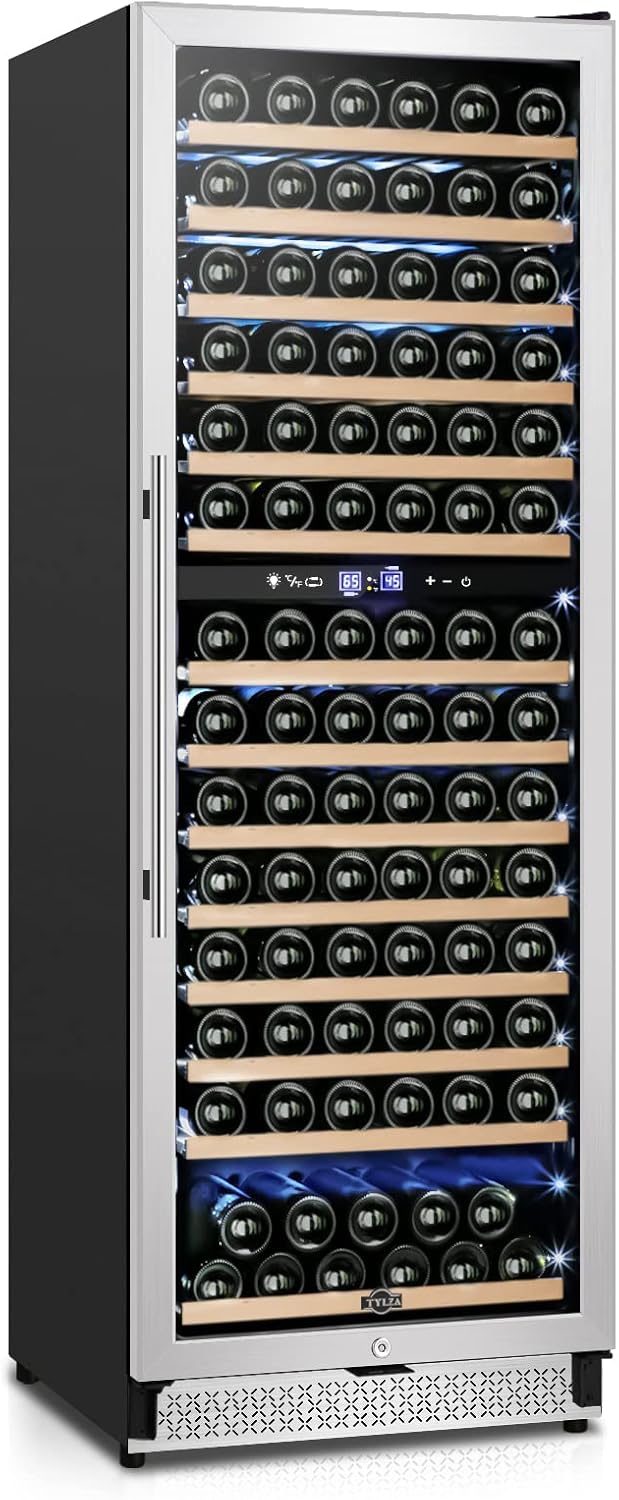
Design-wise, this Tylza fridge goes for the classic stainless steel frame with glass door look. It’s not flashy, but it fits well in a bar, kitchen, or finished basement. The door is right-hinged, and the handle is long and sturdy enough that it doesn’t feel cheap when you pull it. The metallic finish doesn’t show fingerprints too badly, which I appreciate because I hate constantly wiping down doors. The proportions are tall and narrow, so it looks more like a slim wine cabinet than a squat beverage cooler.
Inside, you get 14 beech wooden shelves that slide out on proper metal rails, not just bare wood on plastic. That’s a big plus. Compared to cheaper fridges where the shelves scrape and flex, these feel more secure. You can pull them out far enough to see the labels without having the whole shelf sag. The wooden fronts give it a slightly more serious cellar vibe without being over the top. The internal LED lighting is decent: it lights the bottles enough to see what’s where, especially in the evening, but it’s not super bright mood lighting either.
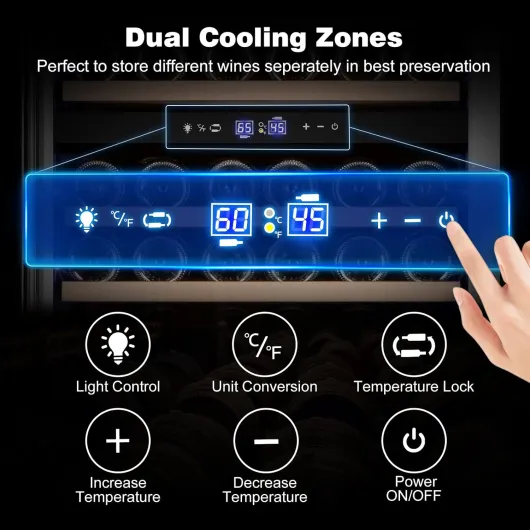
The touch control panel is on the front inside the cabinet, and the display is clear. The only gripe I have is that in the dark, some buttons are not obvious to find by touch, especially the light button. It’s not backlit, so you kind of poke around until you remember where it is. Minor annoyance, but still something you notice when this is used in a dim bar area. The external look, though, is clean and simple. It doesn’t look cheap next to higher-end appliances.
In terms of layout, the dual-zone split is vertical: top section and bottom section, not left/right. That makes sense for typical wine storage since you can naturally use the cooler upper area for whites and bubbles and the lower for reds. Overall, the design is practical and neutral. It’s not going to impress design snobs, but it also doesn’t look out of place next to more expensive brands. For the price range, I’d say the design feels pretty solid and functional, with a couple of small usability quirks.
Materials and build: better than cheap units, not luxury but solid
The materials are honestly one of the stronger points of this fridge for the price. The outside is stainless steel and glass, and it doesn’t feel flimsy. The door has some weight to it and closes with a firm seal instead of that light, hollow feel you get on bargain units. The glass seems thick enough, and after some weeks of use I haven’t noticed condensation or fogging issues on the door in my environment. The door gasket seals well; no obvious gaps or whistling air leaks.
Inside, the beech wood shelves are the highlight. They’re not just decorative; they feel sturdy when loaded. I’ve double-stacked a few spots with two layers of bottles (carefully), and the rails didn’t complain. The shelves slide on metal runners, which is a big step up from cheaper coolers where shelves scrape on plastic grooves. No squeaking, no jerky movement. When you’re pulling a shelf full of bottles, that matters, because a wobbly shelf is how you chip or drop something.
The internal walls are the usual smooth liner material you see in most mid-range fridges. Nothing fancy, but easy to wipe if there’s a spill. The fans and vents inside are plastic, but they don’t rattle. One user mentioned early on that their fan was loud and Tylza sent a newer, quieter fan. That matches the feeling that the brand at least doesn’t cheap out completely on components and is ready to swap parts if needed. The unit is DOE and ETL certified, so it’s not a random untested box.
Overall, the materials feel like mid to upper mid-range, not luxury, but definitely above the sketchy Amazon no-name fridges. You’re not getting EuroCave-level build, but you’re also paying a lot less. The main thing I liked is that nothing feels loose or rattly: shelves are stable, the door feels solid, and the compressor doesn’t make the cabinet buzz. For long-term use, that’s more important to me than fancy trim pieces.
Durability so far and what worries me long term
Durability is hard to judge in a short test, but there are a few signs I look for: door alignment, shelf stability, noises, and support. After some weeks of use, opening and closing the door multiple times a day, the hinge still feels tight and the door closes cleanly. No sagging, no misalignment where you have to slam it. The gasket hasn’t warped and the seal is still even all around. That’s a good start, because a lot of cheaper fridges start to feel loose pretty quickly.
The shelves and rails are holding up well. I loaded them pretty heavily in the middle with red bottles and didn’t notice any bending or creaking. When you slide a full shelf out, it doesn’t feel like it’s about to jump off the tracks. That gives me some confidence that they won’t fall apart after a year. The internal fan and compressor also haven’t developed any rattles or random vibrations, which is usually the first sign something is off.
One thing that reassures me a bit is the 24-month technical support they mention and the customer reviews about Tylza’s service. People talk about getting fans replaced, questions answered, and even help when Amazon messed up the delivery. That doesn’t guarantee the unit will last 10 years, but at least the brand doesn’t go silent once they’ve taken your money. For big appliances bought online, that’s important, because returns are a hassle.
My main long-term concern is the same as with any wine fridge in this price bracket: compressor and electronic controls. If something fails after a few years, repairs can be annoying. That said, the overall build feels more solid than the bargain units I’ve seen at big box stores. If you treat it like an appliance, keep it ventilated if built-in, and don’t slam the door or overload shelves in a crazy way, I’d expect it to hold up reasonably well. Not bulletproof, but decently robust for home use.
Performance: cooling, noise and real capacity
Performance-wise, this is where I paid the most attention: cooling stability, noise level, and actual capacity. Starting with cooling, I set the top zone to around 53°F and the bottom to 58–60°F for reds. It took roughly an hour or so from room temperature to get close to the target, which is fine for a cabinet this size. Once it settled, I put independent thermometers at the top and bottom and let it run. I was seeing a 2–4°F difference between top and bottom of each zone, which is pretty normal. It’s not a lab incubator, but for wine, that range is totally acceptable.
The noise level is honestly one of the better points. Even when the compressor runs, it’s quieter than my regular kitchen fridge. In a typical living space or basement bar, it blends into the background. No constant droning or high-pitched fan noise. There was at least one user review mentioning a loud fan at first, and Tylza shipped them a quieter replacement. My unit out of the box is already on the quiet side, so maybe that newer fan is now standard. Either way, day to day, you don’t really notice it unless you’re standing right next to it in a silent room.
Now for capacity: the 180-bottle claim is very optimistic unless your entire collection is straight Bordeaux bottles. With a mix of Pinot, Champagne, and larger California bottles, you’ll be more in the 150–165 range if you load it smartly and maybe double-stack in a few spots. That’s not a knock on Tylza in particular; every brand inflates capacity based on uniform bottle sizes. But if you’re expecting to throw 180 random bottles in there, that’s not happening. Be ready to shuffle shelves and accept that some bottles just don’t stack nicely.
The temperature memory function is a nice safety net. I tested this by briefly cutting power and turning it back on, and it did go back to the previous settings instead of defaulting. It’s the kind of feature you forget about until you need it. Overall, in terms of pure performance, I’d say it’s reliable, quiet, and strong enough for a serious home user with a growing collection. Not perfect, but definitely good enough that I’m not babysitting it or constantly adjusting settings.

What this Tylza fridge actually offers on paper vs real life
On paper, the Tylza 24" dual zone wine fridge is pretty loaded: dual temperature zones, capacity rated for up to 180 standard Bordeaux bottles, frost-free system, touch controls, low noise compressor, and the option to use it freestanding or built-in. It stands about 65.7" tall, 23.5" wide, and 27" deep, so it’s basically a tall, slim cabinet that will dominate a corner of your bar or basement. It runs on 115V, weighs around 120 lbs empty, and has 14 wooden shelves inside.
The top zone is rated from 40°F to 55°F, and the bottom zone from 55°F to 65°F. So you can do whites and sparkling in the upper zone on the cooler side, and reds down below a bit warmer. There’s also a temperature memory function, which just means if you have a power outage, it goes back to the previous settings instead of forgetting everything. That’s not a glamorous feature, but it’s the kind of thing you appreciate when you’re not home and the power flickers.
In actual use, the specs line up pretty well. I used separate thermometers at the top and bottom, and I was seeing a small gradient of a few degrees, which is normal. The air circulation system and fan do a decent job of avoiding huge hot or cold spots. It’s not laboratory-perfect, but it’s consistent enough that I’m not worried about cooking my wine or freezing it. The frost-free bit also checks out: no ice buildup on the back wall or around the fans so far.
One thing the product page pushes is the “professional compressor, fast cooling, low noise, no fog.” The compressor is indeed quiet and cools the cabinet to target temperature in about an hour or so from room temp, which is reasonable for this size. The glass door doesn’t fog up in my space, but that will also depend on your room’s humidity. Bottom line: most of the advertised features are real, but nothing magical. It’s a well-featured, mid-range large wine fridge that behaves like you’d expect if you’ve used any decent cooler before.
Pros
- Quiet operation with stable dual-zone cooling suitable for mixed red and white storage
- Solid build quality for the price, with sturdy beech wood shelves on proper metal rails
- Large practical capacity (around 150–165 mixed bottles) and decent customer service support
Cons
- Real-world capacity is noticeably lower than the advertised 180 bottles with varied bottle shapes
- Touch controls and light button are not very intuitive to use in the dark
Conclusion
Editor's rating
If you’re actually running out of room in smaller wine fridges and boxes in closets, the Tylza 24" dual zone 180-bottle fridge is a practical upgrade. It gives you a lot of storage in a relatively narrow footprint, keeps noise low, and holds temperatures steady enough for serious home use. The wooden shelves on proper rails and the overall build feel better than the cheap stuff, and the dual zones let you store whites and reds at reasonable ranges without overthinking it. Day to day, it just sits there, runs quietly, and keeps the bottles organized and accessible.
It’s not flawless. The 180-bottle figure is optimistic unless you only own standard Bordeaux bottles. Expect more like 150–165 bottles with mixed shapes, and be ready to shuffle shelves and double-stack in spots. The touch controls could be a bit easier to use in the dark, and like any mid-range wine fridge, long-term durability will depend on how you treat it and a bit of luck with the compressor. But with the 24-month support and the decent track record in customer reviews, it feels like a safe bet for someone who wants a large, quiet, dual-zone cabinet without paying high-end brand prices.
I’d say it’s a good fit if you: have a growing collection, want a cleaner storage solution than random racks everywhere, and care about noise and build quality but don’t want to go crazy with budget. If you only keep a small number of bottles or you’re super picky about exact bottle capacity and brand prestige, you might be happier with a smaller or higher-end alternative. For most home wine fans who are outgrowing their first fridge, though, this Tylza gets the job done well enough to justify the space and cost.