Summary
Editor's rating
Value for money: good for what it does, as long as you know its limits
Simple black box with a glass door – looks like it belongs in a bar
Delivery, packaging and setup: straightforward but mind the straps
Build quality and long-term use: feels decent, but not bulletproof
Cooling performance and noise: does it actually keep drinks cold?
What you actually get with the Dellonda DH13
Pros
- Cools reliably to around 3–6°C and keeps drinks properly chilled
- Good capacity for the size (around 110 x 330 ml cans) with adjustable shelves
- Quiet enough for kitchens and home bars at around 42 dB, plus simple setup and automatic defrost
Cons
- Basic controls and old-school filament light instead of modern LED and digital display
- Energy rating only E on the new scale, not the most efficient option available

Specifications
View full product page →| Brand | Dellonda |
A proper drinks fridge that actually keeps beer cold
I’ve been using the Dellonda Baridi 85L under-counter fridge (model DH13) for a little while in my kitchen, mainly as a beer and soft drink fridge. I’m not a collector of fancy wine or anything, I just wanted something that keeps cans cold, fits under the counter, and doesn’t sound like a jet engine. So I’ll keep it simple: this thing is built for exactly that kind of use.
The first thing I noticed is the size versus capacity. It’s quite compact at about 47 cm wide and 84 cm tall, but you can still pack in a lot of drinks. Dellonda says up to 110 cans of 330 ml, and that’s realistic if you play Tetris a bit with the shelves. I bought it because my main fridge was always overflowing with milk, food, and random sauces, and there was never any space left for drinks. This cooler basically fixed that problem.
In daily use, the fridge runs between 3–10°C depending on how you set the thermostat. In my case, set near the colder end, cans come out properly chilled, not just “a bit cool”. The door is glass, so you can do a quick visual check of stock without opening it every five minutes, which does help it keep the temperature more stable. It’s not a smart fridge or anything fancy like that, but I didn’t want or need that anyway.
To be clear, it’s not perfect. The light is a warm filament style, which gives a nice bar vibe but doesn’t light the interior as evenly as a modern LED strip would. Noise-wise, 42 dB is fine for a kitchen or home bar, but I wouldn’t put it right next to a bed. Overall though, for what it costs and what it’s built to do, it’s a pretty solid extra fridge for drinks, and it has made weekends and gatherings at home a bit easier to manage.
Value for money: good for what it does, as long as you know its limits
In terms of value, I’d say the Dellonda Baridi DH13 sits in the “good but not unbeatable” category. You’re paying for a dedicated drinks fridge with a glass door, 80L usable space, and a proper compressor cooling system. Compared to some of the really cheap mini-fridges that barely get cold and have tiny capacities, this is a step up. Compared to higher-end commercial bar fridges, it’s cheaper but also not as heavy-duty. For home use, the balance makes sense.
What you actually get for your money is: decent cooling performance (3–10°C), space for roughly 110 small cans, a quiet enough noise level for a kitchen or home bar, and a lockable glass door that lets you see what’s inside. Add in automatic defrost and adjustable shelves, and it covers the basics well. It’s not packed with features – no digital display, no dual temperature zones, no fancy lighting – but that’s also why the price stays reasonable. If you’re just trying to free up space in your main fridge and keep drinks cold for family and guests, it does the job without overcomplicating things.
Where the value feels a bit average is in small details like the filament bulb instead of an LED, the fairly basic thermostat dial, and the energy rating being only E on the new scale. None of these are deal-breakers, but if you’re extremely focused on energy bills or want a more modern look inside, you might find those points a bit underwhelming. That said, the annual energy consumption of about 70 kWh isn’t crazy, so in a normal household it’s not going to wreck your electricity bill.
Overall, considering the solid user rating (around 4.4/5) and my own experience, I’d call it good value for most people who want a straightforward drinks fridge. There are cheaper units out there, but they often compromise on cooling power or build. There are more premium options too, but you pay a lot more for features you might not actually use. If you’re realistic about what this is – a simple under-counter drinks cooler, not a high-end wine cabinet – the price-to-performance ratio is pretty fair.
Simple black box with a glass door – looks like it belongs in a bar
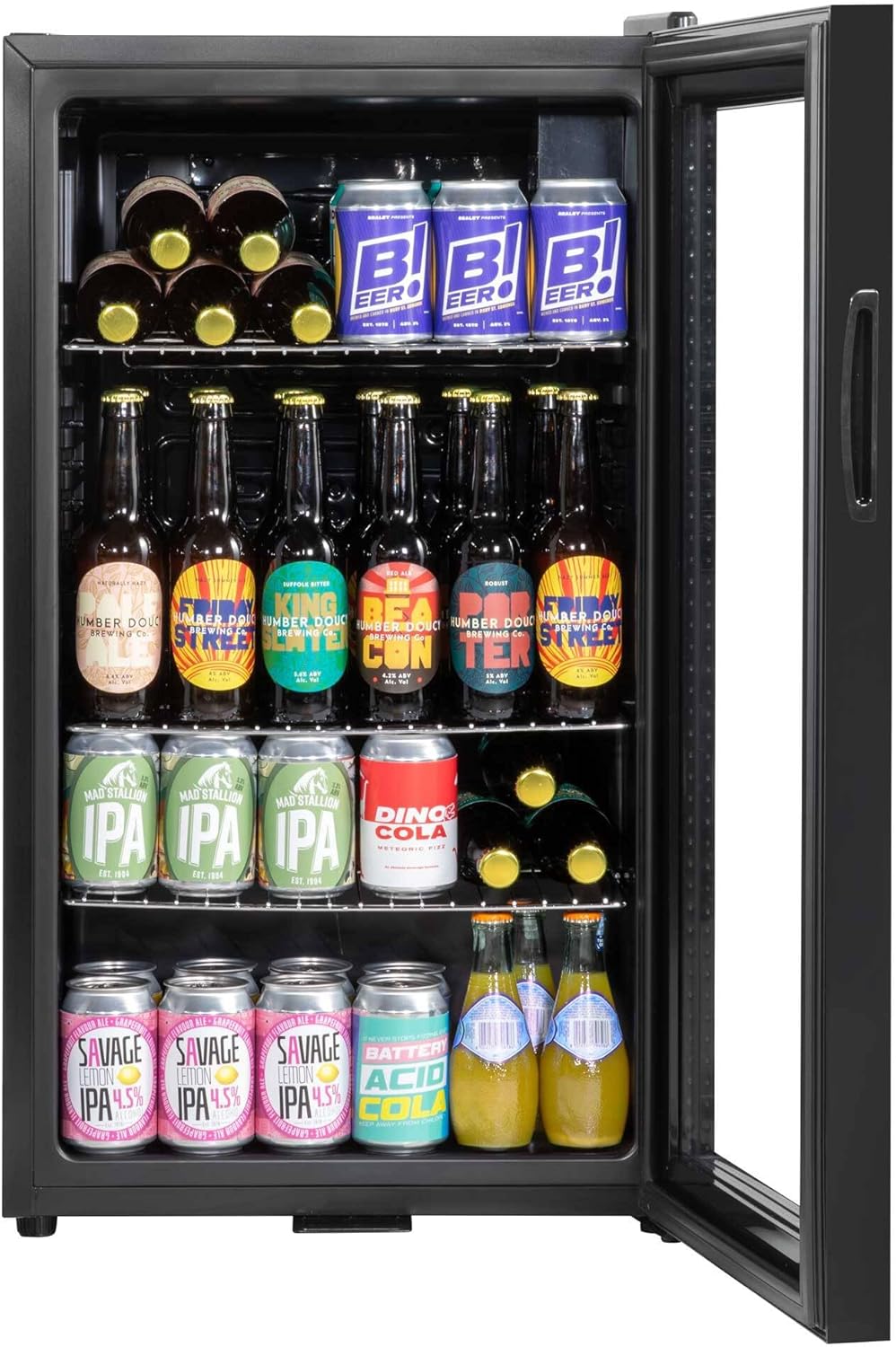
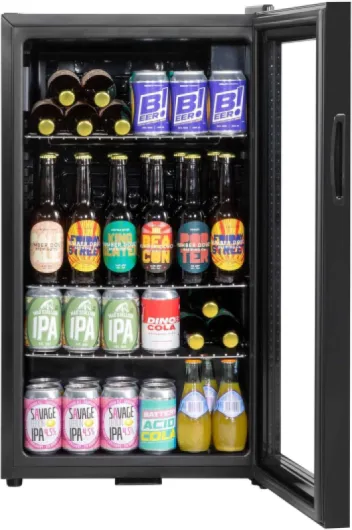
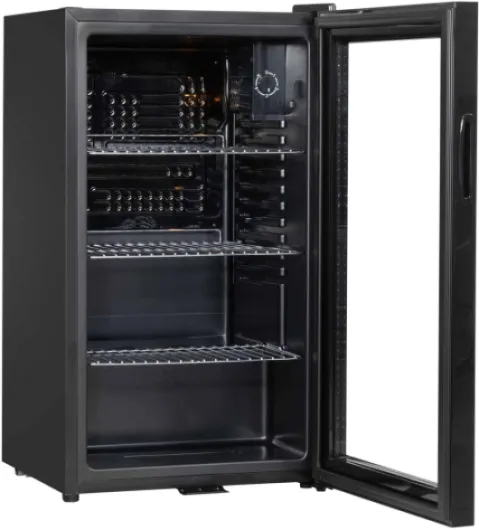
Design-wise, the Dellonda DH13 is pretty straightforward. It’s a black cabinet with a clear glass door, so it has that typical bar-fridge look. No chrome trim or fancy branding screaming at you, just a small logo and a clean front. In my kitchen, it blends in nicely under the counter and doesn’t look cheap or out of place. If you’ve got a home bar setup or a games room, it actually fits the vibe quite well because you can see all the bottles and cans lined up behind the glass.
The door is double glazed and feels reasonably sturdy when you open and close it. The handle is integrated into the side of the door frame rather than sticking out, which is good if you’re tight on space and don’t want something to snag on. The door orientation is reversible, so you can switch it to open left or right. I didn’t bother changing mine, but if your layout is awkward, that’s a useful option. The light inside is a warm filament-style bulb at the top, not a bright white LED strip. It gives a softer, slightly yellowish glow. It looks decent at night, but if you pack the fridge full, the bottom shelf is a bit darker.
Inside, the layout is very basic: three metal shelves plus the base. The shelves are coated metal, not bare wire, and they slide out easily enough. You can adjust the height using the side rails. If you mainly store cans, the default layout works fine. If you want to stand wine bottles upright, you’ll probably end up removing one shelf or dropping them on their sides. There’s no door storage like in a standard kitchen fridge, so everything has to go on the shelves or base.
One thing to note: the back of the fridge needs a bit of space for ventilation, so you can’t ram it flush against a wall. It’s not huge, but if you’re trying to squeeze it into a very tight under-counter gap, measure properly. Overall, the design is nothing fancy, but it’s practical. It looks like what it is: a compact bar fridge. If you want something flashy with glass shelves and blue LEDs everywhere, this isn’t it. If you just want a black glass-door fridge that doesn’t look tacky, it does the job pretty well.
Delivery, packaging and setup: straightforward but mind the straps
On the packaging and setup side, Dellonda has done a decent job. The fridge arrives in a large box with foam and cardboard braces. One Amazon reviewer mentioned that you should not cut the straps too early, and I completely agree. The way it’s packed, the straps keep everything tight, so if you slice them before the box is where you want it, it becomes more awkward to move. I waited until it was in front of the final spot, then cut the straps and lifted the box off. That made the whole process a lot easier.
Inside the box, the fridge is wrapped in plastic with foam padding on the corners and base. Mine arrived with no dents, scratches, or damage, so the packaging did its job. The glass door was protected with extra film to avoid marks. There’s a small bag with the key for the lock, the manual, and a couple of bits of tape holding the shelves in place so they don’t rattle around during transport. You do have to peel off a fair amount of tape and plastic film, which is slightly annoying but also reassuring because it means they tried to protect the surfaces properly.
Setup is simple: you get it out of the box, remove the transport protection, place it where you want, level the feet, and plug it in. Like any fridge, you should leave it standing upright for a few hours before switching it on if it’s been laid on its side during transport, to let the refrigerant settle. In my case, it was delivered upright, so I just left it for an hour or two to be safe. The manual is basic but clear enough: shows how to adjust the thermostat, reverse the door, and explains the temperature range.
The only mild downside with packaging is the amount of waste: big box, lots of foam, plastic wrapping. That’s standard for large appliances though, not specific to Dellonda. I didn’t have any missing parts or surprises. For a product in this price range, the unboxing and setup experience is pretty painless. You don’t need any special tools unless you want to reverse the door. If you’re reasonably handy, you can go from delivery to a running fridge in the same afternoon without any drama.
Build quality and long-term use: feels decent, but not bulletproof
In terms of durability and build quality, the Dellonda DH13 feels decent for the price, but you can tell it’s not a high-end commercial unit. The cabinet itself is sturdy enough; it doesn’t flex or creak when you move it, and at 28 kg it has a bit of weight to it. The door hinges feel solid so far, and the door closes with a clear seal rather than a flimsy wobble. I’ve had it loaded pretty heavily with cans and bottles, and nothing has bent or sagged yet.
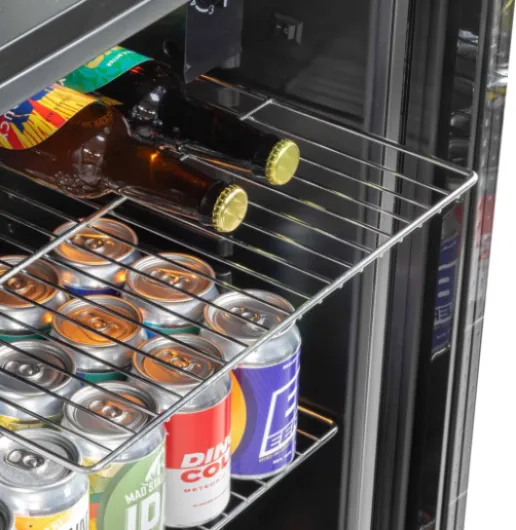
The shelves are metal and coated, which is good. I prefer that to bare wire racks because they feel more stable under small cans and bottles. If you’re stacking a lot of glass bottles on one shelf, there’s a bit of flex when you pull the shelf out, so I tend to support it with one hand. It’s not falling apart, but I wouldn’t treat it as roughly as a full-blown commercial back-bar fridge. For home use, it’s fine. If you’re planning to use it in a very busy environment with constant loading and unloading, I’d probably look at a more heavy-duty model.
The internal light is a simple filament bulb, which is one of the parts I can see needing replacement at some point. That said, filament bulbs are cheap and easy to replace, so it’s not a big deal. The thermostat dial and internal plastic parts feel basic but functional. Nothing screams high-end, but nothing feels like it’s going to fall off in your hand either. The rubber door seal is important for long-term use, and on mine it sits flat all around with no gaps. If that deforms over time, you’ll lose efficiency, but so far it’s holding up well.
I haven’t had it for years yet, so I can’t comment on five-year reliability, but looking at the user reviews (4.4/5 from hundreds of ratings) and my own use, it seems that most people don’t run into major failures early on. Compressor fridges are usually pretty simple: if the compressor, thermostat, and fan are okay, they keep going. I’d say the build quality matches the price bracket. It’s not indestructible, but it feels like a sensible home appliance rather than a flimsy toy. If you treat it reasonably, don’t slam the door, and don’t overload the shelves like crazy, it should last a decent amount of time.
Cooling performance and noise: does it actually keep drinks cold?
On performance, the Dellonda DH13 is pretty solid for the price. It uses direct compressor cooling and is rated for 3–10°C. In real use, with the dial set near the cold end, my cheap fridge thermometer sits around 4–6°C once everything has settled. That’s cold enough that beer and soft drinks come out properly chilled, not lukewarm. One Amazon reviewer mentioned hitting 5°C on full power, and that matches roughly what I’m seeing. If you keep opening the door a lot or load it with a big batch of warm cans, you’ll see the temperature go up a few degrees for a bit, then it recovers.
The temperature is fairly stable once the fridge is full and you’re not constantly messing with it. If you’re picky about exact temperatures for wine, you might want something more precise with a digital readout. For general drinks use, this is fine. The double-glazed door helps a bit with insulation, but obviously, a glass door will always lose more cold than a solid one. You trade a bit of efficiency for the convenience of seeing what’s inside. For me, that’s worth it, especially when you’ve got people over and everyone keeps checking what’s in there.
Noise-wise, the 42 dB rating seems about right. When the compressor kicks in, you hear a low hum, but it’s not piercing or annoying. In my open-plan kitchen/living area, I notice it the first day, then my brain just tunes it out. If you’re the kind of person who gets irritated by any background noise, you might be more sensitive, but compared to a standard fridge, it’s in the same range or even slightly quieter. I wouldn’t put it right next to a bed or in a super quiet office where silence is key, but for a regular home setting, it’s fine.
The automatic defrost is another point in its favour. I haven’t seen any serious ice buildup at the back wall. There’s the usual bit of condensation, but no thick frost layer that needs scraping. The fridge just quietly deals with it. Power consumption at 70 kWh/year is okay for a small drinks fridge; it’s not ultra-efficient, but it’s not a power hog either. If you keep it in a hot room or garage in summer, the compressor will obviously work harder. In a normal indoor space, it’s reasonable. Overall, performance is more in the “does exactly what it says” category rather than anything impressive, which for this kind of appliance is all I really want.
What you actually get with the Dellonda DH13
The Dellonda Baridi DH13 is basically a compact, freestanding drinks fridge with no freezer. Capacity is 80 litres usable, which is enough for a family’s drinks or a small home bar. It’s designed to slide under a counter or sit on its own against a wall. Dimensions are roughly 47.4 cm wide, 44 cm deep, and 84 cm high, so it’s more or less standard under-counter height, but a bit narrower than a regular kitchen unit. That makes it easier to fit in awkward spaces, but you might have a small gap either side if you want it in a fitted kitchen.
Inside, you get three removable metal shelves (even though the spec sheet weirdly mentions glass shelves, mine are metal). You can adjust the shelf height, or take one out if you want to stand wine bottles upright or stack bigger bottles. The manufacturer claims it can hold around 110 x 330 ml cans, and if you line them up properly in rows, that’s not far off. I’ve had a mix of beer cans, 1.5L bottles of soft drink, and some random condiments in there and didn’t struggle for space.
On the tech side, it uses a standard compressor cooling system with a temperature range of 3–10°C. There’s a simple thermostat dial inside, nothing digital or complicated. It also has automatic defrost, which means you don’t have to manually scrape ice off the back every couple of months. The door is double glazed, which helps with insulation and also makes the front look a bit more solid. There’s a built-in lock at the bottom of the door with a small key, handy if you don’t want kids raiding your beer stash.
Energy consumption is rated at about 70 kWh per year, with an E rating on the newer scale (used to be A+ under the old system). It’s not the most efficient thing in the world, but for a drinks fridge that you open a lot, it’s within reason. Noise is quoted at 42 dB. In practice, that means you hear the compressor kick in now and then, but it’s more of a background hum than an annoying buzz. For a kitchen, office, or home bar, it’s fine. For a recording studio or bedroom, I’d think twice.
Pros
- Cools reliably to around 3–6°C and keeps drinks properly chilled
- Good capacity for the size (around 110 x 330 ml cans) with adjustable shelves
- Quiet enough for kitchens and home bars at around 42 dB, plus simple setup and automatic defrost
Cons
- Basic controls and old-school filament light instead of modern LED and digital display
- Energy rating only E on the new scale, not the most efficient option available
Conclusion
Editor's rating
The Dellonda Baridi 85L DH13 is a straightforward drinks fridge that does what most people actually need: it keeps beer, wine, and soft drinks properly cold, fits under a counter, and doesn’t take over your kitchen with noise. The capacity is generous for its size, and being able to see everything through the glass door is genuinely practical, especially when you’ve got kids or guests constantly grabbing drinks. The adjustable shelves, automatic defrost, and built-in lock are all useful touches rather than gimmicks.
It’s not perfect. The interior light is a bit old-school, the controls are basic, and the energy rating is only average by modern standards. If you’re a wine enthusiast who wants precise temperature control and premium finishes, or if you need something built for heavy commercial use, you should probably look at more specialised, and more expensive, models. But for most home users who just want extra cold storage for drinks in a kitchen, home bar, office, or games room, this Dellonda cooler is a solid, no-fuss option.
If you value simple operation, decent build quality, and a clean bar-style look over fancy features, it’s a good buy. If you’re extremely sensitive to noise or chasing the absolute lowest energy use, you might want to compare a few alternatives first. Overall, I’d happily keep using it and recommend it to anyone who’s fed up with a main fridge permanently crammed full of cans and bottles.