Summary
Editor's rating
Is it good value for money?
Slim design that looks good but has quirks
Build quality and materials feel decent for the price
How durable does it feel after some use?
Cooling performance and noise in everyday use
What you actually get with this wine cooler
How well it actually works in real life
Pros
- Very slim design fits 15–16.5 cm kitchen gaps and can be built-in or freestanding
- Keeps drinks properly cold with a simple 5°C–18°C temperature range and low noise
- Decent build quality for the price, with reversible door and chrome shelves
Cons
- Real capacity is closer to 6 standard bottles; wider bottles like Champagne don’t fit well
- Needs slightly more than 15 cm clear width to open the door fully and access bottles easily
- Single-zone, no auto-defrost and limited interior flexibility compared to larger coolers

Specifications
View full product page →| Brand | Russell Hobbs |
A skinny wine fridge for that annoying 15 cm gap
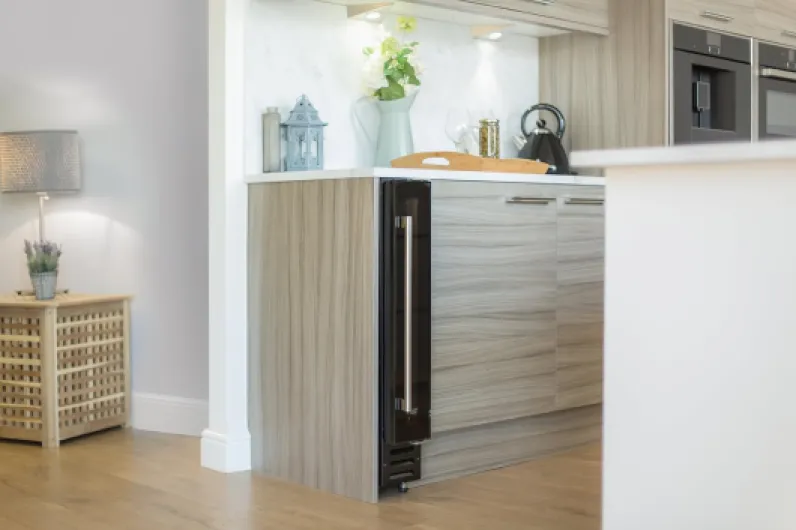
I picked up the Russell Hobbs RHBI7WC1 because I had that classic useless 15 cm gap at the end of a run of kitchen units. A normal cupboard is pointless there, and I didn’t want a fake panel, so a slim wine cooler seemed like a decent way to fill the space and get something useful out of it. I’ve been using it for a few weeks now as a built-in unit under the counter, next to the dishwasher.
From day one, my goal was simple: keep a few bottles of white, rosé and beer cold, without too much noise or faff. I wasn’t expecting miracles from a 15 cm wide cooler, but I did want it to be reliable and not look cheap. On paper it holds 7 bottles, has a temperature range from 5°C to 18°C, and can be either freestanding or integrated. That flexibility was one of the reasons I went for it instead of a random no-name brand.
In practice, it’s a pretty straightforward appliance. No fancy features, no Wi‑Fi, no weird touch screens everywhere. You get a simple LED display, temperature controls, chrome racks and a glass door. It’s more of a practical gadget than something to show off. I’ve mostly run it at 6–7°C for whites and beers, and played a bit with the temperature just to see how it reacts.
Overall, it does what it’s supposed to do, but it’s not perfect. The capacity is a bit optimistic, big bottles are a pain, and you have to think about how and where you install it, otherwise the door and bottle access can get annoying. If you go in knowing its limits, it’s a pretty solid little cooler. If you’re expecting a full wine cellar experience in 15 cm of width, you’ll probably be a bit disappointed.
Is it good value for money?
On the value side, I’d say this cooler sits in a pretty good spot. Similar 15 cm wide wine coolers from other brands often cost quite a bit more, especially the fancy ones with wooden shelves or dual zones. The Russell Hobbs RHBI7WC1 usually comes in at a more reasonable price, and for what it offers – narrow footprint, decent build quality, reversible door, simple controls – it feels like good value for money if you specifically need this skinny format.
However, if you’re not locked into the 15 cm width, the value calculation changes. For the same or slightly more money, you can sometimes get a wider cooler that holds a lot more bottles and is more flexible with bigger formats like Champagne or soft drink bottles. So a lot depends on your kitchen layout. In my case, I had a useless 15 cm gap, so this made sense. If you’ve got more space, I’d seriously look at a 30 cm or 40 cm wide unit instead, because you’ll get a lot more storage for not that much extra cash.
You also have to factor in running costs. The annual energy consumption is around 108 kWh, which isn’t huge. It’s not the most efficient thing in the world, but for a small wine cooler that’s on all the time, it’s acceptable. The noise level is low enough that it doesn’t feel like you’re paying with your sanity just to keep a few bottles cold. The 1-year warranty (extendable to 2 years if you register) is okay, not generous but standard for this kind of appliance.
So in the end, I’d rate the value as solid, as long as you actually need this exact type of product: a narrow, integrated-friendly cooler for a handful of bottles. If you just want a place to keep drinks cold and you have more space, there are probably better capacity-per-pound options out there. But if your main constraint is that skinny gap in your kitchen, this one makes sense and doesn’t feel overpriced for what it offers.
Slim design that looks good but has quirks
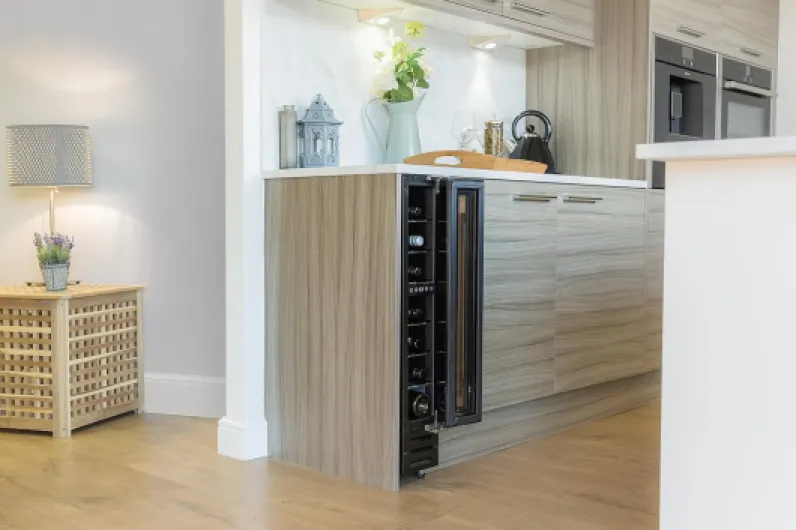
Design-wise, the RHBI7WC1 is one of those products that looks nicer in reality than you’d expect for the price. The black glass door gives it a clean, modern look that blends in well with most kitchens. It doesn’t scream “cheap plastic appliance”, which I appreciate. The LED temperature display on the front is small, white, and not too bright, so it doesn’t turn your kitchen into a nightclub at night. If you’ve got darker cabinets or a black oven nearby, it fits in quite well visually.
The real selling point of the design is the width. At only about 15 cm wide, it’s clearly built for those awkward gaps. In my case, it slotted into a spare space at the end of an island. But here’s where the design trade-offs show up. Because the door frame and seal are fairly thick, you actually need a bit more than 15 cm of usable width around it if you want to open the door fully and get bottles in and out without swearing. One Amazon reviewer mentioned needing at least 16.5 cm, and I’d agree – if your carpenter has left you a super tight opening, you’re going to fight with it.
The interior design is functional but not very flexible. You get six narrow chrome shelves that are clearly made for standard wine bottles. There’s no adjustable shelf height, and because the fridge is so narrow, you can’t really stack things sideways without blocking the airflow or making it awkward to pull bottles out. For normal Bordeaux-style bottles, it’s fine. As soon as you try anything wider – Champagne, some rosés, craft beer bottles – the design starts to show its limits. They either don’t fit, or you have to remove a shelf and then you lose capacity.
One thing I did like is the reversible door. Swapping it over was straightforward and makes a big difference to how usable the fridge feels in a tight space. The handle is integrated into the edge of the door, so there’s nothing sticking out to catch on clothes or nearby drawers. Overall, the design is clean and practical, but it’s very focused on one job: standard wine bottles in a narrow gap. If you try to use it too creatively, the design gets in the way a bit.
Build quality and materials feel decent for the price
The build quality on the RHBI7WC1 is better than I expected from a relatively cheap, narrow wine cooler. The glass door feels solid and has a bit of weight to it when you open and close it. It doesn’t feel flimsy or rattly, which is often the case on budget appliances. The black finish on the door looks clean and doesn’t show fingerprints too badly, although you’ll still want to give it a wipe now and then if you’re picky.
The body itself is fairly standard metal with a painted finish. You’re not getting anything fancy, but it doesn’t feel like it’s going to fall apart if you move it. At around 19.8 kg, it’s not super heavy, but heavy enough to feel stable once it’s in place. The chrome shelves are basic but functional. They slide out enough to access bottles without bending them out of shape, and they don’t sag under the weight of a full load. They’re obviously not luxury wooden racks or anything like that, but at this price point, chrome wire is pretty normal.
Inside, the plastics are what you’d expect: nothing premium, but nothing that screams “toy” either. The seals around the door are chunky and do their job, though they’re also part of the reason you need a bit of extra space to open the door fully. The LED display and buttons feel okay – not high-end, but they respond properly and don’t feel like they’re going to break off in your hand. The included reversible hinge kit is metal, not some weird plastic mechanism, which is reassuring when you’re swapping the door side.
One thing I’ll say: this is not a tank built to survive constant moving or rough treatment. It’s clearly designed to be installed once and then left alone. As a built-in or freestanding unit that basically sits in one place, the materials are perfectly acceptable and feel pretty solid for the price. If you treat it like a normal kitchen appliance and don’t slam the door or drag it around, I don’t see any major weak points in the materials themselves.
How durable does it feel after some use?
I haven’t had this cooler for years, but after a decent period of use, I can say it feels fairly robust for a small appliance. The door still closes firmly, the seal hasn’t started peeling or twisting, and the hinges haven’t sagged even after plenty of daily openings. The fact that it comes with a proper metal hinge kit and a 1–2 year manufacturer warranty (depending on registration) gives a bit of confidence that it’s not just a disposable gadget.
The chrome shelves are holding up fine too. No bending, no flaking, no rust so far. I’ve slid bottles in and out a lot, sometimes a bit roughly when in a hurry, and nothing has warped or come loose. The interior light and LED display still work as they did on day one. There’s no weird buzzing, no random temperature errors, and the compressor sound hasn’t changed, which usually would be a sign of something wearing out.
The only minor durability concern I can see long-term is the door seal and the narrow opening. If you install it in a really tight space and constantly scrape bottles against the rubber while forcing them past, I can imagine the seal might wear quicker or get damaged. That’s more of an installation and use issue than a manufacturing flaw, but it’s worth keeping in mind. Give the door some breathing space and don’t slam it, and it should last longer.
Overall, for a compact cooler at this price, the durability feels pretty solid. It’s not built like a commercial bar fridge, but for home use – a few openings per day, mostly staying in one place – I don’t see any obvious weak points so far. As with most appliances, treat it halfway decently and it should serve you for several years without drama.
Cooling performance and noise in everyday use
On the performance side, this cooler is pretty straightforward. It has a temperature range from 5°C to 18°C, controlled by simple buttons next to the LED display. I mostly ran it between 6°C and 8°C for whites and beers. It reaches the target temperature in a reasonable time – not instant, but within a couple of hours from room temperature. Once it’s there, it stays fairly stable. I checked it with a cheap fridge thermometer and it was usually within about 1 degree of what I set, which is fine for home use.
Noise-wise, it’s rated at around 41 dB, and that lines up with what I hear. The compressor isn’t silent, but it’s not annoying either. When it kicks in, you hear a low hum and a bit of fan noise, then it stops again. Compared to my main fridge-freezer, this one is actually a bit quieter. If your kitchen is open-plan with a living room, you’ll hear it occasionally, but it’s not the kind of sound that ruins watching TV. One of the Amazon reviewers said it’s quieter than a standard fridge, and I’d agree with that. You just need to accept that no cooler with a fan is going to be completely silent.
In day-to-day use, it keeps drinks properly cold. At 6–7°C, whites and beers come out at a nice, drinkable temperature. If you push it down to 5°C, it gets genuinely cold, so the cooling system is doing its job. I didn’t notice any big warm or cold spots inside – the bottles on the top and bottom shelves felt roughly the same. That said, because it’s a small unit, opening the door a lot does warm it up quickly, and then the compressor has to work harder to bring it back down. If you’re constantly in and out grabbing beers, expect it to cycle on more often.
The only minor downside in terms of performance is the manual defrost. Over a few weeks, you get a bit of condensation and a tiny bit of frost build-up at the back. It’s not dramatic, but every now and then you’ll want to empty it, turn it off, and wipe it down. It’s not a big job, just something to be aware of. Overall, in terms of raw performance – cooling, temperature stability and noise – it gets the job done without any nasty surprises.
What you actually get with this wine cooler
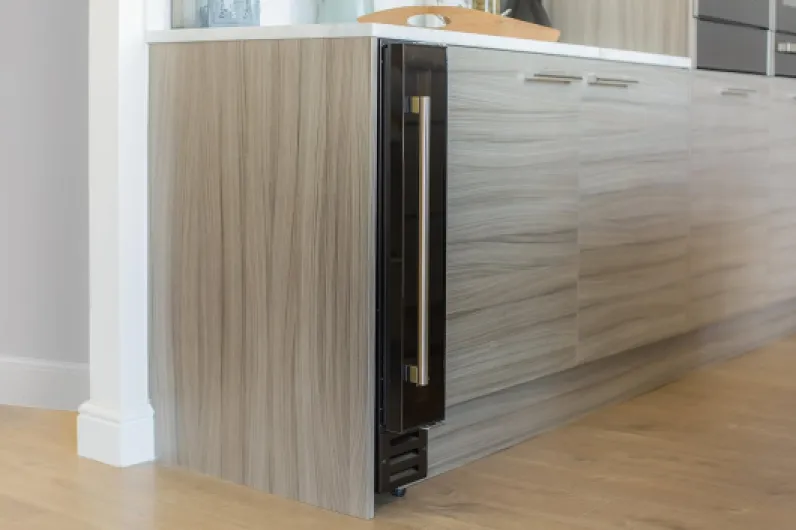
The RHBI7WC1 is basically a very narrow, 87 cm high wine fridge with a claimed 7‑bottle capacity and about 22 litres of space. The front is black glass with a small LED temperature display, and inside you’ve got 6 chrome shelves that slide out just enough to grab a bottle. It’s designed for a 15 cm wide gap, with product dimensions around 87 x 15 x 52.5 cm, and Russell Hobbs says it can be either freestanding or built-in. I’ve only used it integrated under a worktop, but you can technically just stick it on its own somewhere too.
It comes with adjustable feet to line it up with your units, and a reversible door. That’s actually handy: I swapped the door hinge on day one so it opened away from the dishwasher and didn’t clash. The hinge kit is in the box, and the swap is not rocket science if you’re used to basic DIY. If you’re not, it’s still doable, just take your time. Inside, the layout is simple: no separate zones, just one temperature for everything. So if you’re dreaming of reds at 14°C and whites at 7°C in one unit, this is not it.
One thing that’s worth mentioning: the bottle count is a bit confusing. The listing and specs throw around “7 bottles” and “17 bottles”, but in reality, with standard 75 cl wine bottles, it’s more like 6–7 depending on how you juggle them. If you use it like many people do – a mix of wine, beer and soft drinks – that capacity number becomes more of a rough guideline than a strict figure. Larger bottles like Champagne, Prosecco or 2L soft drink bottles don’t really fit on the normal racks, which limits how flexible it is.
Feature-wise, that’s about it. There’s no automatic defrost (it’s manual), no lock, no fancy lighting beyond the basic LED display. The noise rating is around 41 dB, which matches my experience: you hear it when the compressor kicks in, but it’s quieter than a lot of full-size fridges. So from a pure spec and feature standpoint, it’s a simple, compact, single-zone wine cooler made to fill a narrow kitchen gap and keep a small stash chilled, nothing more.
How well it actually works in real life
In everyday use, the cooler is effective at one main job: keeping a small number of standard wine bottles and drinks cold in a narrow space. If that’s what you’re buying it for, it does the job. I typically keep 4–5 bottles of white or rosé inside, plus a couple of beers or tonic bottles when there’s space. Set at around 7°C, everything comes out nicely chilled. It’s not as precise as a high-end wine cabinet, but for casual home drinking, it’s more than enough.
Where the effectiveness drops a bit is when you try to use it outside its comfort zone. The official capacity numbers are optimistic. In reality, if you stick to normal 75 cl bottles, you’re looking at about 6 bottles comfortably. One Amazon reviewer flat-out said “it is not a seven bottle wine cooler but six”, and that matches what I’ve seen. You can sometimes squeeze a seventh, but it starts to feel cramped and you risk knocking labels or scraping the glass when pulling bottles out. As soon as you throw in a Champagne bottle or something with a wider base, you’re forced to remove a shelf and then the whole layout becomes less efficient.
Accessibility is another point. Because of how narrow the unit is, you really need the door to open fully to get bottles in and out easily. If it’s boxed into too tight a space, you end up fighting with the door seal and scraping bottles against the rubber. One reviewer mentioned needing at least a 16.5 cm opening to avoid this, and I’d say that’s a fair guideline. Once it’s installed with enough clearance, day-to-day use is fine: open door, slide shelf, grab bottle, done. But if your installer or kitchen layout doesn’t respect that extra space, the cooler suddenly feels a lot less practical.
Despite these quirks, I’d say the overall effectiveness is decent. It cools properly, it’s relatively quiet, and it fills that awkward gap in the kitchen with something useful instead of a dummy panel. Just don’t buy it expecting a big capacity or flexibility with bottle shapes. It’s a niche tool for a specific job, and within that niche, it works well enough.
Pros
- Very slim design fits 15–16.5 cm kitchen gaps and can be built-in or freestanding
- Keeps drinks properly cold with a simple 5°C–18°C temperature range and low noise
- Decent build quality for the price, with reversible door and chrome shelves
Cons
- Real capacity is closer to 6 standard bottles; wider bottles like Champagne don’t fit well
- Needs slightly more than 15 cm clear width to open the door fully and access bottles easily
- Single-zone, no auto-defrost and limited interior flexibility compared to larger coolers
Conclusion
Editor's rating
The Russell Hobbs RHBI7WC1 is basically a solution for a very specific problem: a narrow 15 cm gap in your kitchen that you’d rather turn into something useful than just cover with a blank panel. For that use case, it works well. It looks clean with its black glass door, keeps wine and drinks properly cold, and doesn’t make much noise. The build quality is decent, the reversible door is genuinely useful, and the controls are simple enough that you set the temperature once and forget about it.
It’s not perfect though. The claimed 7‑bottle capacity is optimistic – in reality you’re looking at 6 standard bottles comfortably, and anything wider like Champagne or big soft drink bottles is a pain or simply doesn’t fit. You also need a bit more than the nominal 15 cm opening if you want to open the door fully and get bottles in and out without fighting with the seal. So if your kitchen fitter has left you a super-tight gap, plan ahead or you’ll be annoyed later.
If you have the space for a wider cooler, I’d say look at 30 cm or 40 cm models because you’ll get more capacity and flexibility for similar money. But if you’re locked into that skinny gap and just want something that gets the job done without costing a fortune, this Russell Hobbs is a pretty solid choice. It’s for people who drink a reasonable amount of white or rosé and want them ready to go, not for serious collectors with dozens of bottles. If that sounds like you, it’s worth considering. If you’re after a big, flexible wine storage solution, you should skip this and go bigger.