Summary
Editor's rating
Value for money: decent features, but risk drags it down
Design: looks premium from the front, less polished in the details
Materials & build: nice face, average guts
Durability & issues: where concerns start to show
Cooling performance & noise: does the job, with a few quirks
What you actually get with this NewAir wine fridge
Pros
- Quiet operation with stable enough dual-zone cooling for everyday wine storage
- Attractive black stainless and glass design with warm interior lighting
- Front venting and reversible door make it flexible for built-in or freestanding use
Cons
- Small, awkward condensate pan design that can overflow and damage floors if unchecked
- Only 1-year warranty and reports of units failing around 18 months with poor support
- Door and hinge design can require pulling unit out from cabinets and doesn’t self-close strongly

Specifications
View full product page →| Brand | NewAir |
A wine fridge that looks high-end but has some catches
I’ve been using the NewAir 24" 46-bottle dual zone wine fridge as an under-counter unit, basically where a trash compactor used to be. So this is coming from normal home use: kitchen island, mix of daily drinkers and a few nicer bottles I don’t want in a warm pantry. I’m not a sommelier, I just wanted something that keeps reds and whites at decent temps and doesn’t sound like a jet engine.
On paper, this fridge checks a lot of boxes: dual zones, built-in or freestanding, lock, black stainless finish, wooden shelves, and a 46-bottle capacity. In reality, it mostly does what it claims, but there are a few design choices and reliability stories that kept me from feeling totally relaxed about it. It’s one of those products where you kind of like it when you look at it and use it day to day, but some details in the background make you a bit nervous.
From my time with it and reading through other owners’ experiences, it’s clear this is not a perfect appliance. Some people are very happy with it, others had serious issues like water leaks and units dying just after the 1‑year warranty. So if you’re thinking of cutting a hole in your cabinets for this thing, you want to know the pros and cons ahead of time.
Overall, I’d say it’s a pretty solid mid-range wine fridge if you accept the quirks, keep an eye on it, and are okay with the fact that it might not last 10 years. If you expect commercial-grade durability or zero maintenance, this probably isn’t the one. I’ll break down what felt good in daily use and what annoyed me or worried me long-term.
Value for money: decent features, but risk drags it down
Price-wise, this NewAir usually lands in the mid-range for a 24" dual-zone built-in wine fridge. It’s not the cheapest, and it’s not the super high-end brands either. For that money, you’re paying for the dual zones, the black stainless look, the wood shelves, and the ability to build it under a counter. On those points, it delivers: it looks good, it runs quietly, and it cools drinks properly. If that’s your checklist, you’ll probably feel like you got what you paid for in the first year or so.
Where the value becomes questionable is the combination of limited warranty, potential leak design, and some units dying just past the warranty. If you think of it like renting a nice-looking wine fridge for 18–24 months, the math is a bit harsh. Spending around a thousand dollars (depending on taxes and shipping) for something that might not last more than a couple of years doesn’t feel great. Some buyers got clever and ordered via other sellers to dodge sales tax, which helps a bit, but it doesn’t solve the lifespan issue.
Compared to cheaper brands, this one does feel and look a bit more upmarket, especially with the lighting and the finish. Compared to pricier brands, it lacks the more robust drain design, longer warranty, and more polished hinges and interior. So it sits in the middle: not a bargain, not luxury. I’d call it fair value if you get a good price and accept the risk, but not a no-brainer buy at full MSRP.
If you’re on a tighter budget and don’t care about black stainless or dual zones, you can find simpler single-zone units that will probably treat your wallet better. If you’re storing very expensive wine and want something you never have to think about, I’d look at higher-end brands with 3–5 year warranties. This NewAir is fine for someone who wants a good-looking, quiet fridge for everyday bottles and is okay with keeping an eye on it and maybe doing a bit of DIY if the condensate tray becomes a problem.
Design: looks premium from the front, less polished in the details
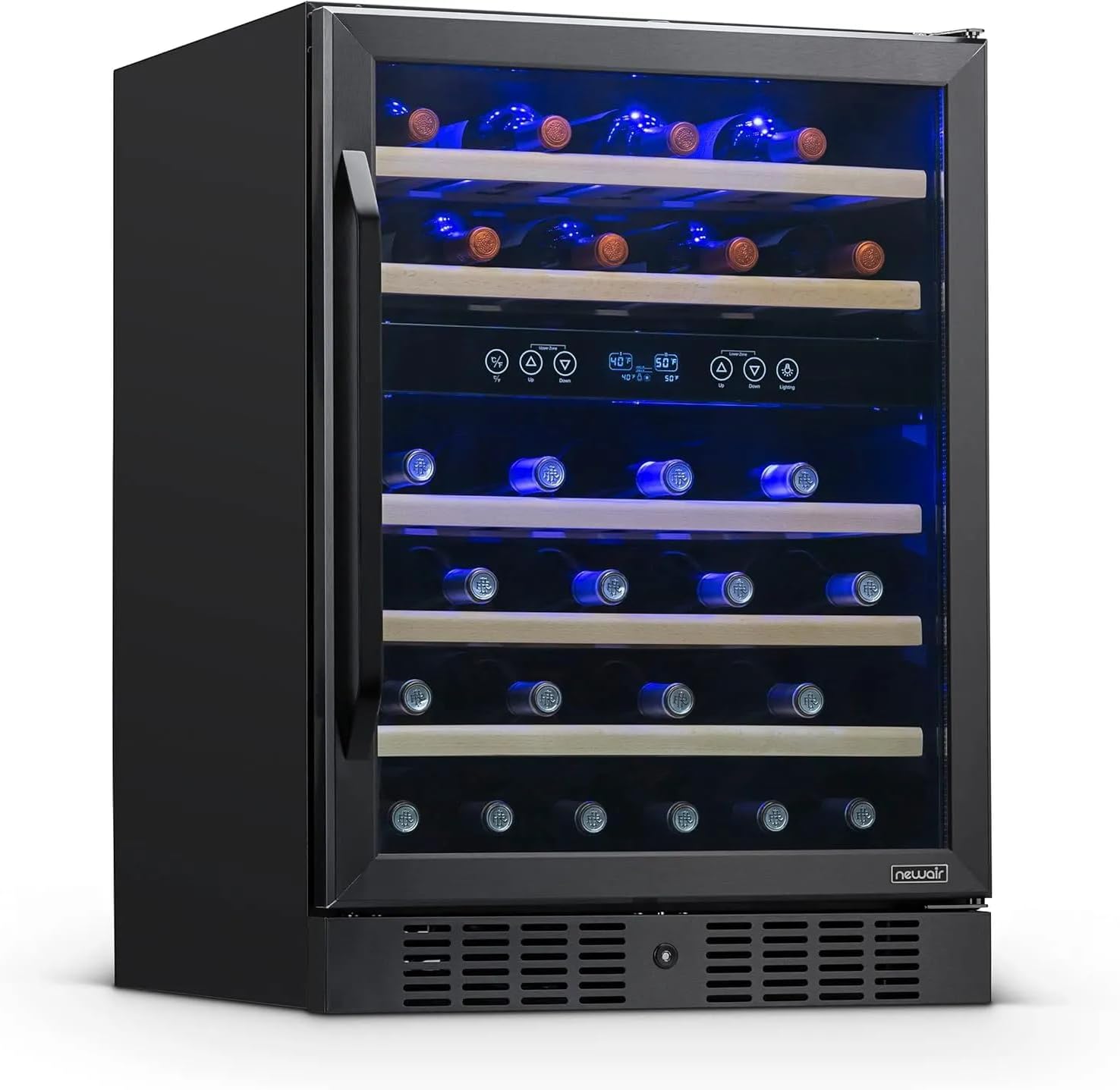
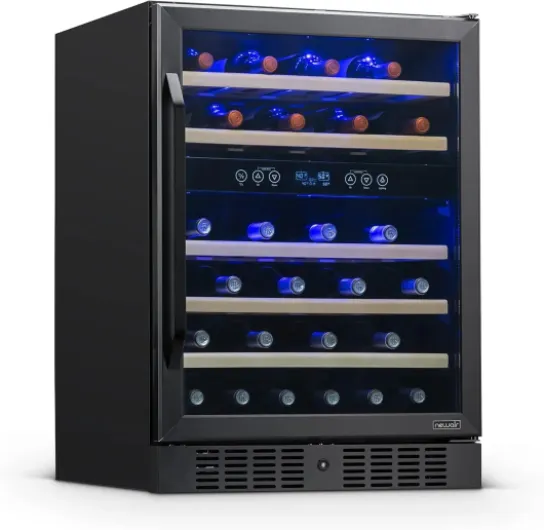
The front of this fridge is honestly the part I liked the most. The black stainless steel and tinted glass door look clean and modern, and it blends in nicely with darker or mixed-color kitchens. It doesn’t scream “cheap appliance” like some chrome or bright-blue-lit units. The amber interior lighting is a nice touch too – softer and warmer than the usual blue LEDs, and you can choose between full, half-brightness, or off.
The door itself feels solid. It’s fairly heavy, opens smoothly, and the triple-pane glass has a slight tint that does make it look more upscale. There is a lock at the bottom, which is handy if you have kids or teenagers and you don’t want them raiding your wine or leaving the door cracked open. One thing some users pointed out (and I agree) is that the door doesn’t self-close aggressively like a normal fridge. If you’re used to just nudging the door and walking away, you might find it sitting slightly open. With kids in the house, that’s an issue.
For built-in use, the front-vent design is good, but the hinge setup is a bit annoying. To get the door to open fully under a counter, you often have to pull the unit out a bit from the cabinets. That means it may not sit perfectly flush like a true panel-ready built-in. It’s not horrible, but if you’re picky about lines and alignment, you’ll notice it. Several owners mentioned having to slide it out more than they wanted just so the shelves could clear the cabinet frame.
From the back and underneath, the design is more basic. You can see exposed condenser lines under the front area, so you need to be careful when using a hand truck or sliding it around. This is the kind of thing you don’t think about until you move it and accidentally bend a line. Also, the condensate pan and drain setup at the back is not well thought out, which I’ll get into later. Overall: front looks good, integration is okay but not perfect, and the hidden bits feel more budget than the face suggests.
Materials & build: nice face, average guts
Material-wise, the fridge is a mixed bag. The black stainless on the door frame feels solid and looks pretty good. It resists fingerprints better than shiny stainless, though not completely. The sides and back are just painted black metal – totally fine for an under-counter or wall install, but nothing fancy. The glass feels sturdy, and with three panes plus UV coating, it doesn’t seem flimsy at all.
Inside, the main talking point is the beech wood shelves. First impression: they look nice and match the whole “wine storage” vibe better than wire racks. In the hand, they feel a bit light and flexible, and several people (me included) initially thought they might be too flimsy. But once loaded and slid in on the metal rails, they actually hold up better than they look. They do sag slightly when fully loaded, especially when you’re sliding a shelf full of bottles back in, so you might need to lift a hair to avoid scraping the shelf below. That’s not a deal-breaker, but you notice it.
The rails themselves are on ball bearings and slide pretty smoothly. There’s a small “click” when they lock in place, which is a nice touch so shelves don’t drift out. The downside: the beech wood stains very easily. One user had a screw-top bottle drip overnight and it left visible marks on the lower shelves. If you’re picky about looks, you’ll either live with darker stains, or you’ll be sanding and refinishing at some point. A darker wood or a sealed finish from the factory would have been smarter.
Behind the scenes, the plastic parts and the condensate tray feel more budget. The condensate pan is small and awkwardly placed, and the tubing and wiring layout isn’t exactly confidence-inspiring if you’re used to higher-end appliances. The unit is ETL certified, so it meets basic safety standards, but it doesn’t give off a “this will last 15 years” vibe. Overall, I’d say the materials are decent for the price but clearly optimized for cost, not longevity.

Durability & issues: where concerns start to show
This is the part that made me less relaxed about recommending it blindly. While the fridge works well out of the box and for the first months, there are two big long-term concerns that show up in user reviews: water leakage from the condensate pan and units dying just after the 1-year warranty. Not everyone has these problems, but the stories are detailed enough that it’s hard to ignore.
First, the leak issue. One owner found that after running the unit freestanding for a while, the floor behind it was soaked and an area of old wood flooring was destroyed. When they opened the back, they saw the condensate tray was tiny (around 2" x 2" x 3") and full, with water overflowing. They measured the drip rate at about a quarter cup per day, which means the pan fills and overflows in under a week if it doesn’t evaporate fast enough. The pan is awkwardly placed among the compressor and wiring, held with screws where only one is easily reachable. You can’t just slide it out and dump it. You basically have to sponge it out in a cramped area near electrical parts. That’s not great design for something that can quietly soak your floor.
Second, reliability. There are reports of the fridge failing completely around 18 months: lights out, no cooling, totally dead. The big annoyance is the warranty is only one year, and NewAir’s process apparently expects you to ship the unit back at your cost for evaluation, both ways. For a 100+ pound built-in appliance, that’s not realistic. Some people didn’t even get a reply from customer service. That makes the risk feel higher, because if the main board or compressor dies after the first year, you’re probably eating the cost or replacing the whole thing.
In daily use, if you’re careful with ventilation, don’t block the front vent, and occasionally check behind the unit for moisture, you might never hit these issues. But they’re worth knowing about before you commit. I’d rate durability and support as the weak points. If this were a $500 unit, I’d shrug a bit more. At around $700–$1300 depending on where and when you buy it, you expect a bit more confidence in lifespan and support than what’s described in some of these reviews.
Cooling performance & noise: does the job, with a few quirks
On the performance side, the fridge actually does pretty well where it counts: keeping wine at stable temperatures and running quietly. Once installed, leveled, and loaded with bottles, both zones held their temperatures within a few degrees of the set point. One thing to understand: no fridge holds the exact number on the screen all the time. It will swing a few degrees up and down as the compressor cycles, and that’s normal. With this unit, I typically saw about a 3–5°F range, which is perfectly fine for wine.
The dual-zone logic is a bit odd though. The upper zone is supposed to be the colder one (for whites), and the lower zone warmer (for reds). That goes against the usual “cold air falls, warm air rises” idea. In practice, testers with independent thermometers noticed that the upper zone tends to drift warmer than its setting if the lower zone is set higher, because heat rises. So if you set 45°F up top and 50°F below, you might actually see something like 50°F up top and 48–50°F below. It still works, but you might need to tweak your settings and not just trust the numbers on the display blindly.
The digital display itself also has a slightly weird behavior: when you change the set temperature, the display next to it immediately shows that new temp, even though the inside hasn’t actually cooled or warmed yet. It feels like they synced the reading to avoid complaints about inaccuracy. When checked against an external thermometer, the real internal temp is pretty close, but not instant. So, if you’re a bit nerdy about temperatures, just know the display is more “comforting” than fully honest in real time.
Noise-wise, this is one of the strong points. The compressor and fans are very quiet. Standing in the same room, you barely notice it unless everything else is silent. You might hear a soft hum if you kneel down near the vent, but that’s about it. For a kitchen, dining room, or open-plan living space, it’s perfectly acceptable and much better than some cheap beverage fridges that buzz constantly. Overall, performance is solid for home use, as long as you’re okay with a bit of temp fiddling at the start and you don’t treat the display like a lab instrument.

What you actually get with this NewAir wine fridge
This model is the NewAir NWC046BS00: 24" wide, about 33" high, and 22.5" deep. It’s meant for a standard 24" under-counter opening and can also stand alone if you don’t want to commit to cutting cabinets. The capacity is advertised as 46 bottles, but that’s based on standard Bordeaux bottles and some careful staggering. In real life with mixed shapes (Pinot, Champagne, screw tops, etc.), expect less, especially if you want easier access.
You get two temperature zones: the upper zone is for whites (40–55°F), the lower zone for reds (50–66°F). Both are controlled by a central digital panel inside. There’s triple-pane glass with UV protection, a lock on the door, and beech wood shelves on ball-bearing rails. It runs on a compressor system, not thermoelectric, which is why it can hit lower temps more reliably and handle being built-in with front venting.
Out of the box, it’s heavy (around 118 lbs), and moving it is a two-person job. It ships with the door handle off, so you have to bolt that on. The door hinges are reversible, but unless your layout forces you, I wouldn’t bother flipping it after install because the unit is awkward to handle. It has automatic defrost and a carbon filter, so you don’t have to manually defrost or worry too much about odors building up inside.
In daily use, the overall package is “decent and functional” more than anything else. The main selling points in practice are the dual zones, the quiet operation, and the look. Everything else is pretty standard for this price range, with some details that feel a bit thought-through and some that feel like cost-cutting. If you go in expecting a solid mid-tier appliance and not a commercial cellar unit, the feature set makes sense.
Pros
- Quiet operation with stable enough dual-zone cooling for everyday wine storage
- Attractive black stainless and glass design with warm interior lighting
- Front venting and reversible door make it flexible for built-in or freestanding use
Cons
- Small, awkward condensate pan design that can overflow and damage floors if unchecked
- Only 1-year warranty and reports of units failing around 18 months with poor support
- Door and hinge design can require pulling unit out from cabinets and doesn’t self-close strongly
Conclusion
Editor's rating
Overall, the NewAir 24" dual-zone 46-bottle wine fridge is a good-looking, quiet, and generally effective wine cooler that fits nicely under a counter and handles reds and whites at reasonable temps. Day to day, it’s pleasant to live with: the black stainless and glass door look good, the amber lighting is easy on the eyes, the shelves slide decently, and the compressor noise is minimal. For casual wine drinkers who want something nicer than a basic beverage fridge, it ticks a lot of boxes.
The downside is mostly on the long-term side: a questionable condensate pan design that can overflow and damage floors if you never check it, a short 1‑year warranty for a built-in appliance, and real-world reports of units dying around 18 months with weak support. Add to that the slightly awkward door clearance under counters and the need to fiddle with temps a bit because of the zone layout, and you end up with a product that works well but doesn’t feel totally worry-free.
I’d recommend this fridge to someone who cares about appearance, wants dual zones, and is reasonably handy or at least willing to monitor for leaks and accept that they’re rolling some dice on lifespan. If you’re putting this on expensive hardwood or in a place that’s hard to access, or if you expect a 5–10 year appliance with strong service, I’d look elsewhere or budget for something more robust. It’s a solid unit in the short term, but the long-term value is where it starts to look more “meh” than great.