Summary
Editor's rating
Value for money: good capacity and dual zone, but not the quietest
Design: compact, decent-looking, but with some practical quirks
Build quality and materials: mostly solid, not luxury
Durability and reliability: long-term users seem happy, but noise issues exist
Performance: cooling is solid, noise depends on your expectations
What you actually get with this 32-bottle dual-zone cooler
Pros
- Dual-zone temperature control that actually works for reds and whites
- Compact footprint with room for around 24–32 bottles depending on shapes
- Compressor cooling keeps stable temps better than small thermoelectric units
Cons
- Noise and occasional buzzing may bother sensitive users, especially in quiet rooms
- Real-world capacity is lower than 32 bottles if you use larger or mixed bottle shapes

Specifications
View full product page →| Brand | Wine Enthusiast |
A compact wine fridge that mostly does what it says
I’ve been using this Wine Enthusiast 32-Bottle Dual Zone MAX wine cooler for a while now in my small home bar area, and I’ll be straight: it’s pretty solid overall, but it’s not perfect. If you’re expecting a silent, built-in level appliance like a premium kitchen fridge, you’ll probably find a few things to complain about. If you just want something to keep a decent amount of bottles at the right temperature without taking over your whole room, it mostly gets the job done.
What pushed me to try it was the mix of size and dual zone. I didn’t want a giant cellar, but I also didn’t want one of those tiny 12-bottle thermoelectric units that struggle in summer. The compressor on this model was the selling point for me: in theory, better cooling and longer life. Reading through the Amazon reviews, I saw a lot of people saying it’s quiet, and a few saying it buzzes like crazy. So I went in expecting something in the middle.
Out of the box, I followed the classic routine: let it stand upright for several hours before plugging it in, then set the temperatures and let it stabilize. The top zone cooled fairly quickly, the bottom zone took longer, which matches what some other buyers said. After a day, both zones were stable and the temperature readings were close to what I measured with a cheap fridge thermometer I already had at home.
In day-to-day use, it’s basically what you think: a compact, matte black glass-door box that keeps wine cold. The main questions are: how loud is it, how annoying is the layout, and does it feel like it will last? I’ll walk through all of that, because there are a few details that don’t show up in the product page but matter in real life.
Value for money: good capacity and dual zone, but not the quietest
From a value standpoint, this cooler sits in that middle ground: not cheap, not luxury. For the price, you’re getting a 32-bottle capacity, real compressor cooling, and dual-zone control in a compact footprint. Compared to the tiny 12-bottle thermoelectric fridges, this feels like a more serious piece of equipment that can actually hold a small collection and keep it at proper temps, even when the room is warm.
If you compare it to similar dual-zone, 30-ish bottle compressor coolers from other brands, it’s usually in the same ballpark price-wise. Where it earns points is the brand reputation (Wine Enthusiast is at least known in the wine world) and the generally decent build quality. The Amazon rating around 4.1/5 with over 1,000 reviews matches my feeling: it’s good, not flawless. You’re not getting a bargain steal, but you’re also not overpaying for pure marketing.
The main trade-off for the money is noise and potential variability. Some units, like mine, are reasonably quiet; others seem to buzz more and annoy their owners. If you’re super sensitive to sound or you plan to put it in a bedroom, the value drops, because that hum will bother you. If it’s going into a kitchen, bar, or office where there’s already some background noise, the value is better, because you’re getting good storage and reliable cooling without needing a full-size cellar.
Overall, I’d say it’s good value if you specifically want dual zones and around 30 bottles in a compact footprint. If you just want something to chill a handful of bottles and don’t care about zones or long-term storage, a smaller, cheaper unit might make more sense. If you want silent operation and top-tier finish, you’ll need to spend more and look at higher-end brands. For most casual wine drinkers who are starting to build a small collection, this is a reasonable middle option.
Design: compact, decent-looking, but with some practical quirks
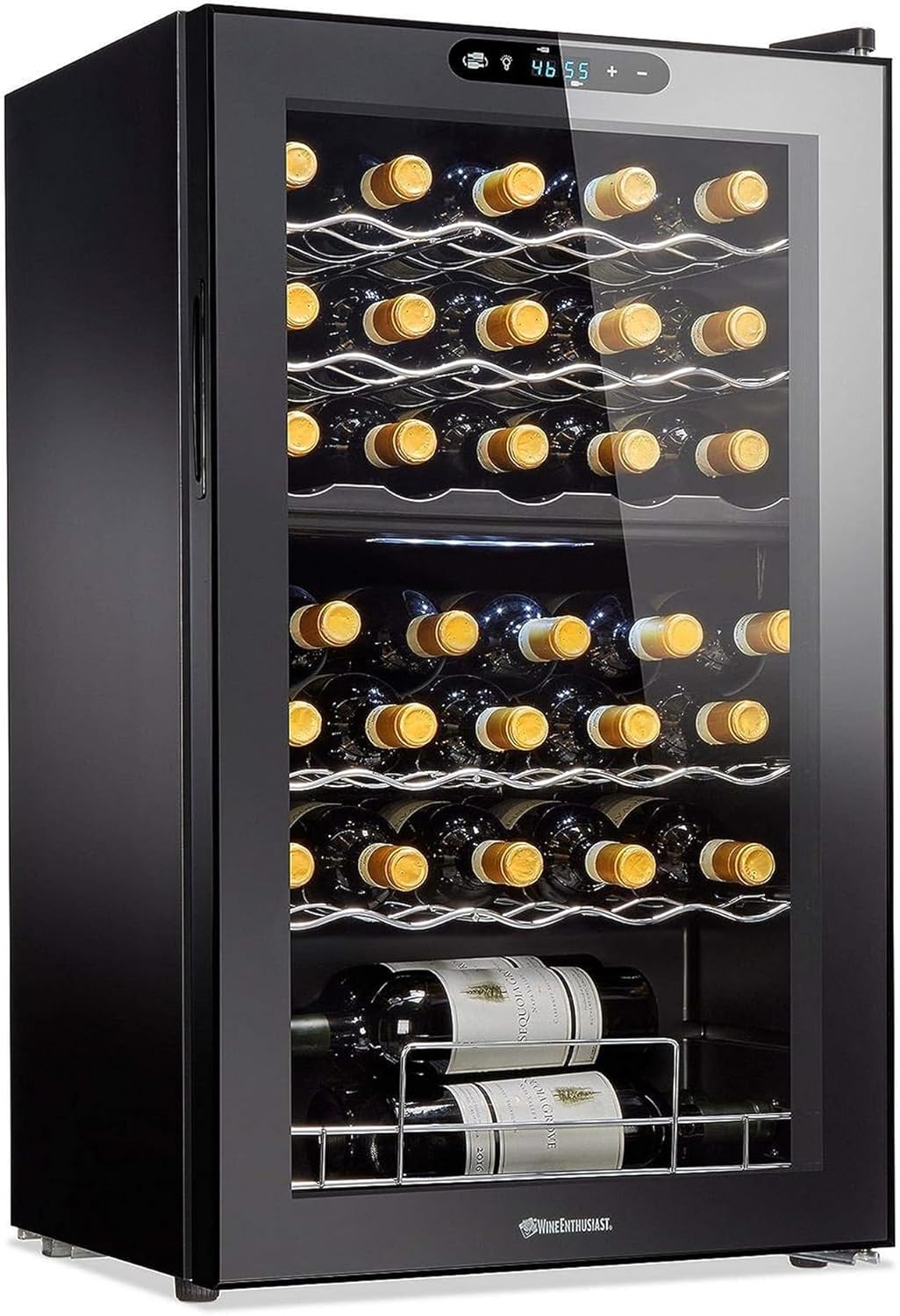
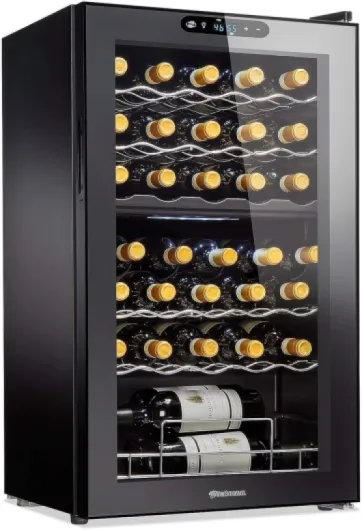
Design-wise, the fridge is pretty straightforward and discreet. The matte black sides and top are simple and don’t scream for attention. The glass door gives you a view of the bottles, and the LED lighting inside is bright enough to see what’s where without lighting up the whole room. It looks good next to a small bar cart or under a counter gap, and it doesn’t clash with most decors. I wouldn’t call it fancy, but it looks modern enough.
The digital touchscreen on the front is easy to understand: a couple of buttons for each zone to raise or lower temperatures, plus controls for the light and lock. The display is clear and readable from a distance. In practice, you set your temps once and rarely touch it again, so I’m glad they kept it simple. No app, no Wi-Fi, no nonsense. For a wine cooler, that’s fine by me.
The internal layout is where the design shows some limits. The racks are arranged to maximize that 32-bottle claim, which means they’re fairly close together. Standard Bordeaux bottles slide in and out without too much trouble, but as soon as you start mixing Burgundy bottles or slightly larger shoulders, you’ll feel the tight spacing. I had to pull a whole rack out a couple of times when I tried to squeeze in some wider bottles. So yes, 32 bottles is technically possible, but only if you’re careful with shapes and don’t mind a snug fit.
One practical detail: leveling matters a lot with this unit. The feet are adjustable, but if your floor is slightly off, you’ll need to spend a few minutes getting it stable. When it’s not level, the door doesn’t always close as smoothly and the compressor noise can get louder. After I adjusted the feet properly, the general noise dropped a bit and the vibrations felt more controlled. So the design is decent, but it expects you to do a proper setup, not just drop it on the floor and forget it.
Build quality and materials: mostly solid, not luxury
The outer shell is standard painted metal with a matte black finish. It feels sturdy enough when you tap it; not flimsy, but also not super thick like a commercial unit. The paint job is clean and doesn’t pick up fingerprints as badly as glossy finishes. After moving it once and bumping it lightly into a wall, I didn’t see any dents or chips, so for normal home use it seems fine.
The glass door is probably the nicest part of the materials. It looks clean, seals well, and doesn’t feel wobbly on the hinges. The handle is integrated into the door design (no huge bar sticking out), which keeps the footprint tight. The door closes with a decent seal; you can feel a bit of resistance at the end, which is what you want. I didn’t see any condensation issues on the glass in a normal indoor environment, though I’m not in a super humid climate.
Inside, the shelves are glass rather than wire racks. They look nicer, but they’re not super thick, so I wouldn’t treat them roughly. They slide in and out using little grooves, and as long as you don’t overload them with very heavy bottles, they feel stable. Five racks plus the bottom give you a flexible layout, but again, tight spacing means you’re often playing Tetris with bottle shapes. The plastic trim and interior walls are fairly standard; nothing fancy, but nothing that screams cheap either.
Overall, the materials feel mid-range: better than the really low-end plastic-heavy mini fridges, but clearly not premium built-in quality. The unit weighs about 60 pounds, so it doesn’t feel hollow. For the price point, I’d say the build matches expectations: solid enough for several years of normal use if you don’t abuse it, but I wouldn’t expect it to feel like a high-end kitchen appliance.
Durability and reliability: long-term users seem happy, but noise issues exist
Durability is always tricky to judge early, so I relied not only on my time with it but also on what long-term Amazon reviewers reported. There are users saying they’ve had this same model for years and it’s still running fine, which is a good sign for the compressor and general electronics. That’s better than many of the tiny thermoelectric units that tend to die after a year or two.
On the flip side, there are also a few reports of electrical buzzing and support not being very responsive. One reviewer mentioned an annoying buzzing that sounded unsafe and said Wine Enthusiast basically brushed it off as normal, then stopped replying. That’s not great. My own unit has some light humming and occasional short buzz at startup, but nothing that made me feel like it was going to blow up. Still, if you get a bad one, it sounds like you might have to push a bit with customer service.
The manual recommends letting it sit upright before plugging in, keeping it in a room that isn’t too hot, and leveling it properly. From what I’ve seen, following those steps does help. When I first put it down quickly without leveling, the sound and vibration were worse. After adjusting the feet and giving it space around the back, both noise and cycling seemed smoother. So some of the complaints might come from rushed setups, but not all.
In short, durability seems decent but not bulletproof. There are enough positive long-term reviews to suggest the compressor design itself is okay, but also enough negative noise/support stories to say there’s some variability. If you want something you never think about for 10+ years, this probably isn’t it. If you’re fine with a mid-range appliance that should last several years with reasonable care, it’s acceptable.
Performance: cooling is solid, noise depends on your expectations
In terms of cooling performance, the unit does what it’s supposed to do. The top zone reached my set temperature (around 57–58°F for reds) within a couple of hours after first plugging it in. The bottom zone, which I set around 45–47°F for whites, took longer to stabilize, closer to half a day. That lines up with what some Amazon reviewers said. Once both zones settled, the temperatures stayed pretty consistent, usually within 1–2 degrees of the set value when checked with a basic fridge thermometer.
The dual zone feature is genuinely useful if you actually drink both reds and whites regularly. I’ve kept reds around 57°F and whites at 45–46°F, and both felt right when serving. If you don’t care about that, you can just set both zones to the same temperature and treat it as one big fridge. The compressor doesn’t seem to struggle, even when the room is around 70–72°F. In warmer days, it runs more often, but it still keeps up.
Noise is where opinions split. Personally, I’d say it’s not silent, but it’s not crazy loud either. When the compressor kicks in, there’s a low hum. In my small open-plan living area, I can hear it if the room is quiet, but it doesn’t drown out TV or conversation. It’s nowhere near as loud as a cheap buzzing mini fridge, but if you’re extremely sensitive to noise and want total silence, you’ll notice it. I did have one or two moments where there was a short, sharper electrical-type buzz for a couple of seconds when it started up, which matches some of the complaints in the reviews. It wasn’t constant, but enough to be a bit annoying.
Overall, performance is decent to good: it cools reliably, the temperatures stay stable, and the dual zone is actually functional, not just marketing. The trade-off is that you live with a bit of compressor noise and the occasional brief buzz. For a bedroom, I’d think twice; for a kitchen, bar, or office corner, it’s acceptable as long as you aren’t expecting total silence.
What you actually get with this 32-bottle dual-zone cooler
On paper, this Wine Enthusiast cooler is a 32-bottle, dual-zone, compressor-based, freestanding wine fridge. Dimensions are about 17" deep, 19.5" wide, and 33.5" high, so it’s roughly the size of a narrow under-counter cabinet. It’s not built-in; it needs some breathing room around it, especially at the back, so don’t jam it into a tight cabinet thinking it’s a true built-in appliance.
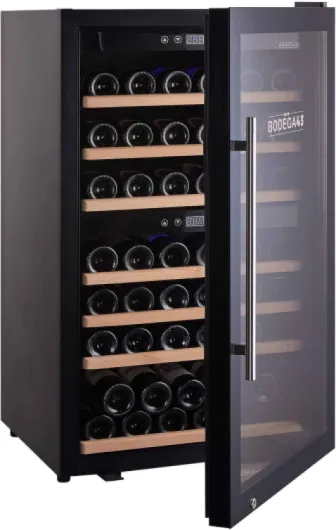
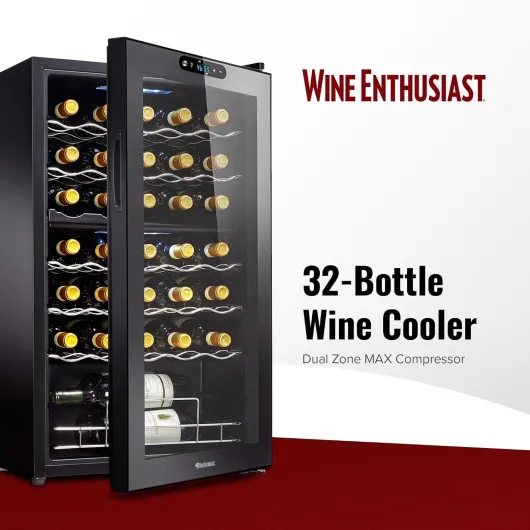
You get one glass door with a right-side hinge, a matte black body, and a digital touchscreen on the front. Inside, there are 5 glass shelves / racks plus the bottom area where you can also store a few bottles. Officially the capacity is 32 bottles, but that’s based on standard Bordeaux-style bottles. If you like big-shouldered reds, champagne, or oddly shaped bottles, you can expect to fit fewer. Realistically, I’d say around 24–28 bottles comfortably if you mix sizes and don’t want to wrestle the racks every time.
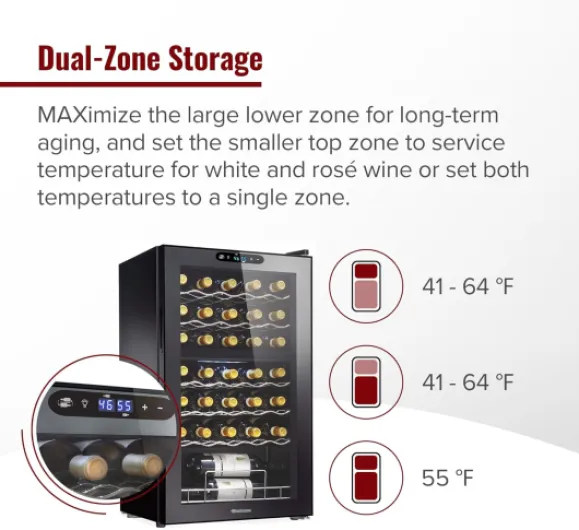
The two zones are split vertically: one for reds, one for whites/rosé. You can set different temperatures for top and bottom, or run them at the same temp if you just want a big beverage fridge. The touchscreen lets you adjust temperature for each zone and toggle the interior LED lights. There’s also a simple lock function, which is more like a kid-deterrent than serious security, but it’s there.
Function-wise, the big point is the MAX compressor cooling. It’s not a thermoelectric toy; it behaves more like a small real fridge. It can pull temps down to typical serving/storage ranges for wine, even if your room is a bit warm. It’s manual defrost, so no auto-defrost magic here. For the price point and size, it lands in that mid-range zone: better than the super cheap plastic-feel units, but not at the level of built-in pro wine cellars.
Pros
- Dual-zone temperature control that actually works for reds and whites
- Compact footprint with room for around 24–32 bottles depending on shapes
- Compressor cooling keeps stable temps better than small thermoelectric units
Cons
- Noise and occasional buzzing may bother sensitive users, especially in quiet rooms
- Real-world capacity is lower than 32 bottles if you use larger or mixed bottle shapes
Conclusion
Editor's rating
Overall, the Wine Enthusiast 32-Bottle Dual Zone MAX is a solid mid-range wine cooler that does the basics right: it cools reliably, offers real dual-zone control, and fits a decent number of bottles in a compact footprint. The design is simple and modern enough, the touchscreen is easy to use, and the compressor cooling means it can handle normal room temperatures without struggling. For someone who has outgrown the tiny 8–12 bottle units and wants a bit more serious storage without going full built-in cellar, it makes sense.
It’s not without downsides. The noise level is acceptable but not ultra-quiet, and there are some reports of annoying buzzing on certain units, plus mixed experiences with customer service. The 32-bottle capacity is also optimistic unless you mostly use standard Bordeaux bottles; once you add bigger shapes, the real capacity drops. Build quality is decent, but clearly mid-range, not premium. If you’re planning to put this in a bedroom or you’re extremely picky about noise, I’d look for a quieter model or be ready to return it if you get a buzzy one.
If you want a dual-zone compressor fridge for reds and whites, have a small to medium collection, and you’re okay with a bit of background hum, this cooler is good value for the features. If your top priorities are absolute silence, perfect fit for all bottle shapes, and rock-solid long-term reliability, you’ll probably need to spend more or accept that this is a “good but not perfect” solution.