Summary
Editor's rating
Value for money: good if you catch it at the right price
Design and noise: looks nice enough, but don’t expect silence
Build quality and materials: decent, with some rough edges
Durability and support: some failures, but responsive customer service
Cooling performance and temperature control: good, but not perfect
What you actually get with this Antarctic Star cooler
Real-life use: how it handles wine, beer, and soda
Pros
- Keeps drinks properly cold with a flexible 40–61°F temperature range
- Compact size with decent real-world capacity for cans and standard wine bottles
- Responsive customer service that actually helps when there’s a problem
Cons
- Noise can include noticeable hums and occasional popping sounds
- Capacity claims are optimistic and depend a lot on bottle and can sizes
- Build quality and finish are average, with some reports of defects or panel issues

Specifications
View full product page →| Brand | Antarctic Star |
A compact drinks fridge for people who are tired of overstuffed main fridges
I picked up the Antarctic Star 26 Bottle / 130 Can Wine Cooler because my main fridge was turning into a chaotic wall of beer cans and soda. I just wanted a simple, separate spot for drinks and a few wine bottles, without going into built-in or super expensive territory. On paper, this model looked like a decent compromise: not huge, not tiny, and priced lower than most “fancy” wine fridges.
After using it for a while, my overall feeling is: it’s a pretty solid basic beverage fridge with some quirks. It cools well, it fits a good amount of stuff for its size, and it looks okay in a living room or pantry. But it’s not perfect: there are some noise issues, the temperature accuracy isn’t lab-grade, and the capacity numbers are a bit optimistic unless you play Tetris with the cans and bottles.
What pushed me to actually keep it is that it does the main job: it keeps drinks cold and doesn’t eat up too much floor space. Also, based on my experience and a lot of other reviews, the customer service seems reactive when something goes wrong, which matters for a product that can show defects like weird noises or failing panels.
If you’re expecting a professional wine cellar for aging expensive bottles, this isn’t it. If you want a reasonably priced extra fridge for beers, sodas, and some wine that you drink regularly, it gets the job done, with a few things you should know upfront before hitting “buy”.
Value for money: good if you catch it at the right price
For the price range this cooler sits in, I’d say the value is pretty good, as long as you’re aware of its limits. You’re getting a 3.2 cu.ft glass-door fridge that can handle both wine and cans, with an adjustable temperature and interior light. A lot of comparable units from bigger “fancy” brands cost significantly more for similar capacity, especially if they’re marketed purely as wine cellars.
The trade-offs are clear: build quality that’s decent but not premium, some units that come with quirks like noise or panel issues, and a temperature that’s good enough for daily use but not perfect. If you’re picky about those points, you might feel you should have spent more. If you just want an extra fridge for drinks and don’t care about a few small flaws, then it feels like good value for money.
What also helps the value is the flexibility: you can use it as a wine cooler, a beer fridge, or a mixed setup. If your needs change (for example, more kids’ drinks in summer, more wine in winter), you just move shelves around. That’s more useful in real life than a strictly wine-only layout that wastes space if you don’t fill it with bottles.
If you find it on sale or with a coupon, it’s even easier to justify. At full price, it’s still reasonable, but you might start comparing it to slightly higher-end models. My take: if your budget is tight and you want to declutter your main fridge, this is a practical choice. If you’re already ready to spend a lot on a perfect, silent wine cellar, you should probably jump a tier up instead of staying here.
Design and noise: looks nice enough, but don’t expect silence
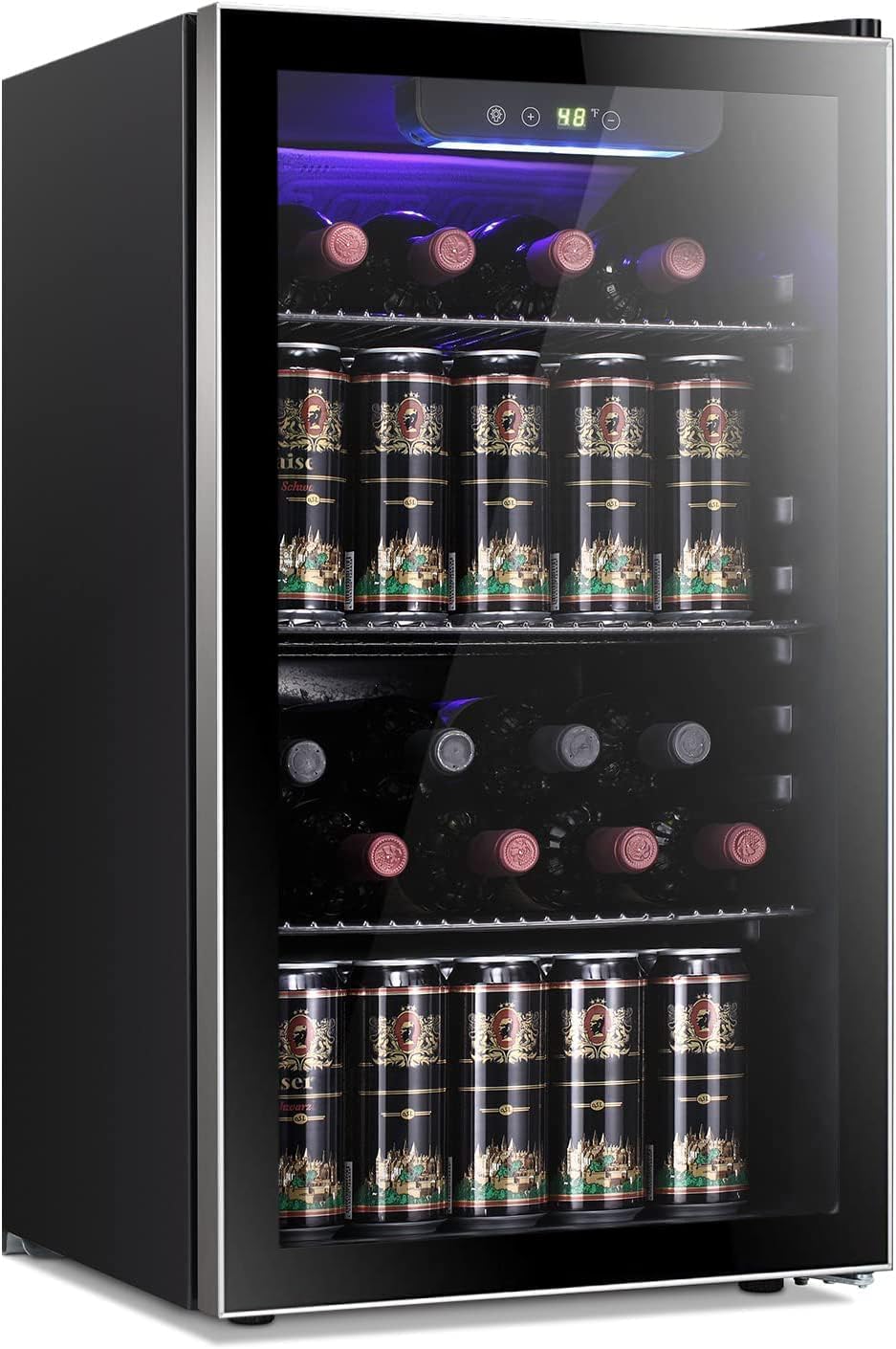
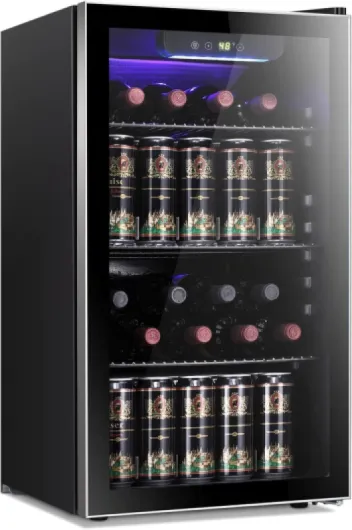
Design-wise, it’s pretty simple: black body, silver/steel-looking trim, and a clear glass door with a blue LED light inside. In a living room or kitchen, it looks decent. It doesn’t scream “cheap dorm fridge”, but it’s also not luxury gear. The glass door lets you see what’s inside, which is practical when you just want to grab a beer without opening three shelves in your main fridge. The blue light is more for looks than function; it’s cool in the evening, but not super bright.
The door closes properly as long as you adjust the front leveling legs so the fridge leans slightly backward. Out of the box, if you just drop it on the floor and don’t touch the feet, the door can feel a bit light and not always swing shut perfectly. Once leveled, it seals better and the temperature stays more stable. The handle is integrated, which I prefer because there’s nothing sticking out to bump into.
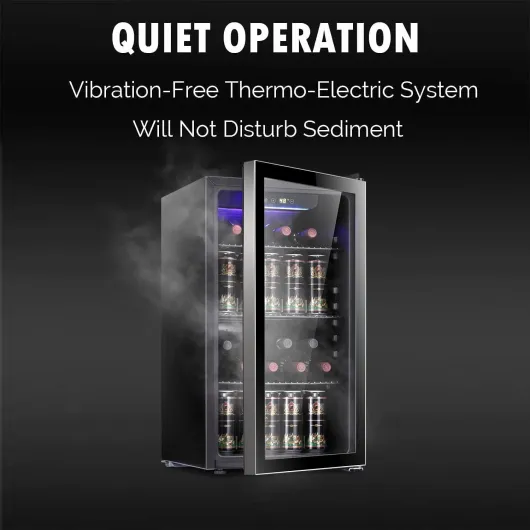
Now, about the noise. The brand calls it “quiet”, and when the compressor is just humming, it is fairly reasonable. If you’re used to a small office fridge, it’s about the same level. But there are some reports of whooshing and popping noises, and I’ve heard occasional pops myself. It’s not constant, but when it happens in a quiet room, you notice it. In a living room with the TV on, it fades into the background. In a bedroom or a super quiet office, it might annoy you.
Visually, I like that it’s compact and not too deep, so it lines up okay with cabinets. The downside is that to hit those nice marketing numbers for capacity, they use tight spacing inside, so larger bottles can feel cramped. In short: design is fine and practical, but if you’re super sensitive to noise or you want something ultra sleek, this isn’t the one that will impress you.
Build quality and materials: decent, with some rough edges
The shell of the fridge is your standard painted metal with some plastic trim. It feels sturdy enough to move around without worrying it will bend, but it’s not thick, premium metal either. The door is glass with a seal that does its job as long as the unit is leveled correctly. The glass feels solid, not flimsy. You’ll want to be a bit careful not to slam it, but that’s true for most glass-door fridges.
Inside, the wire shelves are basic metal racks. They slide in and out without drama, but they’re not heavy-duty restaurant-grade. If you load them with lots of glass bottles, they hold, but there’s a bit of flex. For normal use with cans and regular wine bottles, it’s fine. If you plan to stack very heavy 750ml bottles or weird-shaped magnums, you might have to rearrange or support them differently.
One thing that bothered me a bit is that some units ship with scratches, plastic marks, or sticker residue on the sides or front, based on reviews and what I’ve seen. Mine had small cosmetic imperfections that didn’t affect function, but they make it feel cheaper than it could. The interior has that typical new-appliance smell at first; it went away after a day or two with the door open and a quick wipe-down.
Overall, the materials match the price: not junk, not premium. It’s clearly built to hit a budget. If you treat it like a normal household appliance and don’t abuse the shelves or slam the door, it should hold up fine. If you want something that feels heavy and high-end, you’ll have to pay more and look at higher-tier brands.
Durability and support: some failures, but responsive customer service
Durability is where things get a bit mixed. On one hand, a lot of people have been running this unit for months or years without major issues. On the other hand, there are clear reports of electronic panel failures, loud compressors, and popping noises showing up after a few months. My own unit hasn’t died, but I do get the occasional pop from the compressor area, which isn’t super reassuring even if it still works.
What helps balance this is the customer service. Several buyers mention that when something went wrong – like a control panel dying or a very loud noise – the brand replied quickly by email, sometimes within the same day, and either sent replacement parts, partial refunds, or even a full replacement fridge when parts weren’t available. That doesn’t magically fix the fact that some units have problems, but at least you’re not left alone if you get a bad one.
The cooler is relatively light at about 48.5 pounds, so moving it around isn’t hard, but you still want to avoid banging it or tilting it too much to protect the compressor. Since it’s manual defrost, you’re also responsible for occasionally defrosting if ice builds up, which affects long-term reliability if you ignore it. Basic care goes a long way: keep some space around it, don’t overload the shelves, and wipe condensation from time to time.
Overall, I’d rate durability as “average”: not horrible, not bulletproof. There are enough long-term positive reviews to feel okay about it, but also enough complaints to know it’s a bit of a lottery. The big plus is that if something does go wrong early on, support seems willing to step in with more than just a generic answer.
Cooling performance and temperature control: good, but not perfect
The cooler runs on a compressor system with a stated working range of 40°F to 61°F. For drinks, that’s plenty. For wine, 55°F is the classic target, and the unit does let you set that. In my use, when I set it around 40–42°F for sodas and beers, the drinks came out properly cold, definitely colder than most wine fridges that hover around 50°F. So on the basic job, it delivers.
That said, don’t expect the displayed temperature to be laboratory accurate. I stuck a cheap fridge thermometer inside and typically saw a 2–4°F difference depending on where I placed it (top vs bottom, front vs back). That’s totally normal for this price range, but if you’re trying to age expensive wine at a very precise temperature, this isn’t the right tool. For normal everyday wine and canned drinks, it’s more than good enough.
Some people mentioned ice forming inside even with the temperature set to something like 55°F. I’ve seen very light frost on the back wall when it’s packed and not much air can circulate. This is also a manual defrost unit, so you’ll occasionally have to turn it off and let it thaw if it builds up. If you’re expecting a no-maintenance, perfectly even temperature everywhere, you’ll be disappointed. If you’re okay with “get drinks cold and maybe wipe some condensation now and then”, it’s fine.
In terms of speed, it cools down from room temperature to the low 40s in a few hours. Not instant, but not painfully slow either. The compressor kicks on and off like any small fridge. It’s not the most energy-efficient high-end unit, but for a 3.2 cu.ft cooler, the power draw is in line with what I’d expect. Overall, I’d call the performance solid for the price: cold drinks, reasonably stable temp, a few quirks with frost and readings.
What you actually get with this Antarctic Star cooler
On paper, this unit is sold as a 26-bottle or 130-can cooler with a 3.2 cu.ft capacity. In practice, those numbers are the absolute max if you use every bit of space, mostly with standard-size cans or slim wine bottles. With a mix of chunky craft beer bottles, wider wine bottles, and a few tall bottles you want standing up, you’ll be under that. I’d say more realistically: around 18–22 wine bottles if you really focus on wine, or about 90–110 cans if you use it mainly as a beverage fridge and keep a shelf or two flexible.
The dimensions are roughly 19.3" deep x 17.5" wide x 31.2" high, so it’s not micro, but still compact enough to slide into a pantry, next to a bar cart, or at the end of a counter. It’s freestanding only, so you’re supposed to leave a few inches around it for airflow; if you try to cram it tight into a cabinet, don’t be surprised if it runs hot or louder.
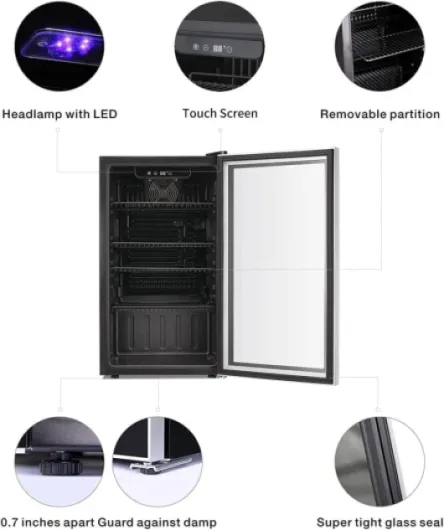
Inside, you get 4 wire shelves that you can move or pull out. They’re basic but functional. You can remove one or two to stand open wine bottles upright or store bigger bottles. The control panel is simple: a display for the temperature, a light button, and up/down arrows. You do have to hold the light button to unlock the controls, which a lot of people miss and then think the panel is broken. Once you understand that, it’s straightforward.
Overall, the presentation matches a middle-of-the-road compact fridge: nothing fancy, nothing ultra cheap. It’s clearly built to be a multipurpose drinks fridge, not a pure wine geek toy. If you go in with that mindset, the specs make sense and you won’t be shocked by the real-world capacity.
Real-life use: how it handles wine, beer, and soda
Day to day, the cooler is most effective as a general beverage fridge rather than a pure wine unit. If you mostly drink beer, soda, and a bit of wine, it’s a good match. I’ve had it loaded with a mix of canned seltzers, soft drinks, and a couple of wine bottles lying down, and it handled that balance well. The horizontal racking is space-efficient for wine, but you do need to be a bit careful with wider bottles; they can snag on the shelf above.
For wine specifically, if you’re using standard Bordeaux-style bottles, the claimed 26-bottle capacity is reachable, but you’ll be using almost every slot and won’t have much room for anything else. If you have a lot of chunky Champagne bottles or odd shapes, the capacity drops quickly. Also, if you like to keep opened bottles upright, you’ll probably remove one or two shelves, which again cuts into the wine count. So for a mixed setup (some lying down, some standing, plus cans), think less about the marketing numbers and more about flexible storage.
Where it shines is freeing up space in the main fridge. Once I moved all the drinks into this thing, my kitchen fridge felt way less cluttered. The blue LED light is handy to quickly glance at what’s left without opening the door constantly. Temperature-wise, everything I pulled out was nicely chilled. Not ice-cold like a deep freezer, but properly cold for beer and soda, and a bit cool for red wine if you set it around mid-50s.
So in practice, I’d say effectiveness is good if your expectations match the price: it keeps a good amount of drinks cold, offers some layout flexibility, and reduces clutter. It’s not a precise wine cellar for aging or a silent showpiece, but for everyday use, it gets the job done well enough.
Pros
- Keeps drinks properly cold with a flexible 40–61°F temperature range
- Compact size with decent real-world capacity for cans and standard wine bottles
- Responsive customer service that actually helps when there’s a problem
Cons
- Noise can include noticeable hums and occasional popping sounds
- Capacity claims are optimistic and depend a lot on bottle and can sizes
- Build quality and finish are average, with some reports of defects or panel issues
Conclusion
Editor's rating
The Antarctic Star 26 Bottle / 130 Can Wine Cooler is a solid, no-nonsense drinks fridge for people who just want more cold storage without wrecking their budget. It cools well, fits a decent amount of cans and bottles for its size, and looks fine in most rooms thanks to the glass door and blue light. The temperature range works for both wine and regular beverages, and the adjustable shelves give you enough flexibility to adapt it to how you actually drink.
It’s not flawless. Some units are noisier than they should be, with occasional popping sounds, and the temperature isn’t perfectly uniform everywhere inside. The quoted capacity is optimistic unless you mostly use standard bottles and cans and pack them tightly. Build quality is okay but not premium, and you may run into minor cosmetic issues. The positive side is that customer service seems responsive and willing to solve problems with refunds, parts, or replacements, which softens the risk a bit.
If you want a reliable, affordable backup fridge for beer, soda, and a handful of wines, this model gets the job done and offers good value. If you’re a serious wine collector looking for absolute temperature stability, near silence, and top-tier materials, you should skip this and look at higher-end units. For most casual users who just need more cold drinks and less clutter in the main fridge, it’s a practical and mostly satisfying choice.