Summary
Editor's rating
Value for money: who this fridge makes sense for
Design and layout: looks good, capacity claims are optimistic
Build quality and materials: better than entry-level, but not luxury
Durability and reliability so far (plus customer service backup)
Cooling performance, noise, and everyday use
What this Tylza wine fridge actually offers on paper
Pros
- Quiet operation with stable, reliable dual-zone cooling
- Real-world capacity around 150–160 bottles with mixed sizes, good for larger collections
- Sturdy sliding wooden shelves and decent overall build quality for the price
Cons
- Advertised 180-bottle capacity is optimistic unless you use only standard Bordeaux bottles
- Controls and buttons are basic and not backlit, slightly annoying in low light
- Right-hinged door only, no reversible option, which can limit placement

Specifications
View full product page →| Brand | Tylza |
A big wine fridge for people who are out of space
I picked up the Tylza 24-inch dual zone wine fridge because my regular fridge was starting to look like a liquor store. Between everyday reds, some whites that actually deserve better treatment, and random Champagne bottles, I just needed a dedicated unit. I went for this model mainly for the 180-bottle advertised capacity, the dual zone, and the fact it can be built-in or freestanding. On paper, it ticks a lot of boxes for the price.
After getting it installed and using it for a few weeks, my overall feeling is that it’s a pretty solid, practical unit with a couple of annoyances you just have to accept at this price point. It’s not perfect, but it does the basics right: it cools reliably, it’s quiet, and it looks decent in a bar or kitchen setup. If you’re expecting EuroCave-level stuff, you’re in the wrong price bracket, but if you just want your wine stored at stable temps without the thing sounding like a jet, it gets the job done.
Day-to-day, what stood out the most to me was the noise level (low), the temperature stability (good), and how optimistic that 180-bottle claim is once you throw in anything bigger than a standard Bordeaux bottle. I’m closer to 150–160 bottles in real life when you mix in Pinot, Champagne, and chunky California bottles. Not a disaster, just don’t plan your whole collection around that 180 number.
If I sum it up, this fridge feels like a good value workhorse for someone who actually drinks and stores wine, not just a showpiece. It has some small design quirks, but nothing that kills it. The key question is whether you care more about raw capacity and quiet performance than perfect shelf layout and super premium finishes. If you’re in that first group, this one is worth a look.
Value for money: who this fridge makes sense for
In terms of value, I’d say this Tylza sits in a good spot if you need serious capacity without going into crazy money. You’re getting dual zones, up to roughly 150–160 real-world bottle capacity, low noise, frost-free operation, and pretty solid build quality. For the price bracket it’s in, that’s a decent package. If you tried to get similar capacity from a premium brand, you’d likely pay a lot more, and for many home users that jump just isn’t worth it.
Where the value is strongest is for people who actually have a growing collection and want to keep it all in one place. If you’ve got, say, 60–80 bottles, this is probably overkill and you could get something smaller and cheaper. But if you’re already filling smaller fridges and stacking cases in closets, this kind of capacity starts to make sense. The fact that it’s both built-in and freestanding also helps – you can slide it into a bar or just park it against a wall in a basement without needing custom cabinetry.
On the flip side, there are a few compromises that keep it from being a perfect deal. The 180-bottle claim is optimistic unless you have very uniform bottles. The controls and interface are basic, nothing fancy. The door isn’t reversible, which might be a dealbreaker depending on your layout. And while the materials are decent, they’re not luxury-grade. So if you’re super picky about finishes or want a more premium brand name, you might feel like spending more is justified.
Overall, though, for someone who cares mainly about quiet, stable storage and good capacity for the money, this Tylza offers good value. It’s not the cheapest, not the fanciest, but it hits a practical middle ground. If you’re realistic about the true capacity and okay with a few minor quirks, you’re getting a lot of function per dollar.
Design and layout: looks good, capacity claims are optimistic
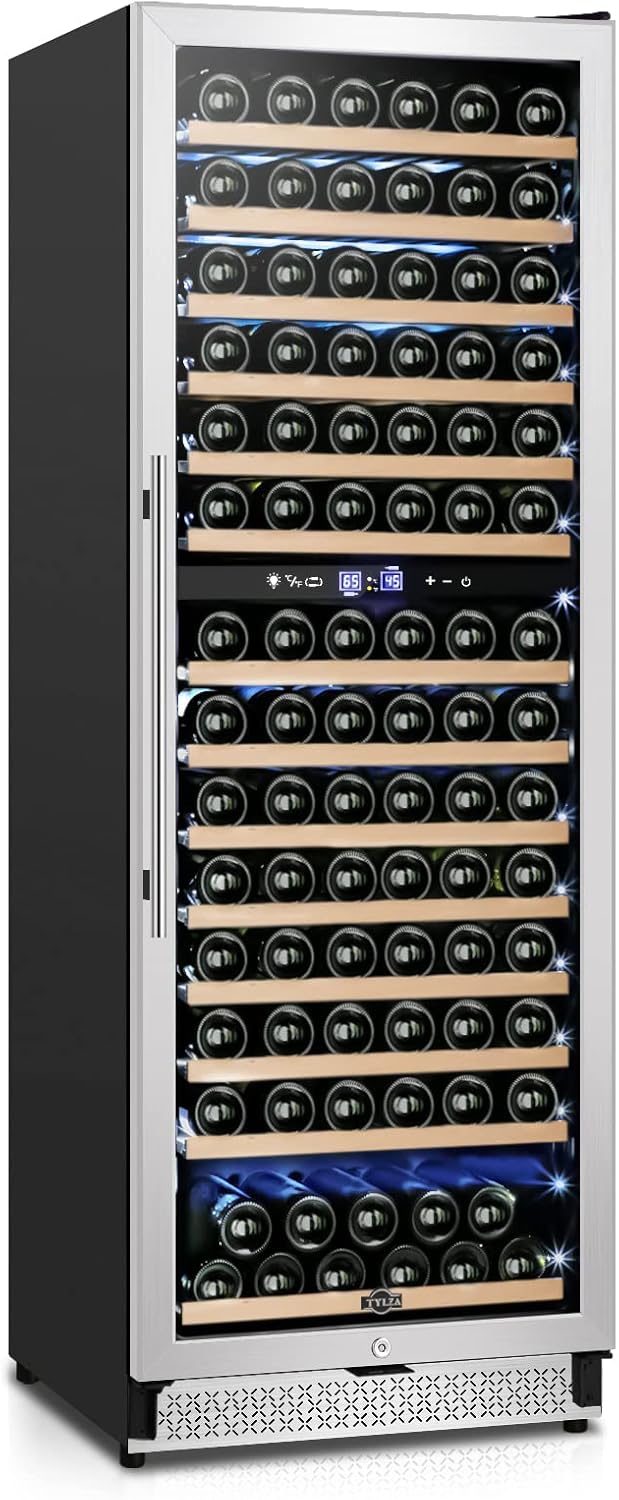
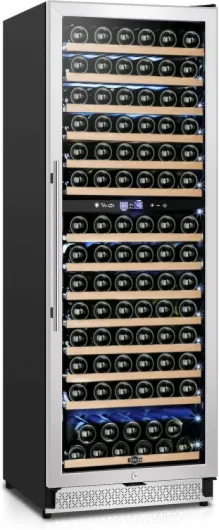
Design-wise, this fridge is clean and modern without trying too hard. Stainless steel frame, glass door, and beech wood shelves give it a decent look, especially if it’s going into a bar area or a finished basement. It doesn’t scream luxury, but it doesn’t look cheap either. From a few feet away it blends in fine with other stainless appliances. The door handle feels solid enough, not flimsy, and the glass doesn’t fog up in normal use, which is nice if you care about seeing the bottles.
The interior layout is where things get interesting. You get 14 sliding wooden shelves on metal runners, plus the bottom area where you can stand or stack larger bottles. In theory, you can pack 180 Bordeaux bottles in there if you go single layer and everything is the same shape. In reality, once you start adding Pinot Noir, Champagne, or chunky California bottles, you quickly lose some of that capacity. I ended up removing a shelf and doing some double stacking in places to get close to 160 bottles. It works, but it’s not as simple as just loading 180 random bottles and shutting the door.
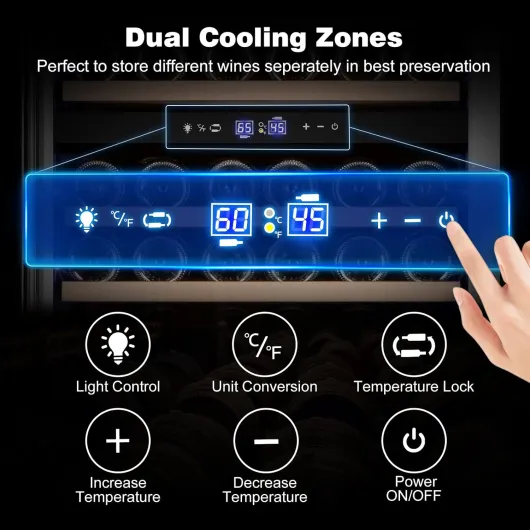
The dual-zone separation is straightforward: top for cooler wines, bottom for reds. The digital display is easy enough to read, but the buttons aren’t backlit, which is slightly annoying in low light. You kind of have to remember where the light button is by feel. The interior LEDs are decent though – they light up the bottles without being blinding, and they make it a lot easier to find specific labels without pulling half the shelves out.
Overall, the design is practical but not perfect. It looks good in a home bar or kitchen, the shelves slide smoothly and don’t feel like they’re going to collapse, and the door has a solid feel. The main catch is that the advertised capacity assumes very uniform bottle sizes, which is not how most people’s collections look. If you’re okay with doing a bit of Tetris with your bottles and maybe sacrificing a shelf for bigger stuff, the layout is workable. Just don’t go into it expecting to easily fit 180 random bottles without some fiddling.
Build quality and materials: better than entry-level, but not luxury
In terms of materials and build quality, this Tylza fridge sits comfortably above the really cheap wine coolers, but it’s also clearly not in the premium category. The outer shell is metallic with a stainless steel door frame and handle. The glass feels thick enough and hasn’t shown any fogging issues for me, which lines up with the "no fog" claim. The door hinge is on the right and feels sturdy, but it’s not reversible, so you need to be sure the swing direction works in your space before you commit.
The beech wood shelves are actually one of the better points. They’re not wobbly, they slide on proper metal rails instead of just scraping plastic, and they don’t flex when you load them with bottles. I’ve pulled out shelves fully loaded and they don’t feel like they’re going to dump everything on the floor. The wood fronts give the interior a nicer look than plain wire racks, and they also help keep bottles from rolling around. The rails have a smooth action, which is a small thing but makes a difference when you’re constantly pulling bottles in and out.
Inside, the plastics and metal panels are decent. Nothing screams "cheap toy", but also nothing feels ultra premium. It’s kind of what you expect at this price: solid, functional, but not fancy. The door seal feels tight, and I haven’t seen any condensation building up around the edges, which is usually where corners get cut. The touch control panel is basic but works; it doesn’t have that high-end glass-touch feel, but it responds reliably to input.
Long-term, I can’t comment on years of use yet, but early signs are positive. No rattles, no weird vibrations, and the compressor and fan noise are well controlled. Compared to some cheaper units I’ve seen at big box stores (with thin wire racks and rattly doors), this feels like a step up. It’s still a mid-range product, though, so if you’re expecting super thick insulation, ultra heavy doors, or museum-level finishes, you’re going to be underwhelmed. For most home users who just want something that feels solid and doesn’t look bargain-bin, the materials are good enough.
Durability and reliability so far (plus customer service backup)
I haven’t had this fridge for years, so I can’t pretend to know how it will behave after a decade, but I can talk about early durability signs and how the brand handles issues. After several weeks of use, nothing feels loose or degraded. The door still closes firmly, the shelves haven’t warped or sagged, and the compressor cycles seem normal – not constantly running or making weird noises. The fan noise has stayed low and consistent, with no grinding or rattling sounds.
What gives me a bit more confidence is reading and matching my experience with other users' feedback: when issues do happen (like a loud fan in some cases), Tylza’s support seems to actually respond and send replacement parts. That’s not something you always get with off-brand appliances. They mention 24 months of technical support, and based on reports of people getting replacement fans and detailed instructions, it’s not just empty words. Knowing that parts like fans can be swapped without replacing the whole unit is a plus for long-term use.
Physically, the unit feels like it can handle being used daily. The shelves are sturdy enough to be pulled in and out regularly without feeling like they’ll break. The rails are metal, which is better than the plastic track systems you see on some cheaper fridges that wear out and start sticking. The door seal hasn’t shown any gaps or tears. No visible condensation around the frame, which is usually where cheaper seals start to fail.
Of course, this is still a mid-range product. I wouldn’t expect it to match the 10–15 year lifespan of a high-end cellar brand without some maintenance. But from what I’ve seen so far – and from other users who’ve had it longer – it seems reasonably durable for the price. The combination of decent build quality and responsive customer service makes me less worried about something small failing and turning the whole thing into a giant paperweight.
Cooling performance, noise, and everyday use
On performance, this fridge does what it’s supposed to do: it cools quickly and stays consistent. When I first plugged it in (after letting it sit upright for a day, as recommended), it hit my target temps in about an hour or so. I set the top zone to 45°F for whites and the bottom to 55°F for reds. I tossed in two separate thermometers, one near the top and one near the bottom. The readings were pretty close to the display: roughly 1–3°F difference, which is totally fine for wine. There is a small gradient from top to bottom, but it’s stable, so you can use that to your advantage by putting more sensitive wines where you want them.
The noise level is probably the biggest plus here. Even when the compressor kicks on, it’s more of a soft hum than anything. In a quiet room you’ll notice it, but it’s much softer than a standard kitchen fridge. Once there’s any background noise – TV, conversation, whatever – you kind of forget it’s running. If you’re planning to put this in a living room or open kitchen, that low noise level matters a lot, and this unit does well there. I never had any loud fan whine or rattling, which some cheaper wine coolers suffer from.
The fan-circulated, frost-free system seems to work. I haven’t seen frost buildup, and I don’t see big hot or cold spots inside. Bottles at the back are roughly the same temp as bottles at the front, which is the whole point of the internal fan. The temperature memory feature also did its job: after a brief power cut, it came back up with the same settings I had before, without me having to reprogram anything.
Everyday use is pretty straightforward. The touch panel isn’t fancy, but you can easily set each zone. The only slightly annoying part is the non-backlit buttons if you’re fiddling with it in low light. Shelves slide smoothly, and you can pull them most of the way out to see labels. The only time performance drops a bit is if you leave the door open too long while reorganizing; it takes a little while to pull the temp back down, which is normal for this type of fridge. Overall, in terms of performance, it’s reliable, quiet, and does the core job without drama.

What this Tylza wine fridge actually offers on paper
Let’s start with the basics. This Tylza model is a 24-inch wide, freestanding or built-in dual-zone wine fridge, about 65.7 inches tall and a bit over 27 inches deep. It claims a capacity of up to 180 standard 750 ml Bordeaux bottles, spread across 14 beech wood shelves plus the bottom area that can handle bigger bottles. It runs on a compressor with fan cooling, frost-free, and has touch controls and interior LED lighting.
The upper zone is rated for around 40°F to 55°F, which is more of a white / sparkling range, and the lower zone is 55°F to 65°F, which is red territory. There’s a temperature memory function, which basically means if the power goes out, it should come back to the last settings instead of defaulting to something random. Voltage is standard 115V, door is stainless steel with a glass panel, and it’s right-hinged only, so no reversible door option here.
On paper, the specs look pretty competitive in this price range: dual zone, frost-free, wooden shelves, low noise claims, and a fairly large stated capacity. The unit weighs about 120 pounds, so it’s not crazy heavy for the size, but it’s still a two-person lift if you’re going up or down stairs. The brand advertises a 24-month technical support window and they do mention certifications like DOE and ETL, which at least suggests it’s not some completely no-name import with zero standards behind it.
In terms of how it fits into the market, it’s kind of in the middle: not a cheap tiny under-counter cooler, but also not in the same league price-wise as high-end cellar brands. If you want a dedicated wine fridge with dual zones and you’re aiming for around 150+ bottle storage, this is the sort of unit you’re likely to compare against NewAir, Kalamera, and similar brands. On paper, Tylza is right in that mix, maybe slightly better on capacity and shelf count for the money.
Pros
- Quiet operation with stable, reliable dual-zone cooling
- Real-world capacity around 150–160 bottles with mixed sizes, good for larger collections
- Sturdy sliding wooden shelves and decent overall build quality for the price
Cons
- Advertised 180-bottle capacity is optimistic unless you use only standard Bordeaux bottles
- Controls and buttons are basic and not backlit, slightly annoying in low light
- Right-hinged door only, no reversible option, which can limit placement
Conclusion
Editor's rating
If I had to sum up the Tylza 24-inch dual zone 180-bottle wine fridge in one line, I’d say: it’s a solid, quiet workhorse with good capacity and a few manageable quirks. It cools reliably, keeps noise low, and looks decent enough to sit in a bar or kitchen without sticking out. The shelves are sturdy, the dual zones work as advertised, and the temperature stability is good for proper wine storage. For the price, that’s a pretty fair deal.
This fridge makes the most sense for people who have a medium to large collection and want one main storage unit instead of multiple small coolers. If you’re sitting on a mix of reds, whites, and some Champagne and you care more about function than fancy branding, it’s a good fit. If you’re extremely picky about exact capacity, premium finishes, or need a reversible door, you might want to look at higher-end options. Also, if you only have 20–40 bottles, this is just too big and you’re paying for space you won’t use.
Personally, I’m happy with it so far. It’s not perfect – the 180-bottle number is more marketing than reality for mixed collections, and the controls are pretty basic – but the core stuff (cooling, noise, build quality) is handled well. If your priority is quiet, dependable storage with room to grow your collection, this Tylza is a good, practical choice. If you want a showpiece or ultra-premium feel, you’ll probably end up spending more with another brand.