Summary
Editor's rating
Value: good price for casual users, but you do trade off precision and capacity
Design: looks high-end at a glance, with some practical quirks
Materials and build: light, decent, but not premium
Durability and reliability: feels okay, but user reviews hint at some inconsistency
Performance: cooling is acceptable, but temperature and capacity claims are optimistic
What this wine cooler actually offers on paper vs in real life
Effectiveness in daily use: does it actually keep your wine how you want it?
Pros
- Nice mirror finish and blue LED lighting give it a modern look for the price
- Quiet enough for kitchen or dining room use, with simple digital controls
- Affordable way to keep 20–28 bottles at a more suitable temperature than a regular fridge
Cons
- Real capacity is much lower than the advertised 43 bottles, especially with mixed bottle shapes
- Temperature display is not perfectly accurate, and some units reportedly don’t cool properly
- Budget build quality with basic wire shelves and a generally light, non-premium feel

Specifications
View full product page →| Brand | Hamilton Beach |
A cheap 43-bottle wine cooler that looks fancier than it really is
I’ve been using the Hamilton Beach HBWF4303 wine cooler for a bit now, and I’ll be straight: this is a budget wine fridge that looks more premium than it behaves. On paper it sounds great – 43 bottles, digital control, mirror finish, blue LED light, quiet compressor, not huge power consumption. In reality, it does the job if your expectations are realistic, but it’s far from perfect.
What pushed me to try it was the combo of capacity, price, and the fact it’s from a known brand. I didn’t want to spend $600+ on a wine fridge, but I also didn’t want some no-name unit that dies in a year. The Amazon ratings were mixed (3.6/5), which actually made me curious. Some people say it’s perfect, others say it doesn’t chill at all. That kind of split usually means quality control is hit-or-miss.
So I treated it like a cheap experiment: I measured the internal temperature with a separate thermometer, filled it with a mix of standard reds, whites, and a few bulkier champagne bottles, and let it run in a normal home environment – not a lab, just my dining room. I also paid attention to noise, vibrations, and how annoying (or not) the shelves are when you actually load real bottles instead of the perfect identical ones they show in product photos.
In short, it’s a decent but imperfect wine cooler. If you’re picky about exact capacity and super stable temperature, you might be annoyed. If you mainly want something that looks nice, keeps bottles reasonably cool, and doesn’t cost a fortune, it can make sense. Just don’t believe the "43 bottles" and "all your wine problems solved" idea. It’s more like a 20–30 bottle practical fridge with a nice face.
Value: good price for casual users, but you do trade off precision and capacity
In terms of value for money, this is where the Hamilton Beach HBWF4303 makes the most sense. It often sells around the low hundred-dollar range (roughly in the $100–$200 band depending on promos), which is low for a branded 40-ish bottle wine cooler. For that price, you get a decent-looking unit, digital controls, a compressor system, and enough space for a small to medium collection. Compared to other freestanding wine fridges from bigger brands, you’re paying less and getting something that still looks pretty modern.
The trade-offs are clear, though. The real capacity is much lower than the advertised 43 bottles for most people. If you were hoping to store a full 40+ bottle collection, you’ll probably be disappointed. You’d either need a second unit or a larger, more expensive fridge. Also, the temperature accuracy and consistency are okay but not top-tier. If you’re really into wine and see this as long-term storage for serious bottles, you might be better off adding more budget and going for a more premium model with better shelving and more stable temps.
On the flip side, if you just want something that looks good in a kitchen or bar area, keeps your everyday reds and whites at a better temperature than your main fridge, and doesn’t blow your budget, this offers pretty solid value. It’s not fancy, but it’s more than a toy. For someone who drinks casually, has maybe 15–25 bottles rotating through, and cares more about look and basic function than perfect specs, the price/feature balance is hard to argue with.
So overall, I’d say: good value if your expectations are realistic, medium value if you take all the marketing claims literally. You’re paying for a decent-looking, functional unit with some compromises. If you’re okay with that, your money is well spent. If you want serious cellar performance, this is probably not the right tier for you.
Design: looks high-end at a glance, with some practical quirks
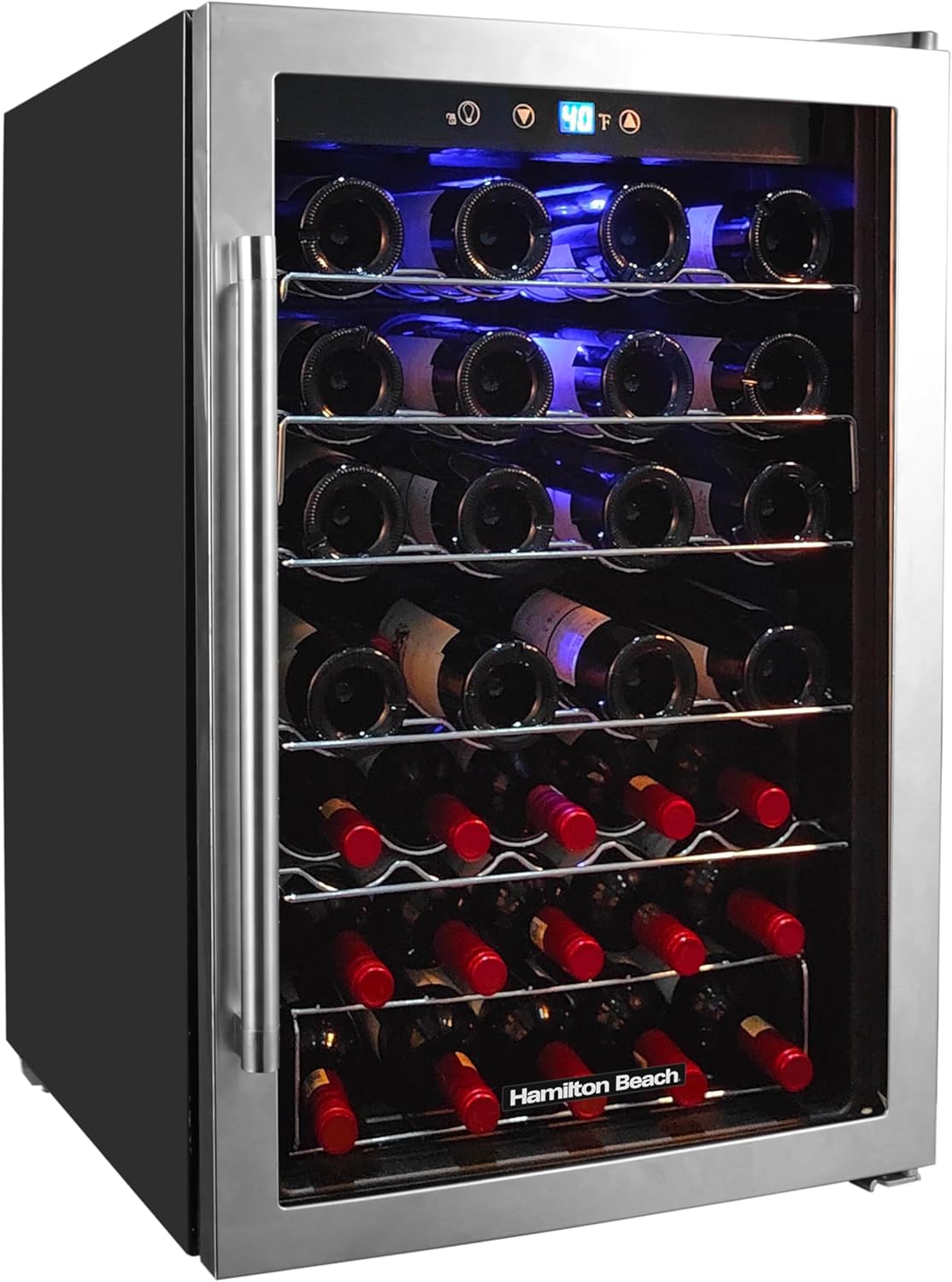
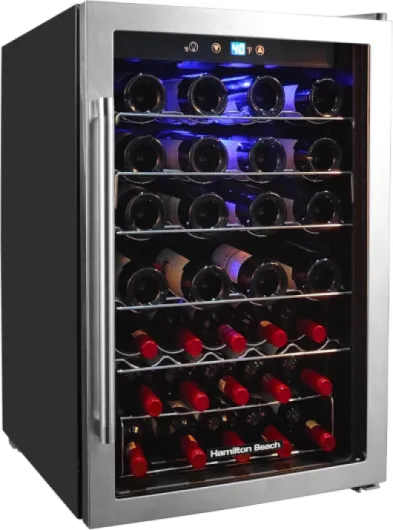
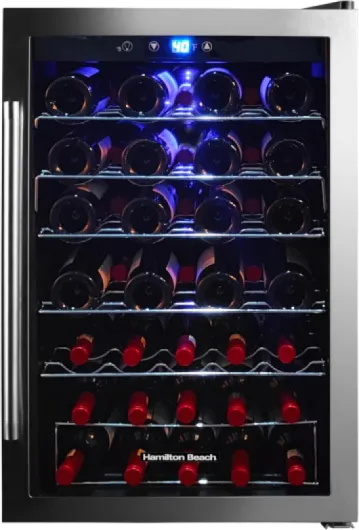
The design is honestly what sells this unit. The mirror finish door with the stainless handle looks clean and modern. When the blue LED light is on inside, it gives off a nice bar vibe. If you care about how it looks in your kitchen or home bar, this one does pretty well for the price. It doesn’t scream "cheap appliance" from across the room, which is kind of what I expected at this price point.
That said, the mirror finish is a fingerprint magnet. You touch it once and you see it. If you have kids or you’re constantly grabbing the handle with messy hands, be prepared to wipe it down often. The tinted glass is a plus because it cuts some light exposure, which is better for wine, even if this isn’t a professional cellar. The reversible door hinge is also handy if your layout is awkward; switching sides isn’t something you do every day, but at least the option is there.
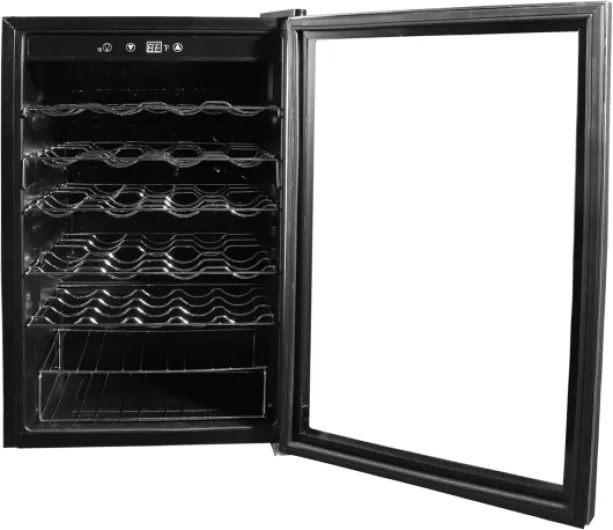
Inside, the layout is simple: 6 curved wire shelves, plus a little area where you can stand bottles upright near the bottom. In theory, those curved shelves should help cradle the bottles, but they also limit how you can stack different bottle shapes. Tall or fat bottles quickly mess up the "perfect rows" idea. The control panel sticking down from the top also steals some space, especially on the top shelf, where necks hit the module if the bottles are normal size. That’s one of the reasons the real capacity is lower than what’s advertised.
Overall, in terms of design: good looks, average practicality. It’s clearly made to impress visually more than to satisfy a hardcore wine collector. If you mostly drink standard Bordeaux or Burgundy-style bottles, you’ll manage. If you like a lot of champagne or odd-shaped bottles, you’ll be playing Tetris every time you rearrange it. I’d rate the design as visually strong but slightly annoying when you actually use it daily.
Materials and build: light, decent, but not premium
When you unbox the HBWF4303, the first thing you notice is the weight: about 49 pounds. That’s fairly light for a 43-bottle unit, which tells you right away this is not built like a heavy-duty commercial fridge. The body panels feel thin but not flimsy. You can flex them a bit if you push, but nothing alarming. For a home unit at this price, it’s about what I expected – not trash, but definitely not high-end.
The door feels better than the rest of the unit. The stainless handle is solid enough and doesn’t wobble. The double-pane tinted glass seems properly sealed and doesn’t fog up. The mirror coating on the frame looks nice, but again, it loves fingerprints. The wire shelves are where it feels the most budget: they’re functional but kind of basic. They slide out, but not on proper rails – more like metal-on-metal. You can feel a bit of scraping when you pull them out loaded with bottles. It’s not going to break instantly, but you don’t get that smooth, sturdy feel you find on more expensive fridges with wooden or ball-bearing shelves.
Inside, the plastic trim and control panel look fine but not fancy. Buttons respond well, and the blue display is clear even in a bright kitchen. Insulation seems okay: the sides get a little warm when the compressor runs, but not burning hot. The door seal is decent; you can feel it "grab" when you close the door, and there’s no obvious gap letting air in. One thing I always check is if the unit wobbles or rattles when loaded – with the leveling legs adjusted properly, this one stays stable, and vibrations are pretty minimal.
So in terms of materials, I’d call it pretty solid for the price, but clearly budget. If you’re expecting thick steel, heavy shelves, and luxury touches, you’ll be disappointed. If you just want something that doesn’t feel like it’s going to fall apart in a month, this hits the mark. My only real concern long-term would be the shelves getting bent if someone yanks them out while overloaded. Otherwise, it feels fine for normal home use.
Durability and reliability: feels okay, but user reviews hint at some inconsistency
Durability is tricky to judge without years of use, but I can at least talk about build feel and what other users are reporting. Physically, nothing on my unit felt loose or poorly assembled out of the box. The door sits straight, the seal lines up, and the shelves don’t rattle excessively. After running it continuously, I didn’t notice any weird burning smells, random shutdowns, or extreme hot spots on the sides. For a budget compressor fridge, it feels reasonably put together.
However, the Amazon rating of 3.6/5 with hundreds of reviews tells another side of the story. You have people giving it 5 stars saying it’s perfect and quiet, and others giving 1 star saying it doesn’t chill at all. That usually points to quality control issues – some units leave the factory fine, others with problems. One review flat-out said "Does not get cold". Mine does cool, but if you’re unlucky and get a bad compressor or faulty thermostat, you might end up in that 1-star camp.
The lighter weight and basic wire shelves also mean this isn’t built like a tank. If you move it around a lot, yank shelves out when they’re fully loaded, or store it in a rough environment, I wouldn’t be shocked if something bends or fails sooner than on a heavier, more expensive fridge. On the other hand, for normal home use where it just sits in one place and you’re not abusing it, I don’t see anything that screams "this will break in six months".
So durability-wise, I’d call it acceptable but not reassuring. You’re buying a budget unit from a known brand, not a professional cellar. If you go into it assuming it might last several years with normal use, that’s realistic. If you expect 10+ years of flawless performance, that’s probably optimistic. Given the mixed reviews, I’d strongly suggest testing it thoroughly in the first weeks: check that it actually reaches your desired temperature and stays there before you trust it with anything expensive.
Performance: cooling is acceptable, but temperature and capacity claims are optimistic
This is the section where things get more mixed. The brand claims a 40°F to 61°F range and talks about efficient cooling and quiet operation. In my use, it does cool, and it’s quiet enough, but it’s not as precise or powerful as the marketing suggests. I set it initially to 45°F and checked with an internal thermometer placed in the middle shelf and another on a lower shelf. After a full 24 hours (you always need to wait that long), the readings were closer to 47–49°F in the middle and around 46°F at the bottom.
So the displayed temperature and the actual internal temperature are off by a couple degrees, which is fairly common in cheap wine fridges. Not a disaster for casual wine drinkers, but if you’re very picky, you’ll notice. Once it stabilizes, it’s fairly consistent though – it doesn’t swing wildly. For red wines set around 55°F, it’s totally fine. For whites if you want them really cold, you might find it a bit soft, depending on room temperature. In a warm room or in summer, it will struggle more; I wouldn’t put this in a hot garage and expect perfect temps.
Noise-wise, the compressor cycles on and off with a low hum. From a couple meters away in a dining room, it blends into background noise. You’ll hear it if the room is totally silent, but it’s not the kind of sound that drives you crazy. The fan is also fairly quiet, which matches some of the positive reviews mentioning "whisper quiet". I wouldn’t put it next to your bed, but for a living area or kitchen, it’s totally acceptable.
The capacity and ergonomics hurt the performance more than the cooling itself. Realistically, you’re looking at something like 20–28 bottles depending on shapes, not 43. If you try to cram it like in the product photos, grabbing a bottle from the back becomes annoying, and you risk knocking others around. For regular home use, I’d treat it as a 24-bottle fridge that can stretch a bit, not a true 43-bottle cellar. So overall performance: it cools well enough for most people, is fairly quiet, but falls short if you take the marketing numbers literally.
What this wine cooler actually offers on paper vs in real life
On the spec sheet, the Hamilton Beach HBWF4303 is a freestanding wine cooler with a listed capacity of 43 bottles, a temperature range from 40°F to 61°F, and a 5 cu ft interior. It uses a compressor system (not thermoelectric), has a digital touch control panel with a blue LED display, and blue internal lighting. Dimensions are about 22.25"D x 19.5"W x 34.25"H, so it fits under most counters but it’s not a built-in model – it needs space around it to breathe.
The fridge comes with 6 curved wire shelves, a stainless and mirror-style door with tinted double-pane glass, and a reversible hinge if you want the door to open the other way. Annual energy consumption is listed at around 200 kWh, which is fairly normal for this type of unit. It’s marketed as quiet, and I’d say it’s not silent, but it’s not obnoxious either. You hear the compressor cycle, but it’s more of a low hum than a loud buzz.
In practice, the big marketing points are: the look, the supposed 43-bottle capacity, and the digital control. The look is honestly the strongest part. It does have that shiny, slightly "fancy bar" vibe thanks to the mirror finish and blue light. The digital display is easy to read, and the touch buttons respond well. But when you start counting bottles and checking temps with your own thermometer, some of the claims start to feel optimistic.
For example, that 43-bottle number is basically fantasy if you drink normal 750 ml bottles from different wineries. One reviewer said they got about 20 bottles realistically, and I’m in the same range once you include some thicker bottles and avoid stacking in ways that risk labels getting torn. So the main takeaway from the presentation vs reality is: the feature list looks generous, but you should mentally downgrade capacity and be prepared to double-check temperature accuracy.
Effectiveness in daily use: does it actually keep your wine how you want it?
In day-to-day use, the real question is simple: does it keep your bottles at a stable, reasonable temperature and is it easy to live with? For me, the answer is: yes, mostly, with some caveats. Once I stopped obsessing over the exact "43-bottle" claim and found a layout that worked with my mix of reds, whites, and a few sparkling bottles, it became a fairly low-maintenance appliance. I set it around 52–54°F for mixed storage, and it stays in that ballpark well enough.
The digital controls are straightforward. You press up/down, the display changes, and it adjusts. You don’t need a manual to figure it out. The blue LED light is nice when you open the door or want to show off the bottles a bit, and it doesn’t seem to generate noticeable heat. The door opens and closes smoothly, and the leveling feet did their job – no rocking or weird vibrations once I took a minute to adjust them. From an effectiveness standpoint, it’s not fussy: you plug it in, set the temp, load your bottles, and it just runs.
The downsides come when you start pushing its limits. If you pack it full, air circulation gets worse, and you start seeing more temperature variation between shelves. Also, if you open the door often (like during a party), it takes a while to recover the set temperature, especially if the room is warm. This isn’t a heavy-duty fridge with a massive compressor, so it behaves like a light-duty unit: fine under normal use, but clearly not built for constant heavy traffic or very hot environments.
So in practical terms, I’d say it’s effective for a casual wine drinker who wants their bottles kept cooler and more stable than a regular kitchen fridge, without obsessing over perfect cellar conditions. If you’re storing very pricey bottles or you’re super picky about 1–2°F variations, this will feel basic. For everyday supermarket and mid-range wines, it gets the job done well enough, as long as you accept its limits.
Pros
- Nice mirror finish and blue LED lighting give it a modern look for the price
- Quiet enough for kitchen or dining room use, with simple digital controls
- Affordable way to keep 20–28 bottles at a more suitable temperature than a regular fridge
Cons
- Real capacity is much lower than the advertised 43 bottles, especially with mixed bottle shapes
- Temperature display is not perfectly accurate, and some units reportedly don’t cool properly
- Budget build quality with basic wire shelves and a generally light, non-premium feel
Conclusion
Editor's rating
The Hamilton Beach HBWF4303 is a budget-friendly wine cooler that looks nicer than most in its price range and does a decent job keeping everyday bottles at a reasonable temperature. It’s quiet enough for a living or dining room, the digital controls are simple, and the mirror door with blue lighting gives it a more high-end look than the price suggests. For casual wine drinkers who want a dedicated spot for their bottles and don’t want to spend a fortune, it’s a pretty practical option.
Where it falls short is mainly in honesty of specs and consistency. The advertised 43-bottle capacity is very optimistic; in real use with mixed bottle shapes, it’s closer to 20–28 bottles. Temperature readings on the display don’t perfectly match the actual internal temperature, and user reviews show that some units have cooling issues out of the box. Build quality is fine for the price, but clearly budget – wire shelves, light body, and a general "good enough" feel rather than something built for a decade of heavy use.
If you’re a casual drinker with a rotating collection and care more about look and basic function than perfect cellar conditions, this cooler gets the job done for a fair price. If you’re a serious collector, plan to store expensive bottles long term, or need true 40+ bottle capacity with very stable temps, you should probably skip this and invest in a higher-end model. Overall, it’s a decent, good-looking starter wine fridge with some clear compromises you need to accept upfront.