Summary
Editor's rating
Value for money: who this fridge makes sense for
Design and layout: tall, narrow, and mostly well thought-out
Build quality, shelves and general feel
Durability and long-term feel (so far)
Cooling performance and noise: does it actually keep wine at the right temp?
What this Klarstein wine fridge actually offers
Everyday use: does it actually make storing wine easier?
Pros
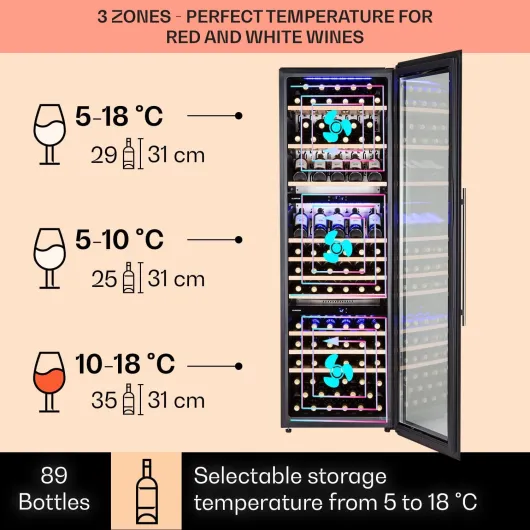
- Three independent temperature zones (5–18 °C) that actually hold stable temperatures
- Good capacity for a narrow footprint, realistically around 60–70 mixed bottles comfortably
- Quiet operation around 38 dB, suitable for open kitchens or bar areas
Cons
- Advertised 89-bottle capacity only realistic with mostly standard bottles and tight packing
- Right-hinged door only, not reversible, which can limit placement options
- No advanced features like humidity control or smart/app connectivity for those who want them

Specifications
View full product page →| Brand | KLARSTEIN |
A big wine fridge that actually fits in a kitchen
I’ve been using this Klarstein Vinsider 89 Built-In Trio for a few weeks now, and it’s the first time I’ve had a wine fridge that feels more like a real appliance and less like a toy. It’s tall, narrow, and meant to be built in, so it doesn’t eat up half the room like some bulky freestanding units. I put it in a tall cabinet space next to my regular fridge, and it basically turned that column into a mini wine corner.
In day-to-day use, the main thing that stands out is the capacity vs. footprint. On paper it says 89 bottles, 246 L, and that sounds like a lot, but it’s different when you actually start loading it with real bottles: Burgundy, Bordeaux, sparkling, odd-shaped craft beer bottles, etc. You quickly see how much it can really handle and where the limits are. Spoiler: 89 bottles is doable, but only if you mostly use standard Bordeaux-style bottles and stack carefully.
I didn’t buy it to show off, I bought it to get my random cases of red, white, and sparkling out of cardboard boxes and into something with a stable temperature. Compared to the small 30–40 bottle coolers I had before, this feels more serious. The compressor is more solid, the door is heavier, and the shelves actually slide properly. It’s not perfect, but it already feels like less of a compromise than my old fridges.
If you’re considering it, the main questions to ask yourself are: do you really need three temperature zones, do you have the height to build it in (almost 1.79 m), and are you okay with a fairly heavy unit (around 90 kg) that you won’t move once it’s in place. If those points don’t scare you, it’s a pretty solid option for someone who actually keeps a decent stock of bottles at home or runs a small bar.
Value for money: who this fridge makes sense for
In terms of value, this Klarstein sits in that middle segment: not the cheapest, not the luxury tier. For the size (246 L, up to 89 bottles) and the triple-zone feature, the price is fairly reasonable compared to what other brands ask for similar specs. If you look at some big-name wine fridge brands, you’ll quickly see prices shoot up for triple-zone and built-in design. Here you’re paying less, but you’re also not getting high-end finishes or brand prestige. It’s a practical purchase more than a status object.
If you only drink a couple of bottles a month and keep them on the counter or in a small 20-bottle cooler, this unit is probably overkill. You’d be paying for capacity and triple zones you don’t really use. On the other hand, if you regularly buy by the case, have a mix of reds, whites, and sparkling, and care about serving temperature and somewhat stable storage, then the value starts to make sense. You get a decently quiet, built-in, three-zone fridge that can live in a kitchen, bar, or even a living room corner without looking out of place.
Where it could feel a bit expensive is if you were expecting super premium materials or very fancy features. There’s no app, no inventory tracking, no humidity control, no carbon filter. It’s a straightforward wine fridge: it cools, it looks decent, it stores quite a few bottles. Personally, I prefer that to paying extra for features I’d never use, but it’s good to be clear on what you’re getting. Compared to the cheaper single-zone, 40–50 bottle units, you’re paying more, but you’re also getting more serious storage and something that can actually replace a small cellar for an apartment or a small business.
Overall, I’d say the value is pretty solid if you actually use its capacity and zones. If you’re just after a nice-looking fridge for a dozen bottles in the living room, I’d look smaller and cheaper. If you’re the person with boxes of wine lying around and no proper place to put them, then this starts to look like a reasonable investment instead of just a fancy gadget.
Design and layout: tall, narrow, and mostly well thought-out
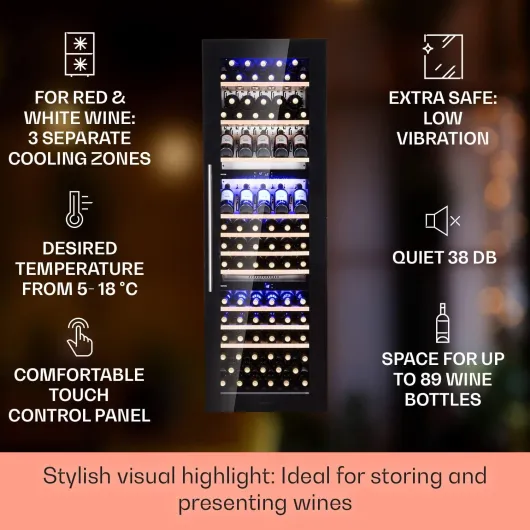
Visually, the fridge is clean and modern. Black exterior, glass door, no fake chrome everywhere. It blends pretty nicely next to a black or stainless kitchen. The glass door is slightly tinted, which helps hide fingerprints and makes it look a bit more discreet. The glossy finish on the frame does catch smudges, so if you’re picky you’ll be wiping it often, but it’s nothing dramatic. The handle is integrated in the edge of the door, not a big bar handle sticking out, which is nice in a tight space.
Inside, the layout is simple: wooden shelves on metal rails, divided into three temperature zones. You don’t get fancy shaping or individual bottle slots; it’s more about straight rows. That’s fine for Bordeaux bottles, but if you drink a lot of Champagne or Burgundy with wider shoulders, you’ll end up playing Tetris a bit. I had to alternate bottle directions on some shelves to make them fit without rattling when I slide the shelf. It works, but the advertised 89 bottles assumes mostly standard bottles and quite tight packing.
The three-colour LED lighting is more cosmetic than functional, but it does help see what’s inside without turning on the big kitchen light. I ended up keeping it on the warm/amber tone because the blue looked a bit nightclub-ish to me. The lighting is even enough, nothing blinding, and it doesn’t heat the inside. Controls sit in the upper part, easy to reach if the unit is at floor level, but if you build it up on a plinth you might need to stretch a little if you’re short.
What I liked in practice is that the door opens smoothly and closes firmly. The right-hinged door works for my layout, but it’s not reversible, which can be a pain depending on your kitchen. Also, this thing is tall: almost 1.8 m. Make sure your cabinet or niche can handle that height with a bit of ventilation space above and behind. Once in place, it looks like a proper built-in appliance, not a random mini fridge sitting around, which for a kitchen or bar where design matters is a clear plus.
Build quality, shelves and general feel
In terms of materials, this is not luxury furniture, but it doesn’t feel cheap either. The cabinet is sturdy, the glass door has a decent thickness, and the whole thing weighs about 90 kg, which already tells you there’s some real hardware inside. When we moved it into place, two adults were definitely needed. Once installed, it sits solidly, no wobble, and the door closes with a firm seal. The gasket around the door looks decent; time will tell how it holds up, but out of the box it feels tight.
The wooden shelves are probably the part most people will look at. They’re not massive oak, but they’re not flimsy either. They slide on metal rails and can handle a full load of bottles without bending. I did notice a very slight flex when I overloaded one shelf with heavy sparkling bottles, but nothing alarming. The wood finish is simple, no varnish that smells strong, and it gives a warmer look than bare metal. You can pull the shelves out far enough to see the back bottles, but not completely out without lifting them, which is fine for safety.
Inside walls are standard plastic/metal fridge liner, nothing fancy. The touch controls feel okay, not super premium, but responsive enough. You don’t have the feeling they’ll break under normal use. The LED lights look good, but you can tell they’re basic strips, not some high-end lighting system. That said, they do their job, and I prefer that over paying more for fancy lights I don’t need. The lock is a simple key mechanism; again, it’s more about keeping kids or casual hands out than hardcore security.
Overall, the materials match the price bracket: above entry-level, below luxury. Compared to the cheaper small wine coolers I had before, this feels more solid and less plasticky. Compared to very high-end brands that cost double or triple, you can see where Klarstein saved money (less metal, simpler interior, basic hinges), but for home or small bar use, it feels robust enough. I don’t baby it, and so far nothing feels loose or fragile.
Durability and long-term feel (so far)
I obviously haven’t had this fridge for years yet, so I can’t pretend to know how it will age over a decade. But based on a few weeks of use and comparing it to other fridges I’ve owned, I can at least talk about the first impressions on durability. The compressor starts and stops smoothly, no weird clunks or rattles. The cabinet doesn’t vibrate, and the shelves don’t buzz when the motor runs, which is usually a good sign that things are properly fixed inside.
The door hinges feel solid. I’ve opened and closed it a lot while loading, reorganising, and showing it to friends, and there’s no play or sagging so far. The door seal also seems to snap back into place correctly every time. I checked for condensation around the frame and didn’t see any, even on a humid day, so the insulation looks decent. The glass doesn’t fog up either, which is nice if you care about the look.
Inside, the wooden shelves slide well and haven’t warped or scratched badly yet. I did accidentally bump a bottle hard against one of the rails, and it left a tiny mark on the wood, but nothing serious. This is normal wear. The LED lights work fine and don’t flicker. The touch controls still respond well after being used with slightly wet hands or after cleaning, so they don’t feel overly fragile.
Realistically, at this price point and with manufacturing in China (which is clearly stated), I don’t expect it to last 20 years like an old-school fridge, but it doesn’t give off a disposable vibe either. If you treat it like a normal appliance and don’t overload shelves beyond reason, it should hold up. The main unknown is the compressor over the long term, but that’s the case with almost any fridge. For now, in terms of perceived durability, I’d say it’s above average for a domestic wine fridge, but of course, time will tell if that holds up.
Cooling performance and noise: does it actually keep wine at the right temp?
Performance-wise, this is where I paid the most attention, because my old cheap wine cooler had wild temperature swings. Here, with the Klarstein, the temperature stability is much better. I set the bottom zone to 6 °C for sparkling and beer, the middle to 10–11 °C for whites, and the top to 14–15 °C for reds. With a simple fridge thermometer placed on a couple of shelves, I saw variations of about ±1 °C around the set point once the fridge had fully cooled down. That’s decent for a home unit in this price range.
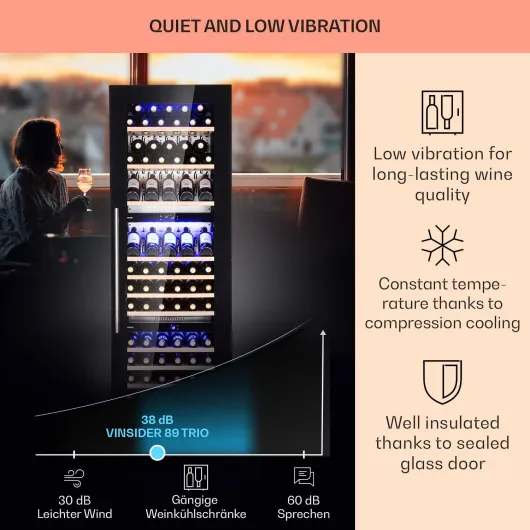
It’s not lightning fast to pull down a full load of warm bottles, but that’s normal. When I loaded around 40 bottles at room temperature (about 22 °C), it took a good 24 hours for all three zones to stabilize close to their targets. After that, it just quietly maintained. The compressor cycles on and off, but the 38 dB noise level feels accurate. In an open-plan living/kitchen, you can hear a low hum when the room is silent, but it’s not annoying. My dishwasher is way louder. If you sleep next to it, it might bother you, but in a kitchen or bar area it’s totally acceptable.
The triple-zone function is the main selling point, and in practice, it’s useful if you actually separate your wines. I liked having reds at a higher temp ready to drink, while whites and bubbles stayed colder. The only small downside is that the zones are stacked vertically, so when you open the door, you’re always letting warm air into all three zones at once. It still manages to keep them at different temperatures, but if you’re constantly opening and closing, expect a little fluctuation, especially in the top zone.
I didn’t notice any major hot spots, but the very front of the shelves near the door is always slightly warmer than the back, as with any glass-door fridge. If you’re storing long-term bottles you care about, I’d push them towards the back and keep the stuff you drink often in front. Overall, the performance is pretty solid for home and small professional use: steady temperatures, automatic defrost so no ice buildup dramas, and no crazy noise. Not perfect laboratory-level stability, but clearly better than the cheap single-zone coolers I’ve used before.
What this Klarstein wine fridge actually offers
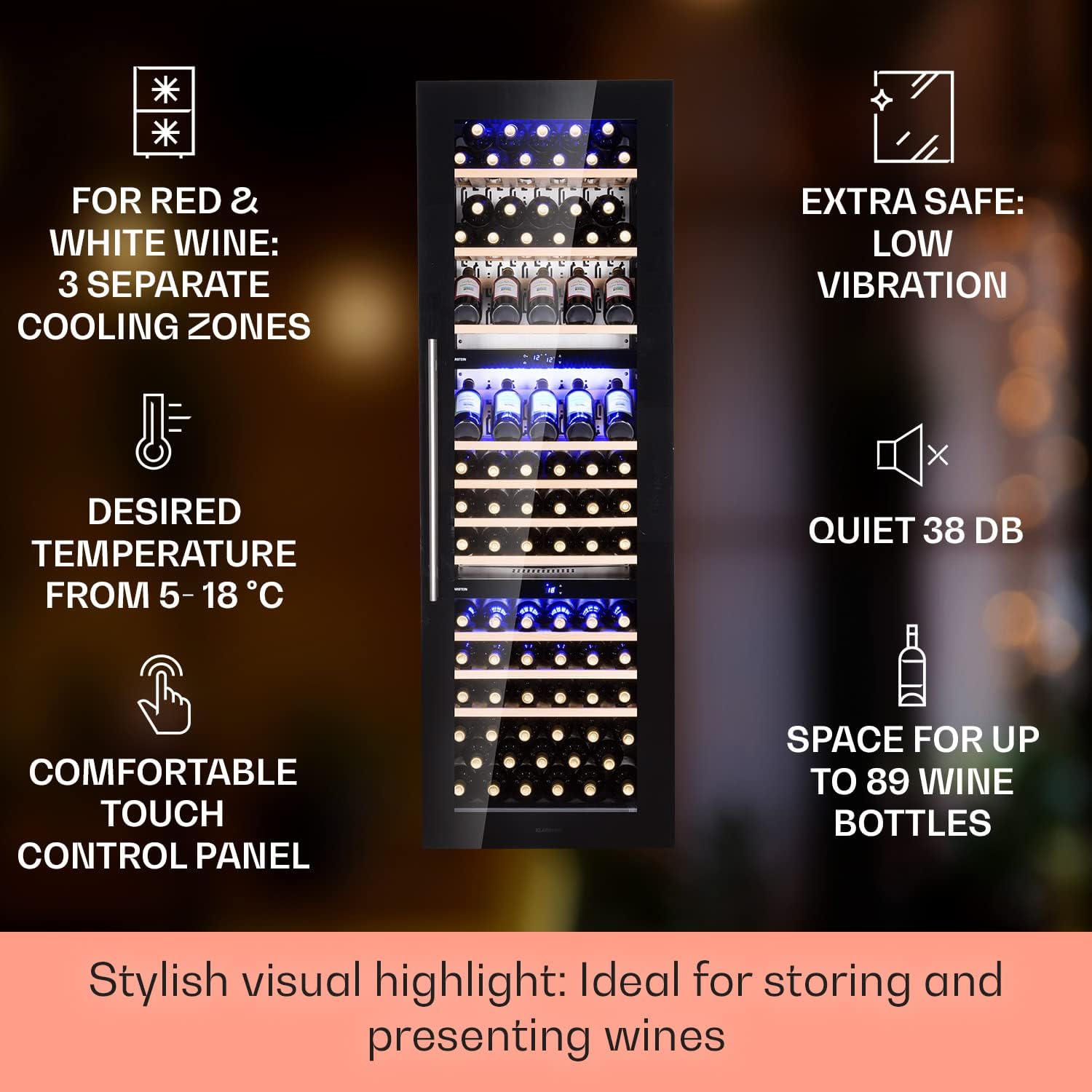
On paper, the Klarstein Vinsider 89 Built-In Trio is a tall, 246 L, triple-zone wine fridge that can be built into your kitchen or bar furniture. Dimensions are 58 cm deep, 59.5 cm wide, and 178.7 cm high. So width-wise it’s basically a standard 60 cm built-in column, just taller than your usual under-counter unit. It runs on a compressor with R-600A refrigerant, has automatic defrost, and is rated for 220 V with a standard Europlug. No battery nonsense, it’s just a regular corded appliance.
The brand claims it can hold up to 89 bottles, with 3 temperature zones adjustable between 5 °C and 18 °C. The idea is: you put your sparkling and whites in the coldest part, your reds a bit warmer, and maybe keep a middle zone for stuff you want ready to drink. The door is glass with a glossy black frame, there are wooden shelves inside (8 shelves plus some door layout details), and you get a three-colour LED interior lighting system that you can switch between white, blue, and amber tones.
The controls are via an LCD display and touch buttons inside, so no physical knobs. You can adjust each zone independently, and it shows the set temperature clearly. There’s also a key lock on the door, which is mainly useful if you have kids or if the fridge is in a more public space like a small bar or office. It’s not a bank vault, but it stops casual opening. Noise level is listed at 38 dB, which is in the low range for compressor fridges, especially for something this size.
Overall, in terms of raw features, it checks most of the boxes you’d expect in this price/size category: triple zone, glass door, built-in design, LED lighting, automatic defrost, and a decent capacity. There’s no Wi-Fi, no app, no fancy smart home stuff. Personally, I see that as a plus: fewer things to break and no app updates just to cool a bottle of wine.
Everyday use: does it actually make storing wine easier?
On a daily basis, what matters to me is: can I find my bottles quickly, are they at the right temperature, and is the fridge annoying to live with. On those points, this Klarstein is mostly effective. Being able to separate reds, whites, and sparkling into three zones is genuinely practical. I don’t have to move bottles in and out of the kitchen fridge anymore depending on what I’m drinking that night. I know where to reach: top for reds, middle for whites, bottom for bubbly and beers.
Loading and unloading is simple enough, though you do need to think a bit if you want to maximise the 89-bottle capacity. If you’re lazy and just throw bottles in randomly, you’ll fill it up far before 89. If you align them well and mostly use standard-size bottles, you can get close. For me, with a mix of Burgundy, Champagne, and some odd bottles, it’s more realistic to say 60–70 bottles without having to play bottle Tetris too much. Still plenty for a household, but don’t expect to hit 89 with only fat bottles.
In terms of comfort of use, the quiet operation is a big plus. I have it in an open kitchen, and I never feel like it’s droning in the background. The automatic defrost also means I don’t have to think about ice buildup. The only thing that can be slightly annoying is the door alarm: if you leave the door open too long while reorganising shelves, it starts beeping. It’s useful to avoid leaving it open by mistake, but when you’re doing a big reshuffle, it gets on your nerves a bit.
For someone who drinks wine occasionally, this might be overkill. But if you regularly have a few cases at home, or if you run a small bar or restaurant corner, it does the job: bottles are organised, kept at stable temperatures, and you can show them off through the glass door. It doesn’t magically improve the wine, but it takes care of it better than random storage in a warm kitchen or a standard fridge that’s too cold and constantly opened.
Pros
- Three independent temperature zones (5–18 °C) that actually hold stable temperatures
- Good capacity for a narrow footprint, realistically around 60–70 mixed bottles comfortably
- Quiet operation around 38 dB, suitable for open kitchens or bar areas
Cons
- Advertised 89-bottle capacity only realistic with mostly standard bottles and tight packing
- Right-hinged door only, not reversible, which can limit placement options
- No advanced features like humidity control or smart/app connectivity for those who want them
Conclusion
Editor's rating
After living with the Klarstein Vinsider 89 Built-In Trio for a bit, my overall feeling is that it’s a solid, practical wine fridge for people who actually store and drink a fair amount of wine. It cools reliably, the three zones are genuinely useful if you separate reds, whites, and sparkling, and the noise level is low enough for an open kitchen. The build quality is decent, the design is clean, and once it’s built in, it looks like part of the kitchen rather than a random appliance.
It’s not perfect: the 89-bottle capacity is optimistic unless you mostly use standard bottles and pack them tightly, the door is right-hinged only, and there are no fancy extras like Wi‑Fi or humidity control. The materials are good but not luxury grade, which is normal at this price. If you’re expecting a showroom-level object, you might be a bit underwhelmed. But if you just want something that gets the job done without fuss, it does that well.
I’d recommend it to: people with a medium to large wine collection who lack a cellar, small bars or restaurants wanting a decent-looking front-of-house fridge, and anyone redoing a kitchen who wants a tall built-in wine column. I’d skip it if you only keep a few bottles at home, have very limited height, or care more about brand prestige and high-end materials than raw practicality. For most wine drinkers who are past the beginner stage but not full-blown collectors, it hits a pretty good balance between capacity, features, and price.