Summary
Editor's rating
Value for money: who this makes sense for
Design: decent looks, more practical than flashy
Materials and build: solid enough, not luxury
Durability and day-to-day wear
Cooling performance and noise in real life
What you actually get with the DH96
Pros
- Genuine dual-zone cooling with independent temperature control (5–20°C each side)
- Undercounter-friendly size with recessed plinth for a tidy kitchen install
- Good capacity for the footprint (up to 40 bottles or 120 cans in ideal conditions)
Cons
- Not as quiet or premium-feeling as higher-end wine cabinets
- Capacity figures are optimistic once you mix different bottle shapes and sizes

Specifications
View full product page →| Brand | Dellonda |
A dual-zone fridge that actually fits under the counter
I picked up the Dellonda Baridi 40 Bottle / 120 Can Dual Zone fridge (model DH96) to sort out a messy mix of beers, soft drinks and a few wine bottles that were constantly fighting for space in my main fridge. I wanted something that would slide neatly under a standard 60 cm kitchen worktop and stay reasonably quiet. On paper, this one ticked all those boxes: 595 mm wide, 860 mm high, dual zone, and a claimed noise level of 41 dB.
After getting it in and using it for a while, I’d say it does what it says, without any big surprises. It’s not some fancy showpiece for a luxury kitchen, it’s more like a practical bar fridge that looks decent and just gets on with the job. The dual-zone feature is the main reason I went for it, because I wanted colder drinks on one side and slightly warmer wine on the other.
In day-to-day use, the fridge feels pretty straightforward. The controls are simple, the display is clear, and the automatic defrost means you don’t have to mess around with maintenance. It’s basically a set-and-forget appliance once you’ve dialed in the temperatures you like. There are a few quirks with the shelving and capacity claims, but nothing that makes it unusable.
Overall, my impression is that this Dellonda is a practical, mid-range drinks fridge: not cheap, not ultra high-end, but a solid middle ground. If you’re expecting perfect build quality and silent operation, you’ll probably nitpick a few things. If you mostly care about having lots of cold drinks and somewhere sensible for your wine, it does the job pretty well.
Value for money: who this makes sense for
On value, you have to look at what you’re actually getting: dual zones, undercounter size, glass doors, wood shelves, and a 40 bottle / 120 can claimed capacity. For that combo, the DH96 sits in the middle of the market. There are cheaper single-zone fridges with wire racks and smaller capacity, and there are pricier wine cabinets with fancier finishes and quieter operation. This one is clearly aimed at people who want decent capacity and dual temperature control without spending a fortune.
If you’re mainly a beer and soft drinks person and don’t care about wine at all, you could save money with a simpler beverage fridge. The dual-zone feature is overkill if you run both sides at the same temperature. But if you do drink wine and like having reds slightly warmer and whites/rosé colder, the split zones actually make sense and justify the extra cost over a basic single-zone unit.
Compared to some branded wine fridges I’ve seen, this Dellonda feels less polished but more affordable for the same capacity. You don’t get fancy touch panels on the outside or super-quiet operation, but you also aren’t paying premium prices. The running costs (160 kWh/year) are okay for the size, so it’s not going to blow up your electricity bill unless your energy prices are already sky-high and you’re stuffing the place with appliances.
So in terms of value, I’d call it good but not mind-blowing. It makes the most sense for someone who actually uses both zones properly and needs the undercounter-friendly size. If you’re just after somewhere to dump a few extra beers, it’s probably more fridge than you need. If you want a serious, high-end wine cabinet, you’ll find better but you’ll pay a lot more. For a practical home bar setup, it hits a sensible price/performance balance.
Design: decent looks, more practical than flashy
Design-wise, the DH96 sits in that middle area: it looks clean and modern, but it’s not a show-off piece. The black body with the glossy glass doors works fine in a typical kitchen or bar area. The mirror-style tempered glass does help it blend in a bit, and it also hides fingerprints better than completely clear glass, but you’ll still see smudges and need to wipe it down occasionally if you’re fussy.
The two-door layout is practical. Each zone has its own door, so you’re not dumping all the cold air every time you open it. The handles are integrated and don’t stick out loads, which is good in a tight kitchen where you don’t want to catch yourself on them. The control panel is inside at the top, basic but clear: up/down buttons for temperature, a small display, nothing complicated. It feels more “appliance” than “gadget,” which I prefer for something like this.
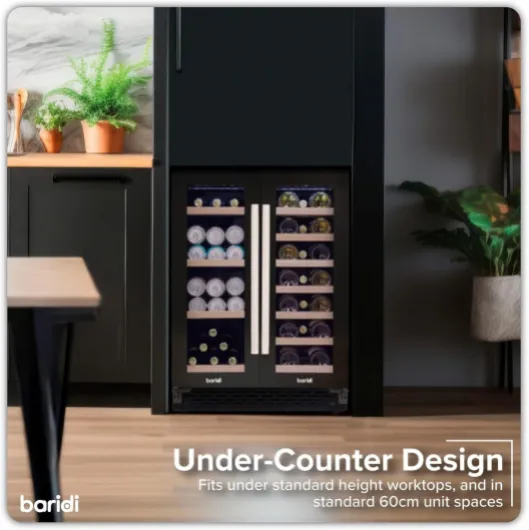
The recessed plinth is a smart touch. When you slide it under a worktop and run the kitchen plinth in front, it looks a bit more built-in instead of like a random box shoved under the counter. It’s not a fully integrated appliance, so don’t expect perfect flush lines like a built-in dishwasher, but it doesn’t look out of place. The black finish also helps it disappear visually if your other appliances are dark.
If I nitpick, the overall look is nice enough but not premium. The doors close fine, but they don’t have that heavy, solid feel you get on much more expensive wine fridges. The internal lighting is okay but not particularly bright; it’s more for a bit of ambiance than really showing off labels. For me, that’s acceptable: it’s good-looking enough not to ruin a kitchen, but clearly built for function first.
Materials and build: solid enough, not luxury
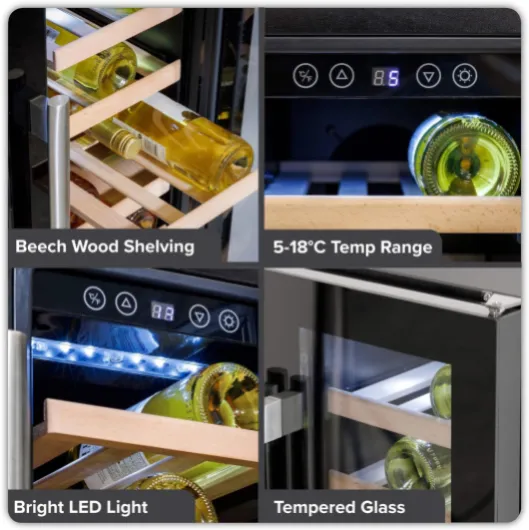
The materials are a mix of metal cabinet, glass doors, and beech wood shelving. The outer shell feels sturdy and doesn’t flex when you move it into place. It’s a heavy unit at around 52 kg, so it doesn’t feel cheap or flimsy. The glass doors are tempered, which is standard for this type of fridge, and the mirror-style finish helps with UV protection for wine, at least in theory. I don’t have lab gear to test UV levels, but bottles haven’t discoloured or warmed up noticeably behind the glass.
The beech wood shelves are a nice touch compared to plain wire racks. They slide in and out reasonably smoothly, though they don’t glide like high-end rails. When fully loaded with bottles, they flex a tiny bit in the middle, but nothing alarming. If you’re planning to use it mostly for cans, you might end up removing some of the shelves anyway and stacking directly on the base, which the fridge handles fine.
Inside, the walls and fittings are standard plastic. It’s all wipe-clean and practical, but don’t expect high-end finishes. The shelf supports are basic but do the job. After loading and unloading a few times and shuffling the shelves around, nothing felt like it was about to snap. The door seals are decent; they grip properly, and you can feel a good seal when you close the doors. No obvious cold air leaks or condensation issues on the outside so far.
Overall, I’d say the build quality is pretty solid for the price bracket. It’s clearly not aimed at the luxury wine-cellar crowd, but it doesn’t feel cheap either. If you’re rough with it, you might scratch the black body or ding the shelves, but with normal home or bar use, I don’t see it falling apart quickly. It hits a sensible balance between cost and sturdiness.
Durability and day-to-day wear
On durability, I obviously can’t simulate several years of use, but after regular use, a few things stand out. The cabinet and doors feel robust enough. Opening and closing the doors many times a day hasn’t caused any looseness or sagging. The hinges still feel tight, and the doors line up properly. The seals haven’t warped or started peeling, and there’s no sign of condensation between the glass layers, which is a good sign for the door construction.
The inside has held up fine to bottles being slid in and out, shelves being moved, and the usual clumsy handling when you’re loading it in a hurry. The beech shelves pick up minor marks if you drag metal caps or bases across them, but that’s cosmetic and expected. The plastic interior walls don’t scratch easily under normal use. If you ram heavy bottles into them, you’ll mark them, but that’s more user error than a design flaw.
The compressor and cooling system seem stable. There’s no odd rattling, no sudden temperature swings, and no weird smells. The automatic defrost means you’re not scraping ice off coils or messing with trays every month. The only maintenance I’ve really had to do is wiping down the glass and occasionally cleaning up the usual drips or condensation from opened bottles.
From a practical point of view, I’d say it feels like a fridge that will last several years in a normal home or small bar as long as you’re not abusing it. It’s not built like a heavy-duty commercial back-bar fridge designed for 24/7 abuse in a nightclub, but it also doesn’t feel fragile. For the price point and the target use (home, man cave, small bar), the durability seems reasonable.
Cooling performance and noise in real life
In terms of performance, the key points are how fast it cools, how well it holds temperature, and how loud it is. Out of the box, once I plugged it in and set both zones to my target temperatures (7°C for drinks, 12°C for wine), it took a couple of hours to get down there from room temperature. That’s normal for a compressor fridge of this size. With both zones loaded with a mix of bottles and cans, it kept those temperatures pretty stable, usually within about ±1°C according to a separate thermometer I put inside.
The dual-zone control actually works. You can set each side anywhere between 5–20°C, as long as you remember that it can’t cool below the ambient limits or heat above the room temperature. So if your room is 15°C, you’re not going to get a 20°C “cellar” zone. That’s mentioned in the description, but it’s worth repeating because some people expect it to heat as well as cool. For drinks and wine in a normal home or bar at around 18–22°C, it’s fine.
On noise, the spec says 41 dB, which matches what I’m hearing. It’s not silent, but it’s not bothersome. You can hear the compressor kick in and a gentle hum when it’s running, similar to a modern kitchen fridge, maybe slightly quieter. In an open-plan living room/kitchen, you notice it if the room is completely quiet, but it fades into the background most of the time. If you’re ultra-sensitive to noise and want something near a bedroom, you might find it a bit too noticeable. For a kitchen, man cave, or bar, it’s perfectly acceptable.
Cooling power is decent. Drinks loaded at room temperature take a few hours to get properly cold, so if you’re stocking up for a party, plan ahead. Once chilled, they stay cold even with people opening the doors regularly. The automatic defrost also seems to work well; I haven’t seen any serious ice buildup or water pooling. Overall, performance is solid and predictable, which is exactly what you want from this kind of appliance.
What you actually get with the DH96
The DH96 is sold as a 40-bottle or 120-can dual-zone undercounter fridge. In reality, those numbers are only accurate if you’re using standard 75 cl wine bottles and regular 330 ml cans, and if you pack them quite neatly. With a more mixed setup (beer bottles, bigger wine bottles, odd-shaped soft drink bottles), you’ll definitely get less in, but that’s true for pretty much every drinks fridge that advertises big capacity numbers.
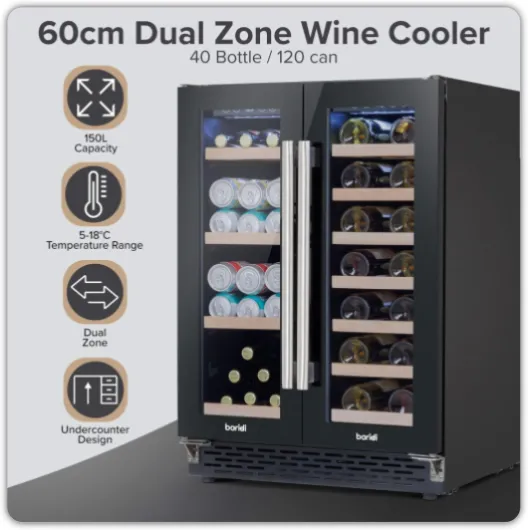
Physically, it measures 57 cm deep, 59.5 cm wide and 86 cm high, so it fits under a standard worktop without you having to hack anything apart. The recessed plinth is handy if you want it to sit behind a kitchen baseboard for a more built-in look. Mine went into a gap where a dishwasher used to be, and with a bit of adjustment on the feet, it lined up well enough with the rest of the units.
Inside, you get two separate zones, each with its own door and digital control. The brand says each zone can take 20 bottles or 60 cans. You also get beech wood shelves, which slide out, and you can remove them if you want to stack cans directly or fit taller bottles. There are four main shelves in total, plus the base area. The layout is more wine-focused by default, but it’s easy enough to rearrange for mixed use.
On the feature side, you’ve got compressor-based cooling, automatic defrost, a UV-reflecting tempered glass front, and a lock with a key if you want to keep kids or guests out of the booze. It runs on a standard UK Type G plug. The energy consumption is listed at 160 kWh per year, which isn’t microscopic but reasonable for a dual-zone unit of this size. In short, it’s a fairly standard spec for a mid-size drinks fridge, with the dual zone and undercounter-friendly dimensions being the main selling points.
Pros
- Genuine dual-zone cooling with independent temperature control (5–20°C each side)
- Undercounter-friendly size with recessed plinth for a tidy kitchen install
- Good capacity for the footprint (up to 40 bottles or 120 cans in ideal conditions)
Cons
- Not as quiet or premium-feeling as higher-end wine cabinets
- Capacity figures are optimistic once you mix different bottle shapes and sizes
Conclusion
Editor's rating
The Dellonda Baridi DH96 is a practical dual-zone undercounter drinks fridge that does what it says without trying to be fancy. Cooling performance is stable, the dual zones genuinely work, and the size makes it easy to slide under a standard 60 cm worktop. Noise is there but reasonable, on par with a normal kitchen fridge. Build quality is solid enough for home or light bar use, even if it doesn’t feel like expensive commercial gear.
I’d recommend it to people who actually care about having two different temperature zones: for example, wine on one side and beers/soft drinks colder on the other. If you’re setting up a home bar, man cave, or you’re tight on space in the main fridge, it’s a good way to free up room and keep everything organised. The design is clean and modern enough to blend into most kitchens, and the glass doors let you see what you’ve got without opening it constantly.
If you’re looking for ultra-quiet operation, premium materials, or a showpiece wine cabinet, this isn’t it. There are nicer-looking and quieter options out there, but they cost noticeably more. For most people who just want a reliable, decent-looking drinks fridge with dual zones, this Dellonda is a pretty solid choice and offers fair value for the money.