Summary
Editor's rating
Value for money: decent price for what it offers, with some trade-offs
Design: compact, simple, and not exactly a showpiece
Daily use: noise, space layout, and little annoyances
Build quality and durability: feels okay, but not bulletproof
Cooling performance: keeps drinks cold, but you’ll hear it
What you actually get with this 36L mini wine fridge
Pros
- Compact size fits easily on countertops, under shelves, or in small rooms
- Compressor cooling actually reaches proper fridge temperatures (around 4–8°C for drinks)
- Glass door with blue LED light and wavy racks make it handy for displaying and storing wine and other drinks
Cons
- Noticeable compressor noise, especially in quiet rooms or at night
- Short 6-month warranty and basic build quality, not ideal for long-term or serious wine storage

Specifications
View full product page →| Brand | HOMCOM |
A small fridge to free up space in the main one
I picked up the HOMCOM 36L table-top wine cooler mainly because my main fridge was constantly packed with cans and bottles. I don’t have a big kitchen, so I wanted something compact that could sit on a counter or under a shelf without taking over the whole room. On paper, the 12-bottle capacity, 4–16°C range, and low yearly consumption (105 kWh/year) looked decent for the price.
After a couple of weeks of use, I’ve used it more as a general drinks fridge than a pure wine cooler. I’ve thrown in wine, beer, soft drink cans, and a couple of 1.5L water bottles to see how flexible it really is. The short version: it cools properly and the size is handy, but the noise level is not as discreet as I hoped based on the listing. If you’re planning to keep it in a bedroom or a quiet office, that’s something to think about.
I also paid attention to how stable the temperature was and how it behaved during a hot day. The compressor system is usually more reliable than those cheap thermoelectric coolers, so I wanted to see if it could actually hold around 6–8°C for drinks without constantly cranking up. It does get there, but it cycles in a way you definitely hear in a quiet room. If you’re used to a normal fridge hum in the kitchen, you’ll probably accept it; if you expect near-silence, you might be annoyed.
Overall, my first impression is: it gets the job done and the format is practical, but it’s not flawless. It feels like a decent compromise between capacity, price, and performance, as long as you’re not too sensitive to noise and you understand it’s a basic, single-zone fridge with manual defrost and no smart features. Nothing fancy, but usable.
Value for money: decent price for what it offers, with some trade-offs
Looking at the features and the current price range, the HOMCOM 36L wine cooler sits in the budget to mid-budget segment. For the money, you get compressor cooling (better than many cheap thermoelectric units), a reversible glass door, adjustable temperature from 4–16°C, and a compact footprint that fits in small spaces. The yearly energy consumption of 105 kWh is reasonable, so it shouldn’t destroy your electricity bill if you run it continuously as a drinks fridge.
Where the value is good is if you specifically want: a small, countertop-size fridge, proper cooling down to fridge-like temperatures, and you don’t care about smart features or dual zones. Compared to some very cheap mini fridges that barely cool below room temperature, this one actually gets drinks nicely cold. Also, the glass door and internal light are nice touches for the price; you can see your stock at a glance and it looks a bit more “bar-like” than a solid-door cube fridge.
On the downside, the short 6-month warranty and the noise level drag the value down a bit. There are other mini fridges in a similar price bracket that offer longer warranties or slightly quieter operation, though you might lose the wine-specific wavy shelves or the temperature range. If you’re extremely noise-sensitive, you may end up regretting not spending a bit more on a quieter model. Also, if you’re a serious wine collector, this is too basic: it’s single-zone, no humidity control, and the capacity is limited.
Overall, I’d call the value “good but not outstanding”. It’s a fair deal if you need a compact drinks fridge and can live with the hum. You’re paying mostly for the compact format and the compressor cooling. If you just want extra cold space and don’t care about a glass door or wine racks, sometimes a slightly larger under-counter fridge can offer better long-term value, but it will also take more space. So it really depends on your constraints: for small flats, offices, or garden rooms, this HOMCOM makes sense.
Design: compact, simple, and not exactly a showpiece
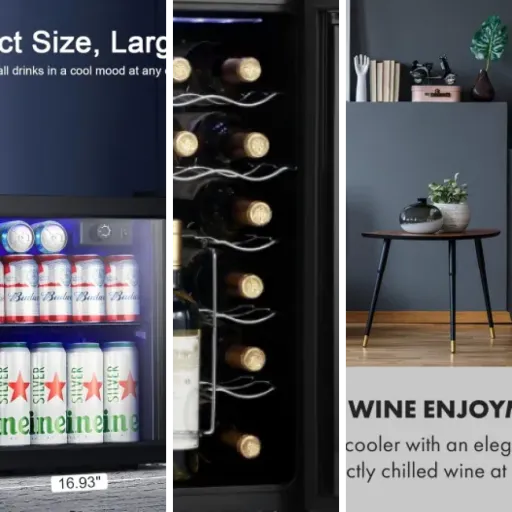
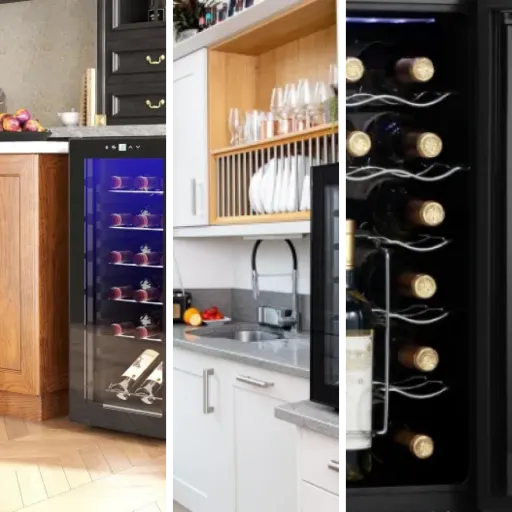
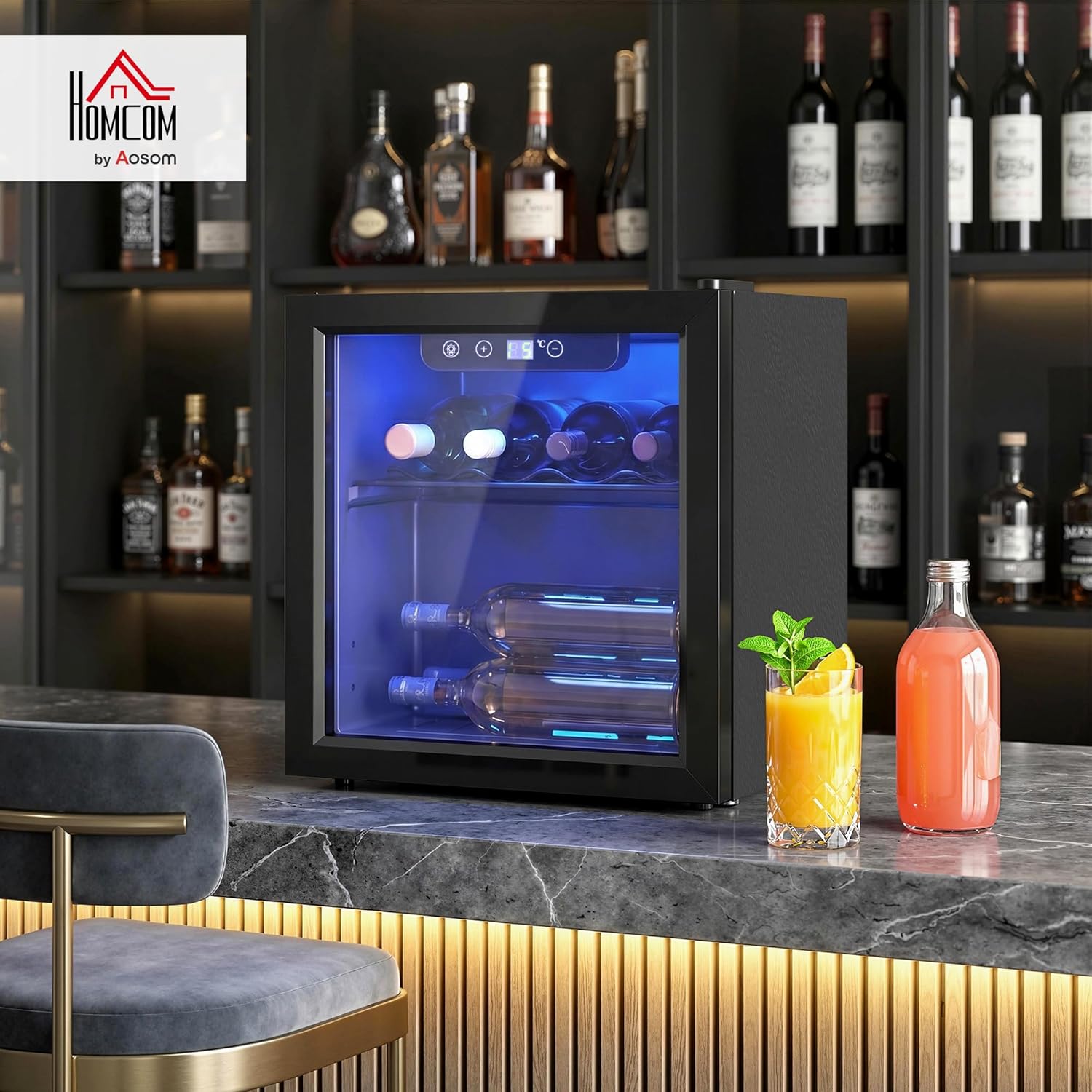
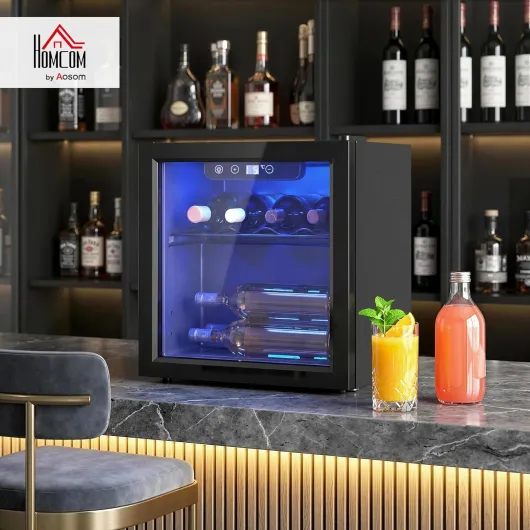
Design-wise, the HOMCOM wine cooler is pretty straightforward. It’s a black matte box with a front glass door and a small control panel at the top. The look is neutral: it doesn’t scream luxury, but it also doesn’t look cheap from a distance. On my countertop it blends in fine next to a microwave and a coffee machine. The glass door lets you see your bottles and cans, and the blue LED light inside gives it a bit of a bar vibe, especially in the evening. If you like to see what’s inside at a glance, that’s handy.
In terms of layout, the wavy steel racks do what they’re supposed to: they keep bottles from rolling around. For standard wine bottles, they’re okay. Once you start adding beer bottles, cans, or larger bottles, you’ll probably end up removing one rack and improvising. The internal height is not massive, so tall bottles may need to go on the bottom or lie slightly angled. It’s a compact fridge, so don’t expect the flexibility of a bigger under-counter model.
I liked the fact that the door is reversible. I didn’t actually have to switch it, but I checked the hinges and screws, and it looks quite doable if your space requires the door to open the other way. The adjustable feet are also useful—my countertop isn’t perfectly level, and a small tweak stopped it from wobbling. Once levelled, the door closes properly and the seal feels decent. No obvious gaps or weak magnets.
One thing to note: the control panel and display are basic, and the overall design is clearly more “functional” than “decorative”. If you’re planning to put this in a fancy living room as a centrepiece, it will look a bit like a small office fridge with a glass door, not like a designer wine cabinet. For a kitchen, home office, or man cave, the design is fine: not special, not ugly, just practical and compact.
Daily use: noise, space layout, and little annoyances
Using this thing every day, a few practical points stand out. First, the internal layout is fine for wine, but just okay for mixed drinks. If you mainly store standard wine bottles, the wavy racks are convenient and you can slide bottles in and out easily. Once you start mixing in cans, stubby beer bottles, and taller water bottles, you end up playing Tetris. I removed one rack to fit bigger bottles upright and made it more of a general mini fridge than a proper wine rack. It works, but you’ll probably tweak the setup to match what you drink most.
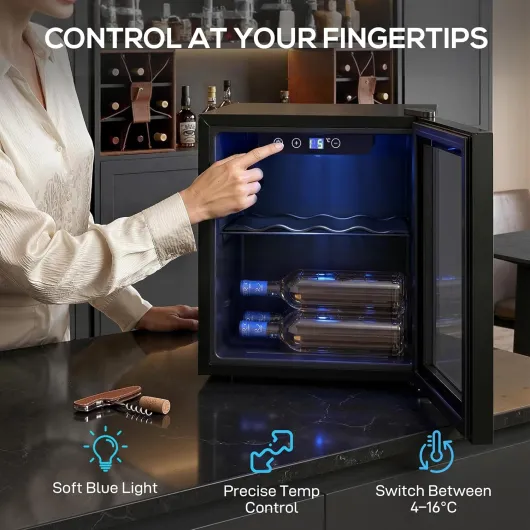
The door opens smoothly, and the clear glass is handy because you don’t have to open it every time just to check what’s inside. The blue LED light is not very bright, but it’s enough to see what you’re doing in a dim room. The control buttons are simple: up/down for temperature, light on/off, that’s it. No complicated menus. For basic use, that’s honestly all you need. The display is legible from a short distance, so you can quickly check the set temperature.
The main comfort issue is the noise. If you place it in a kitchen, garage, or man cave, you’ll probably get used to it. In a home office, it depends how quiet you like your space. I tried it in a small office for a day, and during calls I could hear the compressor kick in. It’s not deafening, but it’s noticeable. At night, in an open-plan living space, you’ll hear it if you’re sitting close by. So in terms of comfort, it’s okay if you accept that background hum.
Another small point: manual defrost. You won’t be doing it every week, but it’s not as convenient as automatic defrost. Over time, you may see a bit of frost build-up if you run it at low temperatures and open the door often. You’ll have to switch it off, let it melt, and clean it up. Not the end of the world, but worth knowing. Overall, daily use is fairly straightforward: it’s a plug-in-and-forget fridge with basic controls and a few compromises on noise and layout flexibility.
Build quality and durability: feels okay, but not bulletproof
In terms of durability, I obviously haven’t had it for years, but there are a few signs you can look at to guess how it might hold up. The unit weighs about 15 kg, which is not super heavy but also not flimsy. When you move it, it feels like a real compressor fridge, not a hollow plastic box. The exterior panels are fairly solid, with a matte finish that doesn’t show fingerprints too badly. The door hinge feels decent, and the door doesn’t sag even when loaded with a couple of heavier bottles.
Inside, the wavy steel racks are basic but functional. They’re not super thick, but they don’t bend under the weight of full wine bottles. The glass shelf also feels sturdy enough for cans and smaller bottles. I wouldn’t overload it with very heavy items, but for normal drink use it’s fine. The interior plastic doesn’t feel premium, but it’s in line with other mini fridges in this price range. Easy enough to wipe down if there’s a spill.
What worries me slightly is the short warranty: only 6 months against manufacturer defects. That’s not very generous for an appliance with a compressor. It doesn’t mean it will fail quickly, but it shows the brand is not going all-in on long-term guarantees. If you’re unlucky and get a bad unit, you’ll likely see issues early (strange noises, not cooling properly, or compressor problems). I’d recommend testing it thoroughly in the first weeks: run it at low and higher temperatures, open and close the door, and listen for anything odd.
Based on the feel and the early use, I’d say durability is “decent but nothing more”. It doesn’t feel fragile, but it also doesn’t give that rock-solid impression you get from higher-end brands. For a secondary drinks fridge in a home or office, it should be okay if you treat it normally: don’t slam the door, don’t overload the shelves, and keep some space around it for ventilation so the compressor doesn’t overheat. Just don’t expect premium build or long warranty coverage.
Cooling performance: keeps drinks cold, but you’ll hear it
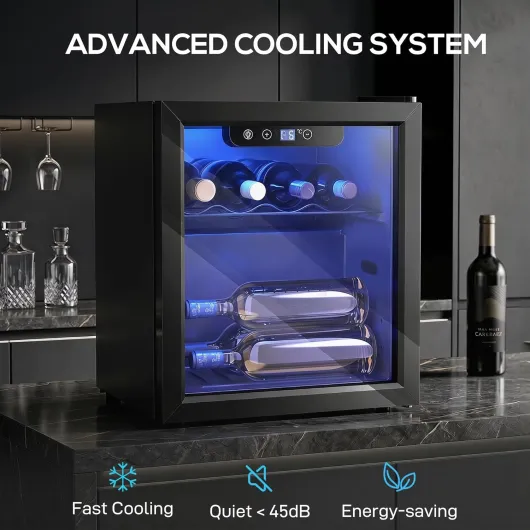
On performance, I focused on two things: how well it cools and how loud it is. The brand advertises 4–16°C, so I set it to 6–8°C for general drinks and used a cheap fridge thermometer to check. After a couple of hours from empty, the temperature inside dropped to around 7°C and stayed in that range. Once I filled it with a mix of room-temperature bottles and cans, it took a bit longer, but by the next morning everything was nicely chilled. So in terms of cooling power, it does its job. Even on a warm day, it kept a stable temperature without any drama.
Noise is another story. The listing says around 45 dB, and that feels about right. When the compressor kicks in, you clearly hear it. It’s not jet-engine loud, but it’s more noticeable than my main kitchen fridge. In my small open kitchen/living area, if I’m watching TV or cooking, it doesn’t bother me. But when the room is quiet, especially at night, you definitely notice the hum and the cycling on and off. I would not put this in a bedroom or a very quiet office unless you’re not sensitive to background noise.
In terms of daily use, the cooling feels consistent. I didn’t see huge temperature swings on the thermometer. The door seal seems decent: opening and closing the door a few times in a row obviously makes the compressor work harder, but it recovers reasonably quickly. There’s no fan noise inside, just the compressor sound. I didn’t see any frost building up quickly, but since it’s manual defrost, you should expect to give it a quick defrost every now and then, especially if you run it very cold.
Overall, performance is pretty solid for a small compressor fridge. It cools properly and can handle the advertised range. The trade-off is noise: it’s clearly not silent, and the reviews that mention it being “a little noisy” or “very loud” are not lying. If you treat it like a small kitchen or bar fridge and not like a bedroom appliance, you’ll be fine. If quiet operation is your top priority, this model is not ideal.
What you actually get with this 36L mini wine fridge
The HOMCOM wine cooler is a compact compressor-based fridge with a stated 36L capacity, which they translate as up to 12 standard wine bottles. Dimensions are 41.5 cm deep, 43 cm wide, and 46.5 cm high, so it really is a small cube-style unit. It’s meant to sit on a countertop or table, and the door is reversible, so you can swap the opening side if your space requires it. Out of the box you get the fridge, the manual, and that’s it—no fancy extras.
Inside, there are a few removable wavy steel racks plus a flat glass shelf, and a soft blue LED light that you can toggle. The wavy shelves are clearly designed with regular wine bottles in mind, but I managed to fit a mix of 750 ml wine bottles, 330 ml beer bottles, and cans. Once you start mixing shapes and sizes though, you can forget about the full “12 bottle” marketing claim. In real life, I’d say it’s comfortable with maybe 8–10 items if you’re mixing different formats and don’t want to cram everything.
Temperature is adjustable between 4°C and 16°C via simple button controls on the front, with an LED display. There’s no fancy app, no dual-zone, no automatic defrost. It uses an R-600A refrigerant and runs on standard 240V with a Type G plug. So from a tech standpoint, it’s pretty straightforward and basic. That’s not a bad thing if you just want a simple drinks fridge and don’t care about extra modes or phone connectivity.
Overall, the product matches the listing fairly well: small footprint, single-zone, compressor cooling, manual controls. It’s clearly built to be a budget-friendly countertop wine and drinks fridge. If you’re expecting a premium wine storage solution with ultra-precise humidity control and super quiet operation, this isn’t it. If you just want extra cold storage for drinks without buying a full-sized fridge, the spec sheet makes sense.
Pros
- Compact size fits easily on countertops, under shelves, or in small rooms
- Compressor cooling actually reaches proper fridge temperatures (around 4–8°C for drinks)
- Glass door with blue LED light and wavy racks make it handy for displaying and storing wine and other drinks
Cons
- Noticeable compressor noise, especially in quiet rooms or at night
- Short 6-month warranty and basic build quality, not ideal for long-term or serious wine storage
Conclusion
Editor's rating
After using the HOMCOM 36L table-top wine cooler as a daily drinks fridge, my overall feeling is that it’s a solid, no-frills option with two clear strengths and two clear weaknesses. The strengths: compact size and proper cooling. It fits easily on a counter or under a shelf, and it actually gets drinks cold in a reliable way, down to typical fridge temperatures. For a small flat, office, or man cave, that’s exactly what many people want. The glass door, blue LED light, and wavy racks are nice bonuses, especially if you plan to store mostly wine.
The main downsides are the noise and the short warranty. The compressor hum is noticeable in quiet rooms, so I wouldn’t put this in a bedroom or a silent workspace. And with only 6 months of warranty, you’re basically trusting that the unit won’t have early failures. Build quality feels okay for the price, but clearly this isn’t a premium, long-term wine cellar. It’s more of a practical extra fridge for drinks and casual wine storage.
If you need a small, affordable fridge to free up space in your main fridge and you’re planning to place it in a kitchen, office corner, or garden room where a bit of noise is acceptable, this HOMCOM cooler is a reasonable choice. If you’re very picky about noise, want advanced wine storage features, or expect rock-solid build and a long warranty, you should look at higher-end models and be ready to pay more. For simple everyday use, it’s decent value and gets the job done.