Summary
Editor's rating
Value for money: decent if you know its limits
Design and layout: nice look, a bit optimistic on capacity
Everyday use: noise, handling, and small annoyances
Build quality and reliability: feels okay, but some worrying reports
Cooling performance: fine for reds, weak for cold whites and beers
What you actually get out of the box
Pros
- Very quiet operation, suitable for open-plan living rooms and kitchens
- Compact footprint with glass door and interior light, looks tidy and modern
- Keeps red wine at a stable, cooler-than-room temperature and is easy to use
Cons
- Real minimum temperature is around 11–13°C, not the 4–5°C advertised
- Supplied with an EU 2-pin plug and awkward adaptor situation for UK users
- Capacity and shelf layout are tight with larger bottles, and durability reports are mixed

Specifications
View full product page →| Brand | KLARSTEIN |
A compact wine cooler that’s good, but not flawless
I’ve been using the KLARSTEIN Bellevin 18-bottle wine cooler for a little while now, mainly for reds and a few beers, and I’ll be straight: it’s a pretty solid little fridge, but it’s not perfect. If you’re expecting a mini professional cellar, you’ll be a bit disappointed. If you just want your bottles not to sit at room temperature in the kitchen, it gets the job done with some compromises.
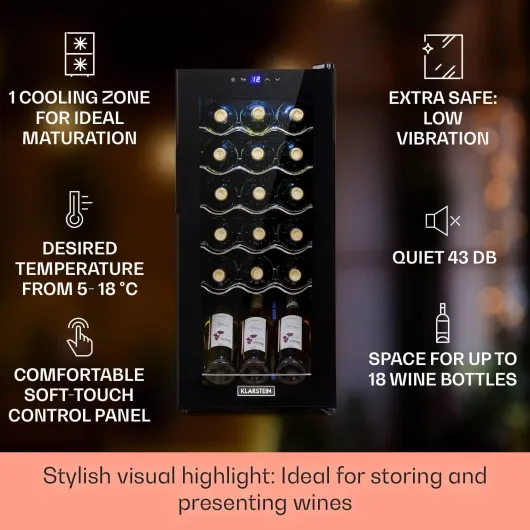
What pushed me to try it was the mix of size (52L / 18 bottles) and the glass door look. I don’t have space for a full-height wine cabinet, and I wanted something that could sit in a corner without taking over the room. On paper it ticks all the boxes: single zone, 4–22°C, UV glass door, touch controls, interior light, and quiet operation. In reality, some of those specs are a bit optimistic, especially the low temperature claims.
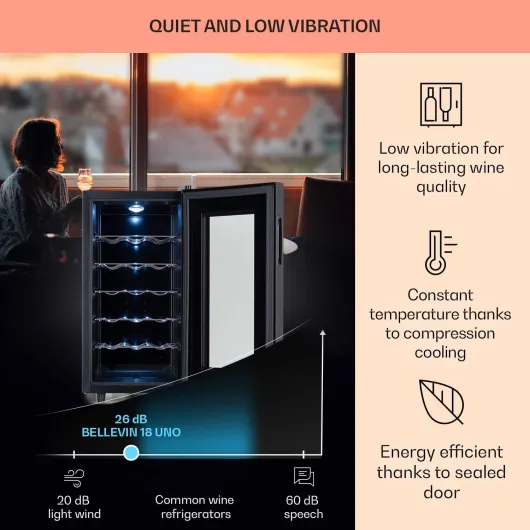
My usage is pretty basic: I keep 10–14 bottles of red in there most of the time, plus a few beers or a bottle of prosecco now and then. I’m not cellaring wine for years; I just don’t want my bottles cooking in a 24–25°C flat. I also pay attention to noise because it sits in an open-plan living room/kitchen, so any constant hum drives me mad. On that point, it does quite well.
In this review I’ll walk through how it actually behaves day to day: the design and build, how it cools in real conditions, the annoying plug/adaptor situation, and whether it’s worth the money compared to just buying a slightly better conventional under-counter fridge. It’s not a disaster, but there are a few things you really need to know before you click “buy”.
Value for money: decent if you know its limits
In terms of value, I’d put the KLARSTEIN Bellevin 18-bottle cooler in the “decent but nothing special” category. You’re mainly paying for a compact footprint, quiet operation, and the glass-door wine-fridge look. If that’s what you want, and you understand that it’s more a cool storage unit than a proper cold drinks fridge, the price is fairly reasonable. It’s not dirt cheap, but it’s also not in the high-end wine cabinet bracket.
Where the value takes a bit of a hit is the overstated temperature range and the plug situation. When a product claims 4–22°C but in real use barely goes below 11°C, that’s misleading. If you bought it expecting to chill beer to near-fridge levels, you’ll feel short-changed. Same with the EU plug and half-baked adaptor: it’s a small cost, but it adds hassle and makes the whole thing feel slightly half-finished for UK buyers.
Compared to just buying a small under-counter compressor fridge, you’re trading stronger cooling and more flexible storage for quieter operation and a nicer display of your bottles. If your priority is genuinely cold drinks and you don’t care how it looks, a basic under-counter fridge might give you more performance per pound. If your priority is quiet wine storage in a living area, this cooler makes a bit more sense.
So overall, I’d say the value is okay for casual wine drinkers who want a neat place to keep their bottles at a stable, slightly cool temperature and who care about low noise. For serious collectors or anyone obsessed with precise serving temperatures and long-term reliability, I’d look at spending more on a better-specified compressor-based wine fridge instead.
Design and layout: nice look, a bit optimistic on capacity
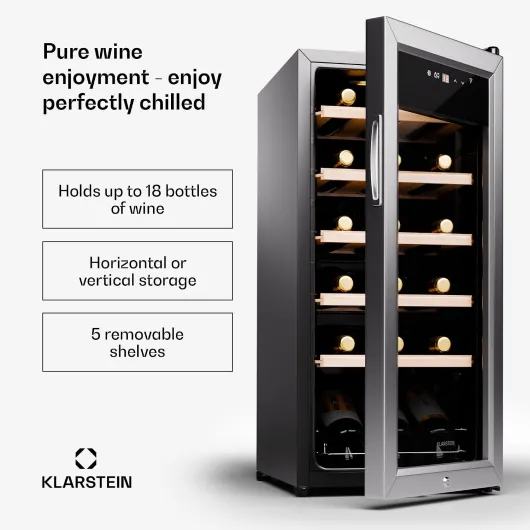
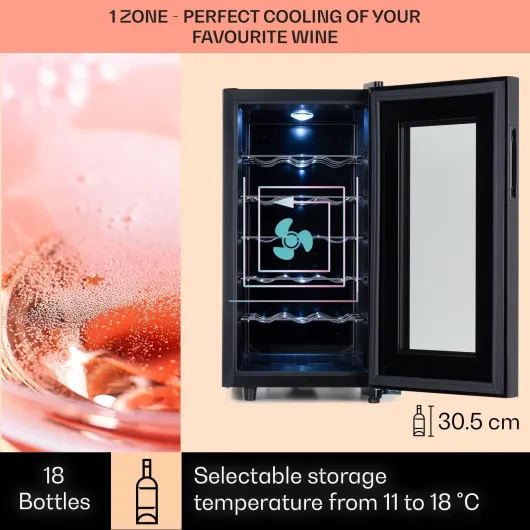
On the design side, I actually liked the Bellevin more than I expected. It’s black with a metallic finish and a full glass door, so it blends in easily with other kitchen appliances without screaming for attention. The brushed metal frame around the door gives it a more grown‑up look than the cheap plastic-front coolers you often see. The interior light is not very bright, but it’s enough to see the labels in the evening, and it does make the whole thing look a bit more premium when it’s on.
The layout inside is where the marketing gets a bit optimistic. It’s advertised for 18 bottles, and yes, you can technically fit that many standard Bordeaux-style bottles if you arrange them carefully and don’t mind tight stacking. Once you start throwing in fatter bottles (Burgundy, some prosecco, or champagne), you quickly realise the capacity drops. Realistically, I’m comfortable at around 12–14 bottles plus a few cans or small beers. If you’re planning to store a lot of champagne, you’ll need to remove or adjust a shelf and accept you’re not hitting the full 18.
The door opens to the right and feels reasonably solid. It’s not heavy-duty commercial grade, but for a home unit at this price, it’s fine. The seal is decent, and I didn’t notice condensation issues on the glass in a normal indoor setting. The touch controls on the top front are easy to reach, though they’re a bit sensitive; I’ve accidentally brushed against them while wiping the door and changed the temperature once.
In terms of placement, the footprint is pretty compact, but you still need to respect the ventilation space around it. I had it against a wall with a few centimetres clearance at the back and sides. That’s enough, but if you cram it into a tight cupboard, you’ll hurt performance. So design-wise: looks good, sensible layout, but don’t trust the 18-bottle claim too literally, especially if your bottles aren’t all the same slim shape.
Everyday use: noise, handling, and small annoyances
On a daily basis, the Bellevin is pretty easy to live with. The big plus is noise: it’s genuinely quiet. I can hear a very soft hum if the room is silent and I’m standing next to it, but once there’s normal background noise (TV, people talking, extractor fan), it just blends in. If you’re sensitive to noise and you’re putting this in a living room or open kitchen, this is one of its strong points compared to a louder compressor fridge.
Using the touch controls is straightforward. You just tap up or down to set the temperature and the small display shows the target. There’s no fancy menu to fight with. The only minor annoyance is that the panel is easy to brush accidentally, so I’d like a simple lock function to avoid changing the settings when cleaning. The interior light is controlled by a button and is more decorative than functional; it’s not blinding, but it does help you see labels in low light.
Accessing bottles is fine as long as you don’t overpack it. Once you start cramming 16–18 bottles in, getting the one in the middle without shifting three others becomes a bit of a puzzle. The shelves are metal and feel okay, but they’re not super smooth rails, more like simple supports, so you slide bottles in and out with a bit of care. For everyday use with 10–12 bottles, it’s comfortable. For maximum capacity, it’s more fiddly.
The only real comfort downside for me was the plug/adaptor mess. Having to buy and hide a chunky adaptor behind the unit is not the end of the world, but it’s the kind of small thing that makes the product feel less polished. Once set up, though, you don’t think about it much. Overall, in terms of comfort and daily handling, it’s decent: quiet, simple controls, and manageable shelves, as long as you’re not expecting luxury-level fittings.
Build quality and reliability: feels okay, but some worrying reports
Physically, the unit feels reasonably solid for the price. It’s not heavy like a full compressor wine cabinet, but at around 17 kg it doesn’t feel flimsy either. The glass door sits straight, the hinges on my unit are aligned, and the shelves slide in and out without drama. The casing is basic metal with a black finish that doesn’t mark too easily; after moving it around a bit I didn’t pick up any scratches.
However, the Amazon reviews do raise a few red flags. There are some reports of units arriving damaged even when the box looked fine, which suggests quality control issues at the factory or rough handling before packaging. More worrying are the comments about cooling failures, like the buyer who said their unit stopped cooling on the second use. Mine hasn’t done that so far, but thermoelectric coolers in general have a weaker track record than proper compressor fridges when you push them in warm environments.
In my case, after a few weeks of regular use, I haven’t seen any obvious performance drop or strange noises. The automatic defrost seems to work; I haven’t had any ice build-up or water pooling. But I wouldn’t treat this as a long-term investment piece for a serious wine collection. It feels more like a mid-range gadget that will hopefully last a few years if you treat it gently, keep it ventilated, and don’t run it at max power in a very hot room all the time.
So durability-wise, I’d rate it as acceptable but not reassuring. If you get a good unit, it should be fine for casual home use. But between the energy class G rating, the thermoelectric system, and the occasional DOA or early failure in reviews, I wouldn’t store very expensive bottles in here and rely on it as your only storage solution.
Cooling performance: fine for reds, weak for cold whites and beers
This is the part that matters most: does it actually cool properly? In my experience, it’s decent for red wine storage but not a replacement for a real fridge if you want very cold drinks. The product page throws around different minimum temperatures (4°C, 5°C, 11°C), which is confusing and honestly a bit misleading. In real life, in a normal heated room, the unit bottoms out around 11°C, just like some Amazon reviewers said. I never saw it hit 5°C, even with the setting cranked all the way down.
My flat sits around 21–23°C most of the time. With the cooler set to its minimum, the internal temperature hovered between 11 and 13°C depending on how full it was and how often I opened the door. That’s perfectly fine for red wine storage and okay for letting a white wine finish chilling in a standard fridge before serving, but it’s not enough if you like your beer really cold. If you put in room-temperature bottles, it takes a while to bring them down. We’re talking many hours, even a day or two to stabilise a full load of warm bottles.
It’s also worth noting that the performance changes with the room temperature. On a warmer day when the room was closer to 25°C, the cooler really struggled to stay at the lower end of its range. This matches what other buyers said about it being affected by the external environment. It’s a thermoelectric cooling system, not a full-blown compressor fridge, so it simply doesn’t have the same power. For a quiet wine cooler that lives in a relatively stable indoor temperature, it’s okay. For a hot conservatory or a garage in summer, I wouldn’t trust it.
So in practice: if your goal is to store reds at a stable, slightly cool temperature and keep whites out of the heat before moving them to a proper fridge, it works. If you’re expecting a 4°C drinks fridge for beer and soda, this is not that. I’d call the performance “good enough for wine enthusiasts on a budget”, but not more than that.
What you actually get out of the box
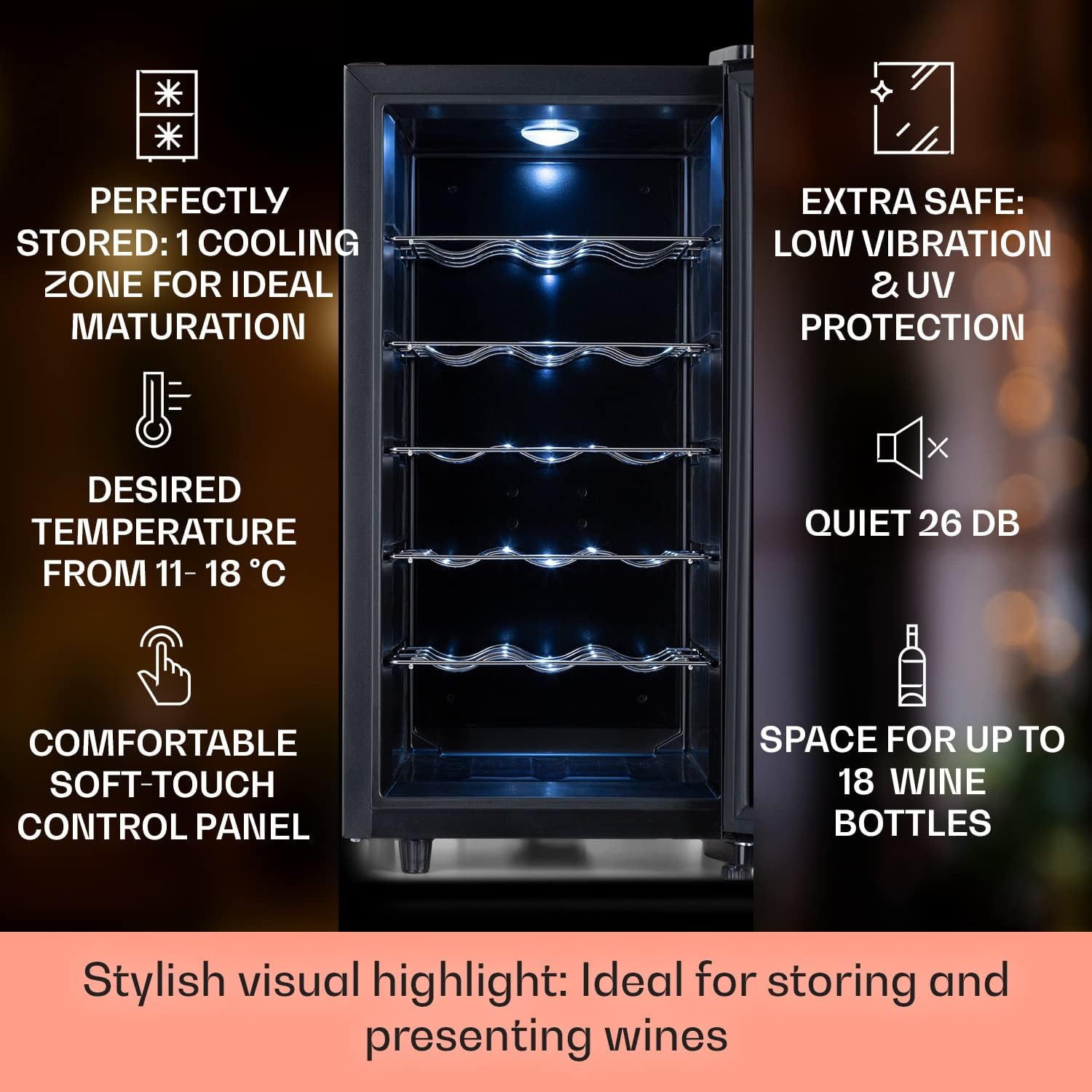
Out of the box, the KLARSTEIN Bellevin is a freestanding, single-zone wine cooler with space for up to 18 standard bottles, at least according to the specs. It’s roughly 49 cm deep, 35 cm wide and 68 cm high, so it’s more like a small under-counter unit than a tiny countertop gadget. It comes with 5 racks/shelves, a glass door with UV protection, a touch control panel at the top of the door, and a simple interior light. In the box I had: the fridge, two main removable shelves (plus fixed rails), and a basic multilingual manual.
One of the first surprises is the power plug. The unit is fitted with a 2‑pin EU style plug, not a UK 3‑pin (and not a North American 3‑pin either, despite what some specs say). In my case, the included adaptor was either missing or useless, which matches the Amazon reviews. I had to buy my own 2‑pin to 3‑pin converter for a few pounds. It’s not a big technical issue, but it’s annoying and makes the plug area bulky behind the unit. This should be clearly stated in the product description and sorted by the brand.
The control side is simple: you set the temperature on the touch pad, and the small LCD shows the current target. Officially it claims 4–22°C, but in real use, like other buyers mentioned, you’re realistically looking at a bottom limit around 11°C, especially in a warmer room. That’s totally fine for red wine and okay for storage, but if you want very cold white wine or beer, this is not going to act like a proper fridge.
Overall, the presentation is straightforward: it’s a compact, quiet-oriented wine fridge for home use, not a heavy-duty bar unit. The manual is short but enough to get going. Just don’t expect a lot of accessories or clever features. No smart home, no app, no fancy multi-zone tricks. It’s a simple single-zone cooler with some decent looks and a few quirks you need to work around.
Pros
- Very quiet operation, suitable for open-plan living rooms and kitchens
- Compact footprint with glass door and interior light, looks tidy and modern
- Keeps red wine at a stable, cooler-than-room temperature and is easy to use
Cons
- Real minimum temperature is around 11–13°C, not the 4–5°C advertised
- Supplied with an EU 2-pin plug and awkward adaptor situation for UK users
- Capacity and shelf layout are tight with larger bottles, and durability reports are mixed
Conclusion
Editor's rating
The KLARSTEIN Bellevin 18-bottle wine cooler is a quiet, decent-looking option for people who mainly want to store red wine and a few other bottles at a stable, cooler-than-room temperature. It fits nicely into small spaces, doesn’t make much noise, and the glass door with interior light gives your bottles a cleaner, more organised home than just lining them up on a shelf. For this kind of casual use, it gets the job done without much fuss once you’ve set it up.
But it’s not perfect. The claimed 4–22°C range is very optimistic; in real life, you’re looking at around 11–13°C minimum in a normal room, and it struggles more when it’s hot. That’s fine for storage, but not great if you want icy beer or very cold white wine. The EU plug and adaptor story is another avoidable annoyance, and there are enough reviews mentioning damage or failures to make me a bit cautious about long-term reliability. I’d say it’s good for casual wine drinkers on a budget who care about low noise and don’t need extreme cooling. If you’re serious about wine, live in a hot flat, or want a proper cold drinks fridge, you should probably skip this and look at a stronger compressor-based model instead.