Summary
Editor's rating
Value for money: good if you need the slim format, average otherwise
Design: slim, decent-looking, but with some usability quirks
Daily use & comfort: quiet and simple, but a few small annoyances
Build quality & durability: feels decent, but clearly budget-level
Performance: keeps wine cool, but don’t expect ice-cold drinks
What this little Baridi fridge actually is (and isn’t)
Pros
- Very slim 15 cm width fits into narrow undercounter gaps most other fridges can’t use
- Quiet compressor operation around 41 dB, suitable for open-plan kitchens
- Keeps 5–7 standard wine bottles at a stable, drinkable temperature with simple touch controls
Cons
- Cooling limited by room temperature, so drinks never get as cold as a normal fridge
- Temperature display and controls are hidden under the worktop when the door is closed
- Weak manual interior light and basic wire shelves that don’t handle chunky bottles well

Specifications
View full product page →| Brand | Dellonda |
A skinny wine fridge for tight kitchens
I picked up the Dellonda Baridi 7 Bottle Extra-Slim Undercounter Wine Fridge (model DH77) because I had a useless 15 cm gap at the end of my kitchen units and wanted something more useful than a filler panel. I’m not a wine collector, I just wanted somewhere to keep a few bottles at a steady, drinkable temperature without filling my main fridge. After a few weeks of use, I’ve got a pretty clear idea of what it does well and where it’s just “okay”.
The first thing to know is that this is a very slim, very basic wine fridge. It’s not a pro cellar, it’s not for ageing expensive bottles for years. It’s for keeping up to seven bottles reasonably cool and looking a bit nicer than a random crate under the stairs. If you expect that level, it’s fine. If you expect miracles in cooling or precision, you’ll probably be a bit underwhelmed.
I installed it under a standard worktop, next to my normal fridge, and I’ve been running it mostly between 10–12°C. I’ve tried both red and white bottles in it, plus a couple of beers just to see what happens. I’ve also checked the noise, the real temperature versus what the screen says, and how annoying it is to use day to day. Overall, it’s pretty solid for the price, but definitely has some quirks.
If you’re thinking of using it as a second fridge for ice‑cold drinks, or if your kitchen gets very warm in summer, you should read the details. It’s quiet, looks decent, and fills a narrow gap nicely, but it’s not magic. I’d say it’s a good fit for casual wine drinkers who mainly care about convenience and looks more than super precise temperature control.
Value for money: good if you need the slim format, average otherwise
On value, this fridge sits in an interesting spot. If you look only at capacity and cooling power, you can definitely find bigger wine fridges or standard undercounter fridges that hold more bottles for not much more money. But those are 30–60 cm wide. The unique thing you’re paying for here is the extra-slim 15 cm width. If you have that exact gap in your kitchen and want to use it, suddenly this model makes more sense and feels like decent value.
For the price, you get: compressor cooling, automatic defrost, stainless door, quiet operation, and simple touch controls. You don’t get: dual zones, strong interior lighting, very precise low temperatures, or fancy shelves. So if you compare it to higher-end wine coolers, it obviously looks basic. But then those cost a lot more and usually need more space. I’d say this Dellonda is good value if your main requirement is saving space and you’re okay with the limitations.
The running cost is a factor too. 144 kWh per year isn’t crazy, but it’s not ultra-efficient either for something that only holds seven bottles. You’re paying a bit in energy for the convenience and the look. If you rarely drink wine or only store one or two bottles at a time, it’s probably overkill. If you regularly keep five to seven bottles on hand and like having them all in one place, then the cost starts to feel more justified.
Compared to just sticking bottles in your main fridge door, this is obviously more expensive and less flexible. But it frees up space in the main fridge and looks nicer than bottles lying sideways on a shelf. Overall, I’d rate the value as solid but very dependent on your kitchen layout. If you don’t need the 15 cm format specifically, I’d consider a slightly bigger cooler. If you do need that exact slim size, this one is one of the more sensible options and the price feels fair rather than cheap or overpriced.
Design: slim, decent-looking, but with some usability quirks
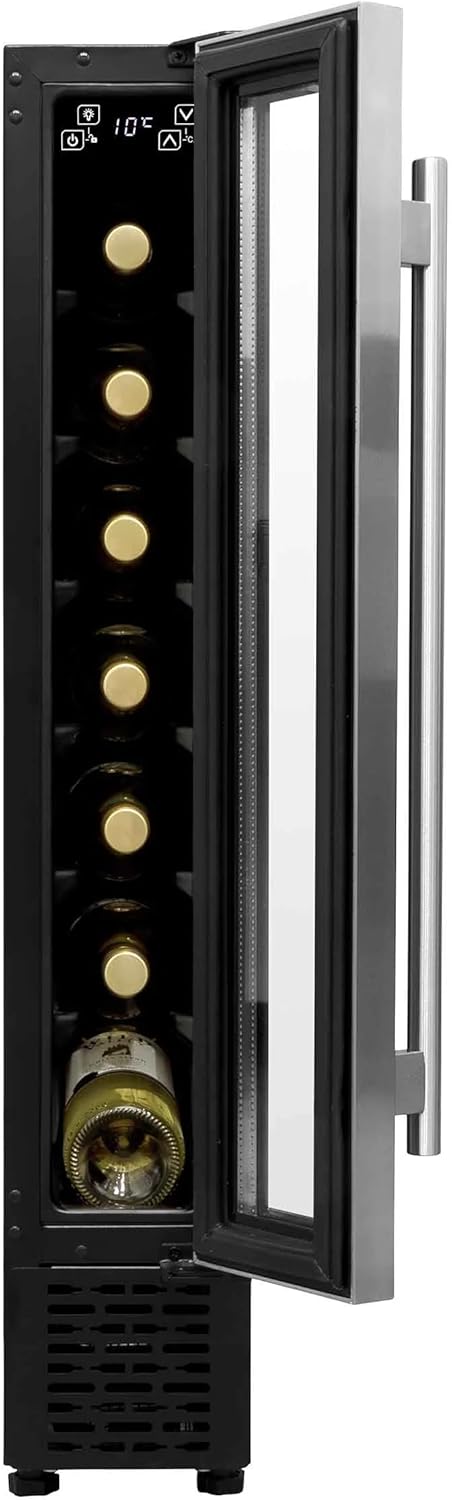
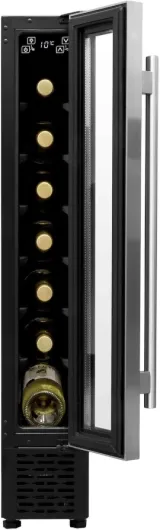
The main selling point of this fridge is the design: it’s only 15 cm wide, so it slides into that awkward skinny gap most kitchens end up with. In my case, it went between a base unit and the main fridge, and it lined up nicely under the worktop. Height-wise, it fits a standard UK worktop height, and the door sits just above the kickboard, like advertised. That part is genuinely handy – it looks like it belongs there rather than a random afterthought.
The stainless steel door and handle look decent in real life. It’s not luxury-level finish, but for the price it’s fine. The glass panel lets you see the bottles and the LED light gives it that typical wine-fridge look. One thing that annoyed me a bit: the LED light is manual and not very bright. You have to tap the control to turn it on, and it doesn’t light the whole interior much. It’s more decorative than practical. If you keep the kitchen lights low, you’ll still be squinting to see what bottle is where.
Usability-wise, there’s a weird design choice: the temperature display and touch controls are at the very top of the door frame, and once the door is closed, they’re basically hidden by the worktop edge. This matches what one of the Amazon reviews mentioned. In my kitchen, I have to either bend down or slightly open the door just to check the temperature or change a setting. Not a deal-breaker, but a bit silly. It would have been more practical to have the display visible with the door closed.
From a day-to-day point of view, the door feels solid enough, the handle doesn’t wobble, and the fridge doesn’t stick out awkwardly. The overall look is clean and modern, but nothing fancy. I’d say it’s a good match if you’ve got other stainless appliances and you care more about having that gap filled neatly than about design perfection. For me, it scores well on space-saving and looks okay, but loses a point for the hidden controls and weak light.
Daily use & comfort: quiet and simple, but a few small annoyances
In daily use, the thing I liked most is that it’s quiet and low-effort. Once I set the temperature, I pretty much forgot about it. The compressor cycles on and off without drawing much attention, and there’s no high-pitched fan noise. For a small flat or open-plan layout, that’s important. I’ve had noisier undercounter fridges in the past and this one is definitely on the quieter side. You can still hear it if you stand next to it, but it doesn’t dominate the room.
Loading bottles is mostly fine, but the wire shelves are basic. Standard Bordeaux-style bottles slide in and out easily, but as soon as you use thicker bottles (Prosecco, some craft wines), it becomes a bit of a Tetris game. You can remove a shelf if you need more height, but then of course you lose capacity. For the claimed 7-bottle capacity, assume they mean normal-shaped 750 ml wine bottles. If you’re into champagne or unusual bottle shapes, I’d mentally downgrade it to 4–5 “comfortably stored” bottles.
Control-wise, it’s simple: touch buttons to adjust temperature and control the light. But like I said earlier, the display is hidden when the door is shut under a typical worktop. That means every time you want to check the temperature or switch the light, you’re opening the door, which lets warm air in. It’s not the end of the world, just clumsy design. Also, the internal light is weak and doesn’t switch on automatically when you open the door, which would have been much more logical. You have to tap the button, and then it barely lights the bottles anyway.
From a general comfort point of view, though, it’s a “set and forget” product. There’s no water to empty, no manual defrosting, no tricky menus. You plug it in, set a number, and that’s it. If you just want something that quietly sits there and keeps a few bottles cooler than the room, it’s perfectly usable. I’d just say that if you’re picky about interior layout or want really slick ergonomics, you might find it a bit basic and slightly annoying in places.
Build quality & durability: feels decent, but clearly budget-level
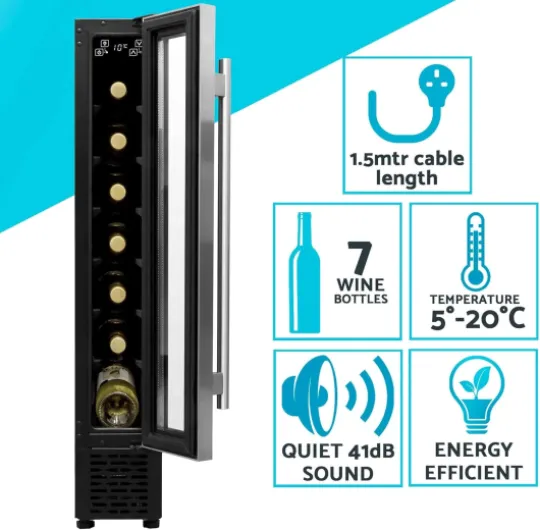
In terms of build quality, this fridge feels somewhere in the middle: not cheap and flimsy, but also not premium. The door has a bit of weight to it, the hinge feels secure, and the handle doesn’t flex when you pull it. The stainless steel front is smooth and hasn’t picked up scratches yet, although it does show fingerprints, which is normal for this type of finish. The cabinet itself is light enough that one person can move it, but it doesn’t feel hollow or wobbly once in place.
Inside, the wire shelves are basic but acceptable. They’re not heavy-duty, but they hold the bottles without bending. Sliding them in and out is a bit clunky; there are no fancy runners, just simple grooves. I wouldn’t keep stacking heavy items on them, but for seven bottles it’s fine. The plastic bits (interior lining, control panel area) look and feel like standard budget-appliance plastic. Nothing has cracked or warped so far, but you can tell this is made to a price, not built like a commercial unit.
As for long-term durability, I obviously haven’t had it for years, but a few clues help. It uses a normal compressor (R-600A refrigerant), which is a tried-and-tested setup. That’s usually more reliable than the cheaper thermoelectric coolers you see at very low prices. The automatic defrost means you’re not dealing with frost build-up, which is one less thing to break. On the other hand, it’s made in China like most appliances in this range, and at this price level you can’t expect top-tier components everywhere.
Reading through other user reviews, the overall rating around 4.2/5 suggests most people don’t have major failure issues in the short term. A few complaints mention temperature limitations more than breakdowns. My feeling is: if you treat it as a light-duty home appliance, don’t slam the door, and give it some ventilation space, it should last a reasonable number of years. I wouldn’t buy it expecting 15 years of service, but for filling a narrow gap and doing a simple job, the build seems fair for the money.
Performance: keeps wine cool, but don’t expect ice-cold drinks
On performance, this fridge is good enough if you’re realistic. It uses a compressor system with an automatic defrost, so it behaves more like a small real fridge than one of those thermoelectric coolers that struggle in warm rooms. The official range is 5–20°C, but in real life, that depends heavily on your room temperature. In my kitchen at 21–22°C, setting it to the lowest number gives me around 9–11°C inside, based on a separate thermometer I left in there for a few days.
For white wine and rosé, that’s okay for casual drinking – the bottles come out nicely cool, not freezing. For red wine, I just bump it up to 12–14°C on the panel and that feels about right. If you’re hoping to chill beer to proper fridge-cold, this isn’t ideal. I tested a few beers and cans of soft drink: they got cooler than room temperature, but my main fridge was clearly colder. So if you want a dedicated beer fridge, I’d look elsewhere. This one is more about keeping wine at a steady, moderate cool rather than making everything icy.
Noise-wise, it’s actually pretty quiet. The 41 dB spec seems fair. You can hear a soft hum when the compressor kicks in, but it’s less noticeable than my main fridge. In an open-plan kitchen/living room, it didn’t bother me at all while watching TV. No weird rattling or buzzing so far. Heat-wise, the sides get a bit warm when it’s working hard, but nothing extreme. Just don’t wedge it in with zero ventilation; give it at least a bit of space around as you would with any fridge.
The cooling speed is average. From first plug-in, it took about an hour and a half to get down near its stable temperature. If you load seven room-temperature bottles at once, it needs a while to settle. It’s not instant, but for something that just sits there all day, that’s fine. Overall, I’d rate performance as solid but limited: it does what a narrow wine chiller at this price should do, but it’s not powerful enough for people who want very cold drinks or who have a very hot kitchen environment.
What this little Baridi fridge actually is (and isn’t)
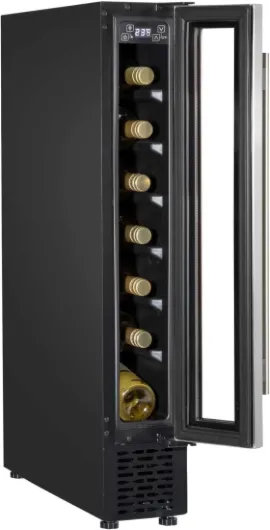
On paper, the Dellonda Baridi DH77 is a 7-bottle, 20L, compressor-based wine fridge that’s only 15 cm wide. It’s meant to slide under a standard-height worktop and fill those skinny gaps that normal appliances can’t use. It has a stainless steel door, a small internal LED light, three wire shelves, digital touch controls, and claims a temperature range of 5–20°C. The annual energy consumption is listed at 144 kWh, and the noise level is 41 dB, which is roughly a quiet background hum.
In practice, it behaves like a compact, single-zone wine cooler with limited cooling power. The important line in the description is that it won’t go cooler than the ambient temperature of the room. In my fairly average UK kitchen (around 20–22°C most of the time), I can get it down to about 9–10°C on the display, and my thermometer inside reads about 1–2 degrees higher than that. So if you want wine just nicely chilled rather than ice cold, that’s fine. If your kitchen hits 26–28°C in summer, you’re not going to see 5°C inside, no matter what the panel says.
The inside layout is simple: three metal racks that hold standard 750 ml bottles lying horizontally, plus a bit of space at the bottom. You can squeeze in a couple of slightly larger bottles, but chunky champagne bottles are a pain; they either don’t fit nicely on the shelves or you end up taking a shelf out. Realistically, it’s 7 normal bottles or fewer if you mix shapes and sizes. There’s no fancy multi-zone stuff, no humidity control, no lock worth bragging about. It’s basically a neat metal box that cools a bit and looks smarter than a plastic drinks cooler.
If you’re expecting a serious cellar or something that keeps reds and whites at two different temperatures, this isn’t it. But if your main goal is: “I want a narrow, decent-looking place to put a few bottles so they’re cooler than the cupboard,” then the spec matches that. For the price point and the size, the feature list is fair, just not exciting. I’d call it functional and straightforward, nothing more.
Pros
- Very slim 15 cm width fits into narrow undercounter gaps most other fridges can’t use
- Quiet compressor operation around 41 dB, suitable for open-plan kitchens
- Keeps 5–7 standard wine bottles at a stable, drinkable temperature with simple touch controls
Cons
- Cooling limited by room temperature, so drinks never get as cold as a normal fridge
- Temperature display and controls are hidden under the worktop when the door is closed
- Weak manual interior light and basic wire shelves that don’t handle chunky bottles well
Conclusion
Editor's rating
Overall, the Dellonda Baridi 7 Bottle Extra-Slim Undercounter Wine Fridge is a practical, space-saving option if you’ve got a narrow 15 cm gap and want something useful in it. It keeps wine at a steady, moderately cool temperature, it’s quiet enough for open-plan spaces, and the stainless steel door looks decent alongside other modern appliances. For casual wine drinkers who just want a few bottles ready to go at a drinkable temperature, it gets the job done without much fuss.
It’s not perfect though. The cooling is limited by room temperature, so don’t expect ice-cold drinks, especially in a hot kitchen. The interior light is weak, the display and controls are awkwardly hidden when the door is closed, and the wire shelves are basic and a bit awkward with chunky bottles. If you don’t specifically need the ultra-slim design, there are larger coolers that offer more capacity and sometimes better features for similar money.
I’d recommend this fridge to people who: have a skinny undercounter gap they want to fill, mainly drink wine (not loads of beer), and care more about quiet operation and looks than ultra-precise low temperatures. If you want proper cold drinks, plan to store lots of odd-shaped bottles, or expect high-end build and features, you should probably look at a bigger or more advanced model instead.