Summary
Editor's rating
Value for money: worth paying more than the budget brands?
Design: tall, slim, and looks decent without screaming for attention
Materials and build: solid enough, but not luxury furniture
Durability and long-term feel
Performance: temperature, noise, and that famous 77-bottle claim
What you actually get with this Haier wine cooler
Effectiveness in real life: does it actually protect your wine?
Pros
- Very quiet operation, suitable for hallways and living areas
- Stable temperature and decent humidity control for proper wine storage
- Solid build with reversible door, lock, and good internal lighting
Cons
- Real-world capacity is lower than the advertised 77 bottles with mixed bottle shapes
- App is more gimmick than useful tool and adds little to daily use
- Single temperature zone and average energy efficiency (Class G)

Specifications
View full product page →| Brand | Haier |
A proper wine fridge that doesn’t sound like a tractor
I’ve been using the Haier HWS77GDAU1(UK) wine cooler for a while now, in a pretty normal setup: small UK house, open-plan kitchen/dining, fridge sitting against a wall, not hidden in a utility room. I bought it to move bottles out of random cupboards and the kitchen fridge and into something that actually keeps a stable temperature. No fancy cellar here, just a practical place to store wine without annoying background noise.
From day one, the main thing that stood out is how quiet it is. I’ve had cheaper compressor fridges before that buzz, hum and click all the time, and I was ready to be annoyed again, but this one is honestly very discreet. You do hear it kick in sometimes, but it’s more of a low murmur than a sharp noise. If you’re sitting a few metres away watching TV, you forget it’s even on.
I also paid attention to how well it holds temperature, because that’s the whole point of a wine cooler. The digital display is clear, and the reading doesn’t jump all over the place. Once I set it, it basically sits there. I checked it with a separate fridge thermometer out of curiosity, and it was within about half a degree of what the display said, which for me is good enough.
It’s not perfect, and there are some things that bug me – especially the whole “77 bottles” claim, which is optimistic unless you only drink standard Bordeaux-shaped bottles. The app is also more of a gimmick than a real tool. But as a day-to-day wine fridge for someone who actually stores and drinks wine regularly, it gets the job done pretty well.
Value for money: worth paying more than the budget brands?
In terms of price versus what you get, this Haier sits in that middle band: not the cheapest wine fridge on Amazon, but not in the high-end designer category either. You’re basically paying extra for three things: lower noise, better humidity control, and a build that feels a bit more serious than the bargain-basement stuff. If you just want a drinks fridge for beer and soft drinks, this is overkill. But if you’re storing decent bottles and care about them, the extra cost starts to make sense.
Compared to cheaper units I’ve seen and used, the big difference is noise level and stability. The budget models usually have louder compressors and more obvious temperature swings. If the cooler is going somewhere out of the way, like a garage, then saving money might be fine. But if it’s near living space – a hallway, dining room, open kitchen – paying more for quieter operation is, in my opinion, money well spent. You notice the lack of noise every single day.
On the flip side, there are a few things that stop it from being a killer deal. The 77-bottle claim is optimistic in real life, so if you thought you were getting huge capacity, you might be disappointed. The app is basically a novelty – it works for scanning labels, but it’s not essential and feels like it’s there more to push wine info than to actually manage the fridge. I deleted it after testing it because it added nothing to daily use.
Overall, I’d say the value is good but not outstanding. You’re paying for a well-behaved, quiet, decent-looking wine cooler that does its core job reliably. If your budget is tight and you don’t care about noise, you can get cheaper. If you want luxury finishes and dual zones, you’ll pay more. This sits comfortably in the middle, and for a lot of people, that’s exactly what they need.
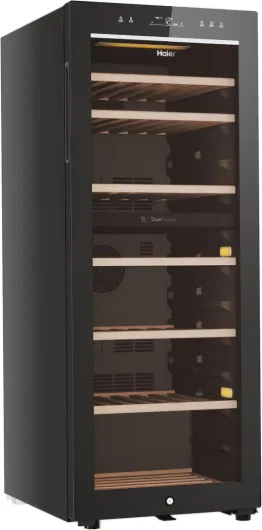
Design: tall, slim, and looks decent without screaming for attention
Design-wise, this cooler is pretty understated, which I like. The black matte finish doesn’t grab attention, and it blends in easily with other dark appliances or furniture. It’s more “quiet cabinet” than “showpiece bar unit”. If you want something flashy with chrome everywhere and glass all over the front, this isn’t that. It looks tidy, modern enough, and doesn’t look cheap.
The proportions are tall and narrow, which is good if you’re short on width but have some vertical space. At 127 cm high, it’s about chest height on most people, so you don’t have to crouch too much to grab bottles from the middle shelves. The reversible door is a plus: you can switch the hinge if your room layout demands it. The door itself feels quite solid and has a proper weight to it – it doesn’t slam shut, and the seal grips firmly, which is reassuring for temperature stability.
The 3D LED lighting is one of the nicer parts of the design. You get light from the top and sides, so even bottles on the lower shelves are visible. The light is warm, not that harsh blue-white you get on some cheaper units. It’s bright enough to actually see labels without opening the door fully, but not so bright that it looks like a display cabinet in a shop. You can turn it on and off, which is good if you don’t want it glowing at night.
The control panel is simple: temperature display, a few buttons, nothing overcomplicated. Personally, I prefer that to some overdesigned touchscreens that break after a year. The only design thing that might annoy some people is that the look is fairly plain. No fancy trim, no big brand badge that screams “premium”. For me that’s a positive, but if you’re trying to show off, you might find it a bit too low-key.
Materials and build: solid enough, but not luxury furniture
The overall build quality feels pretty solid for the price range. The cabinet itself is sturdy, no wobbling, and the door feels well anchored. When you open and close it, you don’t get that flimsy rattle some cheaper wine coolers have. The metal body with the matte black finish hides fingerprints reasonably well; you’ll still see smudges if you touch it with greasy hands, but it’s not a fingerprint magnet like glossy black glass.
Inside, the main thing to mention is the wooden shelves. They’re decent but not high-end furniture quality. They slide in and out well enough, but they’re not on full extension rails like you might find on much pricier cellars. If you overload them or try to force in a lot of chunky bottles, you’ll feel a bit of flex, so you do need to be a little sensible. Still, for normal use with a mix of bottles, they hold up fine and look nicer than metal wire racks.
The interior lining is standard fridge plastic – easy to wipe, nothing fancy. The door gasket is thick and seems well made; after repeated opening and closing, it still seals properly and doesn’t show signs of damage. The lock is basic – this is not a security safe – but it’s enough to stop kids casually opening it or guests helping themselves without asking. The key is small, so I’d suggest keeping a fixed place for it.
Overall, materials are good but clearly chosen to hit a price point. You’re not getting handcrafted wood, but you’re also not getting something that feels like it’s going to fall apart in a year. For a mid-range wine cooler, it’s about what I expected: sturdy cabinet, okay shelves, simple but functional interior. If you want a showpiece built like a piece of furniture, you’ll be looking at much more expensive brands and built-in models.
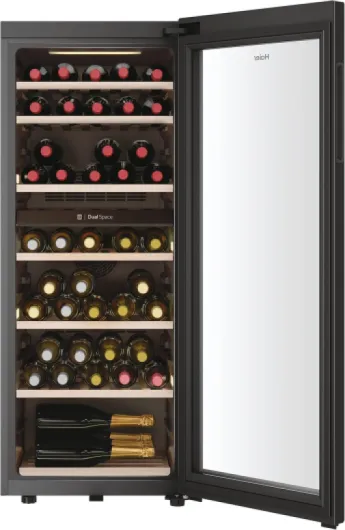
Durability and long-term feel
In terms of durability, a lot will show up only after a few years, but there are some early signs you can judge. The cabinet feels rigid, and there’s no flex when you move it slightly or open the door strongly. At over 50 kg, it’s not a flimsy box; it has some weight to it, which usually means better insulation and a more solid structure. The door hinges feel strong and don’t sag even when the door is fully loaded with bottles.
The wooden shelves are the part I was initially a bit worried about. With normal use and sensible loading, they seem fine. I wouldn’t stack very heavy magnums on a single shelf, but for regular 75 cl bottles, they hold up without bending. Sliding them in and out repeatedly hasn’t caused any obvious wear or wobble so far. They’re not premium carpentry, but they’re not junk either. As long as you don’t treat them like step ladders, they should last.
Haier also offers a 10-year parts warranty on the compressor and 2 years on labour, which gives some confidence that the core hardware isn’t going to die immediately. Obviously, you still need to treat it properly – leave enough ventilation, don’t block the air circulation inside, clean the filters if applicable. But knowing the main component is covered for a long time is reassuring if you’re investing in a dedicated wine fridge.
Based on the feel of the materials, the quiet operation, and the brand’s track record in fridges generally, I’d expect this unit to hold up well for typical home use. It doesn’t feel like a disposable gadget. It feels like something you buy once and keep running for years, as long as you’re not constantly moving it around or abusing the shelves. Not bombproof, but solid enough for a serious home wine drinker.
Performance: temperature, noise, and that famous 77-bottle claim
Let’s talk about temperature performance first, because that’s the key point. Once set, the cooler holds a stable temperature very well. I ran it at 12°C for mixed reds and whites. With a separate thermometer on the middle shelf, it stayed between about 11.5 and 12.5°C, even when the room temperature moved between 18 and 23°C. That’s perfectly fine for home storage. The automatic defrost does its job quietly – no ice build-up on the back wall, no dramatic dripping sounds.
Noise-wise, this is where it shines. The compressor has that anti-vibration system, and you can tell. Compared to a cheap beer fridge I had before, the difference is obvious. When it starts up, there’s a soft hum, but no loud clicks or rattling, and no buzzing that travels through the floor. In a hallway near the living room, you basically forget it’s there. If you’re very sensitive to noise and it’s going next to your sofa, this model is a good option.
Now, the 77-bottle capacity. This is the classic marketing number based on standard Bordeaux bottles, tightly packed. In real life, if you have Champagne, Burgundy, or those slightly fatter Italian bottles, you won’t hit 77. With a mixed collection, expect something more like 40–55 bottles without playing Tetris. If you’re the kind of person who only buys standard Bordeaux shapes, you’ll get closer to the advertised figure. But if your tastes are varied, mentally downgrade the capacity and you’ll avoid frustration.
The humidity control is harder to judge without lab tools, but I didn’t see corks drying or mould on labels, which usually means the balance is roughly right. Energy consumption is rated at 152 kWh/year, which is not ultra-efficient (Energy Class G), but for a compressor wine cooler that runs 24/7, it’s acceptable. Not cheap to run, not outrageous either. Overall, in daily use, it does the job reliably: keeps wine at a stable temperature, quietly, with no drama.
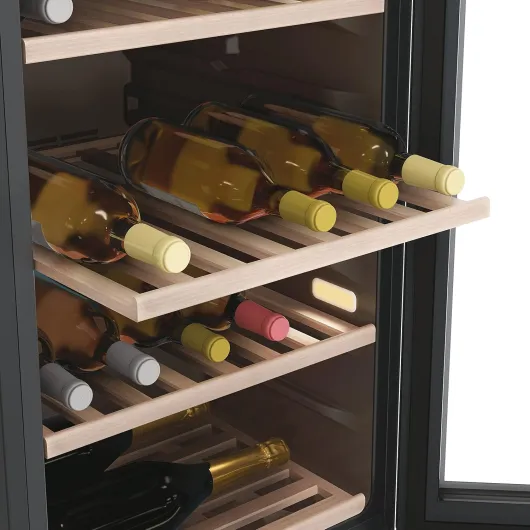
What you actually get with this Haier wine cooler
On paper, the Haier HWS77GDAU1(UK) is a freestanding, single-zone wine cooler with space for “77 bottles”, a height of 127 cm, and a black matte finish. It runs on a compressor system with automatic defrost and claims to manage humidity between 50–70%, which is basically the range you want if you care about corks not drying out. Capacity is listed as 190 litres, and it has 4+1 wooden shelves, plus a lockable door.
In real life, it feels like a mid-sized cabinet that’s tall and slim rather than wide. The dimensions (about 58.5 cm deep and 49.7 cm wide) mean it doesn’t eat up loads of floor space, but it does have some depth, so you need to check how far it sticks out if it’s going in a hallway or next to furniture. It’s not built-in, it’s freestanding only, so you need to leave space around it for ventilation. If you plan to box it into cabinetry, this is the wrong model.
Haier pushes two things hard in the specs: the anti-vibration compressor and the Natural Airflow System for humidity. I can’t scientifically prove the humidity curve, but I did notice corks don’t feel dried out even after a few weeks, and labels aren’t peeling from moisture, so the balance seems fine. The unit also has 3D LED lighting (top and sides), a simple digital control panel, and a lock with a physical key, which is handy if you’ve got kids or nosy guests.
The one thing that feels slightly misleading in the general presentation is the impression of being “smart”. Yes, there’s the hOn app and Vivino integration, but there is no real smart home compatibility (no Alexa, no Google Home, no HomeKit), and the app is more about cataloguing bottles and showing ratings than actually controlling anything meaningful. I’d describe it as a practical, mostly manual wine fridge with a few software extras that you can easily live without.
Effectiveness in real life: does it actually protect your wine?
Effectiveness for me is simple: does this cooler keep wine safe and drinkable without me thinking about it every day? On that front, it’s pretty solid. Once I filled it and set the temperature, I basically forgot about it except when grabbing a bottle. No wild swings, no bottles sweating like crazy when I open the door, no weird smells. The internal air feels neutral, not damp and not bone dry.
The anti-vibration aspect is hard to measure, but in practice, bottles sit still, and there’s no obvious shaking when the compressor kicks in. If you’re storing wines you want to age for a few years, that matters. I moved some of my nicer reds (stuff I’d normally hide in the back of a cupboard) into this fridge and I’m more relaxed now, especially during hot spells when room temperatures shoot up.
The lock is basic but effective. If you’ve got teenagers, guests who like to “help themselves”, or you’re renting out part of the house, it’s enough to keep things under control. It’s not unbreakable, but it will stop casual opening. The lighting also helps effectiveness in a simple way: you can quickly see what you have without rummaging and leaving the door open for ages, which helps keep the internal climate stable.
The one thing I’d say limits its effectiveness a bit is the single temperature zone. If you want separate temperatures for reds and whites, this isn’t the right model. You can compromise at 11–12°C and get away with it for mixed storage, but if you’re extremely picky, you’ll want a dual-zone unit. For most wine drinkers who just want bottles stored correctly and ready to drink after a short time on the counter, this does the job more than well enough.
Pros
- Very quiet operation, suitable for hallways and living areas
- Stable temperature and decent humidity control for proper wine storage
- Solid build with reversible door, lock, and good internal lighting
Cons
- Real-world capacity is lower than the advertised 77 bottles with mixed bottle shapes
- App is more gimmick than useful tool and adds little to daily use
- Single temperature zone and average energy efficiency (Class G)
Conclusion
Editor's rating
The Haier HWS77GDAU1(UK) is a quiet, practical wine cooler that does the main job well: it keeps your bottles at a stable temperature, with controlled humidity, and doesn’t make a racket in the background. The design is low-key, the build feels solid enough, and the lighting and lock are small but useful details. If you live in a flat or have it near your living space, the low noise alone already makes it more appealing than cheaper, louder models.
It’s not perfect. The advertised 77-bottle capacity is optimistic unless you mostly own standard Bordeaux bottles, so mentally downgrade that number before you buy. The energy rating is nothing to boast about, and the app is basically optional fluff rather than a real selling point. Also, it’s single-zone, so if you want separate temperatures for reds and whites, you’ll need to look elsewhere or compromise.
Who is it for? People who care about storing wine properly, have a medium-sized collection, and want the cooler to live in a visible or quiet area of the house. If you’re putting it in a garage and just chilling beer, you can spend less. If you want luxury finishes and full smart-home integration, spend more. For the average wine enthusiast who wants something pretty solid, quiet, and reliable, this Haier is a sensible choice that gets the job done without fuss.
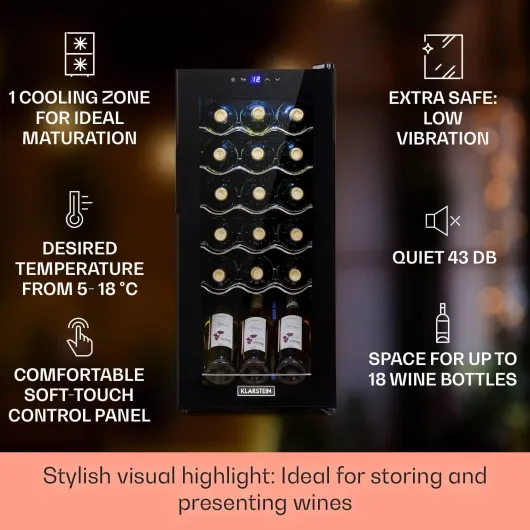



![HWS77GDAU1(UK) Freestanding Wine Cooler, 1 door, 77 Bottles, 127cm Tall, Black [Energy Class G]](https://www.wine-cooler-guru.com/storage/933417/612Ef7ySbyL._AC_SL1500_.jpg)