Summary
Editor's rating
Value for money: decent capacity, but too many compromises at this price
Design: looks good, but not as practical as it should be
Daily use and comfort: fine if you don’t change bottles too often
Materials and build: decent overall, with some rough edges
Performance and noise: cools well, but louder and more limited than advertised
What you actually get with the Barossa 73
Pros
- Good theoretical capacity (up to around 73 standard bottles) in a relatively compact footprint
- Dual-zone cooling allows basic separation of reds and whites
- Nice overall look with glass door, interior lighting and wooden shelves
Cons
- Noisier than a modern standard fridge, noticeable in quiet rooms
- Real temperature ranges per zone are limited (top ~5–10°C, bottom ~10–18°C), less flexible than advertised
- Tight shelf spacing and bottle size issues reduce practical capacity and ease of use
- Reports of missing shelves and poor customer service / no spare parts

Specifications
View full product page →| Brand | KLARSTEIN |
A big dual-zone wine fridge that looks great… on paper
I’ve been using this KLARSTEIN Barossa 73-bottle wine fridge for a little while now, mainly in a living/dining area, and I’ll be honest: it’s not the dream cellar the product page tries to sell you. It does cool, it does keep reds and whites at different temperatures, and it looks pretty good from a distance. But once you live with it day to day, a few things quickly start to bug you, especially if you’re picky about noise, bottle sizes, and how honest the specs are.
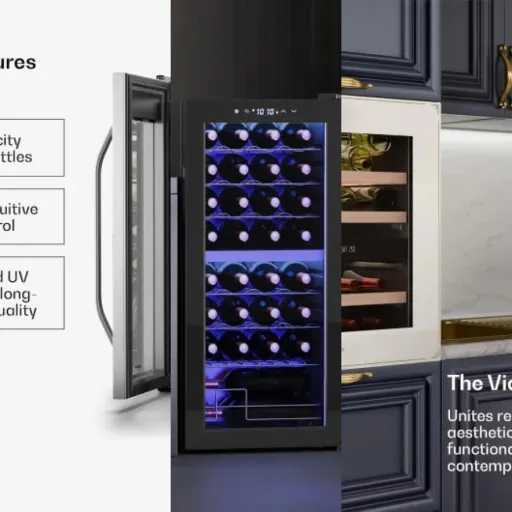
On paper, the concept is nice: a dual-zone compressor wine fridge, 73-bottle capacity, glass door with UV protection, wooden shelves, digital controls, and a sleek black body. For someone who drinks both red and white and wants them ready to serve, that sounds like a solid setup. I was looking for something that could sit in a shared space and not look like a clunky garage fridge, and this one clearly aims at that kind of buyer.
In practice though, a few design choices and some marketing shortcuts take the shine off. The noise level is higher than a normal fridge, the actual temperature ranges per zone don’t match what you’d expect from the description, and the famous “73 bottles” is optimistic unless you only drink standard Bordeaux bottles. Add to that some stories about missing shelves and not-so-great customer service, and you get a product that works, but with caveats you really need to know before buying.
If you just want something that chills a decent amount of bottles and you’re not ultra-sensitive to noise or layout quirks, it can still get the job done. But if you’re serious about storage flexibility, bottle variety, and you want a set-and-forget appliance with no hassle, I’d say this one is more of a compromise than a clear win.
Value for money: decent capacity, but too many compromises at this price
Looking at the overall package, the value is a bit mixed. On the positive side, you get a fairly large capacity (up to 73 bottles in theory), dual-zone cooling, a decent-looking design with wooden shelves and a glass door, and relatively stable temperatures. If you compare that to some smaller thermoelectric coolers that can barely hold 20–30 bottles, this Klarstein gives you more space for a similar or slightly higher price, depending on sales.
But then you factor in the compromises. The first is the real vs advertised flexibility: the zones are not both truly 5–18°C in practice, which limits how you organise your collection. The second is the noise level, which is clearly above a modern standard fridge and can be a deal-breaker in a quiet home. The third is capacity: yes, you can technically cram a lot of standard bottles in there, but the shelf spacing means that with real-world bottle shapes, you’ll often be under the 73 bottles quoted, or you’ll have to accept tight fits and risk scraping labels.
Then there’s the customer service and reliability angle. User reviews talking about missing shelves and Klarstein saying they don’t have replacement parts is not reassuring. When you spend this kind of money on a dedicated wine appliance, you expect at least basic support for missing or damaged components. Having to return the whole thing because they can’t send you a few extra shelves is both annoying for you and shows how weak the spare parts system is.
So in terms of value, I’d call it “okay if you find it at a good discount and know exactly what you’re getting”. If you pay full price expecting a very flexible, quiet, high-end wine fridge with perfect capacity, you’ll probably feel a bit short-changed. There are competitors in this segment that may offer better noise control, more honest specs, or stronger after-sales service, even if they hold slightly fewer bottles on paper.
Design: looks good, but not as practical as it should be
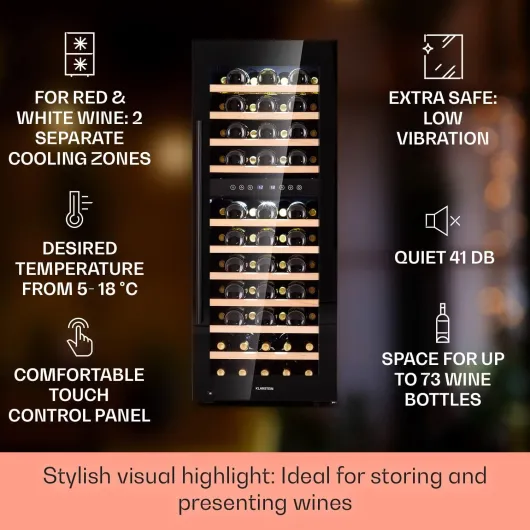
Visually, I actually liked the design. The black body with the glass door and wooden shelves gives it a clean, modern look that fits well in a living room or dining room. It doesn’t scream “garage appliance,” which was important for me because it’s in a shared space, not hidden away in a basement. The interior LED lighting is also nice: it highlights the bottles without being too harsh, and it’s good when you want to show off your collection a bit.
Where the design stumbles is on the practical side. The first big point is the spacing between the wooden shelves. Several users mention it and I can confirm: if you have slightly bulkier bottles (think many Beaujolais, some Rhône, some sparkling, or random craft wine bottles), the necks and shoulders start to clash with the shelf above. You end up either forcing bottles in, which is not ideal, or removing a shelf, which immediately kills the advertised 73-bottle capacity. So if your collection is not mostly standard Bordeaux-shaped bottles, expect to fight with the layout.
Another design miss: no automatic light when you open the door. You need to manually turn the interior light on and off using the touch controls. It’s not the end of the world, but on a product in this price range, a simple door sensor would make more sense. Every time you open it in a darker room, you’re fumbling for the button if you actually want to see what you’re grabbing.
Finally, there’s the symmetry and shelf count issue. The product visuals clearly show 11 wooden shelves nicely spaced, which looks tidy and evenly distributed. But at least one verified buyer got only 7 shelves and Klarstein apparently said they don’t have spare parts to send. That means you might end up with big gaps and a very unbalanced interior, which not only looks off but also reduces how many bottles you can store in a neat way. For something marketed on its design and capacity, that’s pretty disappointing. Overall: good looks from afar, but when you start loading it up and using it daily, the design flaws become very obvious.
Daily use and comfort: fine if you don’t change bottles too often
In daily use, the fridge is okay but not super convenient. If you set it up once, fill it mostly with similar bottle shapes, and then just grab a bottle here and there, it’s manageable. The door opens smoothly, the handle is comfortable, and the height is good for quickly seeing what’s inside without crouching too much. The digital display is easy enough to read from a distance, so you can check the temps at a glance.
Where comfort drops is when you try to actually use the full capacity and mix different bottle types. The tight shelf spacing means you often have to think about which bottles go where. For example, I ended up grouping standard Bordeaux bottles in the tightest spots and using the more accessible shelves for bulkier Beaujolais or fatter bottles. That’s not the end of the world, but it makes restocking slower and more annoying than it should be. If you’re often rotating bottles or storing random new finds, you’ll feel that friction every time.
The manual light control is another small but real annoyance. There’s no automatic light-on when you open the door, so if the room is a bit dark, you either guess where things are or you remember to hit the light button each time. It sounds minor, but after a few weeks of use, you notice it. It’s one of those small comfort features that you expect at this price point, and its absence makes the fridge feel a bit more basic than its marketing suggests.
Finally, the noise directly affects comfort. In a kitchen away from living spaces, it’s fine. In an open-plan living room or near a dining table, you’ll hear the compressor. If you like quiet evenings, reading, or watching TV without background humming, it can get on your nerves. So in terms of everyday comfort, I’d say it’s decent if you accept the noise and don’t constantly rearrange bottles, but it’s not what I’d call hassle-free.
Materials and build: decent overall, with some rough edges
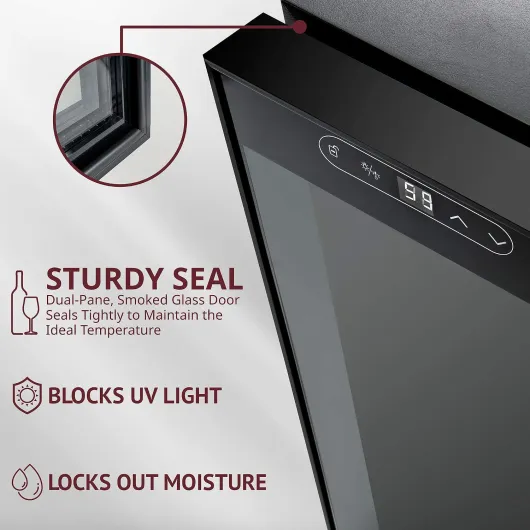
Material-wise, the fridge is a mix of metal cabinet, glass door, and wooden shelves. The outer casing feels sturdy enough and the door has a bit of weight to it, which is reassuring. The glass doesn’t feel flimsy and the UV protection is a nice touch if you have it in a bright room. I wouldn’t put it in direct sunlight all day anyway, but at least you’re not completely cooking your labels and wine with every ray of light.
The wooden shelves are probably the nicest part of the build. They slide reasonably well, they don’t feel like cheap bendy metal, and they look better when the light is on. But they’re also part of the problem: to keep the capacity up, the spacing is tight, and the rails don’t always slide as smoothly once the fridge is loaded with heavier bottles. If you’re constantly pulling shelves in and out, you’ll notice some resistance, and with larger bottles you sometimes end up lifting the shelf slightly to avoid scraping labels.
The touch controls and LCD are okay, nothing fancy. The buttons respond well enough, but it’s not high-end by any means. It’s more “it works” than “it feels premium”. You can clearly see the temperatures for each zone, and changing them is straightforward. I haven’t had any issues with the panel glitching or misreading touches, so at least that part seems stable.
Overall build quality feels middle of the road: not cheap junk, but not high-end either. The main worry is not so much the materials themselves but the after-sales support. When a verified buyer says they were missing four shelves and Klarstein simply said they don’t have spare parts, that’s a red flag. If anything breaks or a shelf warps or cracks, it doesn’t sound like you can easily get a replacement from the brand. So even if the materials are okay, the long-term confidence isn’t great because you’re basically on your own if something specific fails.
Performance and noise: cools well, but louder and more limited than advertised
On the cooling side, the fridge does its job. The compressor kicks in, the zones get down to their set temperatures, and bottles are properly chilled. Reds stay at a decent serving/storage range and whites are nice and cool. So if your main question is “will it keep my wine cold and relatively stable?” the answer is yes. I didn’t see any huge temperature swings once it had settled, and the automatic defrost means you don’t have to mess around with manual defrosting.
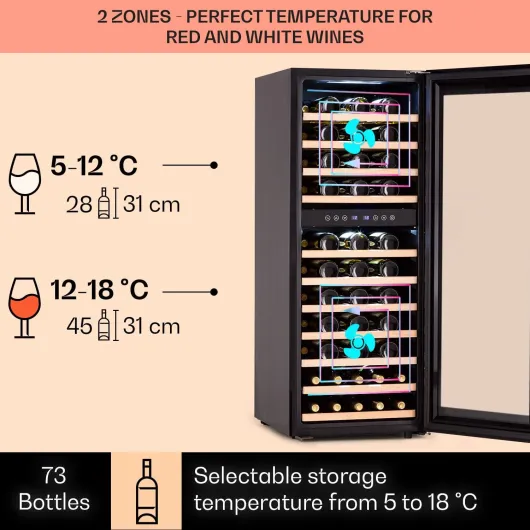
The big frustration for me is the temperature range per zone. The way it’s marketed makes it sound like both zones are fully adjustable from 5 to 18°C. In reality, users have found, and it matches my experience, that the top zone goes roughly from 5–10°C and the bottom zone from 10–18°C. That means you’re basically locked into: top = whites/sparkling/beer, bottom = reds. If you wanted the flexibility to store reds on top and whites at slightly higher temps below depending on your collection size, you’re out of luck. For the price, this kind of limitation feels lazy, and it’s the kind of thing you want to know before buying.
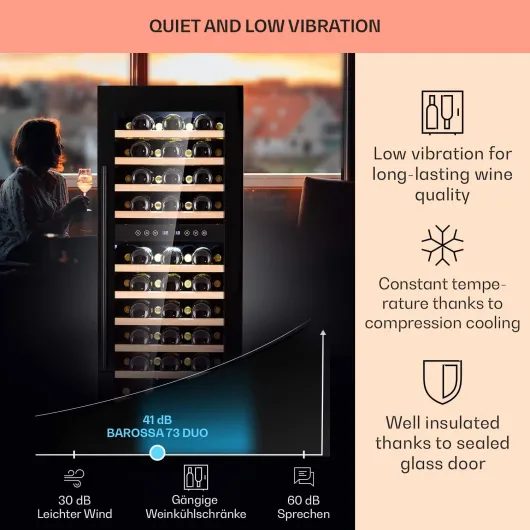
The other big point is noise. Multiple reviews say it’s louder than a normal fridge, and I agree. The compressor is definitely noticeable, especially in a quiet room. It’s not jet-engine loud, but if you’re used to a modern, quiet kitchen fridge, this will stand out. You also hear it cycling quite often, so if it’s near your sofa or in an open-plan living room, you’ll notice it. Some people might get used to it, but if you’re sensitive to noise, it can be annoying.
One user also mentioned the compressor basically running 24/7 and getting a useless response from customer support (they just sent a generic product sheet). That doesn’t inspire a lot of confidence. Mine runs frequently but not literally non-stop; still, the combo of regular cycling and the higher-than-average noise means it’s not exactly a discreet background appliance. So: cooling performance is okay, but the noise level and the misleading dual-zone spec drag it down.
What you actually get with the Barossa 73
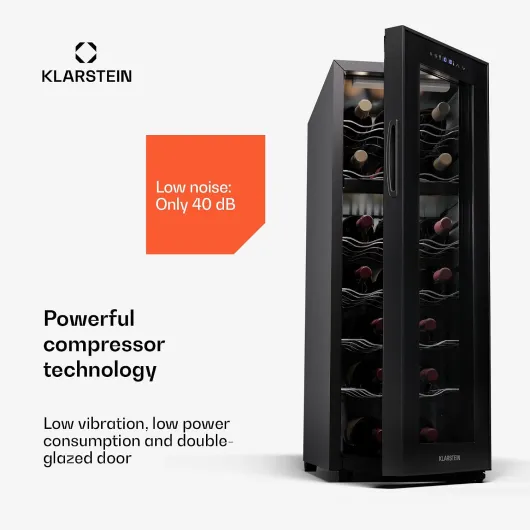
The KLARSTEIN Barossa 73 is sold as a freestanding dual-zone wine cooler with room for up to 73 bottles and a temperature range of 5–18°C. It’s a fairly tall unit: about 127.5 cm high, 49.5 cm wide, and 57.5 cm deep. So it’s not tiny – you need to plan where this thing will live. It runs on a compressor system, not thermoelectric, so it has more punch for cooling but naturally makes more noise and vibrations than those smaller silent coolers.
The brand pushes several key features: glass door with UV protection, interior lighting, wooden shelves, and touch controls with LCD display. On the spec sheet, you see 11 shelves and a dual-zone layout, both zones supposedly adjustable between 5 and 18°C. You also see mentions of indoor/outdoor use, but personally I wouldn’t put a compressor wine fridge outside unless it’s a very mild and protected area. Temperature swings and humidity outside can mess with any appliance that isn’t really built for that.
When you unpack it, what you see is mostly in line with the photos: tall black cabinet, stainless handle, glass door that shows off the bottles, and the wooden shelves which give it a more “home cellar” vibe than metal racks. But user reviews show a big caveat: some people only received 7 shelves instead of 11. That changes everything in terms of bottle organisation and aesthetics. If you’re unlucky and this happens, it looks weird and doesn’t match the advertised capacity or layout at all.
Overall, as a product category, it’s a mid-size, mid-range wine fridge for enthusiasts who have more than a few bottles but don’t want or can’t install a proper built-in cellar. The problem is that the way it’s presented sets high expectations – full 73-bottle storage, wide temperature flexibility in both zones, quiet operation – while the reality is a bit more mixed. It works, but you have to accept some compromises and maybe some hassle with the brand if anything is missing or goes wrong.
Pros
- Good theoretical capacity (up to around 73 standard bottles) in a relatively compact footprint
- Dual-zone cooling allows basic separation of reds and whites
- Nice overall look with glass door, interior lighting and wooden shelves
Cons
- Noisier than a modern standard fridge, noticeable in quiet rooms
- Real temperature ranges per zone are limited (top ~5–10°C, bottom ~10–18°C), less flexible than advertised
- Tight shelf spacing and bottle size issues reduce practical capacity and ease of use
- Reports of missing shelves and poor customer service / no spare parts
Conclusion
Editor's rating
Overall, the KLARSTEIN Barossa 73 is a decent but flawed wine fridge. It cools properly, the dual-zone layout works in a basic way, and the design looks good enough to sit in a living or dining room. If your main goal is simply to keep a fair number of bottles at roughly the right temperature and you’re not hyper-sensitive to noise or small usability annoyances, it will do the job. It’s especially okay if most of your bottles are standard shapes and you’re fine with top = whites/beer and bottom = reds.
However, there are clear downsides that you shouldn’t ignore. The noise level is higher than a regular modern fridge, so it’s not ideal for very quiet spaces. The real temperature ranges per zone are more limited than the marketing suggests, so you don’t get full flexibility on how you arrange reds and whites. Bottle spacing is tight, which reduces the practical capacity once you start mixing different bottle types. And the feedback about missing shelves and weak customer service is worrying if something goes wrong.
I’d say this fridge is for people who want a mid-size, decent-looking wine storage solution, accept some compromises, and maybe grab it on sale. If you’re picky about noise, want maximum flexibility, or care a lot about after-sales support, I’d look at other brands or maybe a smaller but better-thought-out model. It’s not terrible, it’s just a bit too compromised for the price bracket it aims at.