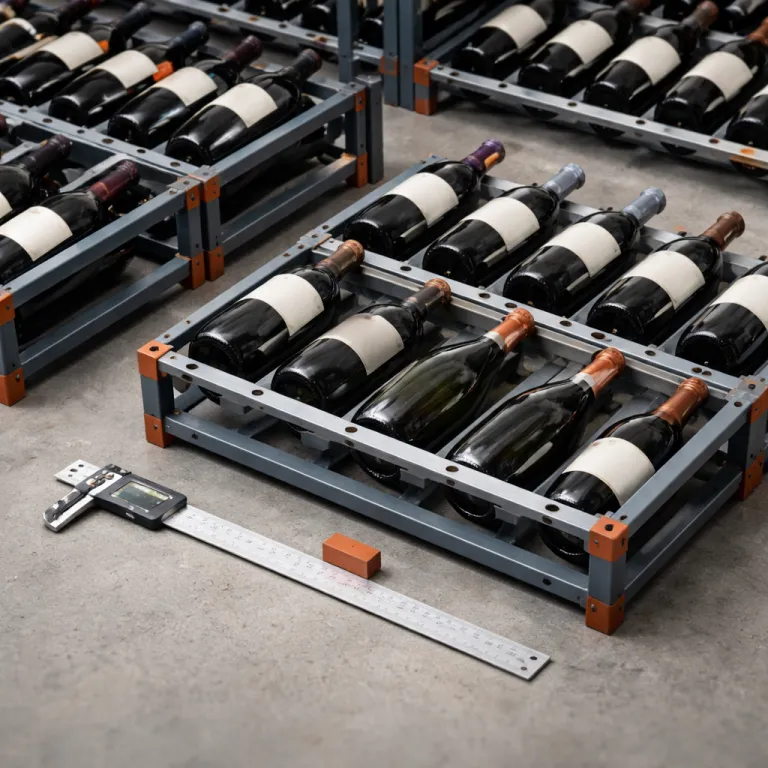
Why wine rack bottle sizing fails mixed collections
Most home wine racks are quietly engineered around a single bottle format. Manufacturer capacity claims typically assume a standard 750 ml wine bottle in the classic Bordeaux shape, not the wider Burgundy or Champagne formats you probably enjoy. When you start mixing bottle sizes in the same wine storage area, the real capacity of a wine rack often drops to sixty or even eighty percent of the number printed on the box, a range echoed in capacity notes from brands such as VintageView, Wine Racks America and EuroCave.
A typical Bordeaux wine bottle has a diameter of about 2.9 inches (≈7.4 cm), while Burgundy bottles average around 3.3 inches (≈8.4 cm) and Champagne bottles reach roughly 3.5 inches (≈8.9 cm). These figures align with common trade references and manufacturer drawings from producers like Saxco and Saverglass. Standard rack dimensions for many off-the-shelf wine racks use slots between 3.0 and 3.25 inches (≈7.6–8.3 cm), which works for Bordeaux bottles but makes Burgundy and Champagne bottles either painfully tight or simply incompatible. That mismatch between bottle size and rack dimensions explains why your elegant rack design looks full long before all your bottles are actually stored.
Riesling bottles complicate wine storage in a different way because they are taller and slimmer, so they challenge rack depth more than rack width. Half bottles (375 ml) and magnums (1.5 L) introduce yet another layer of measurements wine enthusiasts must consider, since their bottle sizes demand different rack design choices. If you want a wine cellar that handles all these bottles gracefully, you need to think about dimensions wine by wine instead of trusting a single generic standard.
Quick reference: common bottle diameters
| Bottle style | Typical diameter (inches) | Typical diameter (centimetres) |
|---|---|---|
| Bordeaux (750 ml) | ≈2.9 in | ≈7.4 cm |
| Burgundy (750 ml) | ≈3.3 in | ≈8.4 cm |
| Champagne (750 ml) | ≈3.5 in | ≈8.9 cm |
| Riesling / Alsace (750 ml) | ≈2.9 in | ≈7.4 cm |
Key bottle dimensions and how they affect rack design
Before you choose any wine rack, measure the bottles you actually buy. Use a tape measure to note the bottle size in both diameter and length in inches and centimetres, then group bottles into Bordeaux, Burgundy, Champagne, Riesling, half bottles and magnums so you can plan rack dimensions accurately. This simple measurements wine exercise reveals how many racks you need for each family of bottles and where a universal wine rack might help.
Bordeaux bottles, at about 2.9 inches (≈7.4 cm) wide, glide easily into most standard wine racks that offer 3.0 to 3.25 inches (≈7.6–8.3 cm) between rails. Burgundy and Champagne bottles, at roughly 3.3 and 3.5 inches (≈8.4 and 8.9 cm) respectively, often require wine racks with at least 3.5 inches (≈8.9 cm) of clear rack dimensions to avoid scraping labels or jamming bottles. Universal metal wine racks with 3.75 inch (≈9.5 cm) spacing solve the width problem for almost all bottle sizes, but they reduce total bottle storage capacity by roughly fifteen to twenty percent in a given space, a tradeoff also noted in specification sheets from several premium rack manufacturers.
Riesling bottles are usually narrow but tall, so rack design must allow extra depth to keep the wine bottle fully supported. If your wine cellar uses shallow wall mounted racks, those tall bottles may overhang the rack and risk impact when you walk past the wall. For a mixed collection, I recommend dedicating one bottle rack or a short run of racks to tall bottles, then using a different rack design for standard wine and Champagne bottles so every bottle size has a secure home.
To make planning easier, use a simple sizing matrix when you compare rack specifications. Imagine a side-on diagram where horizontal lines represent rails and vertical arrows show depth: Bordeaux bottles sit comfortably on shorter arrows, while Champagne and Riesling bottles extend to longer arrows, clearly illustrating how rail spacing and rack depth must increase as bottle diameter and length grow.
| Bottle type | Recommended rail spacing | Suggested rack depth |
|---|---|---|
| Bordeaux 750 ml | 3.0–3.25 in (≈7.6–8.3 cm) | 11.5–12 in (≈29–30.5 cm) |
| Burgundy 750 ml | 3.5–3.75 in (≈8.9–9.5 cm) | 12 in (≈30.5 cm) |
| Champagne 750 ml | 3.5–3.75 in (≈8.9–9.5 cm) | 12–13 in (≈30.5–33 cm) |
| Riesling 750 ml | 3.0–3.25 in (≈7.6–8.3 cm) | 12–13 in (≈30.5–33 cm) |
| Half bottles 375 ml | 2.75–3.0 in (≈7.0–7.6 cm) | 9–10 in (≈23–25 cm) |
| Magnums 1.5 L | 4.0–4.5 in (≈10.2–11.4 cm) | 13–14 in (≈33–35.5 cm) |
For readers planning a feature wall, a modern wine wall that treats bottle sizes honestly will always outperform a decorative but cramped display. A well planned wall mounted wine storage system can combine label forward display racks for prized bottles with denser horizontal racks for everyday bottles. When you design that kind of wine wall, you respect both the aesthetics of the display and the practical needs of long term wine storage.
Adjustable versus fixed racks for Burgundy and Champagne
Adjustable wine racks promise flexibility, but they rarely advertise the tradeoff in stability. Systems with movable metal rails or sliding wooden wine supports let you widen a bottle rack for Champagne bottles or tighten it for Bordeaux bottles, yet every adjustment introduces more joints that can flex under weight. If your wine cellar will hold many heavy Champagne bottles, fixed rack dimensions in solid wood or welded metal usually feel safer over time.
Fixed wooden wine racks excel at vibration dampening, which matters if your wine storage shares a wall with a kitchen or a laundry room. The continuous timber structure absorbs small movements better than thin metal wine supports, so the wine bottle rests more quietly while it ages. For Burgundy bottles, a fixed rack design with 3.5 to 3.75 inches (≈8.9–9.5 cm) between rails and a depth of at least 30 centimetres (≈11.8 in) gives both the glass and the cork generous protection.
Adjustable metal wine racks shine when you are still learning your buying habits and bottle sizes. You can start with wider spacing for Champagne and Burgundy bottles, then tighten some racks later if your collection shifts toward standard wine bottles from Bordeaux. Just remember that every adjustable glass rack or bottle rack has a maximum load rating, so check how many bottles per shelf the manufacturer allows before you fill every inch of space.
For awkward spaces such as under a staircase, custom wine solutions often make more sense than forcing a generic rack into a tight corner. An under stairs wine rack can combine deeper cubbies for Champagne bottles with narrower racks for half bottles, using the changing ceiling height to your advantage. When you explore elegant under stairs wine rack ideas for a refined home cellar, pay close attention to how each concept handles different bottle sizes rather than only admiring the overall cellar design.
Label forward display versus dense horizontal storage
Label forward display racks look spectacular, especially with Burgundy and Champagne bottles that often wear beautifully designed labels. These display systems hold each wine bottle on narrow supports so the label faces outward, turning the wine wall into a visual catalogue of your cellar. The tradeoff is that label forward wine racks usually require more depth and width per bottle, so you sacrifice storage density for aesthetics.
Horizontal storage racks, by contrast, stack bottles neck to punt in tight rows that maximise space. A standard wine cellar cube or diamond rack can hold many bottles in a compact footprint, but the rack design often assumes Bordeaux dimensions and hides labels behind other bottles. When you mix Champagne and Burgundy bottles into these racks, the larger bottle size can push neighbouring bottles out of alignment and strain the wooden wine supports.
For a balanced wine cellar, I suggest combining both rack options in one coherent cellar design. Use label forward metal wine racks on the most visible wall to display special bottles and to keep track of ready to drink wines at a glance. Reserve deeper horizontal racks for long term wine storage of standard wine bottles, where capacity matters more than instant label visibility.
If you are planning a glass fronted room, a modern wine cellar glass design for elegant home wine rooms can integrate both display and dense storage behind a single transparent wall. In that kind of space, wall mounted racks with different sizes and depths can sit behind the glass, with Champagne bottles on slightly deeper rails and Bordeaux bottles on shallower ones. The key is to map bottle sizes to specific rack dimensions during the design phase, not after the glass is installed.
Materials, depth and real world capacity for serious collectors
Material choice has a direct impact on how well a rack handles non standard bottles. Solid hardwood racks provide gentle support and excellent vibration control, which benefits older Burgundy and Champagne bottles with fragile corks. Metal racks, especially those made from stainless steel or powder coated aluminium, offer slimmer profiles and more daring display options but can transmit more vibration if not anchored firmly to the wall.
Depth is the second major variable that most manufacturers gloss over when they list rack dimensions. Many compact wine racks are only deep enough for a single Bordeaux bottle, so Champagne bottles either protrude dangerously or force you to offset bottles between rows. For a mixed collection, aim for at least 30 to 33 centimetres (≈11.8–13 in) of usable depth so every wine bottle, including Champagne and some magnums, sits fully within the rack. This range mirrors the depth used in many commercial wine cabinets and professional cellar installations.
Real world capacity almost never matches the headline number on the packaging, because that number assumes only Bordeaux bottles. When you add Burgundy, Champagne and tall Riesling bottles, expect your wine cellar to hold roughly sixty to eighty percent of the stated capacity, depending on how many larger bottles you own. This gap between theoretical and practical capacity is why serious wine cellars often include both universal racks and narrower racks, each optimised for specific bottle sizes.
To see how this plays out in practice, compare a few typical manufacturer examples: a 72 bottle wooden cube rated for Bordeaux might realistically hold about 50–55 bottles once you mix in Champagne and Burgundy; a 36 bottle metal label forward rack with 3.75 inch spacing may accept almost any bottle shape but behaves more like a 28–30 bottle unit in a tight alcove; and a 45 bottle under stairs kit often drops into the high twenties when you dedicate several wider slots to magnums and sparkling wine. For those building or renovating wine cellars, a modern wine cellar glass design for elegant home wine rooms can be adapted to these realities with careful planning. Work with a cellar design professional who understands how dimensions wine, rack design and bottle size interact, rather than one who only repeats manufacturer capacity charts. When you treat wine racks as precision storage tools instead of generic furniture, your bottles stay safer and your space feels intentionally organised.
FAQ
How much wider should a rack be for Burgundy and Champagne
For Burgundy bottles at about 3.3 inches (≈8.4 cm) in diameter, aim for at least 3.5 inches (≈8.9 cm) of clear spacing between rails. Champagne bottles at roughly 3.5 inches (≈8.9 cm) wide are more comfortable in racks with 3.75 inches (≈9.5 cm) of spacing, especially if labels are textured or embossed. Universal racks with 3.75 inch spacing handle both bottle types reliably, though they reduce overall capacity compared with tighter Bordeaux focused racks.
What rack depth do I need for Champagne and Riesling bottles
Champagne bottles are shorter but wider, while Riesling bottles are taller and slimmer, so both challenge shallow racks. A practical minimum depth for mixed wine storage is about 30 centimetres (≈11.8 in), which keeps most Champagne and Riesling bottles fully supported within the rack. If you plan to store many magnums or unusually tall bottles, consider 33 to 35 centimetres (≈13–13.8 in) of depth in at least one section of your wine cellar.
Why does my rack hold fewer bottles than the stated capacity
Manufacturer capacity numbers almost always assume only Bordeaux shaped bottles, which are narrower than Burgundy and Champagne bottles. When you introduce larger bottle sizes into the same rack dimensions, each wider bottle effectively occupies more than one theoretical slot. In practice, mixed collections usually achieve only sixty to eighty percent of the stated capacity, depending on how many non standard bottles you own.
Are metal racks safe for long term storage of fine wine
Metal racks are safe for long term wine storage if they are well anchored and designed with adequate spacing for your bottle sizes. Welded metal wine racks with solid wall mounted brackets can be very stable, but thin or poorly fixed systems may transmit vibration or flex under heavy Champagne bottles. If you plan to age valuable Burgundy or Champagne for many years, combining metal display racks with deeper wooden wine racks for long term rest offers a good balance.
Should I choose adjustable or fixed racks for a first serious cellar
Adjustable racks suit collectors whose buying habits are still evolving, because they let you reconfigure spacing as your mix of bottle sizes changes. Fixed racks, especially in solid wood, provide better long term stability and vibration control once you know how many Bordeaux, Burgundy and Champagne bottles you typically store. Many intermediate collectors start with a core of fixed racks sized for standard wine bottles, then add a smaller adjustable section dedicated to Champagne and other oversized bottles.