Summary
Editor's rating
Value for money: good for beginners, limited for serious wine fans
Compact design that fits almost anywhere, with a few small annoyances
Noise level and everyday use: easy to live with, but not invisible
Build quality and durability: feels budget, but not fragile
Cooling performance: good for casual use, but not for extreme conditions
What this wine cooler actually offers on paper
Pros
- Compact 8-bottle format that fits easily in small kitchens or home bars
- Quiet thermoelectric operation, suitable for open living spaces
- Simple LED temperature control with a practical glass door for quick viewing
Cons
- Generic brand with uncertain long-term support and warranty clarity
- Limited cooling power in very warm rooms and slow to chill bottles from room temperature
- Basic build quality and racks that don’t inspire strong confidence for heavy, long-term use

Specifications
View full product page →| Brand | Generic |
A tiny wine fridge for people who are tired of overcrowding the main fridge
I’ve been using this little 8-bottle wine cooler for a few weeks now, mainly because I was tired of cramming bottles into the main fridge and moving food around every time we opened a bottle. I didn’t go for a big brand here; this one is from a generic manufacturer, which honestly made me a bit suspicious at first. But I wanted something cheap, compact, and quiet for a small apartment kitchen, so I gave it a shot.
From day one, my expectations were pretty simple: keep wine at a stable temperature, not sound like a jet engine, and not look too ugly next to my basic kitchen furniture. I’m not a sommelier, I just like to have a few bottles ready to drink at the right temperature. So my feedback is from a normal user, not a wine pro. If you want ultra-precise cellar conditions for expensive bottles, this probably isn’t your dream machine, but for everyday bottles it might be enough.
The first impression when I unpacked it was that it’s really compact and light. At 23L and 8 bottles, it’s more like a countertop gadget than a real cellar. That’s both a good and bad thing: easy to place, but you hit the capacity limit very fast. I managed to squeeze 8 standard 750 ml bottles in, but anything with a fatter shape already starts to get tricky. So if you like big Champagne bottles or chunky reds, be aware it’s tight.
Overall, after a few weeks, my feeling is that it does what it says for basic use, but you clearly feel the “generic” side of it: no fancy features, no brand reassurance, and finish quality that’s just okay. It’s the kind of product that’s fine if you keep your expectations realistic: a small, simple wine fridge that keeps bottles cooler than the room and looks decent behind its glass door, but nothing more.
Value for money: good for beginners, limited for serious wine fans
In terms of value for money, I’d put this cooler in the “pretty solid if your needs are simple” category. You get a compact fridge that can hold up to 8 bottles, keeps them noticeably cooler than room temperature, and doesn’t make a lot of noise. For someone who just wants a small dedicated spot for wine in a tiny apartment or home bar, it gets the job done without costing as much as the big-name brands. You’re basically paying for function, not for brand prestige.
Where the value is a bit weaker is if you start asking for more: more precise temperature, bigger capacity, better materials, or a real warranty from a known brand. At that point, this generic model shows its limits. No dual-zone, no advanced settings, basic racks, and unknown long-term support. If you know you’re getting more and more into wine and plan to grow your collection, it might actually be smarter to skip this step and invest directly in a more serious model, even if it costs more upfront.
For casual drinkers who keep a few bottles around and don’t want them sitting on the kitchen counter, I think the value is good enough. You don’t pay a fortune, you get a fridge that holds 6–8 bottles at a reasonable temperature, and you free up space in your main fridge. If it lasts several years, the cost per year will be quite reasonable. If it dies early, that’s where the lack of brand reputation could hurt. So it’s a bit of a calculated risk.
Overall, I’d say the product makes sense if: you’re limited on space, you don’t want to overspend, and you’re not too picky about perfect cellar conditions. If you’re the kind of person who buys expensive bottles and cares a lot about long-term storage, the value here is weaker and you should probably look higher up the range.
Compact design that fits almost anywhere, with a few small annoyances
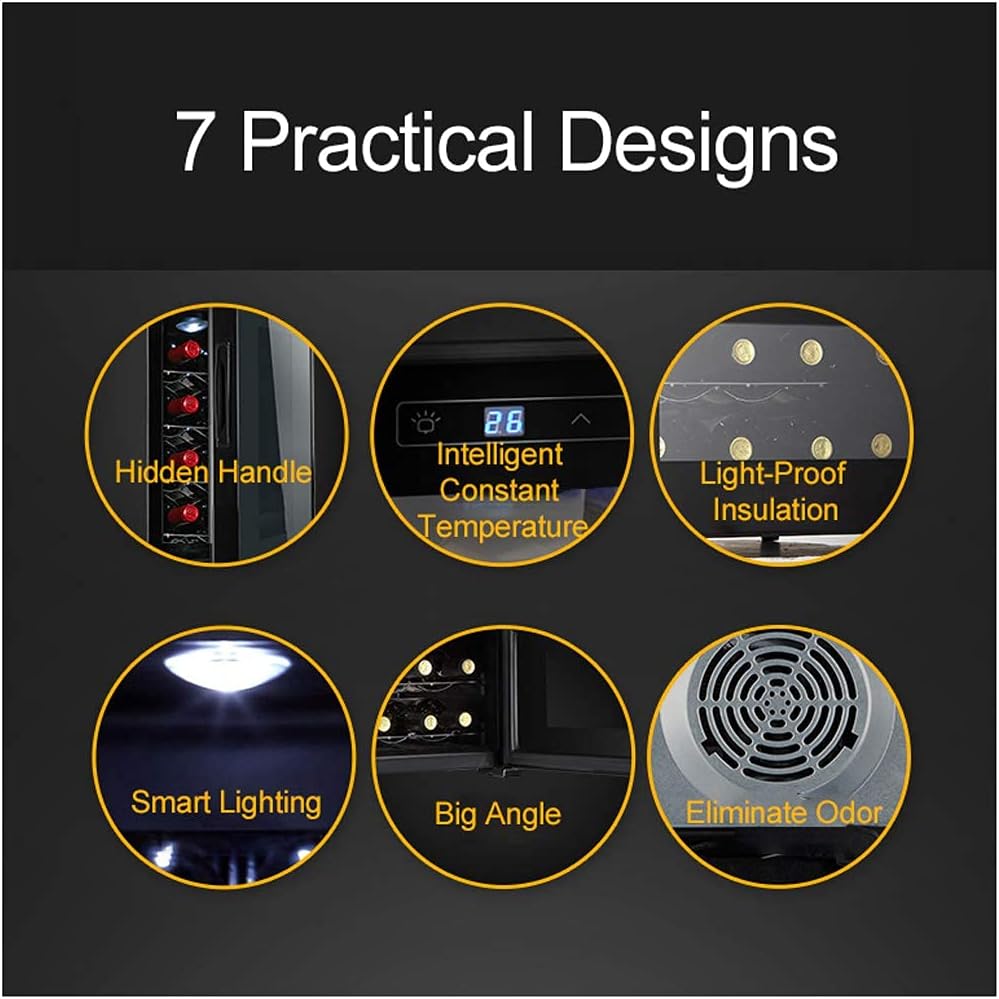
Design-wise, the thing I liked is that it’s really compact and doesn’t dominate the room. It’s light enough that I could move it alone without any trouble, and it sits nicely on a counter or under a bar shelf. The glass door is handy because you can quickly see what’s inside without opening it and letting warm air in. It gives a small “home bar” look without being over the top. For a generic product, the overall look is decent: black body, glass front, basic LED display at the top.
Inside, you’ve got racks for 8 bottles, but that’s for standard shapes. As soon as you have a bottle that’s slightly wider or a weird shape, you start playing Tetris. I had to remove one bottle a couple of times just to make everything fit comfortably. Also, the racks aren’t the thickest metal I’ve seen. They do the job, but they bend a tiny bit when fully loaded. It’s not scary, but it doesn’t scream long-term solidity either. For occasional use, it’s fine. For heavy use and constant loading/unloading, I’d be a bit more cautious.
One point I noticed is that the door isn’t reversible, at least not without DIY. It opens one way, and that’s it. In my kitchen it was okay, but if you’re tight on space or want to tuck it into a corner, that can be annoying. The handle is integrated into the door design, so there’s no bulky grip sticking out, which is nice in narrow spaces. The door seal is okay; it closes properly, but I had to give it a firm push the first few times to be sure it was really shut.
Overall, the design is simple and practical, but clearly budget-level. It looks fine from a distance and fits easily in small apartments, studios, or as a side fridge in a living room corner. If you’re picky about finishes, you’ll notice the plastic trim and the basic feel of the racks. If you just want something that looks okay and doesn’t eat up space, it gets the job done. I’d call it pretty solid visually for the price range, but nothing more.
Noise level and everyday use: easy to live with, but not invisible
Day to day, the big question for me was: is it noisy or annoying to live with? The cooler uses thermoelectric technology, which is usually quieter than compressor fridges. In practice, that’s true here. It’s not totally silent, but the sound is more like a soft fan rather than a humming compressor. In my open kitchen-living room, I only really notice it at night when the rest of the apartment is dead quiet, and even then, it’s more background noise than a real bother.
If you put it in a bedroom, I think light sleepers might hear it, but in a living room, kitchen, or hallway, it’s perfectly fine. Compared to a standard under-counter fridge, this one is clearly quieter. I never had to raise the TV volume or anything like that because of it. The fans kick in and out, but the noise level stays pretty constant and doesn’t pulse in an annoying way. So in terms of comfort, I’d say it’s quite manageable.
Using it day to day is very simple: open the door, grab a bottle, close the door. The LED controls are basic and easy to understand. Press up or down to change the temperature, that’s it. I didn’t even really need the manual. The only slightly annoying thing is that the display is a bit bright in a dark room. If you have it in the living room and watch TV with the lights off, the blue LED can catch your eye. Not a disaster, but worth mentioning if you’re sensitive to light sources at night.
As for vibrations, I didn’t feel any big shaking. The bottles stay stable on the racks, no rattling noises when the fans run. That’s important if you keep the fridge on a light piece of furniture. So overall, in terms of comfort and daily use, it’s easy to live with: quiet enough, simple to control, and no weird quirks. It’s not completely invisible in the room, but it doesn’t irritate you either.

Build quality and durability: feels budget, but not fragile
On the durability side, let’s be honest: this is not a premium unit. The materials are mostly thin metal and plastic, and you can feel the cost-cutting when you touch the racks or the door frame. That said, after a few weeks of normal use, nothing has broken or come loose. The door still closes properly, the seal hasn’t warped, and the LED display is working fine. So it feels budget, but not like it will fall apart in a month.
The racks are the part that worry me the most long term. They bend a tiny bit under full load, and if you’re constantly pulling bottles in and out, I can see them deforming over time. If you treat it gently and don’t overload it with heavy or oversized bottles, it should be okay. But if you expect the kind of robustness you’d get from a high-end wine cabinet, this isn’t in that league. It’s more of a light-duty product for everyday home use, not industrial-grade storage.
The thermoelectric system has fewer moving parts than a compressor, which in theory is good for reliability, but with a generic brand, the big unknown is the quality of the electronics and fans. If a fan dies in two years, I’m not sure how easy it will be to repair or replace. There’s no clear long warranty or solid brand support behind it, at least none that I’ve seen. So you kind of have to accept that at this price and with this brand, you’re taking a small gamble on long-term durability.
In short, I’d say the durability looks acceptable for the price, but not reassuring enough for someone who wants to store expensive bottles for years. For cheap to mid-range wines you rotate regularly, it’s probably fine. For someone building a serious collection, I’d invest in something with better build quality, a known brand, and clearer support options. This one feels more like a practical gadget than a long-term cellar solution.
Cooling performance: good for casual use, but not for extreme conditions
Let’s talk about what matters most: does it actually cool properly? In my case, the cooler was placed in a room at around 21–24°C most of the time. Set at 12–14°C, it managed to keep the bottles clearly cooler than room temperature, and fairly stable. I don’t have lab-grade tools, but with a basic fridge thermometer and checking bottle neck temps, I was generally within 1–2 degrees of the set value after a few hours. For everyday drinking, that’s good enough. You’re not running a professional cellar here, you just want wine that’s not warm.
Where you feel the limits is when the room gets hotter. On one warm day, the room went up to about 28–29°C, and I could see the fridge struggling a bit. The display still showed the target temperature, but the bottles felt slightly warmer than usual to the touch, and the internal thermometer I put inside showed more like 15–16°C instead of the 13°C I set. So in a very warm room, don’t expect miracles. That’s classic for thermoelectric coolers: they’re quiet and efficient at moderate ambient temps, but they’re not beasts.
The dual-fan system helps with air circulation. I didn’t notice strong hot spots inside, and there weren’t any weird smells building up. The air seems to move enough to avoid stale areas. Also, the cooling isn’t super fast. If you put a room-temperature bottle inside, it takes a few hours to get down near the target temperature. So if you’re the type who throws in a bottle 30 minutes before dinner, this won’t replace a normal fridge for quick chilling. It’s more about keeping wine at a stable temp than rapidly cooling it.
Overall, in terms of performance, I’d say it’s decent but nothing more. It does the job for standard home use: keeps a few bottles at a nice drinking temperature, especially reds and lightly chilled whites. If you live in a very hot place without air conditioning, or you want near-perfect precision, you’ll hit its limits. For a small apartment with normal room temperatures, it’s okay and does what you’d expect for a budget wine cooler.

What this wine cooler actually offers on paper
On paper, this fridge is pretty straightforward: 8-bottle capacity, 23L, and a temperature range of 11–18°C (52–64°F). It’s a freestanding model, so you just plug it into a standard 220V outlet and you’re done. Power draw is 70W, which is low enough that I didn’t see any crazy jump on my power bill after a few weeks, even leaving it on 24/7. It uses thermoelectric cooling, not a compressor, which is why it’s quieter but also less powerful if your room gets very hot.
Control-wise, you get a simple LED display on the front with a couple of buttons to adjust the temperature. Nothing smart, no Wi-Fi, no app, just basic manual control. Honestly, that’s fine for this type of product. I set it to 12°C for whites and rosés, then bumped it closer to 15–16°C when I had more reds. The temperature range is clearly more suited to reds and light chilling for whites, not ice-cold drinks like beer or soda.
The brand is literally labeled as “Generic”, with the model number KM-WwXPqW. That tells you a lot: you’re not paying for a big name, you’re paying for a simple device. There’s no big user manual full of tips, no fancy packaging, and I didn’t find much real support info online. If something breaks after the return window, I’m not sure how easy it will be to get help or spare parts. That’s one of the trade-offs with this kind of generic device.
In practice, the presentation matches the reality: it’s a basic, entry-level wine cooler that offers just enough features to be useful for casual drinkers. No dual-zone, no humidity control, no special racks for odd-shaped bottles. If you just want a small dedicated space for 6–8 everyday bottles and a clear temperature display, it ticks those boxes. If you’re looking for advanced cellar features, this isn’t the right category at all.
Pros
- Compact 8-bottle format that fits easily in small kitchens or home bars
- Quiet thermoelectric operation, suitable for open living spaces
- Simple LED temperature control with a practical glass door for quick viewing
Cons
- Generic brand with uncertain long-term support and warranty clarity
- Limited cooling power in very warm rooms and slow to chill bottles from room temperature
- Basic build quality and racks that don’t inspire strong confidence for heavy, long-term use
Conclusion
Editor's rating
After using this generic 8-bottle wine cooler for a while, my conclusion is pretty straightforward: it’s a small, practical fridge for casual wine drinkers, not a serious cellar for collectors. It keeps bottles at a decent, stable temperature in normal room conditions, it’s quiet enough for an apartment, and it doesn’t take up much space. The glass door and simple LED controls make it easy to live with, and for everyday reds and whites, it does what you need: the wine is ready to drink and not sitting warm on the counter.
On the downside, you clearly feel the budget side of it: basic materials, racks that aren’t very robust, no advanced features, and a completely generic brand with uncertain long-term support. The cooling performance is fine in moderate temperatures but shows its limits in hotter rooms, and the 8-bottle capacity fills up fast if you like to stock up. For someone who just wants to store a handful of bottles in a small flat, it’s good value for money and a reasonable compromise. But if you’re building a serious collection, live in a hot climate, or want something you can trust for many years with expensive bottles, I’d look at a higher-end, branded model instead.