Summary
Editor's rating
Value for money: good if you accept the realistic bottle count
Design: looks modern, with a few practical quirks
Materials and build: decent, but you feel the price point
Durability and long-term feel: solid enough, with a few watch points
Cooling performance and noise: does the job with a few realistic limits
What you actually get with this Loops wine cooler
Pros
- Dual-zone cooling (5–18°C in each zone) that stays reasonably stable in normal home conditions
- Compact, slim design with mirror glass door and wooden shelves that looks decent in a living room or kitchen
- Compressor cooling with automatic defrost, so low maintenance and better performance than basic thermoelectric units
Cons
- Realistic capacity is closer to low 20s bottles rather than the claimed 27 if you use mixed bottle shapes
- Wooden shelves are a bit light and flex slightly when fully loaded, not ideal for heavy or constant use
- Not silent: compressor hum is noticeable in very quiet rooms if placed close to seating

Specifications
View full product page →| Brand | Loops |
A small wine fridge for people who actually drink their bottles
I’ve been using this Loops 27 Bottle Dual Zone Wine Cooler for a few weeks now, in a fairly normal setting: small house, open-plan living room/kitchen, and a mix of supermarket wines and a few slightly nicer bottles I don’t want to cook next to the oven. I’m not a sommelier, I just wanted something that keeps reds and whites at decent temperatures without taking over the room or sounding like a tractor.
Right away, the main thing to know is this: it’s a practical, mid-range wine fridge that mostly focuses on doing the basics right. The dual zone is handy, the capacity is okay for a casual drinker or small household, and the look is modern enough that it doesn’t scream “cheap appliance”. At the same time, it’s not some high-end cellar: the shelves are a bit tight with fatter bottles, the stated capacity is optimistic, and the noise level is fine but not invisible.
In everyday use, I’ve treated it like a working fridge, not a museum. Bottles go in and out, doors get opened a lot on weekends, and the temperature gets tweaked depending on what I’m storing. That’s where you really see what’s solid and what’s slightly annoying. The good news is the unit doesn’t freak out every time you open the door, and the compressor doesn’t roar back to life every ten minutes. But you do feel it’s built to a price point, especially on the interior details.
So if you’re looking for a realistic opinion: it’s pretty solid for casual to semi-serious wine drinkers, as long as you don’t expect miracles or a perfect 27-bottle Tetris. It keeps bottles at the right temperature, it looks decent in a corner of the living room, and it doesn’t require a PhD to operate. There are a few trade-offs, and I’ll go through them, but overall it gets the job done without any drama.
Value for money: good if you accept the realistic bottle count
On the value side, this Loops wine cooler sits in that middle ground between cheap thermoelectric units and high-end cellar brands. For the price, you’re getting compressor cooling, dual zones, wooden shelves, and a mirror glass door. That combination is not bad at all if you compare it to other similar products. Many cheaper units either have only one zone, weaker cooling, or a much more basic look. So from that angle, it feels like you’re getting a fair feature set for the money.
The part where the value can feel a bit stretched is the 27-bottle capacity claim. If you’re the kind of person who will fill it with 27 identical standard bottles and never change them, you might reach that number. In real life, with a mix of shapes and sizes, you’ll probably be more in the low 20s. If you’re okay with that and just wanted a compact fridge for a rotating selection of bottles, it still makes sense. If you absolutely need to store close to 30 bottles, I’d say you might want to look at a slightly larger model or accept that you’ll be playing bottle Tetris all the time.
Running costs shouldn’t be crazy either, since it’s a small, narrow unit using compressor tech. I can’t give exact numbers without the energy label details, but it’s not running like a giant American fridge. In everyday use, I just left it on and didn’t see any shocking changes in my electricity bill over a month. Maintenance is also low, which adds to the overall value: no defrosting rituals, just occasional cleaning and making sure the back isn’t blocked.
So in terms of value for money, I’d call it pretty solid for casual to moderately serious wine drinkers. You get two real temperature zones, a decent look, and stable cooling without jumping into luxury pricing. The main thing is to be honest with yourself about how many bottles you really need to store and whether you’re okay with a bit of compromise on capacity and interior robustness.
Design: looks modern, with a few practical quirks
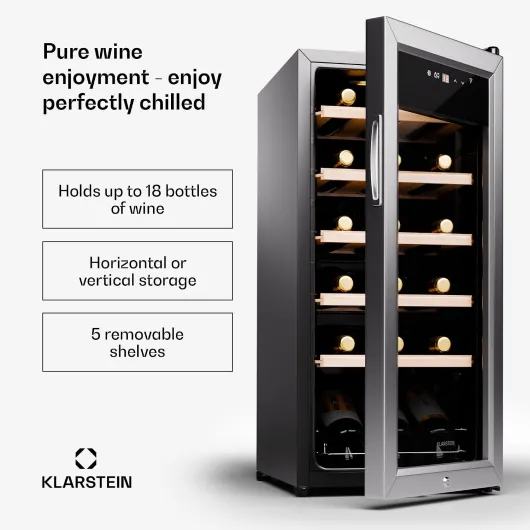
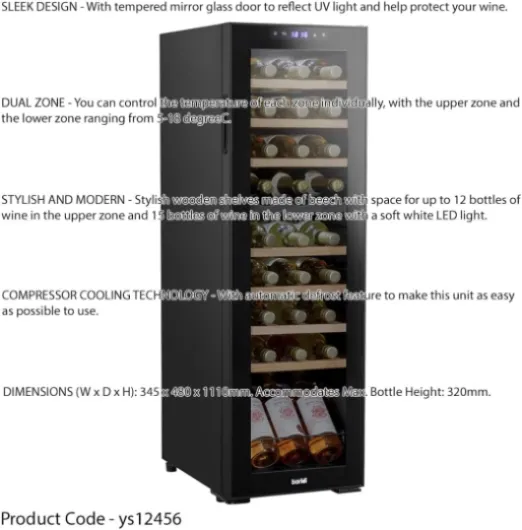
The overall design is pretty clean: black body, mirror glass door, and wooden shelves. The mirror glass door is the first thing people comment on when they see it. It does look neat and hides the bottles a bit when the light is off, which some people will like. It’s also supposed to reflect UV light to protect the wine. I can’t scientifically verify that, but at least it doesn’t look cheap and plasticky. Fingerprints do show up, though, so if you have kids or greasy hands after cooking, expect to wipe it down now and then.
The proportions are slim and tall, which works well in small spaces but makes it look a bit like a narrow tower. I had no trouble fitting it beside a cabinet without it dominating the room. The door opens smoothly, but you do need to respect the recommended side clearance; otherwise, the hinge can feel a bit restricted. The white LED inside is soft, not blinding, and does a decent job of showing the labels without turning the whole thing into a disco. It’s more functional than atmospheric, which is fine by me.
One thing I noticed is that the internal layout is clearly designed around standard bottles. When you slide the wooden shelves in and out, they look good, but the spacing is tight. If you try to double-stack or squeeze in larger bottles, it starts to look messy and harder to access. Also, the control panel is basic but legible. You don’t get a massive screen or fancy icons, just simple buttons and a small display. It fits the overall design philosophy: not ugly, not luxury, just neutral.
In a living room or kitchen, it blends in pretty well. It doesn’t scream “professional cellar”, but it also doesn’t look like a budget mini-fridge. If your priority is a modern, neutral look that doesn’t clash with most furniture, it does that job well enough. If you’re obsessed with perfectly aligned labels on show behind clear glass, the mirror finish might annoy you a bit because it hides some of that visual effect.
Materials and build: decent, but you feel the price point
Material-wise, the fridge uses a mix of steel for the body, tempered mirror glass for the door, and beech wood for the shelves. The outer shell feels solid enough when you knock on it, not super thick, but not flimsy either. It’s in line with other mid-range wine coolers I’ve seen. The door has a bit of heft to it, which is reassuring, and the seal sits properly all around. After a few weeks of use, I haven’t noticed any condensation issues on the door or weird noises from the hinges.
The shelves are where you really feel the compromise. The beech wood looks nicer than metal racks, and it gives the inside a warmer look. But they’re fairly light, and when fully loaded they flex a tiny bit when you pull them out. Nothing scary, but it doesn’t give you that rock-solid feel you’d get on more expensive units. Also, because they’re quite thin and close together, you have to be a bit careful sliding bottles in and out, especially the heavier ones. If you’re rough with it, you’ll probably scuff the wood over time.
The internal walls are basic, standard fridge plastic, easy enough to wipe down. No weird smells out of the box, which is always nice. I let it run empty for a day anyway, just to be safe, then cleaned the shelves before loading bottles. The buttons and display on the control panel feel okay, but obviously not premium. Think “decent home appliance”, not high-end audio or anything like that. They respond well and haven’t misbehaved in my testing.
So overall, the materials are perfectly acceptable for the price range. You’re not getting luxury thickness or ultra-rugged shelves, but nothing feels like it’s about to fall apart either. If you treat it like a normal household appliance and don’t slam or overload it, I don’t see any immediate red flags. Just don’t expect the kind of build you’d see on much more expensive wine cabinets.
Durability and long-term feel: solid enough, with a few watch points
I obviously haven’t had this fridge for years, so I can’t pretend to know exactly how it will age. But after a few weeks of pretty regular use, you start to see where potential issues could show up and where things feel stable. Structurally, the cabinet and door feel sturdy. The door still closes firmly, the seal hasn’t warped, and there’s no rattling or loose panels. The compressor starts and stops normally without odd clunks or vibrations, which is usually a good sign.
The parts I’d keep an eye on over time are mainly the wooden shelves and the control buttons. The shelves are fine for normal use, but if you’re constantly sliding them in and out fully loaded, you might see wear on the runners or flexing over time. I’ve already noticed that if you overload them or push the bottles too far back, they don’t slide as smoothly. So my feeling is: don’t treat them like heavy-duty drawers. Load them sensibly and they should last, but they’re not built for abuse.
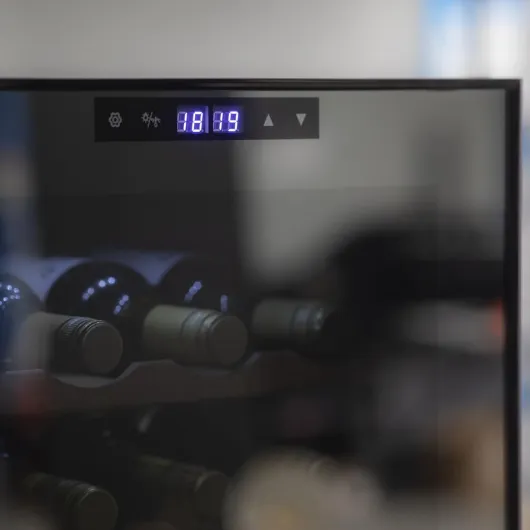
The control panel seems okay, but it’s still basic plastic buttons. If someone in the house likes to mash buttons or adjust the temperature every day, I could see the icons wearing off or the click feeling looser down the line. That said, once you’ve set your zones, you don’t really touch them much, so it’s not a huge concern. The automatic defrost is handy because you don’t have to manually mess with it, which usually helps with long-term reliability since there’s less user error.
Overall, I’d say the durability feels reasonable for a mid-range home appliance. If you respect the ventilation clearances, don’t overload the shelves, and don’t treat it like a storage cupboard, it should be fine for several years of regular use. If you want something bulletproof for a restaurant or a bar, I’d look at more heavy-duty gear. For home users, it’s acceptable, just don’t expect industrial toughness.
Cooling performance and noise: does the job with a few realistic limits
Performance-wise, this fridge uses compressor cooling with automatic defrost. That’s good because it can reach lower temperatures than thermoelectric units and handle warmer rooms better. I tested it in a living room that sits around 20–23°C most days. I set the top zone at 10°C for whites and the bottom at 14–15°C for reds. It reached those targets in a few hours from room temperature and then stayed pretty stable. The display readings matched a simple thermometer I put inside within about 1°C, which is fine for home use.
When you open the door a few times in a row, you obviously see the temperature climb a bit, but the fridge recovers in a reasonable time. I didn’t see any wild swings or big differences between the front and back of the shelves. For a compact unit, that’s already decent. Just keep in mind the usual rule: don’t cram it against a wall, and don’t keep it in a very hot room. In a normal home, it’s totally fine. I wouldn’t put it in a sun-baked conservatory and expect perfect stability, but that’s not really what it’s made for.
On the noise side, it’s not silent, but it’s not annoying either. You hear the compressor kick in as a low hum, similar to a regular kitchen fridge, maybe slightly softer because of the size. When the room is quiet at night, you’ll notice it if you’re sitting right next to it, but from a few meters away it fades into the background. If you’re super sensitive to noise and planning to put it right next to your sofa or bed, you might find it a bit present. For a living room or open-plan area, I found it acceptable.
In summary, the performance is good enough for everyday wine storage and serving temperatures. It’s not lab-grade precise, but it’s stable, the dual zones work as advertised, and the noise level is reasonable. If your main concern is “will my white wine actually be cold and my red not cooked?”, then yes, it handles that without drama.
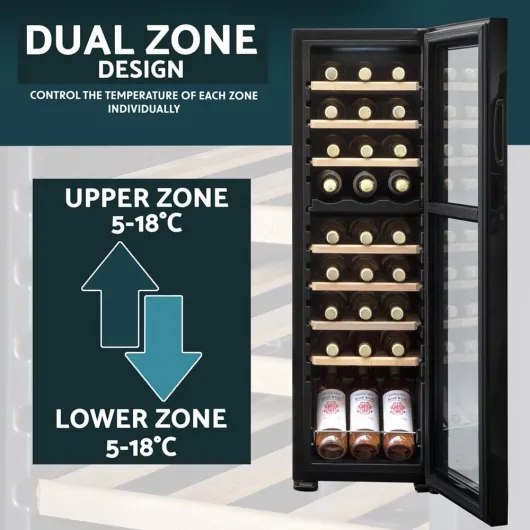
What you actually get with this Loops wine cooler
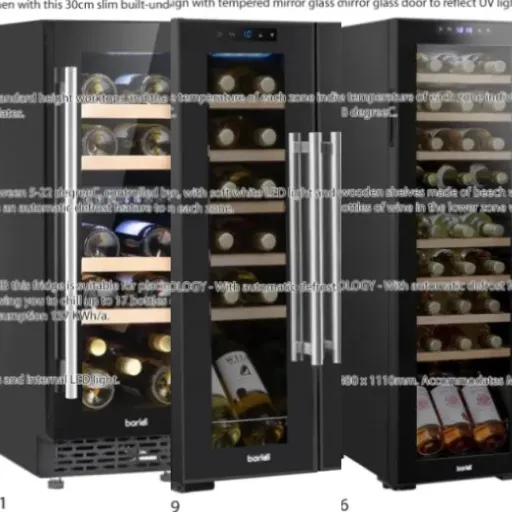
On paper, this Loops wine cooler is a 27-bottle, dual-zone, freestanding fridge with compressor cooling and a mirror glass door. In reality, you’re looking at a tall, slim unit (about 111 cm high, 34.5 cm wide, 48 cm deep) that fits nicely next to a sideboard or in a kitchen corner. It’s not built-in, so you just plug it in, leave some space around it (they recommend 50 mm at the back and 30 mm on top and sides), and you’re good. That ventilation space is important; I tried pushing it closer to the wall at first and the sides warmed up more and the compressor kicked in more often.
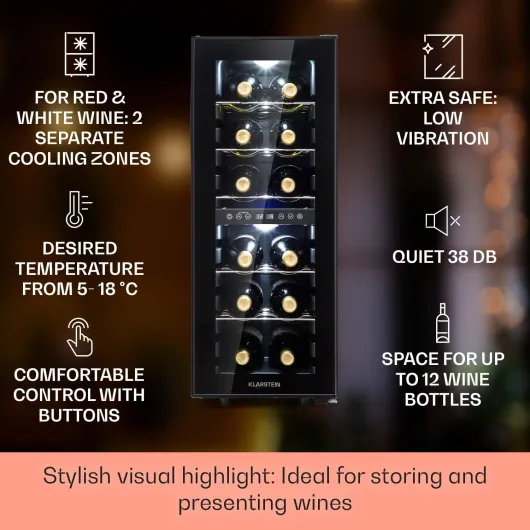
The fridge is split into two independent temperature zones, both adjustable between 5–18°C. The top zone is supposed to hold around 12 bottles, the bottom around 15. In practice, that’s only really true if you mainly store standard Bordeaux-style bottles. As soon as you start adding wider Burgundy-style bottles, some sparkling, or oddly shaped bottles, you’ll lose a few spaces and start playing bottle Tetris. I’d personally call it a comfortable 20–22 bottle fridge if you like variety.
The controls are straightforward: a small panel lets you set each zone’s temperature, and there’s a soft white LED light you can switch on to see what’s inside. Nothing fancy, no Wi-Fi, no app, no gimmicks. After using it, I actually appreciated that. You press the buttons, the thing cools, end of story. The compressor cooling plus automatic defrost means you don’t have to think too much about maintenance, apart from keeping the door seals clean and leaving enough space around it.
Overall, in terms of pure functionality, it’s a simple, focused product: keep wine at a stable, reasonable temperature in two ranges, in a fairly compact footprint. If you want a high-tech showpiece with screens, alarms and remote control, this isn’t it. If you want something that just quietly runs in the background and keeps whites cold and reds slightly cooler than room temperature, then it’s aligned with that job.
Pros
- Dual-zone cooling (5–18°C in each zone) that stays reasonably stable in normal home conditions
- Compact, slim design with mirror glass door and wooden shelves that looks decent in a living room or kitchen
- Compressor cooling with automatic defrost, so low maintenance and better performance than basic thermoelectric units
Cons
- Realistic capacity is closer to low 20s bottles rather than the claimed 27 if you use mixed bottle shapes
- Wooden shelves are a bit light and flex slightly when fully loaded, not ideal for heavy or constant use
- Not silent: compressor hum is noticeable in very quiet rooms if placed close to seating
Conclusion
Editor's rating
Overall, this Loops 27 Bottle Dual Zone Wine Cooler is a practical, mid-range option for people who actually drink their wine and just want it stored at sensible temperatures. The dual-zone setup works well, the cooling is stable, and the noise level is manageable for a living room or kitchen. The design is modern enough with the mirror glass door and wooden shelves, without being flashy. It feels like a product built to do a simple job rather than impress you with features you’ll never use.
It’s not perfect, though. The advertised 27-bottle capacity is optimistic unless all your bottles are the same slim shape. The wooden shelves look nice but aren’t heavy-duty, and the overall build clearly sits in the “good home appliance” category, not premium cellar gear. If you’re very picky about super quiet operation or need rock-solid shelves for constant loading and unloading, you might want to spend more on a higher-end model.
If you’re a casual to semi-serious wine drinker who wants a compact, decent-looking fridge to keep whites cold and reds at a comfortable temperature, this unit makes sense and offers good value. If you’re building a serious collection, storing lots of large bottles, or want something ultra-premium and almost silent, you’re probably better off looking at more expensive, larger-capacity cellars. For most everyday users, though, it gets the job done without fuss.