Summary
Editor's rating
Value for money: fair price for what it offers, but not a bargain
Design: simple black box with a glass door – looks fine, not premium
Build quality and materials: feels budget but not flimsy
Durability and long-term thoughts: feels okay, but brand is an unknown
Cooling performance and noise: decent chilling, quiet enough for a bedroom or office
What you actually get with this Electactic mini drinks fridge
Everyday effectiveness: how it actually works in real life
Pros
- Compact size with a glass door that looks clean in an office, bedroom, or bar corner
- Cools drinks to a proper chilled temperature and keeps it steady for everyday use
- Quiet compressor and low energy consumption, suitable for indoor living spaces
Cons
- Limited capacity and basic interior layout, especially if you mix cans and tall bottles
- Build and materials feel budget, and long-term durability from this brand is uncertain

Specifications
View full product page →| Brand | Electactic |
A mini fridge for drinks, nothing fancy – and that’s fine
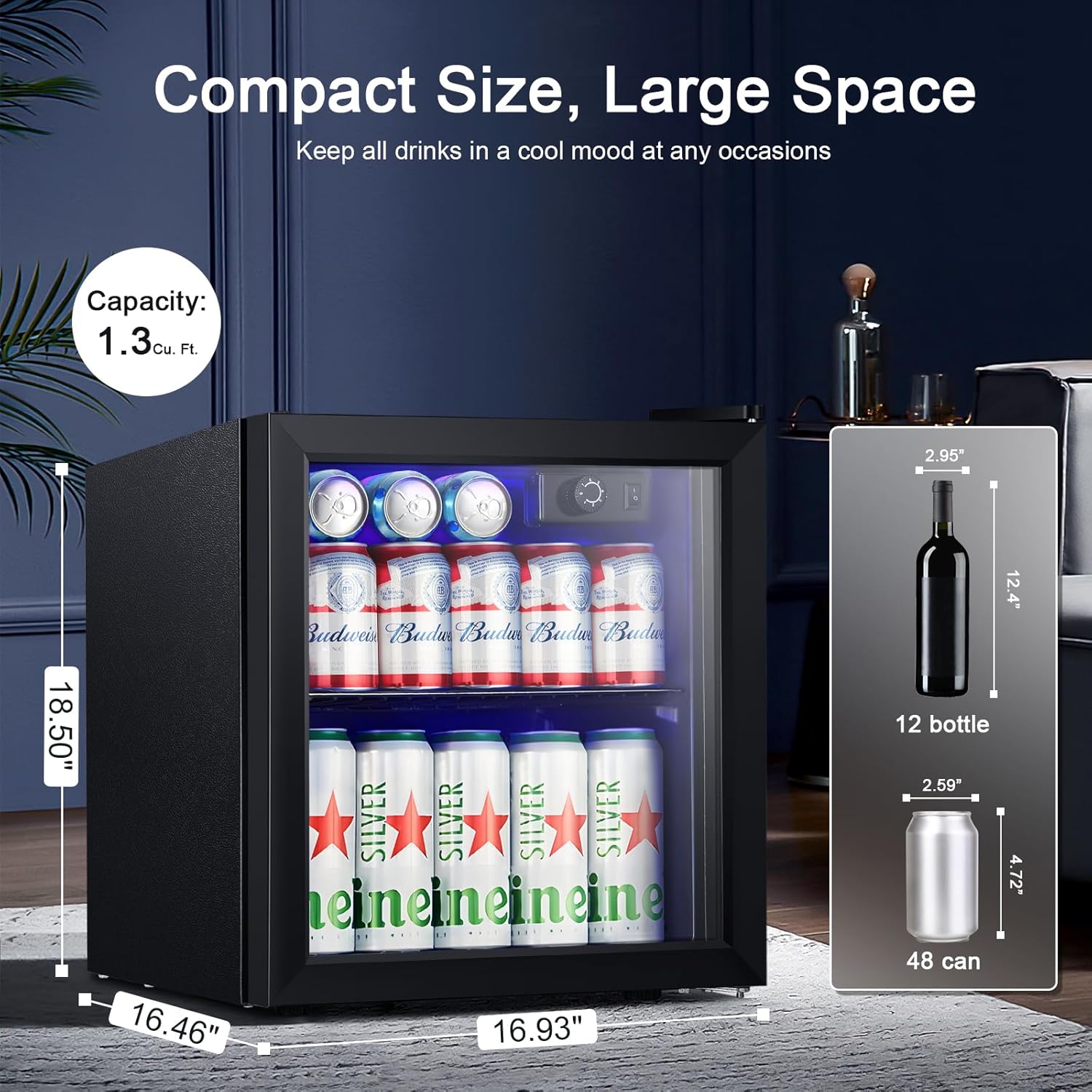
I’ve been using this Electactic 1.3 cu.ft (36L) mini drinks fridge in a small home office / gaming corner for a couple of weeks, basically as a dedicated can and bottle stash. I wasn’t looking for anything high-end, just something that keeps drinks cold without sounding like a jet engine or taking half the room. On paper, this one ticks most of those boxes: glass door, compact size, digital temp control, and a claimed capacity of up to 48 cans or around a dozen bottles.
In practice, it’s pretty much what you’d expect from a budget drinks fridge from a lesser-known brand. It cools properly, it’s reasonably quiet, and it looks decent enough that you don’t feel the need to hide it. At the same time, you can feel that some corners are cut: simple wire shelf setup, basic manual defrost, and the build doesn’t feel premium. Not terrible, just clearly “functional first”.
I mainly used it for a mix of 330ml cans, 440ml cans, and a few 750ml wine bottles to see how flexible it actually is. I also paid attention to noise (because it’s near a desk), temperature stability, and how annoying or not it is to live with day to day. Nothing scientific, just everyday usage – filling it, forgetting about it, and seeing if it quietly does its job.
If you’re expecting a compact, no-nonsense drinks fridge that keeps things chilled and looks okay behind a glass door, it does that. If you’re expecting premium build, perfect temperature accuracy, or massive capacity in a small footprint, you’ll probably find it a bit limited. Overall, it’s a pretty solid secondary fridge, but not some hidden gem that beats everything else on the market.
Value for money: fair price for what it offers, but not a bargain
In terms of value, this Electactic mini fridge sits in that middle zone: not dirt cheap, not high-end. Around the £100–£120 mark (depending on promos), you’re paying for a glass door, compact size, and quiet operation more than for premium materials or fancy features. Compared to some slightly larger no-name mini fridges that can be cheaper, this one feels a bit pricey per litre of capacity. On the other hand, similar glass-door beverage fridges from more established brands often cost more, so it sort of lands in the “reasonable but not outstanding” price bracket.
What you do get for the money is a fridge that actually cools properly, doesn’t roar like a cheap fan unit, and looks decent in a visible spot. If you’re putting this in a bedroom, office, or living room, the quieter compressor and glass door are worth something. The low energy consumption (about 60 kWh/year) also helps over time – it’s not going to spike your electricity bill. There’s no need for extra accessories or filters, so running costs are basically just power and the occasional wipe-down.
Where the value feels a bit weaker is in the overall finish and capacity. For the same price, you can sometimes find slightly bigger units with more shelves or door storage, but they might not look as tidy or run as quietly. So it’s a trade-off: you’re paying a bit for design and noise control rather than raw storage. If your priority is maximum litres per pound, there are better options. If your priority is a compact, reasonably quiet drinks fridge you’re okay looking at every day, then the price starts to make more sense.
Overall, I’d call the value “good enough”. It’s not a steal, but you don’t feel ripped off either. It does what it promises, it seems reliable so far, and it fills a specific niche (small, glass-door drinks fridge) pretty well. If you catch it on a discount, it becomes a much easier recommendation; at full price, it’s a solid but not spectacular deal.
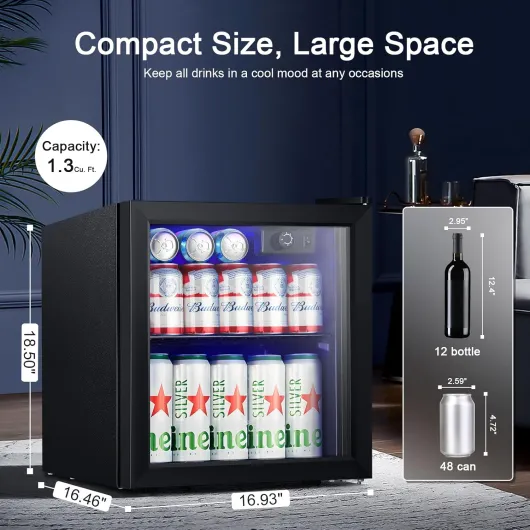
Design: simple black box with a glass door – looks fine, not premium
Design-wise, this thing is basically a black cube with a glass front. That’s not a complaint – for a drinks fridge, that’s exactly what most people expect. The tinted double-pane glass door lets you see what’s inside without having to open it constantly, and the tint helps a bit with light and temperature. It’s not a showpiece like some high-end wine coolers, but it looks clean enough next to a desk, in a gaming room, or under a counter in a small bar setup.
The footprint is actually one of the strong points. At roughly 42 x 43 cm, it doesn’t eat a ton of floor space and can slide under most desks or side tables. The height (about 47 cm) means you can also put it on a countertop without it looking huge. It has front leveling legs, which helps if your floor is slightly uneven. I had to tweak one leg to stop a minor wobble, but once adjusted it sat solidly and didn’t rattle when the compressor kicked in.
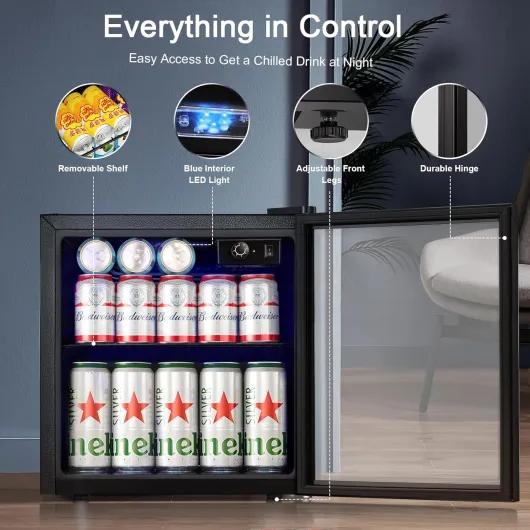
Inside, the layout is as basic as it gets: a wire shelf and open space. No complex compartment systems, no door racks. For a drinks-only fridge, that’s actually fine – fewer plastic bits to break. But it also means you’ll have to play a bit of Tetris if you want to mix tall bottles and short cans. You can remove the shelf entirely to stack bottles upright, but then you lose some of the neat organization for cans. The internal LED light is a nice touch for quickly checking stock, especially in a darker room, and it does give it a slightly more modern feel.
The overall look is “functional modern”. It doesn’t scream cheap, but you can tell it’s a budget appliance if you look closely at details like the door seal and interior plastics. Still, from a couple of meters away, it just looks like a straightforward glass-door drinks fridge, which is probably all most people care about. If you want something that blends quietly into a home office or bedroom without drawing attention, the design works well enough.
Build quality and materials: feels budget but not flimsy
Let’s be clear: this is a budget mini fridge from a relatively unknown brand, and the materials reflect that. The outer shell is basic painted metal, and the interior is standard white plastic with a simple wire shelf. The shelf itself is stainless steel according to the specs, but it still looks and feels like the usual coated wire racks you see in many fridges. It does the job: it holds cans and bottles without bending or wobbling, and it slides out easily for cleaning.
The door is the best-feeling part of the build. The double-pane glass has a bit of weight to it, and the black frame around it looks reasonably clean. The door seal is okay – not super thick, but it closes properly and doesn’t leave obvious gaps. Over a couple of weeks of use, the door didn’t sag or feel loose, and it stayed aligned with the body. The handle is integrated into the side of the door frame, so there’s no separate plastic handle to snap off, which I like.
On the inside, the plastics and finish are clearly not high-end. They’re smooth enough but a bit on the thin side. That said, there are no moving drawers or complex hinges inside, so there’s not much to break. The LED light is small but bright enough to see what’s going on, and it didn’t flicker or get hot. The compressor and rear components are exposed at the back like most small appliances, so you’ll want to avoid kicking it or shoving it right against a wall.
Overall, the materials are “good enough for a drinks fridge”. It doesn’t feel premium, but it also doesn’t feel like it’s going to fall apart in a month. If you treat it like a normal appliance – not a footrest or a stool – it should hold up fine for typical home or office use. Just don’t expect the kind of solid, heavy feel you’d get from a more expensive brand-name cooler.
Durability and long-term thoughts: feels okay, but brand is an unknown
Durability is always a bit of a question mark with lesser-known brands, and Electactic isn’t exactly a household name. From a short-term usage point of view, nothing about this fridge screamed “fragile”. The door hinges feel stable, the seal closes properly, and the compressor cycle sounds normal – no odd clunks or rattles. The wire shelf doesn’t bend under a full load of cans, and the interior plastics didn’t flex or creak more than you’d expect when loading bottles.
The manual defrost system is basic but actually a plus in terms of fewer things to fail. There’s no complex automatic defrost hardware, so as long as you occasionally clean it and don’t let ice build up for years, it should keep running. The energy draw is low, which usually means the compressor isn’t being pushed to crazy extremes. I’d still avoid stuffing it in a tight cabinet, because it does need those 2 inches of clearance around it to avoid overheating. Poor ventilation is one of the fastest ways to kill small fridges.
Where I’m a bit cautious is with after-sales support and spare parts. With bigger brands, you at least know you can usually get door seals or basic repairs sorted. With a smaller Amazon brand, it’s harder to say how things will go if something fails after a year or two. At the same time, the design is simple enough that there aren’t many failure points beyond the compressor and thermostat, and those are pretty standard components in this category.
So, realistically: it feels like it should last a few years with normal home or office use, but I wouldn’t treat it roughly or move it around constantly. If you want a drinks fridge that you’ll drag to events or use in a workshop where it might get kicked or bumped a lot, I’d maybe look for something more rugged. For static use in a corner of a room, the durability seems acceptable for the price, with the usual caveat that long-term reliability is a bit of a gamble with any budget brand.
Cooling performance and noise: decent chilling, quiet enough for a bedroom or office
The main question with a mini drinks fridge is simple: does it actually keep drinks cold, and does it annoy you while doing it? In this case, performance is pretty solid for the size and price. From room temperature, a full load of cans took a couple of hours to get properly chilled – not ice cold instantly, but ready to drink in a realistic time frame. Once cooled, the fridge holds temperature fairly consistently as long as you don’t keep opening the door every few minutes.
The temperature range is advertised at about 5–16°C (40–61°F), which lines up with what most people want for beer, soft drinks, and basic wine storage. I ran it mostly in the lower half of that range for cold sodas and beers. It doesn’t try to freeze anything, which is good – some cheap mini fridges overdo it and end up half-freezing cans at the back. Here, everything stayed liquid and cold, even near the rear wall. Like any fridge, it works better when it’s at least half full; an almost empty fridge swings a bit more in temperature.
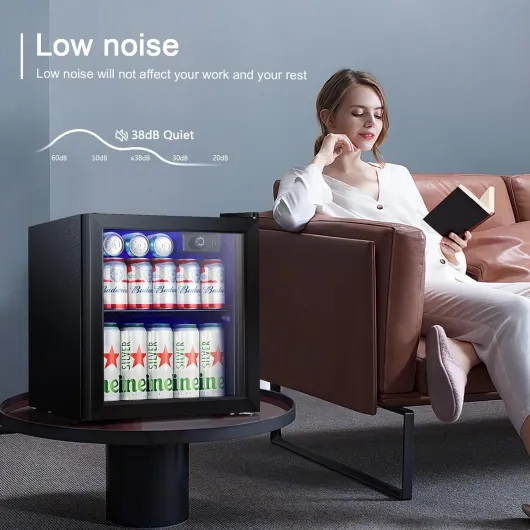
Noise-wise, it’s fairly quiet. You can hear the compressor kick in with a soft click and a low hum, especially in a silent bedroom at night, but it’s not the kind of noise that dominates the room. In a home office with a PC running, or a living room with a TV on, you basically stop noticing it. If you’re super sensitive to any mechanical noise, you’ll still hear it, but for most people it will be fine. I had it next to a desk and no one on calls commented on background noise.
The only slight downside on performance is that it’s not lightning fast at pulling down warm drinks if you stuff it full in one go. If you dump in a big haul of room-temperature cans, give it a bit of time. For regular top-ups – replacing a few cans here and there – it handles it without much issue. Overall, it cools like a normal, small compressor fridge: not high-end, not terrible, just competent and predictable.
What you actually get with this Electactic mini drinks fridge
On paper, the Electactic beverage fridge is a 1.3 cu.ft (36L) unit, roughly 41.8 x 43 x 47 cm, so it’s more “under-desk cube” than “big bar fridge”. The brand advertises it as taking up to 48 cans or 12 bottles, with a temperature range of about 5–16°C (40–61°F). It’s a freestanding unit only, so you’re not building this into cabinetry – it needs about 2 inches of space around it to breathe. It plugs into a standard 120V socket and pulls about 60 kWh per year according to the specs, which is pretty low.
Out of the box, you get the fridge, a removable wire shelf, and basic paperwork. That’s it. No fancy accessories or extra trays. The door is a tinted double-pane glass panel with a black border, and the body is black as well. The door is hinged on the left and not reversible, so keep that in mind when planning where to put it. The controls are described as digital, but in practice it’s very simple: you set a temperature level and forget it – this is not a lab-grade thermostat.
The layout inside is pretty straightforward: open space with a wire shelf you can slide or remove. The stated capacity is a bit optimistic if you mix can sizes and bottles, but you can definitely stock enough drinks for a small household, a bedroom, or a shared office corner. It’s not trying to be a food fridge – no freezer section, no crisper drawer, nothing like that. It’s clearly built around drinks only.
Overall, the presentation is basic but clear: this is a compact, glass-door drinks fridge with simple controls, low-ish power use, and enough space for casual use. It doesn’t pretend to be more than that, and the feature list matches the price point. If you’ve used similar Amazon mini fridges before, this will feel very familiar: same general idea, just a slightly different badge and dimensions.
Everyday effectiveness: how it actually works in real life
In day-to-day use, this fridge does what you buy it for: it keeps a decent amount of drinks at a steady cold temperature and makes them easy to grab. I used it mainly for soft drinks, beer, and a couple of wine bottles. With the shelf in place, you can stack cans in rows and still have room for a couple of taller bottles laid horizontally. If you pull the shelf out, you can stand wine bottles upright, but you obviously lose some can capacity. So you need to decide if you want a can-heavy setup or more flexibility for mixed bottles.
The digital temperature control is basic, but it’s handy not having to guess with a vague dial. You set it within the 5–16°C range and leave it. For cold sodas and beers, I kept it near the lower end, and everything came out pleasantly cold without frosting. For wine, you’d probably nudge it a bit higher. It’s not ultra-precise like a dedicated wine cooler with separate zones, but for casual use it’s more than enough. You don’t get fancy features like different modes or timers, and honestly, that’s fine here.
One thing I appreciated is that it doesn’t seem to over-condense or create a puddle inside. There is manual defrost with an automatic drip tray evaporation system, which basically means that any frost or moisture from defrosting is handled at the back. Over the test period, I didn’t have to do anything about it. Long term you’ll still want to defrost and clean it occasionally, but it’s not high-maintenance. Also, the internal light is genuinely useful when the fridge is in a dim corner – you can see what’s left at a glance through the glass door.
So in practice, it’s effective as a secondary drinks fridge. It doesn’t pretend to be multi-purpose. I wouldn’t rely on it as your only fridge or use it for raw food, but for cans, bottled water, beers, and a couple of wines, it works well. If you keep your expectations realistic – simple cooling, modest capacity, low hassle – it delivers that without any big issues.
Pros
- Compact size with a glass door that looks clean in an office, bedroom, or bar corner
- Cools drinks to a proper chilled temperature and keeps it steady for everyday use
- Quiet compressor and low energy consumption, suitable for indoor living spaces
Cons
- Limited capacity and basic interior layout, especially if you mix cans and tall bottles
- Build and materials feel budget, and long-term durability from this brand is uncertain
Conclusion
Editor's rating
Overall, the Electactic 1.3 cu.ft mini drinks fridge is a straightforward, no-drama option if you just want cold drinks in a small space. It cools properly, runs quietly enough for an office or bedroom, and the glass door with internal light makes it easy to see what you’ve got left. The compact footprint and simple layout make it easy to slot under a desk or on a counter, and the low energy use is a nice bonus. It’s not packed with features, but for cans, beers, and a few bottles of wine, it gets the job done reliably.
On the downside, the capacity is limited and the interior is pretty basic. You won’t be storing loads of mixed bottle sizes without some compromise, and the materials clearly sit in the budget range. The brand isn’t well-known, so long-term support is a bit of a question mark, and at full price it’s more “fair” than “great deal”. If you need maximum storage per pound or want something very premium-looking, you’ll probably want to look higher up the range or at bigger brands.
If you’re setting up a small home office, bedroom, gaming room, or mini bar and just want a compact, decent-looking fridge for drinks that doesn’t make a racket, this one fits nicely. If you want a main kitchen appliance, a serious wine cabinet, or a heavy-duty unit for rough environments, this isn’t it. For casual, everyday drink cooling in a small footprint, it’s a pretty solid, practical choice.