Summary
Editor's rating
Value for money: decent if you prioritise size and looks over efficiency
Design: looks modern, but capacity claims are optimistic
Build quality and materials: mostly decent, with some budget touches
Durability and daily use: feels fine, but energy rating isn’t great
Cooling performance and noise: does the job if your room isn’t too hot
What you actually get with this Loops 28-bottle cooler
Pros
- Compact footprint with space for around 20–24 mixed bottles in real use
- Compressor cooling with 5–18°C range and automatic defrost for stable performance
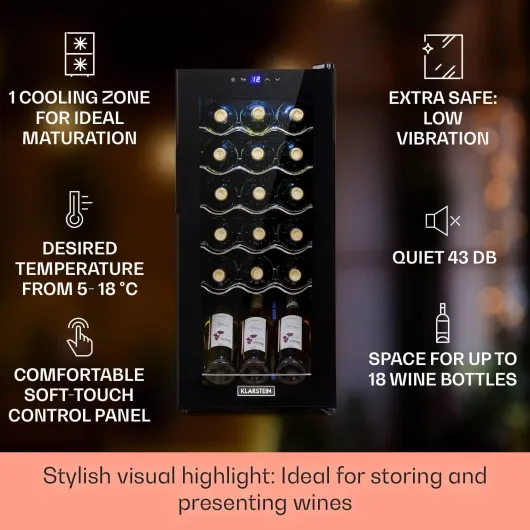
- Quiet enough at around 39 dB and looks modern with the mirrored glass door
Cons
- Energy Efficiency Class G means higher running costs over time
- Real-world capacity lower than the claimed 28 bottles, especially with mixed bottle shapes

Specifications
View full product page →| Brand | Loops |
A compact wine fridge for people who just want cold bottles
I’ve been using this Loops 28 Bottle Free Standing Wine Cooler in my kitchen for a little while now, and I’ll be honest: I bought it mainly because I was sick of wine and beers taking over my normal fridge. I’m not a sommelier, I just wanted something that keeps bottles at a stable temperature and looks decent under the counter. On paper, this one ticked the boxes: 28 bottles, touch controls, LED light, compressor cooling, and a size that doesn’t eat the whole room.
After setting it up and actually living with it, my opinion is a bit mixed. It does the basic job: it cools, it’s fairly quiet, and it looks modern enough with the black finish and glass door. But you quickly realise that the “28 bottles” claim is under pretty ideal conditions, and the energy rating isn’t great. If you’re hoping for some ultra-efficient, perfectly optimised wine cellar, this isn’t it.
What pushed me to test it was the combination of price and size. Compared to some big-brand wine coolers, this one is usually cheaper and more compact, so it seemed like a decent compromise. I wasn’t expecting miracles, just something reliable and not too noisy. In practice, it mostly delivers that, with a few small annoyances that you only notice after a couple of weeks, like how tight the shelves are with different bottle shapes and how sensitive it is to room temperature.
If you’re thinking about getting it, I’d say go in with realistic expectations: it’s a basic compressor wine fridge that looks good and cools properly, but it’s not perfect and there are a few design choices that feel a bit “budget”. Whether that’s a deal-breaker depends on how picky you are about noise, energy use, and shelf layout.
Value for money: decent if you prioritise size and looks over efficiency
On the value side, I’d put this Loops wine cooler in the “good but not unbeatable” category. The main things you’re paying for are the compact footprint, the 20+ bottle capacity, and the decent design with the mirror glass door. If you compare it with big-brand coolers with similar capacity, it often comes in cheaper, and for many people that’s enough: it cools, looks presentable, and you don’t have to spend a fortune.
Where you slightly lose out is on energy efficiency and fine details. The G energy class means it’s not exactly cheap to run over the long term. Also, the interior layout and shelves are a bit basic. If you only ever store standard wine bottles and you’re not too fussy, it’s fine. But if you want to mix sparkling, large-format bottles, and other drinks, you’ll hit the limits of the design quite quickly and might feel like you’re not getting the full 28-bottle promise.
Compared to some thermoelectric coolers I’ve tried before, this one at least offers more stable cooling and better performance when the room gets warm. So while it costs a bit more than the really cheap “toy” wine fridges, you do feel the difference in cooling quality. For me, that’s worth paying for, especially if you actually care about not cooking your wine in the summer.
So, is it good value? I’d say yes, for casual wine drinkers and people who want a tidy drinks fridge, as long as you’re aware of the energy rating and the realistic capacity. If you’re super picky about running costs or you want advanced features like dual temperature zones and premium shelving, you’ll probably be happier spending more on a higher-end brand.
Design: looks modern, but capacity claims are optimistic
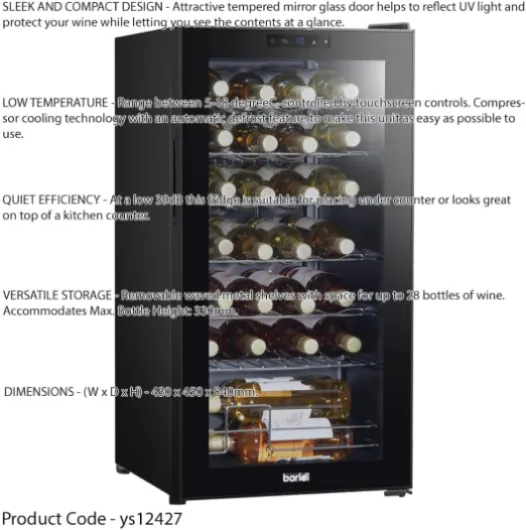
From a distance, the design is actually pretty solid. The black glossy finish and mirrored glass door look clean and modern, and it doesn’t scream “cheap appliance” when you walk into the room. The mirror effect also means you don’t see every single bottle label clearly when the light is off, which some people will like and some won’t. When the LED light is on, you can see the inside well enough through the glass, so you don’t have to open the door every time to check what’s left.
The main design issue for me is the 28-bottle capacity claim. Yes, you can technically get close to that number, but only if you’re using standard Bordeaux-style bottles and you’re careful with how you stack them. As soon as you mix in a few fatter champagne bottles or some odd-shaped craft beer bottles, the capacity drops quickly. In practice, I’m more in the 20–22 bottle range when I have a mixed selection, unless I start removing shelves and playing Tetris with the layout.
The touch controls are on the top front edge inside the door area, which is convenient enough. They’re simple: up/down for temperature, light on/off. They respond fine, but they feel a bit basic and plasticky. Not a big deal, but it reminds you this isn’t a premium unit. The LED light is soft white and not overly bright. It’s good for checking what’s inside in the evening without lighting up the whole room, but if you want a proper display effect, it could be stronger.
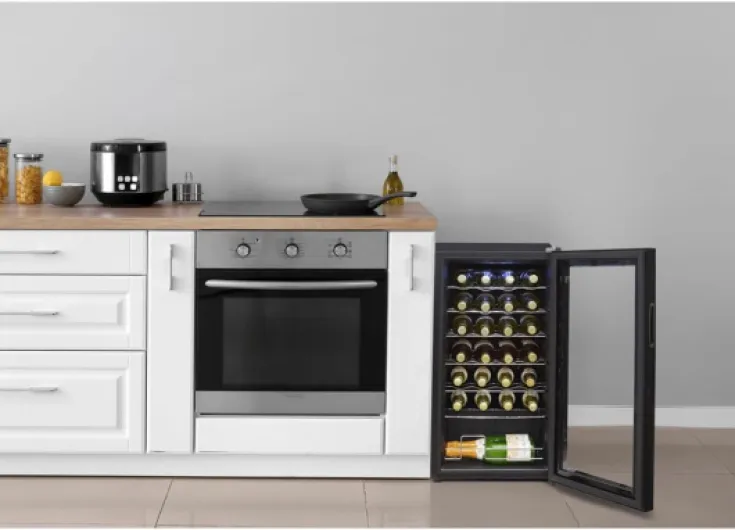
In terms of footprint, the narrow width is a real advantage if you don’t have much space. It slots nicely next to my kitchen units without sticking out too much. Just remember you really do need that airflow gap around it, so you can’t jam it totally flush. Overall, I’d say the design looks good for the price, but the bottle capacity is optimistic and the interior layout is a bit tight once you mix different bottle shapes.
Build quality and materials: mostly decent, with some budget touches
The materials are pretty much what you’d expect in this price range: a mix of metal, glass, and plastic. The tempered glass door feels solid enough when you open and close it. The hinge action is smooth and doesn’t feel wobbly. The mirror effect on the glass does pick up fingerprints, though, so if you’re picky about smudges, you’ll be wiping it down fairly often. The glossy black exterior also shows dust more than a matte finish would, but that’s just the trade-off for that shiny look.
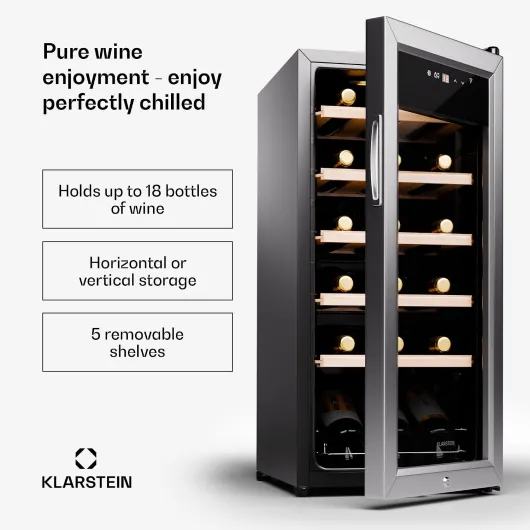
Inside, the waved metal shelves are light but reasonably sturdy. They slide in and out without bending too much, though you can feel they’re not heavy-duty. If you load them with a lot of full bottles, they hold, but I wouldn’t be yanking them around aggressively. The shelves are removable, which is handy if you want to store taller bottles, but then you obviously lose some capacity. The internal walls are standard white plastic, nothing fancy. Easy enough to wipe down if something spills.
The control panel and trim around the door are clearly where they saved some money. The plastic doesn’t feel premium, but nothing feels like it’s about to break either. The door seal sits properly all around the frame and closes firmly, which is more important than how it looks. I haven’t noticed any condensation or weird gaps around the door so far, so from a functional point of view, it’s fine.
Overall, the build quality is “good enough”. It’s not luxurious, but it also doesn’t feel like a toy. If you treat it like an appliance and not like a bench, it should hold up. I wouldn’t expect it to survive rough handling or constant moving, but for a static spot in a kitchen or living room, the materials are in line with the price tag.
Durability and daily use: feels fine, but energy rating isn’t great
In terms of durability, I obviously haven’t had it for years, but after regular use, nothing has given me a bad feeling. The door hinge and seal still feel tight, the shelves haven’t deformed under the weight of full bottles, and the compressor behaviour is consistent: no odd rattles, no strange vibrations. I’ve moved it once to clean behind it and the structure felt rigid, not flimsy. It’s clearly not industrial-level, but for home use it seems decent.
Where it’s less impressive is the energy side. It’s rated Energy Class G, which is pretty much at the bottom of the current scale. In real life, that means it’s not the most economical appliance to run 24/7. It’s not outrageous, but if your electricity prices are high and you’re trying to cut consumption, this is something to think about. A more efficient model might cost more upfront but save a bit over time. Personally, I accepted this because it’s not my main fridge and it’s not huge, but it’s still a point against it.
For day-to-day durability, the interior is easy to wipe down and there aren’t many moving parts besides the door and shelves, so there’s not much to break. The automatic defrost also helps, because you’re not scraping ice or messing with it, which is usually how people damage things. As long as you respect the ventilation gaps and don’t block the back, the compressor should have an easier life and run cooler.
My overall impression: build and durability feel okay for home use, but don’t expect this to be a super efficient, ultra-robust wine cellar for decades. It’s more of a mid-range appliance that should serve fine if you treat it reasonably and accept the weaker energy rating.
Cooling performance and noise: does the job if your room isn’t too hot
Performance-wise, this is where the fridge either makes sense for you or not. The stated temperature range is 5°C to 18°C, and in my usage it actually reaches those numbers, but with one important condition: the room temperature needs to stay reasonable. The brand recommends an ambient temperature up to 25°C, and that’s pretty accurate. In my kitchen at around 21–23°C, it holds 7–12°C without struggling. When we had a warmer day and the room went closer to 26–27°C, it clearly had to work harder and the internal temperature drifted 1–2 degrees higher than what I set.
The compressor cooling is a plus compared to cheaper thermoelectric wine coolers. It cools down from room temperature to 8–10°C in a few hours after setup, and after that it just cycles on and off to maintain the temperature. You hear the compressor kick in, but the 39 dB rating feels about right: it’s a low hum, not a loud buzz. In an open-plan living room/kitchen, you notice it at first, then your brain ignores it. If you’re extremely sensitive to noise and want total silence, you might prefer a different type of cooler, but for me it’s acceptable.
The automatic defrost is basically invisible in daily use. I haven’t seen any ice build-up on the back wall; there’s sometimes a bit of condensation, but it drains away and doesn’t cause puddles. The temperature control is in whole degrees, and the display seems roughly accurate when I compare it with a separate fridge thermometer I put in there. It’s not lab-precise, but close enough for wine and beers.
One thing to keep in mind: if you open the door a lot, the internal temperature jumps quickly and the compressor has to catch up. With a full load of bottles, it takes longer to stabilise again. So if you’re constantly opening it during a party, don’t expect the temperature to stay perfectly stable. In normal day-to-day use, though, the performance is pretty solid for a single-zone, compact unit.
What you actually get with this Loops 28-bottle cooler
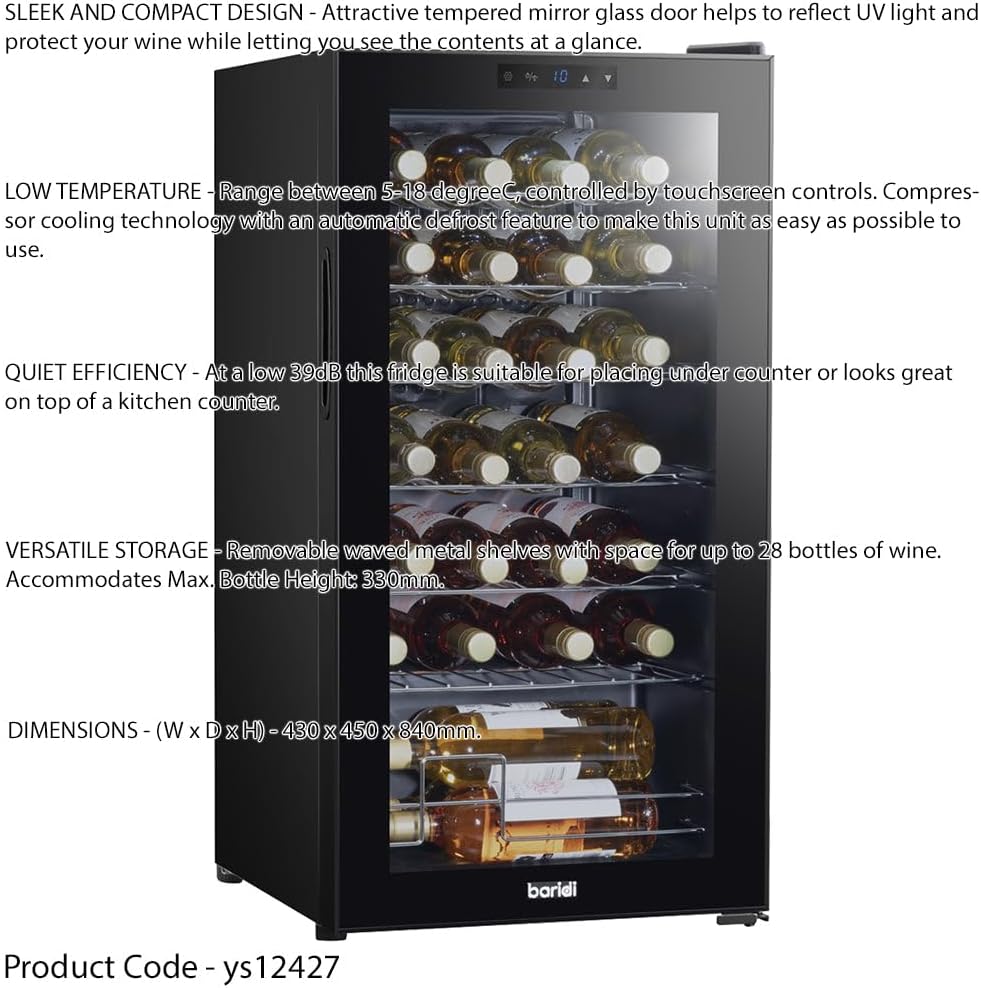
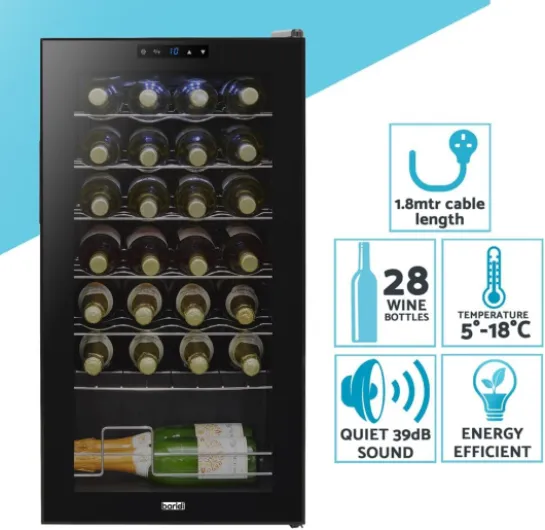
On the spec sheet, this fridge is pretty straightforward. It’s a freestanding wine cooler with a stated capacity of up to 28 bottles, compressor cooling, and a temperature range from 5°C to 18°C. The dimensions are 43 cm wide, 45 cm deep, and 84 cm high, so it’s narrow and fairly tall, which works well if you want to slide it next to a cabinet or under a counter with a bit of clearance. It runs at about 39 dB according to the info, which is on the quiet side for a compressor unit.
Inside, you get waved metal shelves that are removable, a soft white LED light, and a simple control panel at the top with touch buttons to set the temperature and switch the light on or off. The door is a tempered mirror glass that’s meant to reflect UV light and protect the wine. The cooling is handled by a standard compressor system with automatic defrost, so you don’t have to manually scrape ice or anything like that. Power cable is 1.8 m, which is enough to reach a nearby socket without needing an extension in most kitchens.
The manual is pretty clear about one thing: ventilation space matters. You need at least 50 mm at the back and 30 mm on the top and both sides. If you ignore that and cram it into a tight cupboard, don’t expect it to perform well. I left the recommended gap and the sides still get a bit warm, so I’m glad I didn’t try to box it in more.
Overall, the presentation is “no nonsense”. It’s a basic, compact wine fridge. No fancy app, no Wi‑Fi, no dual zones. It cools a bunch of bottles in a single temperature zone and looks decent while doing it. If that’s what you’re after, the feature set is in line with the price. Just don’t expect premium tricks or smart features, because they’re simply not there.
Pros
- Compact footprint with space for around 20–24 mixed bottles in real use
- Compressor cooling with 5–18°C range and automatic defrost for stable performance
- Quiet enough at around 39 dB and looks modern with the mirrored glass door
Cons
- Energy Efficiency Class G means higher running costs over time
- Real-world capacity lower than the claimed 28 bottles, especially with mixed bottle shapes
Conclusion
Editor's rating
After living with the Loops 28 Bottle Free Standing Wine Cooler, my take is simple: it’s a practical, no-frills wine fridge that does the core job reasonably well. It keeps bottles at a stable temperature, it’s quiet enough for a kitchen or living room, and it looks modern with the black glossy finish and mirrored glass door. The compressor cooling and automatic defrost are real advantages over cheaper thermoelectric units, especially if your room temperature varies across the year.
On the downside, the Energy Class G rating isn’t great, and the advertised 28-bottle capacity is optimistic unless you only use standard bottles and pack them carefully. The materials and finish are clearly mid-range, and the controls are basic, but they work. For someone who wants a compact, decent-looking wine or drinks fridge without paying premium-brand prices, it’s a pretty solid option. If you’re more demanding about energy use, capacity flexibility, or you want dual zones and higher-end shelving, you should probably look higher up the range and be ready to pay more.