Summary
Editor's rating
Value for money: who it makes sense for
Design: compact, dual zone, but with some compromises
Noise, daily use, and general comfort
Build quality and how sturdy it feels
Performance: keeps wine in range, but not perfectly precise
What you actually get out of the box
Pros
- Dual-zone cooling that clearly separates whites and reds with simple digital controls
- Compact footprint with a lockable glass door, good for kitchens, bars, or condos
- Reasonably quiet operation and stable day-to-day temperatures for casual use
Cons
- Realistic capacity closer to 18–22 bottles, not the advertised 28 for mixed bottle shapes
- Budget build quality (especially shelves) and unknown brand make long-term durability uncertain
- Door is left-hinged only and not easily reversible, which can limit placement options

Specifications
View full product page →| Brand | DYTesa |
A small dual‑zone wine fridge that tries to do it all
I’ve been using this 15" DYTesa wine cooler for a few weeks in my kitchen, mainly for reds and a few whites I rotate through. I’m not a sommelier, I just drink a fair bit of wine and was tired of stuffing bottles in the main fridge or leaving reds in a warm cupboard. I wanted something narrow, lockable, and with two zones so my whites could actually be cold while the reds weren’t freezing.
On paper, this model ticks a lot of boxes: dual zone, up to 28 bottles, digital temperature control, lockable door, and it’s supposed to be fairly quiet. It’s also from a brand I’d never heard of (DYTesa), so I went into it thinking “this might be decent, or it might feel like a cheap import with a fancy description.” The specs are a bit confusing too, with some weird Fahrenheit ranges in the listing that don’t fully match the Celsius ones, so I paid more attention to what the display shows in real life.
After actually living with it, I’d say it’s a pretty solid budget wine fridge with a few quirks. It does keep bottles at roughly the right temperature, and the dual-zone part works, but it’s not perfect on space, noise, or consistency of cooling. You can tell it’s not high-end, but it also doesn’t feel like a toy.
If you’re expecting a professional-grade wine cellar, this isn’t it. If you just want something narrow that fits in a condo kitchen or bar area and keeps a couple dozen bottles in a reasonable temperature range, it gets the job done. The rest of this review is just me breaking down where it works well and where it’s a bit “meh.”
Value for money: who it makes sense for
On value, this fridge sits in that awkward middle ground: not ultra-cheap, not premium brand either. For a 15" dual-zone, lockable, 20-ish bottle practical capacity unit, the price is generally lower than big-name options but higher than no-name single-zone coolers. So the real question is whether the dual-zone and lock are worth paying a bit extra for an unknown brand like DYTesa.
If you compare it to single-zone coolers in the same size, you’re mainly paying for:
- Dual temperature zones (whites on top, reds below)
- Lockable glass door (useful if you have kids or shared spaces)
- A slightly more “wine cellar” style feature set (humidity claims, carbon filter)
Compared to better-known brands, you’re saving some money but giving up on brand reputation, probably warranty quality, and some polish. The temperature accuracy and shelf design here are clearly more “budget” than what you’d get from a high-end unit. If you’re storing very expensive bottles, I’d say spend more. If you’re storing supermarket-to-midrange bottles that you drink within months, this is good enough and you won’t feel like you’re wasting money.
For me, the value feels fair but not outstanding. It’s good value if you specifically want a narrow, dual-zone, lockable unit and you’re okay with a no-name brand. If you’re flexible on size or can live with a single zone, you might find something cheaper that does 80% of the job. So it’s not a crazy bargain, but it’s also not overpriced for what it offers.

Design: compact, dual zone, but with some compromises
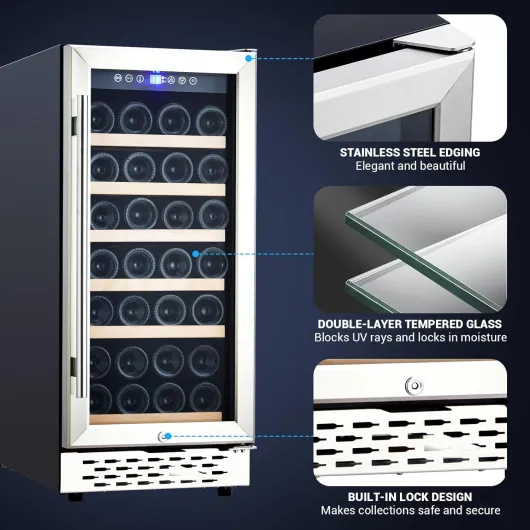
The design is pretty straightforward: black cabinet, glass door, metal shelves, LED lighting, and a dual-zone layout. The door is a double-layer tempered glass, which is meant to block some light and help with temperature and humidity. It’s slightly tinted, so you can see your bottles but they’re not fully exposed like a shop display. The handle is integrated into the side of the door frame instead of being a big bar handle, which helps if you’re tight on space.
Inside, you’ve got 6 adjustable shelves plus the bottom space. The shelves are the typical wire-style racks, shaped to hold standard 750 ml bottles. The manufacturer claims up to 28 bottles, and that’s technically possible if you mostly use standard Bordeaux-style bottles and don’t mind stacking a bit. Once you start adding thicker Burgundy bottles, Champagne, or odd-shaped bottles, you’ll hit more like 18–22 before it starts getting annoying. I had to pull one shelf out to fit a couple of fatter bottles upright at the bottom.
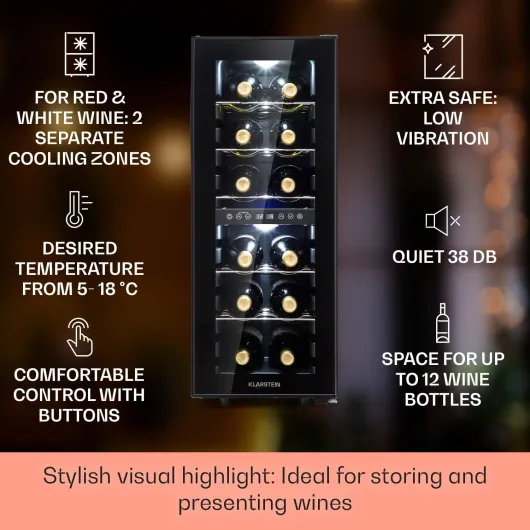
The dual-zone layout is vertical: upper zone for whites/sparkling, lower zone for reds. You control each zone separately. The separation is decent, but don’t expect perfect lab-grade isolation. If you open the door a lot, both zones shift a bit and take time to settle back. It’s designed more for “set and mostly forget” than constant browsing. The LED lighting is soft and not too blue or harsh, which I liked; it lights the bottles without looking like a nightclub.
On the downside, the fridge is left-hinged only and you can’t reverse the door, at least not easily from what I can see. That might be annoying depending on your layout. Also, the depth (46 cm) plus the door swing means you need a bit of clearance in front and to the side, so it’s not as flexible as a smaller under-counter unit. Overall, the design is functional: not pretty, not ugly, just a regular black glass-door wine fridge that fits into a modern kitchen without drawing attention.
Noise, daily use, and general comfort
For everyday comfort, the big question is noise. The listing talks about a shock absorption system and quiet operation. In reality, I’d call it moderately quiet. In my open kitchen/living room, you can hear the compressor kick in as a low hum, but it’s not loud enough to be annoying unless you’re super sensitive. It’s quieter than my old cheap bar fridge, but not as silent as some premium wine coolers I’ve heard in showrooms.
When it runs, there’s a slight vibration if you touch the side panel, but the bottles themselves don’t rattle. The shock absorption seems to do enough to keep things steady. I didn’t notice any sediment being disturbed in reds that had been sitting a while, at least not more than from normal handling. If you plan to put this in a bedroom, I think you’d find it too noisy. In a kitchen, dining area, or home bar, it’s okay.
Using it day to day is simple. The touch controls respond well, and you’re not fighting with weird button combinations. You tap the zone, tap + or −, and that’s it. The lock is basic but works: you turn the key at the bottom of the door and it keeps kids or guests from casually opening it. It’s not a high-security lock, just enough to discourage casual access. The LED light turns on when you open the door; you can leave it on if you want your bottles displayed, but I just let it auto-on/off.
The only comfort downside for me is shelf spacing and access. If you pack it close to the 28-bottle claim, sliding bottles in and out gets a bit fiddly, especially for non-standard bottle shapes. Sometimes you have to partially pull out a shelf to get a bottle in the back. If you keep it more like 18–20 bottles with a bit of breathing room, it’s a lot nicer to use. So in practice, for comfort, I’d treat it as a 20-bottle fridge that can hit 28 if you really push it.
Build quality and how sturdy it feels
Obviously I haven’t had this thing for years, so I can’t speak to long-term durability, but I can comment on how it feels and what I’ve noticed so far. The cabinet itself feels solid enough. It’s heavy (around 86 pounds / ~39 kg), so it doesn’t feel flimsy. Moving it into place is a two-person job if you have stairs. Once it’s in place, it sits stable and doesn’t wobble.
The door is probably the main part I checked. The hinge feels okay, not loose, and the door closes with a decent seal. The rubber gasket is standard quality; I didn’t see any gaps or obvious weak points. I did notice you need to push the door firmly sometimes to make sure it fully seals, especially if the fridge is slightly out of level. So taking a couple of minutes to level it with the adjustable feet is worth it.
The shelves are where it feels more budget. They’re thin metal wire racks; they hold the weight fine, but if you pull them out fully with several bottles, they flex a bit. I wouldn’t yank on them. If you’re gentle and slide them out halfway to grab bottles, they’re fine. I wouldn’t expect them to survive rough handling or constant heavy re-arranging. The plastic trims inside also feel basic, nothing fancy, but no sharp edges or obvious defects on my unit.
Electronics-wise, the control panel and compressor haven’t shown any issues so far. The temperature holds, the lights work, no random beeping or error codes. With unknown brands like DYTesa, my main worry is always long-term spare parts and after-sales service. If something breaks in 3–4 years, it might be cheaper to replace the whole unit than to repair it. So I’d say: build quality is okay for the price, but I wouldn’t buy this expecting 10–15 years of service. Think more in the 4–7 year range if you’re lucky and take care of it.
Performance: keeps wine in range, but not perfectly precise
In terms of cooling performance, it does what it’s supposed to do for everyday use. I set the upper zone to 7 °C for whites and the lower zone to 14 °C for reds. After a few hours, the internal thermometers I put on two shelves showed around 7.5–8 °C at the top and 14.5–15 °C at the bottom. So it’s not dead-on, but it’s close enough for home use. The main thing is that it’s stable once it settles, as long as you’re not opening the door every ten minutes.
The dual zone actually works, in the sense that the upper area is clearly colder to the touch when you grab a bottle. Whites and sparkling come out cool enough to drink pretty quickly, especially if you pre-chill them a bit in a regular fridge. Reds come out at a comfortable, slightly cool temperature, not room temperature. If you’re super picky about exact degrees, this fridge might annoy you a bit, but if you just want “whites cold, reds cool,” it’s fine.
The compressor cycles on and off like any small fridge. It’s not instant-cold; if you load it full of room-temperature bottles, expect several hours to get everything to your target temps. I tested it by filling it with 20 bottles at room temp and checking after 2, 4, and 8 hours. After 2 hours, both zones were still a bit warm (around 10 °C top, 18 °C bottom). After 4–5 hours, they were close to target. So it works better if you don’t throw in a whole warm case at once.
The humidity claim of 60–80% is harder to verify without a hygrometer, but corks didn’t dry out in the test period, and there was no visible condensation on the glass. The built-in carbon filter is there to keep smells down; I didn’t notice any plastic or chemical odor after the first day. Overall, performance is decent but not precision-obsessed. For casual drinkers and small collections, it’s good enough. For serious collectors storing expensive bottles for years, I’d probably look at something higher-end.
What you actually get out of the box
Out of the box, the presentation is pretty basic. You get the fridge, the shelves, a small bag with the key for the lock, and a thin manual that’s clearly translated but at least understandable. No fancy extras, no wine accessories, nothing like that. For the price point and unknown brand, I wasn’t expecting more, so that’s fine.
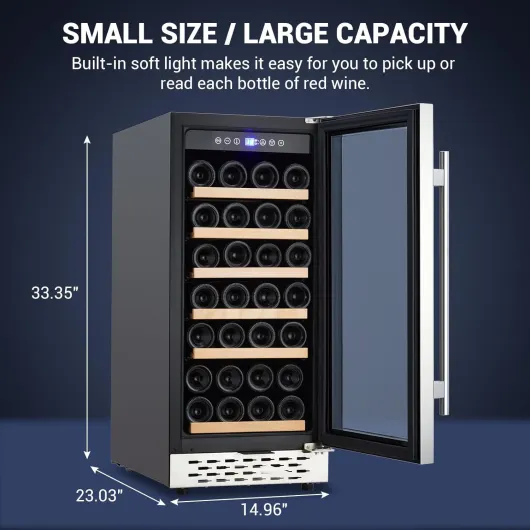
The first thing I noticed is the size: 46D x 65.5W x 93H cm. It’s taller than it looks in the photos and a bit wider than a typical 15" built-in model, so measure your spot. I originally planned to tuck it fully under a counter, but because of the height and the way the door swings (left-hinged), I ended up shifting it slightly to the side of a cabinet instead of flush in the middle. It’s sold as “countertop/compact” but in reality it’s more of a freestanding floor unit you can slide under or next to counters, not something you’d put on top of a counter.
The control panel is at the top inside, with a touchscreen-style digital display. It shows the temperatures for each zone and has simple +/− buttons. Nothing fancy, but it’s straightforward. The display is bright enough to read even in low light, which I liked when checking it at night. The manual’s temperature ranges in Fahrenheit are a bit all over the place (the listing says 10–20°F and 20–60°F, which is obviously wrong), but on the actual unit you set it in Celsius and it matches the 4.4–12.8 °C (upper) and 12.8–18.3 °C (lower) ranges.
Overall, the first impression is: no-nonsense, looks like a regular black wine fridge, clearly budget but not junk. If you’re used to big brands like Haier or Kalamera, you’ll see the difference in polish, but it doesn’t scream “cheap plastic toy” either. It’s somewhere in the middle, which is kind of what I expected for a lesser-known brand at this size.
Pros
- Dual-zone cooling that clearly separates whites and reds with simple digital controls
- Compact footprint with a lockable glass door, good for kitchens, bars, or condos
- Reasonably quiet operation and stable day-to-day temperatures for casual use
Cons
- Realistic capacity closer to 18–22 bottles, not the advertised 28 for mixed bottle shapes
- Budget build quality (especially shelves) and unknown brand make long-term durability uncertain
- Door is left-hinged only and not easily reversible, which can limit placement options
Conclusion
Editor's rating
Overall, this DYTesa 15" wine cooler is a decent, no-frills dual-zone fridge that does what most casual wine drinkers need. It keeps whites reasonably cold, reds comfortably cool, and it looks neutral enough to blend into a kitchen or bar area. The digital controls are simple, the noise level is acceptable for a living area, and the lock and glass door are practical if you want your bottles visible but not easily accessed by kids or guests.
It’s not perfect. The 28-bottle claim is optimistic unless you have all standard bottles and pack them tightly. The shelves feel a bit light, and the brand isn’t exactly reassuring if you’re thinking long-term investment. Temperature is close to target but not precision-level, and the door being left-hinged only might be annoying depending on your layout. That said, for everyday drinkers who rotate through 15–20 bottles and just want them stored better than on a warm shelf or crammed in the main fridge, it gets the job done without too much fuss.
If you’re a serious collector with expensive bottles and you care a lot about exact temperatures, long-term storage, and brand support, I’d skip this and look at higher-end brands. If you’re in a condo or small house, drink regularly, and want a compact dual-zone fridge at a reasonable price, this is a pretty solid option as long as you go in with realistic expectations about capacity and precision.