Summary
Editor's rating
Value for money: decent if you accept its limits
Design: mirror glass looks nice, but it’s a fingerprint magnet
Materials and build: decent for the price, but not high-end
Packaging and installation: protected well, but the size info is confusing
Durability and day-to-day use: feels reliable, with a few small quirks
Cooling performance and noise: stable temps with some hum
What you actually get with this 24-bottle dual zone fridge
Pros
- Stable dual-zone cooling from 5–18°C with reliable compressor performance
- Modern mirror-glass design with wooden shelves that looks decent in most rooms
- Pretty solid build quality for the price, with automatic defrost and straightforward controls
Cons
- Real-world capacity is often less than 24 bottles if you use larger or mixed bottle shapes
- Compressor makes a noticeable hum in very quiet rooms and needs 10 cm ventilation space all around

Specifications
View full product page →| Brand | Loops |
A small wine fridge for people who are tired of cramming bottles in the kitchen fridge
I’ve been using this Loops 24 Bottle Dual Zone Wine Cooler for a few weeks now, mainly because I was fed up with wine bottles rolling around between leftovers and ketchup in the main fridge. I’m not a sommelier, I just wanted something that keeps reds and whites at roughly the right temperature without me having to think about it too much. On paper, this model ticks the basics: dual zone, up to 24 bottles, compressor cooling, and a fairly compact footprint.
Right away, I’ll say this: it’s not a luxury piece of kit, but it does the job for a small collection. If you’re sitting on rare vintages, this is probably not the level of gear you’re looking for. If you just want your supermarket or mid-range bottles stored better than upright on a kitchen counter, it’s a reasonable step up. You get separate temperature control for each side, which is handy if you drink both red and white regularly.
In everyday use, the fridge is pretty straightforward. Plug it in, give it some space around the sides and back, set the temperatures, and you’re done. There’s no app, no Wi‑Fi, no fancy features. That can be seen as a downside if you like tech, but honestly, for a drinks fridge I actually appreciated the simplicity. There’s less to fiddle with and less to break.
So overall, my first impression is: practical, not glamorous. It keeps bottles cool, it’s reasonably quiet for a compressor unit, and it looks decent enough in a living room corner or a dining area. There are a few annoying details I’ll get into—mainly around the shelves and the stated capacity—but if you go in with realistic expectations, it’s a pretty solid little wine fridge.
Value for money: decent if you accept its limits
In terms of value for money, this Loops 24 Bottle Dual Zone cooler sits in that middle area where you’re clearly above the very cheap, noisy, unstable coolers, but also nowhere near the price of serious built-in cellars. For what you pay, you get dual zones, compressor cooling, wooden shelves, and a mirrored glass door. None of that is luxury-level, but it’s a pretty solid feature set for a casual wine drinker who wants better storage than a normal fridge.
Where the value takes a small hit is with the real capacity and the noise. The advertised 24 bottles is achievable only with mostly standard bottles. If you drink a lot of Champagne, Prosecco, or chunky reds, you’ll probably end up closer to 18–20 bottles unless you start removing shelves. That’s not a tragedy, but it’s worth keeping in mind when you compare it to other models. Noise-wise, it’s not loud, but it’s not silent either. If you’re planning to put it in a bedroom or a super quiet office, you might regret it. In a living room or kitchen, it’s fine.
Compared to some cheaper thermoelectric units I’ve tried, this one just feels more trustworthy. The temperatures are more stable, it handles warmer ambient conditions better, and it doesn’t struggle as much. For me, that stability is worth paying a bit more. On the other hand, if you’re really serious about wine and plan to store expensive bottles for years, I’d say save up and go for a more specialised brand with better insulation, more precise control, and maybe vibration reduction.
So overall, I’d put the value at good but not outstanding. It’s a solid option if your budget is limited and you want separate zones for red and white without going into high-end territory. If you’re okay with a realistic 18–22 bottle practical capacity and a normal fridge-level hum, you’re getting a fair deal for the price. If you want silence, maximum capacity, and premium feel, you’ll have to spend more elsewhere.
Design: mirror glass looks nice, but it’s a fingerprint magnet
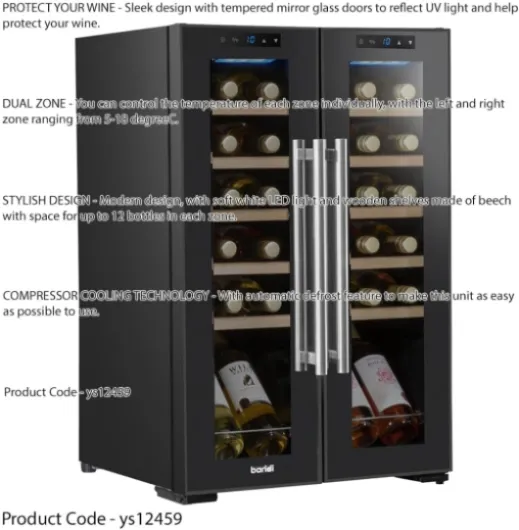
Design-wise, this fridge is black with tempered mirror glass doors. When it’s off or the light is off, the front looks like a big dark mirror. It does look modern and a bit more “grown-up” than the usual clear glass door with a visible frame. The flip side is that it shows fingerprints and smudges very clearly. After a couple of days of casual use, I had to wipe the door down because every time someone grabbed it with slightly greasy hands, it left marks.
The fridge is marketed as freestanding, and that’s how I used it. The brand insists on at least 10 cm of ventilation space on all sides (rear, top, and both sides). That’s important: this is not something you just cram into a tight alcove. I first tried it with maybe 5 cm at the back, and the side panels felt noticeably warmer. After pulling it out to give it the full 10 cm, it ran cooler and the compressor didn’t kick in as often. So the design relies heavily on that open space to perform correctly, which means you need to plan where to put it.
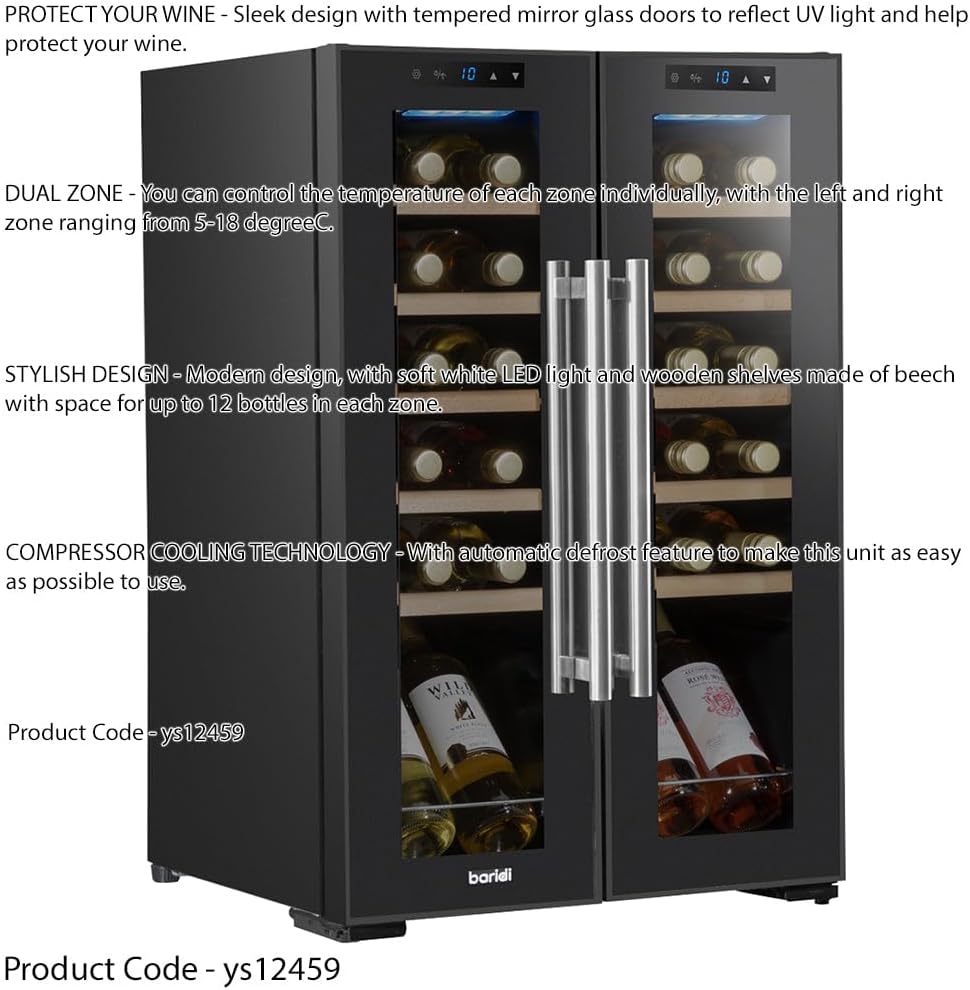
Inside, the layout is symmetrical: five wooden shelves on each side, with a central divider between the left and right zones. The shelves slide out, but they’re not on rails like a fancy kitchen drawer; they’re more basic, you pull them and they slide on side grooves. It’s fine, but when the fridge is pretty full you do have to be a bit careful not to yank them unevenly. The controls sit at the top inside area and are straightforward: up/down buttons and a small display for each side. Not pretty, not ugly, they just exist and work.
Overall, the design is clean and modern, but practical rather than premium. The mirrored glass is a nice touch if you like that look, and it probably does help a bit with UV reflection, but it also needs more cleaning. There’s no handle sticking out, you just pull on the door edge, which keeps the lines tidy but again adds to the smudge issue. If you want something that blends into a modern black-and-steel kitchen, it fits in pretty well. If you want something that screams luxury, this is more on the functional end of the spectrum.
Materials and build: decent for the price, but not high-end
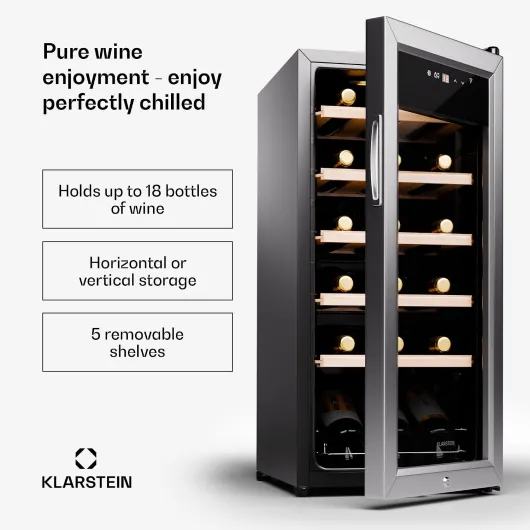
The fridge is mostly steel with a glass front and beech wood shelves. The outer casing feels solid enough; it doesn’t flex when you push against the sides, and there were no rattles once it was placed on a flat surface. The doors close with a firm seal, and the rubber gaskets looked properly aligned on my unit. I didn’t see any big gaps or misalignment that would suggest sloppy assembly, which is good considering it’s made in China and clearly positioned as a budget-to-mid product.
The beech wood shelves are probably the nicest touch. They’re not thick, heavy planks, but they’re also not flimsy. When loaded with four to five bottles each, they didn’t bow or squeak. You can remove them easily if you need to fit taller bottles, which I ended up doing for a couple of magnums. The finish is basic—don’t expect perfectly smooth, oiled wood—but they look fine behind the tinted glass and feel better than the cheap wire racks you see in some entry-level coolers.
The tempered mirror glass door is the part that feels the most “premium” at first glance. It’s sturdy and doesn’t feel like it will crack from a light knock. The mirror effect also serves a purpose: it helps reflect UV light, which is good for long-term wine storage. I’m not going to pretend I measured UV levels, but it’s a standard idea in wine fridges and it’s better than just plain clear glass. The hinges feel okay; they don’t slam shut, and the door stayed aligned over the few weeks I used it.
So from a materials point of view, I’d call it pretty solid but not luxurious. The steel casing is functional, the glass is tough, and the wooden shelves are a nice middle ground between cheap and fancy. If you’re expecting the same feeling as a built-in unit that costs several times more, you’ll be disappointed. But for a standalone fridge at this level, I didn’t see any obvious weak spots or corners cut that would make me nervous about everyday use.
Packaging and installation: protected well, but the size info is confusing
The fridge arrived well packaged, with thick foam on the corners and plastic film over the glass to avoid scratches. I didn’t find any dents, cracks, or loose parts straight out of the box. It’s not insanely heavy, but it’s still around 33 kg according to the specs, so it’s easier to move with two people, especially if you’re going up stairs. I managed to slide it into place on my own, but I wouldn’t want to carry it alone for a long distance.
One thing that bugged me a bit was the product dimensions listed (20 x 20 x 20 cm) in some of the specs, which is obviously wrong for a 24-bottle fridge. That’s clearly a data error, but it’s confusing when you’re trying to plan your space before delivery. In reality, it’s a standard mid-size freestanding wine cooler, not a cube. So don’t rely on those numbers—check the retailer’s proper dimensions or measure the unit when it arrives before building anything around it.
Setup is simple: remove all the tape and packaging, place it where you want it, leave at least 10 cm of space on the sides, back, and top, then let it sit upright for a few hours before turning it on (to let the compressor oil settle). The manual mentions the ventilation requirement, and it’s not just a suggestion. When I tried to push it closer to the wall to hide it a bit, the side panels got warmer and the compressor ran more often. Pulling it forward by a few centimetres fixed that. So yes, the packaging and manual could highlight that more clearly, but it’s there.
Overall, I’d say the unboxing and installation experience is straightforward. No missing parts, shelves were already in place, and the doors didn’t need adjustment. The only real annoyance is the misleading dimension info in the generic spec list, which looks like a copy-paste error. As long as you don’t take that literally and you give it proper breathing room, getting this fridge up and running is not a headache.
Durability and day-to-day use: feels reliable, with a few small quirks
I obviously haven’t had this fridge for years, so I can’t pretend to give a long-term durability verdict, but I can talk about build feel and early signs. After a few weeks of daily use—opening it most evenings, adjusting shelves a couple of times, and loading/unloading bottles—it still feels solid. The doors haven’t sagged, the seals still sit tight, and the shelves haven’t warped or loosened. Nothing rattles when the compressor starts up, which is usually a good sign the internal parts are mounted properly.
The automatic defrost is a small but important feature for durability. I’ve had cheap coolers in the past that built up condensation and then ice along the back wall, which led to weird noises and eventually to the fan failing. With this one, I didn’t see any serious moisture buildup. The back wall got slightly damp at times, then dried off again—exactly what you’d expect from an auto-defrost system working correctly. Less ice and moisture usually means less stress on components over time.
The only minor durability concern I could see is around the wooden shelves and the sliding grooves. Because they’re just resting on side supports, if you’re rough and yank a shelf out at an angle while it’s fully loaded, you could potentially damage the edges over time. It didn’t happen to me, but I can see how someone impatient might chip a corner or wear the grooves faster. So it’s more about user behaviour than a design flaw, but it’s worth mentioning: don’t treat the shelves like heavy-duty drawers.
Overall, the fridge gives a reassuringly sturdy impression for something at this price level. The casing doesn’t feel flimsy, the glass is thick, and the compressor performance stayed consistent during my test. I wouldn’t be scared to use it as my main wine storage for a modest collection. Just make sure you respect the ventilation space they ask for; choking the airflow is a quick way to shorten the life of any compressor fridge, including this one.
Cooling performance and noise: stable temps with some hum
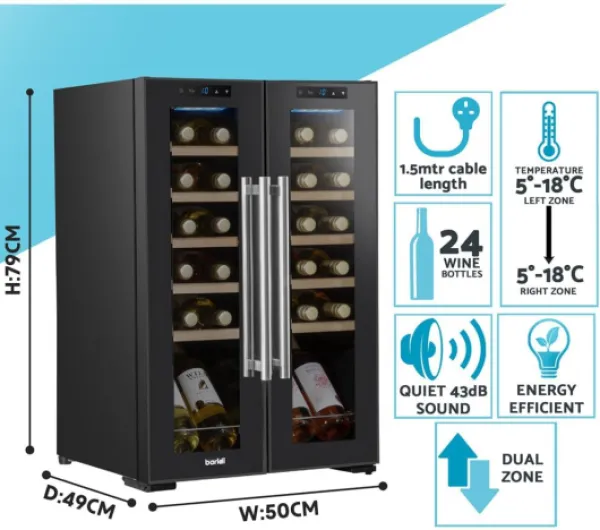
On performance, this is where the Loops cooler does what it’s supposed to do without any real surprises. The dual zones both run from 5–18°C, and in my tests it reached the target temperatures in about an hour or so from room temperature, then stabilised over the next couple of hours. I used a separate thermometer in each zone to double-check the display. The readings were usually within about 0.5–1°C of what the fridge was showing, which is accurate enough for home use.
The compressor cooling is the key difference compared to cheaper thermoelectric models I’ve used before. With this one, even when the room got a bit warmer in the evening (around 24–25°C when cooking), the internal temperatures didn’t drift much. On a thermoelectric unit I had in the past, the “cold” zone would slowly creep up several degrees when the ambient temperature rose, which defeated the point. Here, the compressor kicks in and actually brings it back down quickly. The automatic defrost also means I didn’t see any significant ice buildup or condensation issues during the test period.
Noise-wise, you can hear it. It’s not silent. When the compressor turns on, there’s a low hum, similar to a small under-counter fridge. In an open-plan living room, you’ll notice it if the room is totally quiet and you’re sitting close by. From a few metres away with normal background noise (TV, conversation), it fades into the background. If you’re extremely sensitive to noise and want something almost silent, you might find it a bit annoying, but for me it was acceptable. No strange rattles or high-pitched sounds, just the usual compressor hum.
In everyday use, the fridge kept my whites noticeably colder and more consistent than storing them in the kitchen fridge door, and reds stayed at a comfortable serving temperature instead of room temperature swings. So in terms of practical performance, it gets the job done. It doesn’t try to do anything fancy—it just holds the temperature you ask for and cycles on and off as needed. For the price bracket it’s in, I’d say the performance is one of its stronger points, as long as you’re okay with a standard level of fridge noise.
What you actually get with this 24-bottle dual zone fridge
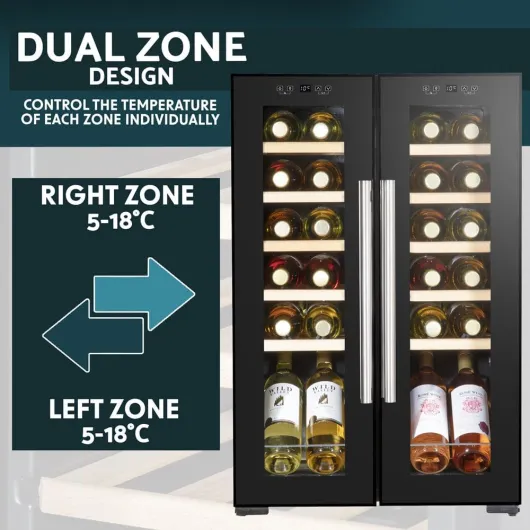
On paper, the Loops wine cooler is a 24-bottle, dual-zone, freestanding fridge with compressor cooling. In practice, that means two separate compartments (left and right) behind one mirrored glass front, each with its own temperature range from 5–18°C. I mainly ran the right side around 7–8°C for whites and the left side around 13–14°C for reds, which is pretty much the standard rule of thumb for casual drinking.
The inside is laid out with ten beech wood shelves in total, five per side. The brand says each zone can hold up to 12 bottles, so 24 in total. That’s technically doable, but only if you stick mostly to standard Bordeaux-style bottles and don’t have too many chunky Champagne or oddly shaped bottles. Once I threw in a couple of fatter bottles, I had to pull a shelf or rearrange the layout a bit, and suddenly you’re not really at 24 anymore. So the capacity is more “up to 24 in ideal conditions” than a guaranteed 24.
The cooling system uses a compressor with automatic defrost, which is what most proper fridges use. Compared to thermoelectric coolers I’ve tried before, this one holds the temperature more steadily, especially in a warmer room. I tested it in a room that sits around 21–23°C most of the day, and the internal temperatures stayed within about 1°C of what I set after it had time to stabilise. No crazy swings, which is the main thing I was worried about.
There’s also a soft white LED light inside. It’s not super bright, but you can see the labels without blasting the bottles with light. Between the mirrored glass and the LED, the presentation is clean enough. It doesn’t scream “high-end cellar”, but if you put it in an open-plan kitchen or living room, it looks modern and not cheap. For the price range, the feature set is nothing special but effective: basic controls, dual zone, stable cooling, and a layout that works fine once you accept the real-world capacity is slightly less than the marketing number.
Pros
- Stable dual-zone cooling from 5–18°C with reliable compressor performance
- Modern mirror-glass design with wooden shelves that looks decent in most rooms
- Pretty solid build quality for the price, with automatic defrost and straightforward controls
Cons
- Real-world capacity is often less than 24 bottles if you use larger or mixed bottle shapes
- Compressor makes a noticeable hum in very quiet rooms and needs 10 cm ventilation space all around
Conclusion
Editor's rating
After living with the Loops 24 Bottle Dual Zone Wine Cooler for a bit, my overall take is pretty straightforward: it’s a practical, mid-range wine fridge that does what it says, with a few small compromises. The dual-zone setup works well if you drink both reds and whites, the compressor cooling keeps temperatures stable even when the room warms up, and the mirrored glass with wooden shelves looks decent in a modern home. It’s not a luxury piece, but it doesn’t feel cheap either.
The downsides are mostly about expectations. The 24-bottle capacity is optimistic if you have a mix of bottle shapes, and the unit needs proper ventilation space, which limits where you can put it. The compressor hum is noticeable in a quiet room, so this isn’t for people obsessed with silence. Also, the generic spec sheet with nonsense dimensions doesn’t help when planning your space, even if the real product is fine.
I’d recommend this fridge to casual wine drinkers who want better storage than a kitchen fridge and like the idea of keeping reds and whites at different temperatures without overthinking it. It’s also fine for someone building a small collection of everyday bottles. If you’re a serious collector with expensive vintages, or you want something nearly silent and truly premium, this isn’t your target. For everyone else who just wants a pretty solid, no-nonsense wine cooler, it gets the job done at a fair price.