Summary
Editor's rating
Value for money: decent if you want capacity on a budget
Design: compact and decent-looking, but not high-end
Materials and build: solid enough, but you feel the budget
Durability and reliability so far: feels okay, but brand is a question mark
Cooling performance and noise: does the job, with a few quirks
What you actually get with this generic dual zone cooler
Pros
- Slim, compact design that fits in narrow spaces while still holding around 24–30 bottles
- Dual zone cooling with fairly accurate temperatures and decent stability
- Quiet enough for a living room or office, with low vibration and no annoying rattles
Cons
- Generic brand with unclear long-term support and warranty confidence
- Real bottle capacity is lower than the advertised 30 once you use wider bottles
- Finish and materials feel basic compared to better-known brands in the same size range

Specifications
View full product page →| Brand | Generic |
A no-name dual zone wine fridge I took a chance on
I’ve been using this dual zone wine cooler (the generic 120L / ~30 bottle model) for a few weeks now. It’s one of those “no real brand” units you find online with a vague name and a long description full of nice promises: dual zone, low noise, UV glass, LED lights, built-in or freestanding, all that. I bought it because I wanted something narrow that could fit in a tight spot in my living room, and the dimensions (about 16 x 21 x 47 inches) were pretty much perfect for that.
Going in, my expectations were pretty simple: I wanted it to keep my reds and whites at stable temperatures, not sound like a jet engine, and not look too cheap next to the rest of the furniture. I wasn’t expecting luxury quality from a “Generic” brand, but I also didn’t want something that feels like a toy. So I paid close attention to noise, temperature stability, and build quality over daily use.
In practice, I’ve used it mostly for wine and a few soft drinks, plus I did a quick test with some beer to see how fast it cooled. I didn’t bother with storing medicine or tea long term, even though the listing claims you can, because for me this is clearly a wine and drinks fridge first. I also checked the internal temperature with an independent thermometer, because I never fully trust the digital display on these budget units.
Overall, my feeling is that it’s a pretty solid basic wine fridge, but with a few compromises that you’d expect at this price and with a no-name manufacturer. It does the main job—keeping bottles cool—fairly well, but it’s not perfect, and there are some details (like the plug situation and the shelves) that you should know about before buying. If you’re okay with a practical, no-frills unit and you’re not too picky about brand reputation, it might suit you. If you want flawless finish and long warranty, I’d look at more established brands.
Value for money: decent if you want capacity on a budget
Value really depends on how much you’re paying and what you expect. Assuming you get this at the kind of price I’ve seen online for similar generic units (usually lower than big brand 30-bottle fridges), the value is pretty good for a medium collection. You’re getting dual zone, UV glass, a compact footprint, and space for around 24–30 bottles in real use. For someone who wants to keep a mix of reds and whites at home without spending a fortune, it makes sense.
Where you’re saving money is clearly on branding, finish, and long-term support. Compared to a known brand like Haier, Hisense, or Klarstein (depending on your market), this one feels a bit more basic in the details: controls, shelf sliding, and overall polish. But in terms of pure function—keeping wine cool and reasonably protected—it’s in the same ballpark. So if your priority is function over name and you’re okay with a more “appliance” look, it’s a good value for money option.
On the downside, the vague info about the plug and the generic manufacturer listing might mean extra hassle if something arrives damaged or if you need replacement parts later. Also, the real capacity is lower than the claimed 30 bottles once you factor in bigger bottle shapes. If you’re counting every bottle slot, that might bother you. And if you care a lot about super quiet operation, you might want to invest a bit more in a thermoelectric or premium compressor model.
Overall, I’d say: if you catch this cooler at a reasonable price and you just need a practical, no-frills wine fridge, the value is there. There’s definitely better out there in terms of finish and long-term trust, but you’ll pay more. For a first wine cooler or for someone who just wants to store a small to medium collection at proper temperatures, it’s a sensible compromise between cost and performance.

Design: compact and decent-looking, but not high-end
Design-wise, the main strong point is the slim footprint. At around 16 inches wide, it fits in spaces where a normal 24-inch wine fridge simply won’t. That’s actually why I bought it. It slides nicely next to a cabinet in my living room without sticking out too much. The height (about 47 inches) makes it feel more like a tall side unit than a countertop appliance. If you live in an apartment with limited space, this form factor is pretty handy.
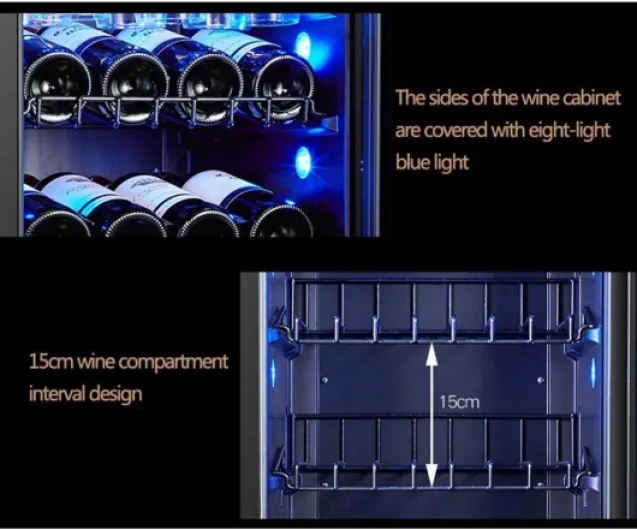
The front is mostly glass with a black frame, plus blue LED lighting inside. The LEDs give it a slightly modern bar vibe when they’re on, but it’s not over the top. You can see the bottles clearly through the glass, and at night it doubles as a small ambient light source. Personally, I leave the LEDs on low, because at full brightness it starts to look a bit cheap, like a drink fridge in a small shop rather than home furniture. Still, for the price range, the look is perfectly acceptable.
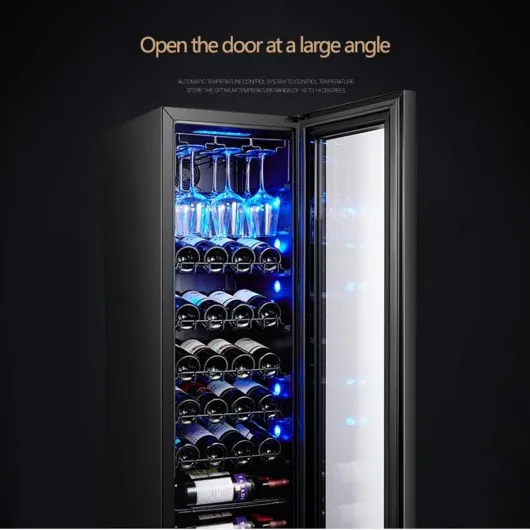
The door opens smoothly and the handle is integrated into the side of the frame on my unit, so there’s no big external handle sticking out. That’s good if you’re putting it in a narrow hallway or near a passage. The only design thing that annoyed me is that the door swing isn’t reversible on my model (or at least not easily). So you need to plan where you put it, because you’re stuck with one opening direction. If you’re left-handed or have a tricky corner, that might matter more than you expect.
In terms of layout, the “wide-angle door” claim mostly just means the door opens far enough that you can pull out the shelves without bumping the frame. That’s true, and it’s practical if you store bottles horizontally. Overall, the design is functional and simple, but you can tell it’s not from a big premium brand: tolerances around the door seal and panel alignment are okay but not perfect if you look closely. For a living room or office, it looks decent; for a luxury kitchen, it might look a bit out of place.
Materials and build: solid enough, but you feel the budget
The materials are basically what you’d expect from a mid-range generic appliance. The outer shell feels like standard painted metal, not super thick but not flimsy either. When you knock on the sides, you get that hollow metal sound, but there’s no weird flex or rattling. The door, with its double glazing, feels heavier and more solid than the body, which is reassuring since that’s the part you handle all the time. The glass has a slight tint that helps with UV protection and hides the inside a bit when the lights are off.
Inside, the shelves on my unit are metal with a wood-like finish coating. They slide out, but not on real rails—just metal-on-metal grooves. That means they can be a bit jerky when the fridge is loaded, especially with heavier bottles. It’s not horrible, but if you’re used to smooth telescopic rails from higher-end fridges, you’ll notice the difference. I haven’t seen any bending or warping after loading them, though, so in terms of strength they’re fine. The plastic parts (shelf supports, inner trim) feel basic but not fragile.
The door seal is reasonably thick and sits pretty flush. I did the “paper test” (closing a sheet of paper in the door and pulling it out) in a few spots, and in most places the resistance was good. There were a couple of corners where the grip was slightly weaker, but nothing dramatic. No visible condensation inside the glass so far, which is a good sign that the double glazing and sealing are doing their job. I also haven’t noticed any moisture building up on the walls, so the humidity control seems at least adequate.
Where you really feel the generic side is in the little details: the digital panel plastic feels cheap, the buttons have a slightly mushy click, and the overall finish (paint edges, alignment) is okay but not precise. It doesn’t scream “junk,” but it also doesn’t feel premium. For the price and the capacity, I’d say the materials are acceptable. Just don’t expect the same feel as a big-name wine cabinet that costs twice as much. If you treat it as a practical appliance and not a design object, it’s fine.
Durability and reliability so far: feels okay, but brand is a question mark
I haven’t had this fridge for years obviously, so I can’t pretend to give a long-term verdict, but after several weeks of daily use, I can at least comment on how it behaves and what gives me confidence or doubts. So far, no malfunctions: no sudden temperature spikes, no error codes, no water pooling at the bottom. The compressor cycles feel regular, and the door seal hasn’t loosened or started squeaking. That’s already better than some cheap fridges I’ve tried in the past that started acting weird in the first days.
The build feels stable enough when moving it slightly to clean behind it. At 43 kg, it’s not ultralight, and that weight usually means a bit more serious hardware than the super flimsy stuff. The shelves haven’t bent even when I loaded them with heavier bottles. The hinges on the door still feel tight, and the glass hasn’t fogged up or formed moisture inside the layers, which is often a sign of poor sealing in budget models. All that is positive for short-term durability.
My main concern is simply the generic branding and unclear support. The manufacturer is listed as “Generic” with a weird part number and even a “no plug” note in the specs, which doesn’t inspire much confidence if you ever need spare parts or service. You’re basically betting that the unit will just keep running, because getting help might be painful. If a fan or the control board fails in two years, I’m not sure how easy it will be to fix. That’s the risk with these no-name appliances.
So, in terms of physical durability, I’d say it feels reasonably solid for home use and should last a few years if you don’t abuse it and give it proper ventilation. But in terms of long-term reliability and after-sales service, there are better options from known brands. If you’re okay with the idea that this might be a “use it while it works and then replace” product, it’s fine. If you want a 10-year companion for a serious wine collection, I’d probably invest more in something with a real brand and clear warranty.
Cooling performance and noise: does the job, with a few quirks
Performance-wise, the key point is that it actually keeps wines in the target range, which is the main reason to buy it. I tested it with two independent thermometers, one in the top zone and one in the bottom. When I set the top to 12°C and the bottom to 8°C, the real temps stabilized around 13°C on top and 8–9°C at the bottom after a few hours. So, the bottom zone is quite accurate, the top runs about 1 degree warmer than the display. For everyday use, that’s totally acceptable, but if you’re ultra-precise, just set it 1 degree lower than what you want.
The dual air duct cooling system seems to spread the cold air fairly evenly. I didn’t notice big differences from front to back or between shelves in the same zone. Bottles on the top shelf of the upper zone were maybe 0.5°C warmer than those in the middle, but nothing that really matters in practice. If you fill it up from empty with room-temp bottles, it takes a few hours to get everything down to target, but that’s normal for a 120L unit with 85W power. It’s more of a storage cooler than a rapid chiller.
On noise, I’d describe it as quiet but not silent. The compressor kicks in with a low humming sound, similar to a small fridge. In my living room, sitting about 2–3 meters away, I can hear it if the room is totally quiet, but it doesn’t bother me. There are no annoying rattles or high-pitched fan noises, which is already good news for a generic unit. The vibration is minimal; bottles don’t buzz or move. They mention shock absorption and low vibration, and in this case that part seems legit.
Electricity use seems modest. With 85W listed, and given how often it cycles, I’d say it’s okay for continuous use. I don’t have exact kWh numbers, but after adding it to my setup, I didn’t see a massive jump on my energy monitor. Overall, performance is decent but not special. It cools reliably, holds temperature reasonably well, and stays fairly quiet. If you’re expecting super-fast cooling or lab-grade precision, you’ll be disappointed. If you just want wine at a stable, decent serving or storage temp, it gets the job done.
What you actually get with this generic dual zone cooler
On paper, this cooler is pretty straightforward: 120L capacity, about 30 bottles, dual zone, temperature range from 5–18°C (41–64°F), and it pulls 85W of power. The size is compact and tall, so it’s more like a narrow column than a big bulky fridge. That’s useful if you’re short on width but have a bit of vertical space. The seller claims it can be used as built-in or freestanding. In reality, it’s more comfortable as a freestanding unit unless you really plan the ventilation gap around it.
The front door is double-glazed glass with a dark tint, and there’s a digital control panel on the front inside the door frame. You set the temperatures for the upper and lower zones separately. In my unit, the top zone runs slightly warmer than the display shows—about +1°C compared to my thermometer—while the bottom is almost spot on. That’s not tragic, but it’s worth knowing if you’re picky about exact temps for certain wines.
Inside, you’ve got several wooden-style or metal racks (depending on the batch; mine were metal with a wood-like finish) and a lower area where you can stack a couple of bottles or cans upright. With standard Bordeaux bottles, you can get close to the claimed 30 bottles, but once you start adding thicker Burgundy or Champagne-style bottles, that number drops fast. Realistically, I’m at about 22–24 bottles without having to play Tetris too much.
Overall, the feature list matches what you get, but I’d say the marketing is a bit optimistic on capacity and built-in usage. It’s fine for a medium-size home collection, not a big cellar replacement. If you’re thinking of using it in an office or hotel room, it’s presentable enough, but it doesn’t have the premium look you see in high-end brands. It’s more “practical appliance” than “showpiece.”
Pros
- Slim, compact design that fits in narrow spaces while still holding around 24–30 bottles
- Dual zone cooling with fairly accurate temperatures and decent stability
- Quiet enough for a living room or office, with low vibration and no annoying rattles
Cons
- Generic brand with unclear long-term support and warranty confidence
- Real bottle capacity is lower than the advertised 30 once you use wider bottles
- Finish and materials feel basic compared to better-known brands in the same size range
Conclusion
Editor's rating
After using this generic dual zone wine cooler for a while, my overall take is that it’s practical and fairly reliable so far, but clearly budget-oriented. It does the main job: keeps bottles at reasonable temperatures, separates reds and whites with two zones, and doesn’t make a lot of noise. The slim design is a real plus if you’re short on space, and the 120L capacity is enough for a casual to intermediate wine drinker who wants more than a tiny 12-bottle unit but doesn’t need a full cellar.
On the flip side, you feel the lack of a real brand in the small details: the finish is basic, the controls feel a bit cheap, and long-term support is a question mark. The claimed 30-bottle capacity is optimistic unless you mostly use slim bottles, and the “built-in” promise is only realistic if you give it good ventilation. It’s not a showpiece for a luxury kitchen, it’s a workhorse fridge for people who mostly care that their wine is stored correctly and don’t want to overspend.
If you’re a new or moderate collector, live in an apartment, and just want a cooler that fits in a narrow space and keeps your reds and whites at decent temps, this is a reasonable choice. If you’re building a serious wine collection, want perfect finish, or care a lot about brand reputation and long warranties, I’d skip this and put more money into a known brand. In short: decent but nothing more, and good value if you find it at the lower end of the price range for 30-bottle dual zone coolers.