Summary
Editor's rating
Value: good if you want function over brand name
Design: nice enough from a distance, a bit budget up close
Materials and build: decent frame, cheap shelves
Durability: early signs and a few concerns
Performance: dual-zone cooling that mostly does what it says
What you actually get with this generic wine cooler
Pros
- Quiet compressor with low vibration, suitable for living rooms and open kitchens
- Dual-zone cooling that actually keeps top and bottom at different, stable temperatures
- Decent-looking stainless/glass design and blue LED lighting at a lower price than big brands
Cons
- Cheap-feeling wire racks that flex under load and don’t slide smoothly
- Generic brand with limited documentation and uncertain long-term support
- Real usable capacity lower than the advertised 30 bottles once you add larger or odd-shaped bottles

Specifications
View full product page →| Brand | Generic |
A no-name wine fridge I picked on a gamble
I’ve been wanting a wine fridge for a while, but I didn’t feel like dropping a lot of money on a big brand. I stumbled on this 30-bottle dual-zone model from a generic brand and, honestly, I bought it mostly because the specs looked decent and the price was lower than the usual names. No fancy logo, just "Generic" and a pretty standard stainless-steel look. I’ve had it running for a few weeks now in my open-plan living room/kitchen, so I’ve had time to see how it behaves day to day.
Right away, the main thing I was watching for was noise and temperature stability. I work from home and my desk is about 3–4 meters from where I put the cooler. If the compressor was whining all the time, it would have gone back in the box. I also wanted to see if the dual zones actually stay at different temperatures, or if it’s more marketing than reality. I mostly keep whites and sparkling on top, and reds on the bottom.
Another point for me was how it fits into the room. I live in an apartment, so space is not huge. This unit is sold as both built-in and freestanding, which sounds nice on paper, but those claims are often optimistic. I started using it freestanding, with about 8–10 cm of space on each side and more at the back, as recommended for most compressor coolers. I checked how hot the sides got after a few hours to see if it would be safe to eventually slide it into a tighter spot.
Overall, my first impression after setting it up was: it’s not fancy, but it looks decent and does what it’s supposed to do. It’s not perfect, and there are a few things that feel very budget, especially the racks and the controls. But if you’re just looking for something to keep 20–30 bottles at the right temperature without drawing attention, it seems to get the job done. The rest of this review is basically the good, the annoying, and the "you should know this before buying" from actually living with it.
Value: good if you want function over brand name
For value, you have to look at what you’re actually getting: dual-zone compressor cooling, around 30-bottle capacity, low noise, and a modern look, from a generic brand. Compared to big-name wine coolers with similar specs, this kind of unit is usually quite a bit cheaper. You lose the brand prestige, the premium materials, and probably some long-term support, but you still get the core function: keeping reds and whites at different, stable temperatures.
In my case, I wanted something that looked decent in the living room and didn’t sound like a jet engine. On those points, this cooler is pretty good. Temperatures are close to what you set, noise is low, and the blue LED lighting is a nice bonus if you like that style. The door with UV protection and double glazing is also a plus if your unit is near a window. So for basic wine storage and serving, I feel like I got fair value for the money.
On the downside, you can see where the price savings come from: cheaper shelves, plasticky controls, thin documentation, and very generic branding. If you’re the type who wants a product that screams quality every time you touch it, this will feel a bit disappointing. Also, if something major goes wrong after the standard warranty, you might end up just replacing the whole thing instead of repairing it, which is part of the trade-off with a no-name brand.
So in terms of value, I’d call it good value for money if your priority is function over badge. If you’re building a high-end kitchen and want everything to feel premium, I’d say spend more on a known brand. But if you just want your wines kept at reasonable temperatures without spending a fortune, this cooler hits a pretty sensible balance.

Design: nice enough from a distance, a bit budget up close
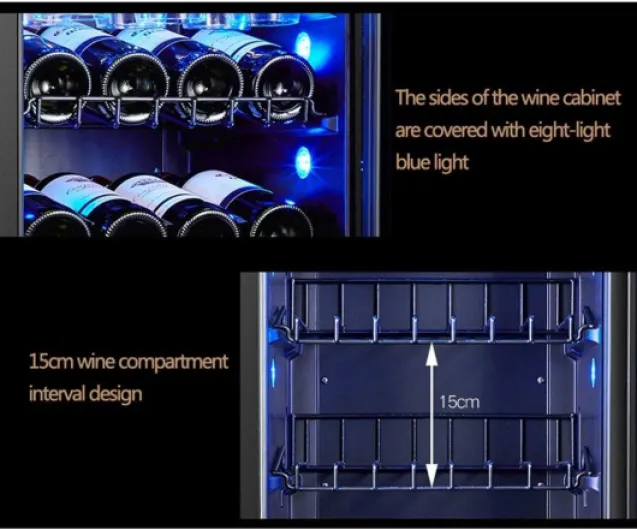
From a couple of meters away, the design is actually pretty solid. The stainless-steel frame around the glass door looks clean, the proportions are good, and it doesn’t scream “cheap appliance.” The blue LED lighting inside gives a cool bar vibe when it’s on, and you can switch it off if you hate the blue glow. In my living room, it blends in next to a stainless-steel fridge and doesn’t look out of place at all. For a generic brand, that’s already a win.
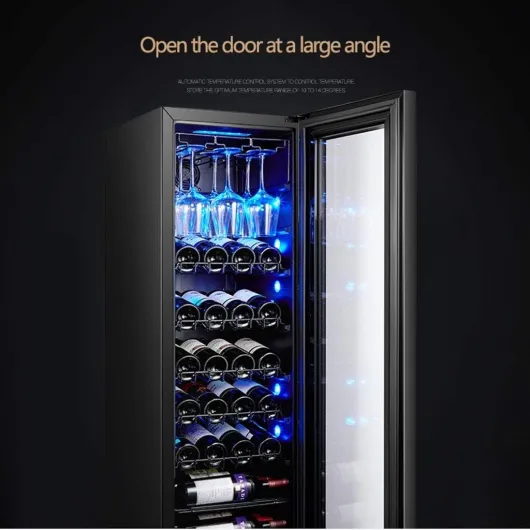
Up close, you start to see where they cut costs. The door handle is fine but feels a bit light; it doesn’t have that heavy, solid feel you get on premium models. The door itself closes correctly, but you need to give it a proper push; it doesn’t “soft close.” The control panel is very plasticky, and the buttons have that clicky cheap-remote feel. It all works, but you’re reminded that this isn’t a high-end unit. The "super-angle" door opening they mention basically means the door opens wide enough that the shelves can slide out without hitting the frame. That’s true, but nothing special – just standard 90°+ opening.
As for dimensions, it’s compact enough for an apartment. It’s not tiny, but you can easily slide it against a wall or under a countertop if you have the height. Just keep in mind you still need space around it for ventilation. The sides and top are plain black metal, nothing fancy. I measured the heat buildup after a couple of hours at 7 °C top / 14 °C bottom: the sides were warm but not burning hot. Still, I wouldn’t fully box it in without an air gap.
On the inside, the design is mostly functional. The wire racks don’t slide smoothly like on rails; they just rest on grooves, so when you pull them out with several bottles on, they can jerk a bit. If you’re careful, it’s fine, but it doesn’t feel premium. There’s no dedicated zone for really large bottles either, so you end up improvising. So in short: looks good enough in a room, feels a bit cheap in the hand. If design details matter a lot to you, this will feel more like a mid-range appliance than a showpiece.
Materials and build: decent frame, cheap shelves
Material-wise, this is clearly built to hit a price point. The stainless-steel around the door looks good and doesn’t feel flimsy. The double-glazed glass is thick enough, and you can feel a bit of insulation when you touch it – it’s cool on the outside even when the inside is cold. The door seal seems okay; I ran a simple test with a piece of paper in the door, and it holds fairly firmly when closed, so the gasket is doing its job. That said, the overall door feel is more “apartment fridge” than “premium cellar.”
The cabinet itself is standard painted metal on the sides and back. It’s not thin like a tin can, but don’t expect heavy gauge steel either. When you knock on the side, there’s a bit of a hollow sound, which is pretty normal for this price range. Inside, the walls are simple black plastic/metal with no fancy finishes. Easy to wipe down, at least. The LED lighting strip is integrated at the top; it doesn’t feel fragile, and I had no flickering or weird behavior during my test.
The weak point is clearly the wire racks. They’re functional but feel cheap. Under the weight of several full bottles, there is a bit of flex, especially in the middle. I wouldn’t overload them with heavy magnums or stack bottles double-high. Sliding them in and out is a bit scratchy, since they just rest on metal supports instead of real rails. Over time, I can see these being the first part to bend or annoy you. If you’re gentle, they’ll be fine, but they don’t give a high-quality impression.
Overall, the materials are nothing special but effective. The parts that matter for insulation and temperature (glass, seals, cabinet) seem decent. The parts you touch more often (shelves, buttons) feel budget. For the price, I wasn’t expecting luxury, and that’s exactly what you get: a structure that should hold up if you don’t abuse it, with some corners clearly cut on the inside fittings.
Durability: early signs and a few concerns
I obviously haven’t had this unit for years, so I can’t pretend to know how it will age, but I can talk about early signs and what looks solid or fragile. After a few weeks of constant use, the compressor starts and stops normally, no strange noises, no rattling. The temperature behavior has stayed consistent, so at least nothing is failing quickly. The door hinge hasn’t loosened, and the seal still looks fine. So short term, no red flags.
My main concerns for durability are the shelves and the control panel. The wire racks flex slightly when fully loaded, and I can imagine them getting bent if someone leans on them or pulls them out too roughly. They’re not on proper rails, so all the stress goes through the metal supports. Over a couple of years, regular use might wear the contact points and make the sliding even rougher. The control panel, with its cheap-feeling buttons, also doesn’t inspire long-term confidence. It works now, but if something electronic fails, good luck finding spare parts for a generic brand.
There’s also the usual question with no-name appliances: after-sales service and warranty. The documentation I got was minimal, with basic instructions and not much detail about support. There’s a manufacturer part number and model number, but no clear hotline or extended warranty information. Compared to a big brand that has service centers and known spare part networks, this is more of a gamble. If the compressor or electronics die after a couple of years, replacement might not be worth it.
That said, if you treat it like a normal household appliance – don’t slam the door, don’t overload the shelves, leave space for ventilation – I don’t see an obvious reason it would fail any faster than other budget fridges. So in terms of durability, I’d say acceptable but uncertain. Nothing in my test period screamed “this will break in a month,” but you’re clearly not buying a tank that will last 15 years either.
Performance: dual-zone cooling that mostly does what it says
On performance, I tried to be a bit methodical. I used a separate fridge thermometer in each zone, because I don’t fully trust any built-in display. I set the top zone to 7 °C for whites and the bottom to 14 °C for reds. After a few hours of running with about 15 bottles inside, the thermometers were reading around 8–9 °C on top and 14–15 °C on the bottom. So it’s close, but not perfectly exact. That’s pretty common on cheaper units, and honestly, for home use, being 1–2 degrees off isn’t a big deal.
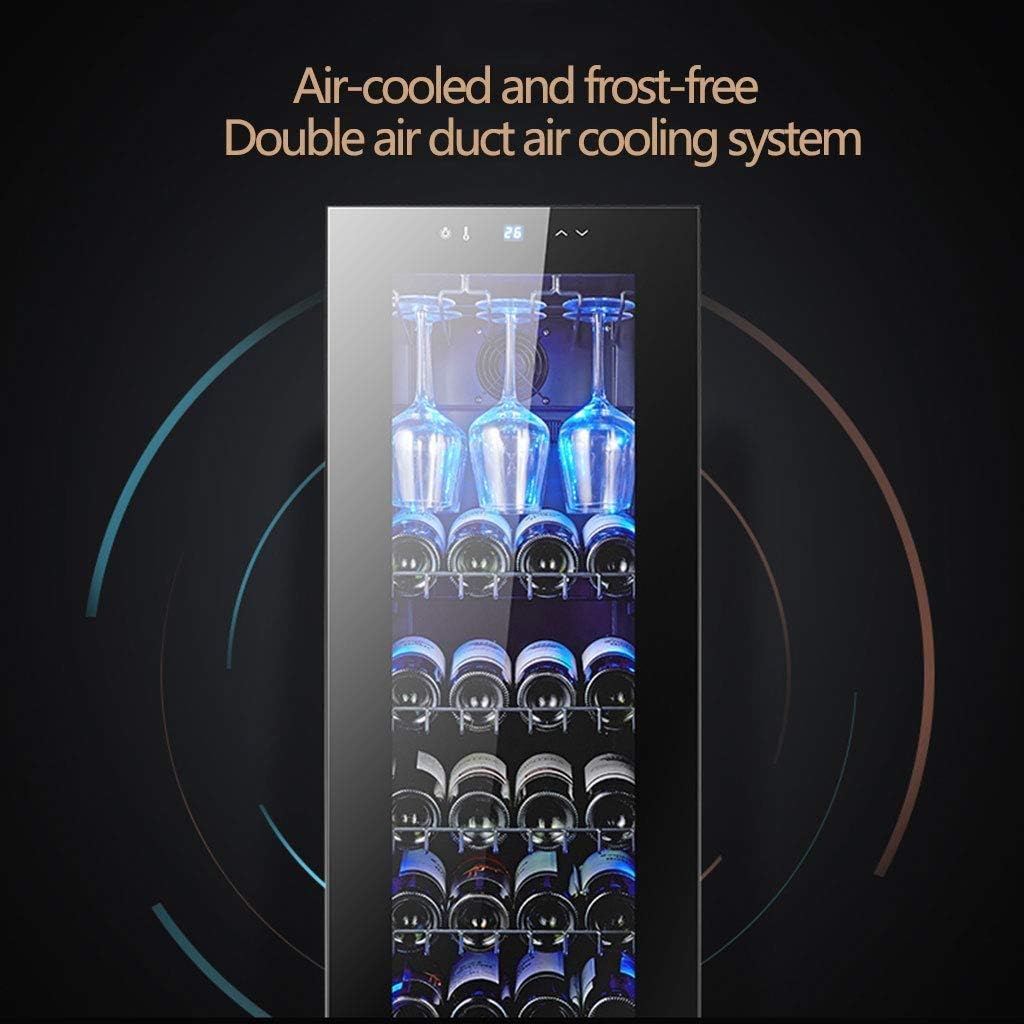
The cooling is compressor-based with a dual air duct system, and you can tell it’s not just a simple fan cooler. When you load in room-temperature bottles, it takes a while to pull everything down, especially in the lower zone. In my test, filling it with 10 bottles at about 22 °C, it took roughly 6–7 hours to stabilize near the set temps. After that, it stayed fairly stable, with small fluctuations of ±1 °C when the compressor kicked in. So for long-term storage and serving temperature, it’s fine, just don’t expect instant chilling.
Noise-wise, it’s pretty quiet. The brand talks about shock absorption and noise reduction, and I’d say that’s not just marketing fluff. Sitting 3–4 meters away, I can hear a low hum when the compressor turns on, but it’s softer than my full-size fridge. At night, if the house is silent, you notice it, but it’s not annoying. There’s also low vibration – I put a glass of water on top as a quick test, and there was only a tiny ripple when the compressor started, nothing dramatic.
One interesting point: after a short power cut (I tested by unplugging it and plugging back in), the temperature memory function really does reload your last settings. It doesn’t reset to some default, which is nice if your area has occasional outages. Overall, performance is pretty solid for the price: stable enough temperatures, actual dual-zone behavior, and noise levels that are okay for a living room or open kitchen. It’s not laboratory-precise, but for normal wine storage and serving, it does its job.
What you actually get with this generic wine cooler
On paper, this wine cooler promises 5–18 °C temperature range, dual zones, space for around 30 bottles, double-glazed door with UV protection, and quiet compressor cooling. It’s sold as both built-in and freestanding, but it’s clearly more at home as a freestanding unit unless you really plan your ventilation. There’s a stainless-steel frame around the glass door, a basic digital control panel, and blue LED lights inside. No fancy app, no Wi‑Fi, no smart features, just buttons and a display.
Inside, you get several wire racks (in my unit, 5 full-width shelves plus a bottom area) that slide out partially. They’re not wooden shelves, just metal, slightly curved to hold standard bottles. The manufacturer claims ~30 bottles, but that’s really if you use mostly classic Bordeaux-style bottles and are willing to play bottle Tetris. As soon as you add thicker Champagne bottles or odd shapes, that capacity drops quickly. Realistically, I managed about 22–24 bottles without forcing anything, including a few sparkling bottles.
The control panel is straightforward: separate temperature settings for each zone, a light button for the internal LEDs, and up/down arrows. There’s also supposed to be a “memory” function, meaning it remembers your last temperature settings after a power cut. I tested that by unplugging it for 10 minutes: when I plugged it back in, it did go back to the previous temperatures, so that part works. The display is bright enough to read from a few meters away, but not so bright that it lights up the whole room at night.
Overall, the presentation is very basic but functional. You’re not getting the polished feel of a premium brand – the documentation is thin, the English is a bit rough, and there’s not much detail about warranties or support. But in terms of what’s physically in front of you – a mid-sized wine cooler with dual zones and a modern glass door – it lines up with what the listing promises. Just don’t expect extras or clever design touches beyond the essentials.
Pros
- Quiet compressor with low vibration, suitable for living rooms and open kitchens
- Dual-zone cooling that actually keeps top and bottom at different, stable temperatures
- Decent-looking stainless/glass design and blue LED lighting at a lower price than big brands
Cons
- Cheap-feeling wire racks that flex under load and don’t slide smoothly
- Generic brand with limited documentation and uncertain long-term support
- Real usable capacity lower than the advertised 30 bottles once you add larger or odd-shaped bottles
Conclusion
Editor's rating
After living with this 30-bottle dual-zone wine cooler for a few weeks, my overall feeling is that it’s decent, practical, and clearly budget-minded, but it gets the main job done. Temperatures are stable enough, the dual-zone function actually works, and the noise level is low enough for an apartment living room. The design looks good from a normal distance, and the blue LED lighting gives it a bit of character without turning it into a disco ball. For the price range, that’s already quite a lot.
Where it falls short is mostly in the details: the shelves feel cheap and flex under load, the controls are basic and plasticky, and long-term durability and support are a bit of a question mark because it’s a generic brand. If you’re picky about build quality or want something that feels premium every time you open the door, you’ll probably be happier spending more on a known brand. But if you just want a quiet, functional wine fridge to keep a couple dozen bottles at reasonable serving temperature and you don’t care about logos, this is a pretty solid option. I’d say it’s best for casual wine drinkers or new collectors on a budget, and less suited for serious collectors with expensive bottles or people who obsess over perfect finishes and long warranties.