Summary
Editor's rating
Is it good value for money or should you spend more?
Simple, black, and doesn’t scream for attention
Build quality and shelves: functional, but don’t expect luxury
Early days on lifespan, but feels decent for the price
Cooling, noise and day-to-day use: does it actually work well?
What you actually get with this 24-bottle Dellonda cooler
How well it actually stores and chills your bottles
Pros
- Compact size that fits easily under counters or in small kitchen gaps
- Keeps wine at a stable, adjustable temperature between 5–18°C for everyday use
- Simple, clean design with glass door and internal LED that looks decent in most kitchens
Cons
- Realistic capacity is lower than the advertised 24 bottles, especially with mixed bottle shapes
- G-rated energy efficiency, so not the cheapest to run long term
- Temperature display and controls are inside, so you can’t see the set temperature with the door closed

Specifications
View full product page →| Brand | Dellonda |
A compact wine fridge that keeps bottles cold without taking over the kitchen
I’ve been using the Dellonda Baridi 24 Bottle Wine Cooler for a little while now, mainly for reds, whites and a few beers when guests come over. I’m not a sommelier, just someone who was tired of cramming bottles into a normal fridge and having them roll around every time I opened the door. This one caught my eye because of the size: it’s fairly slim, fits under a counter, and the price was more reasonable than a lot of the fancy brands.
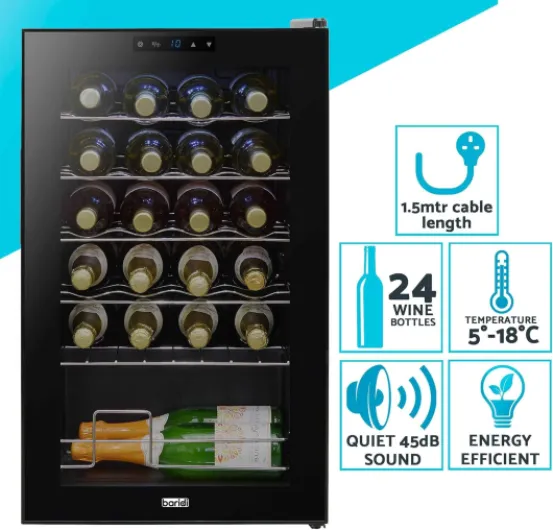
From day one, my expectation was simple: I wanted something that keeps wine at a stable temperature, doesn’t roar like an airplane, and doesn’t look cheap next to the rest of the kitchen. On paper, this Dellonda ticks most of those boxes: 24-bottle capacity, 5–18°C range, compressor cooling and a glass door with a bit of a mirror effect. The Amazon rating around 4.3/5 also gave me some reassurance that it wasn’t total junk.
In real use, it’s not perfect, but it’s fairly solid for the price. It cools properly, the noise level is acceptable, and the design is simple enough that it blends in. There are some small annoyances though: the energy rating isn’t great, the internal layout is a bit optimistic if you actually try to fit 24 standard bottles, and the touch controls are oddly placed so you don’t see the temperature with the door shut.
If you want a serious, dual-zone wine cabinet for expensive bottles, this isn’t it. But if you’re like me and just want a practical, compact fridge for everyday bottles and the odd beer, this Dellonda Baridi does the job reasonably well, as long as you understand its limits before buying.
Is it good value for money or should you spend more?
On value, this Dellonda sits in that middle ground: not bargain-basement, not high-end. For the price, you get a 24-bottle (realistically ~18–20 bottle) compressor wine cooler, with a glass door, digital controls and a fairly compact footprint. It looks decent in a modern kitchen, keeps wine at a stable temperature, and doesn’t sound like a tractor. For someone who just wants a practical wine and beer fridge, that’s pretty good value.
Where the value takes a small hit is the energy rating and the slightly optimistic capacity. The G-rated energy usage means it’s not the cheapest to run long term, especially if you keep it quite cold all year. If you’re very focused on energy bills or trying to keep your home appliances efficient, there are probably more efficient models, but they’ll likely cost more upfront. The capacity issue (24 on paper vs fewer in real life) is common in this category, but it’s still a bit annoying from a value point of view, because you feel like you’re paying for something you don’t fully get.
Compared to cheaper thermoelectric coolers, the Dellonda has a few clear advantages: better cooling power, more stable temperature, and less struggle in warmer rooms. Compared to more expensive branded wine cabinets, it obviously lacks dual zones, premium shelves and better energy ratings. So it sits nicely in the middle: good enough for everyday drinkers, not meant for serious collectors. If you’re upgrading from using a normal fridge or a tiny tabletop cooler, this feels like a solid step up without wrecking your budget.
Overall, I’d call the value pretty solid but not outstanding. You get what you pay for: a functional, decent-looking wine cooler with some compromises. If you’re realistic about the capacity and don’t mind the energy rating, it’s a sensible buy. If you’re super picky about efficiency or want something that feels more premium inside, you might want to spend more on a higher-end brand or a slightly larger model.
Simple, black, and doesn’t scream for attention
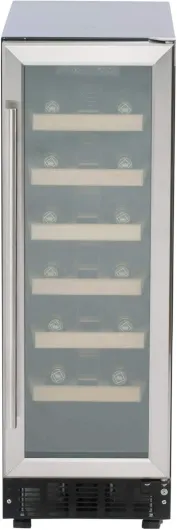
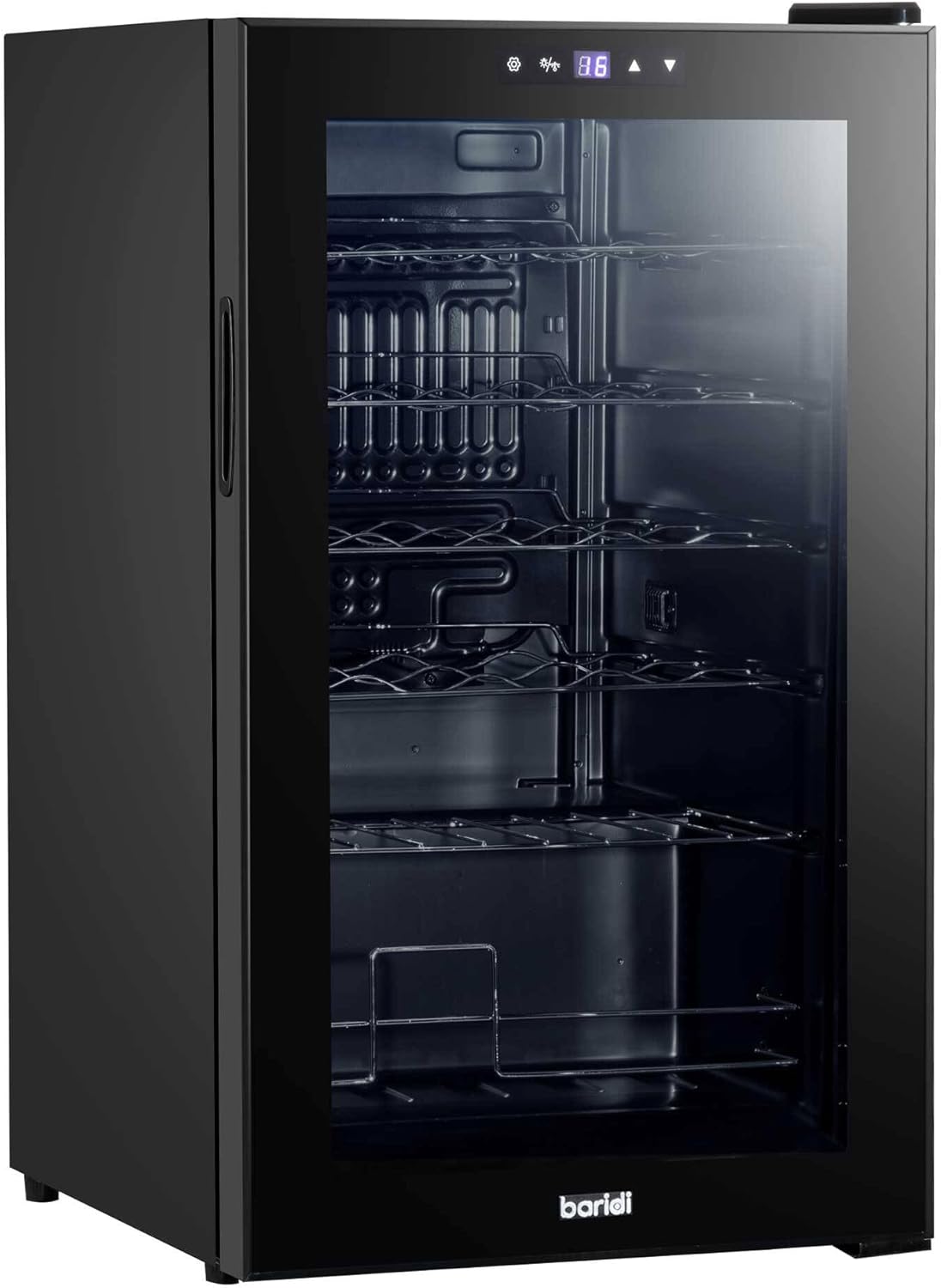
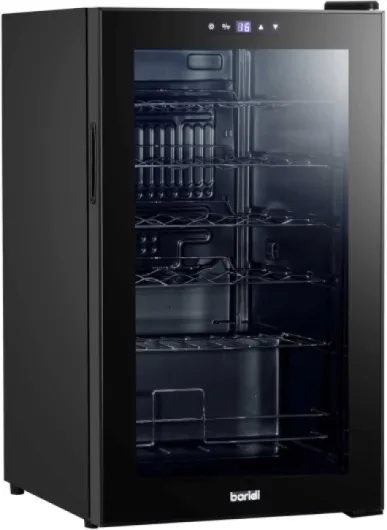
Design-wise, this Dellonda cooler is pretty low-key, which I actually like. The body is black, the door is tempered glass with a mirror effect, and there’s an internal LED light. It doesn’t look cheap from a distance, and next to standard black or stainless appliances it blends in quite well. The footprint is small enough that it fits under most counters or can sit at the end of a run of units without looking odd. I slid mine into a leftover gap in the kitchen and it looked like it was meant to be there, no weird overhang or big gaps.
The glass door has two sides to it. On the positive side, the mirror tint helps block some UV and lets you see the bottles when the light is on, which is handy when you’re trying to pick a bottle without opening the door constantly. On the downside, fingerprints show up easily, so if you’ve got kids or you’re constantly grabbing it with wet hands, expect to wipe it often. The handle installation is straightforward, but you do have to be a bit gentle to keep the door seal sitting properly; one user tip about adding a touch of oil to help the seal sit back in place actually makes sense.
The touch controls are inside the unit, along the top, which is a bit of a weird design choice. It keeps the exterior clean, but it also means you can’t see the temperature unless you open the door. If you’re the type who likes to quickly check the temp from across the room, this will annoy you. In practice, once I set my preferred temperature, I stopped playing with it, so I don’t open the door just to look – but it still feels like a slightly lazy design solution.
One more detail: the adjustable feet are useful if your floor isn’t perfectly level, but the range is limited. I had to tweak the height quite a bit to slide it under a counter, and I can see why someone mentioned sanding the feet down a little. If you have a very tight space, measure properly and don’t rely on the feet giving you huge adjustments. Overall, the design is clean and practical, not fancy, but for a mid-range wine cooler it’s decent enough.
Build quality and shelves: functional, but don’t expect luxury
The build quality is basically what you’d expect from a mid-range Chinese-made appliance: good enough, but you feel where they saved money. The main cabinet feels sturdy, the door hinges seem solid, and the glass door doesn’t flex or feel flimsy when you open it. The door seal sits properly once installed, and I haven’t noticed any obvious cold leaks or fogging that would suggest a poor seal.
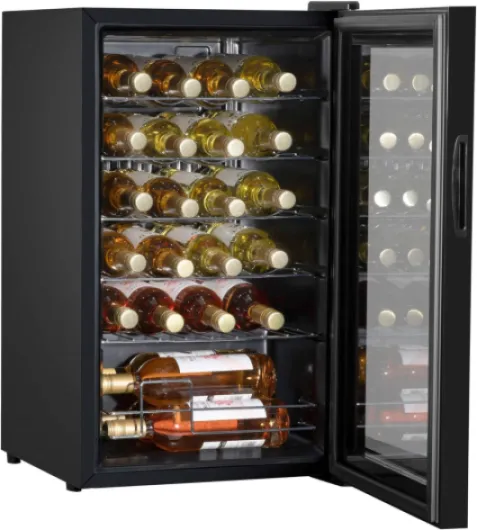
The shelves are where the cost-cutting is more obvious. They’re described as waved metal, and they do hold the bottles in place securely, but the metal is quite thin and doesn’t give that heavy, premium feel. When you slide bottles in and out, there’s a bit of flex and a cheap-ish sound. Functionally though, they work: bottles don’t roll, and you can remove shelves if you want to fit taller bottles or stand a few upright at the bottom. I wouldn’t overload each shelf with very heavy bottles, but for standard wine it’s fine.
Inside, the plastic lining is basic but easy to wipe clean. It doesn’t feel fragile, but it’s not thick, insulated plastic like you’d see in a high-end appliance. The LED light is small but enough to see what’s inside when the room is dim. It’s not a showpiece light, more of a practical one. The touch panel is integrated into the top inside edge and feels okay; the buttons respond properly, but again, you can tell this isn’t top-tier hardware – more like standard appliance level.
Overall, the materials are practical rather than premium. If you’re expecting heavy wooden shelves, thick chrome rails and a super solid inner lining, you’ll be disappointed. If you just want something that holds bottles securely, doesn’t wobble all over the place, and feels reasonably solid when you open and close it, this Dellonda is fine. It matches the price point: not cheap junk, but clearly not luxury either.
Early days on lifespan, but feels decent for the price
Durability is always a bit of a guess unless you’ve had the thing for years, but based on build and what other users report, I’d say this Dellonda is reasonably solid but not indestructible. The compressor type (rotary scroll) is standard for this kind of appliance, and as long as you don’t block the ventilation and you keep it in a normal room, it should last a few years without drama. I haven’t seen any weird noises, rattling or sudden temperature jumps that would hint at a failing component so far.
The door hinges and seal feel like they’ll hold up under normal use. I open it a few times a day and there’s no sagging or misalignment. The glass door doesn’t feel loose, and the frame doesn’t twist when you move the unit slightly. The paint and exterior finish are basic but don’t scratch easily unless you really knock something into it. For an appliance that will probably just sit in one place and be opened and closed, that’s good enough.
Where I’m a bit less confident long term is the shelves and internal plastic. They’re not fragile, but they don’t feel super robust either. If you’re constantly rearranging bottles, pulling shelves in and out and loading heavy bottles, I could imagine some bending or wear over time. The touch panel is also an electronic point of failure, but that’s the case with most modern fridges. So far, the buttons respond fine and there are no dead segments on the display.
Given the price bracket, I’d say the durability is acceptable. You’re not buying a 20-year wine cabinet here. You’re buying a compact, mid-range cooler that should handle everyday use for several years if you treat it reasonably. If you want something to last a decade plus with heavy use, you’d probably need to spend quite a bit more on a higher-end brand.
Cooling, noise and day-to-day use: does it actually work well?
On performance, this fridge is pretty solid for casual use, as long as you understand one key point: it cannot cool below the room’s ambient temperature by a huge margin. The manual and listing mention that it won’t reach a higher temperature than the room, which basically means if your kitchen is roasting at 28°C in summer, don’t expect rock-solid 5°C inside. In a normal home at around 19–22°C, I had no issue getting and keeping it between 7–12°C for whites and around 14–16°C for reds. The compressor kicks in, does its job, and the temperature stabilises after a couple of hours.
Noise-wise, at about 42 dB, it’s not silent, but it’s fine. When the compressor runs, you hear a low hum and a bit of vibration if you’re right next to it, but it’s not worse than a standard under-counter fridge. Sitting in the living room next door, I don’t notice it. If you plan to put it in a bedroom or a very quiet office, you’ll hear it when it cycles, but for a kitchen or open-plan living space it’s acceptable. Compared with a cheap tabletop beer fridge I used before, this Dellonda is actually a bit quieter and less rattly.
The temperature control via the touch screen is simple: up/down arrows and a small display. It responds quickly, and the fridge seems to hit the set temperature within a reasonable time. I did notice that the internal thermometer isn’t millimetre-precise; a separate fridge thermometer inside showed a 1–2°C difference at times. For everyday drinking, that’s fine. If you’re trying to store expensive bottles at a very specific temperature, this might frustrate you, but then you’re probably not shopping in this price bracket anyway.
Day to day, the unit has been reliable so far. No random defrosting, no big swings in temperature, and the automatic defrost means I haven’t had to mess around with ice build-up. You occasionally see a bit of condensation near the back wall, but nothing dramatic. Overall, in terms of performance, it does what it says: keeps drinks cool, runs reasonably quietly, and doesn’t need constant babysitting. Not perfect, but for the cost and size, it’s pretty reasonable.
What you actually get with this 24-bottle Dellonda cooler
On paper, the Dellonda Baridi DH9 is a 24-bottle, 63L wine cooler with a temperature range from 5 to 18°C, compressor cooling and a freestanding design. The dimensions are roughly 43 cm deep, 45 cm wide and 74 cm high, so it’s more of an under-counter height than a tall unit. It’s rated at 142 kWh/year, which isn’t impressive, and uses R-134A refrigerant. The door is glass with a kind of mirror tint, and you get a simple digital touch panel inside to set the temperature.
In the box, you basically get the fridge, the power cable with a UK plug (Type G), and the handle that you have to fit yourself. No fancy accessories, no extra racks, just the basic setup. The shelves are described as waved metal, but in reality they feel a bit like thin metal or moulded sections – they work, but they don’t feel premium. The layout is one compartment with removable shelves and space at the bottom where you can stand a few bottles upright if needed, although that’s where the advertised capacity starts to feel a bit optimistic.
In practice, the 24-bottle claim depends a lot on the shape of your bottles. Standard Bordeaux-style bottles fit fine, but as soon as you start adding chunky Prosecco bottles, wide Champagne bottles or anything unusually tall, you quickly lose capacity. I’d say for mixed bottles, you’re realistically closer to 18–20 without having to play Tetris. That’s not unusual for wine fridges in this price range, but it’s worth knowing so you don’t plan a big party around a theoretical 24 bottles.
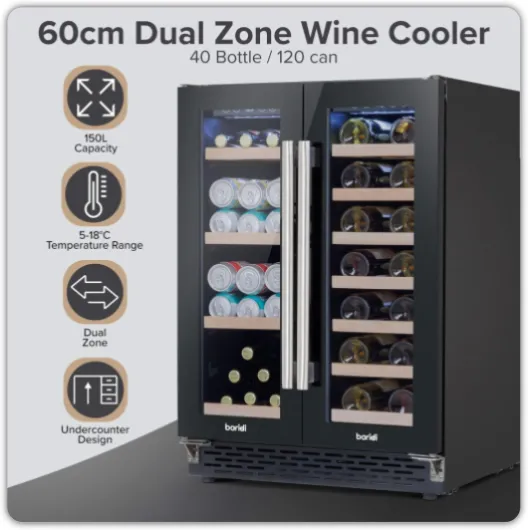
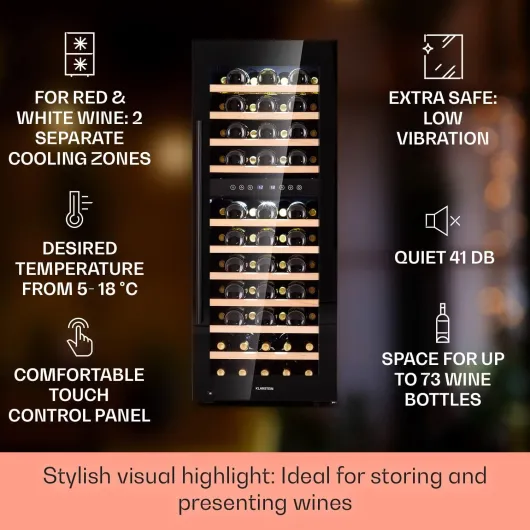
Overall, the presentation is very straightforward: this is a compact, single-zone wine fridge aimed at casual home use. No advanced Wi‑Fi features, no fancy app, no dual temperature zones. If you’re looking for something simple that just sets a temperature and keeps it, that’s exactly what this unit offers. If you want more flexibility or precise storage for a wine collection, you’ll probably feel its limits quite quickly.
How well it actually stores and chills your bottles
In terms of effectiveness, the main question is simple: does it keep your wine at a decent, stable temperature and is the capacity realistic? On the temperature side, I’d say yes, it’s effective enough. I kept whites around 8–10°C and reds at about 14°C, and both felt right when poured. No lukewarm white wine, no overly chilled reds. The compressor doesn’t need to run constantly; it cycles on and off like a normal fridge, and overall the temperature stays within a couple of degrees of the setting.
Where things are less perfect is the capacity and bottle fit. The 24-bottle claim is technically possible if you stick to slim, standard bottles and pack them in carefully, but in real life, with mixed bottles, it’s less. Chunky Prosecco or Champagne bottles quickly mess up the nice rows. I ended up using it as more of an 18–20 bottle unit most of the time. If you mostly drink standard supermarket reds and whites, you’ll get closer to the advertised capacity. If you like funky bottle shapes, be ready to compromise.
One thing it does well is maintain a reasonable humidity and environment for short- to medium-term storage. Corks don’t dry out, and I haven’t seen any mould issues. This isn’t a long-term ageing cabinet, but for keeping bottles a few weeks or months, it’s absolutely fine. The mirror glass door helps reduce direct light exposure, and the LED inside doesn’t seem to heat things up noticeably.
In practice, for everyday use – keeping a few whites ready, having reds at a steady temp, and throwing in some beers – it’s effective. If you’re trying to build a serious wine collection and care about precise storage conditions, this is more of a secondary or starter unit. For a normal household that just wants drinks at a decent temperature, it does the job without too much fuss.
Pros
- Compact size that fits easily under counters or in small kitchen gaps
- Keeps wine at a stable, adjustable temperature between 5–18°C for everyday use
- Simple, clean design with glass door and internal LED that looks decent in most kitchens
Cons
- Realistic capacity is lower than the advertised 24 bottles, especially with mixed bottle shapes
- G-rated energy efficiency, so not the cheapest to run long term
- Temperature display and controls are inside, so you can’t see the set temperature with the door closed
Conclusion
Editor's rating
The Dellonda Baridi 24 Bottle Wine Cooler is a practical, no-nonsense option for people who just want their wine and beers at a steady, decent temperature without giving up half the kitchen. It cools reliably in normal home conditions, runs at an acceptable noise level, and the simple black-and-glass design blends in nicely. The touch controls are basic but easy to use, and once you’ve set your temperature, it pretty much gets on with the job.
It’s not without flaws. The advertised 24-bottle capacity is optimistic if you have a mix of standard and chunky bottles, and the energy rating isn’t great. The shelves feel a bit cheap, and the fact you can’t see the temperature display with the door closed is slightly annoying. But none of these are deal-breakers if your expectations match the price tag. For everyday drinkers who want to free up space in the main fridge and keep a small selection ready to go, it’s a decent, good-value choice.
If you’re a serious collector, want dual temperature zones, top-notch materials and better energy performance, you should probably skip this and look at higher-end brands. If you just want something compact that keeps 15–20 bottles nicely chilled, looks okay and doesn’t require any special setup, the Dellonda Baridi DH9 does the job well enough to justify the cost.