Summary
Editor's rating
Value for money: decent if you catch it at a good price and accept the compromises
Looks good in a kitchen, with a few practical quirks
Materials feel decent for the price, but not premium
Build feels okay, but reliability reviews are a bit worrying
Cooling, noise and real-world capacity: where it works and where it annoys
What you actually get with this 55-bottle Dellonda
Pros
- Dual-zone cooling works well and holds temperatures close to the set points
- Looks pretty solid with mirrored glass door and wooden shelves for the price
- Simple touch controls and automatic defrost make it easy to use day to day
Cons
- Real-world bottle capacity is well below the claimed 55 bottles with mixed bottle shapes
- Energy efficiency is poor (class G) so running costs are higher
- Some reports of compressor failure just after warranty, with limited repair options

Specifications
View full product page →| Brand | Dellonda |
A budget dual-zone wine fridge that’s not perfect, but can do the job
I’ve been using this Dellonda Baridi 55 bottle dual-zone wine fridge for a little while now, and I’ll be honest: I bought it because I wanted dual zones and a decent capacity without spending silly money. I’m not a sommelier, just someone who likes to keep reds and whites at roughly the right temperature and free up space in the main fridge. So this is very much a “normal user” view, not a collector with thousand‑pound bottles to protect.
Out of the box, it comes across as a fairly straightforward appliance: freestanding, black cabinet, mirrored glass door, touch controls on the front. Nothing fancy in terms of smart features or Wi‑Fi, which I actually liked. I just wanted to set a temperature and forget about it. The brand isn’t exactly premium, so I didn’t expect miracles, just something that cools properly and doesn’t sound like a tractor in the kitchen.
In day‑to‑day use, it’s a bit of a mixed bag. On the positive side, the dual‑zone feature works, the temperatures are pretty accurate once it’s settled, and visually it looks better than the price might suggest. On the downside, the bottle capacity is optimistic, the energy rating is poor, and there are some question marks around long‑term reliability if you read through the more negative reviews.
If you’re thinking about buying it, I’d say the key is to know exactly what you’re getting: a decent but not premium wine fridge, with some compromises on space, noise and efficiency. If you accept that upfront, it’s easier to live with. If you expect a perfect 55‑bottle cellar for a budget price, you’ll probably end up annoyed.
Value for money: decent if you catch it at a good price and accept the compromises
In terms of value, I’d call this fridge decent but not spectacular. You’re mainly paying for three things: dual‑zone cooling, a mid‑size capacity, and a design that looks reasonably smart in a kitchen or dining room. If you look at other dual‑zone units with similar capacity, a lot of them are either more expensive or uglier. So on that front, the Dellonda makes some sense if you’re trying to keep costs under control but still want two zones.
However, there are a few things that drag the value score down. First, the energy class G means higher running costs over time compared to more efficient models. If you keep it on 24/7 (which you will), that adds up over a few years. Second, the real‑world 55‑bottle claim is optimistic. You’re not buying a true 55‑bottle solution unless you only drink slim Bordeaux bottles and are happy to play puzzle every time you add or remove something. For most people with mixed bottles, it’s more like a 40‑bottle fridge, and that changes how good the deal actually is.
Then there’s the reliability side. A 3.7/5 average rating with some reports of units dying just after the warranty doesn’t scream long‑term bargain. If you get a good one that lasts several years, it’s pretty good value for the price. If you’re unlucky and the compressor fails after 13–14 months, it suddenly becomes an expensive gamble. That’s the risk you’re taking with a budget‑leaning brand.
So overall, I’d say the value is okay if you go in with eyes open: you want dual zones, you’re not obsessive about exact bottle count, and you’re not expecting a decade of service. If you want rock‑solid reliability and truly accurate capacity, you’re better off paying more for a higher‑end brand. If you’re just trying to get your wine and beer out of the main fridge and into something that looks decent and cools properly, this Dellonda can be a reasonable compromise.
Looks good in a kitchen, with a few practical quirks
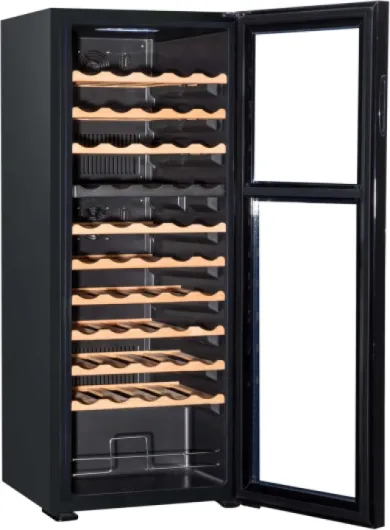
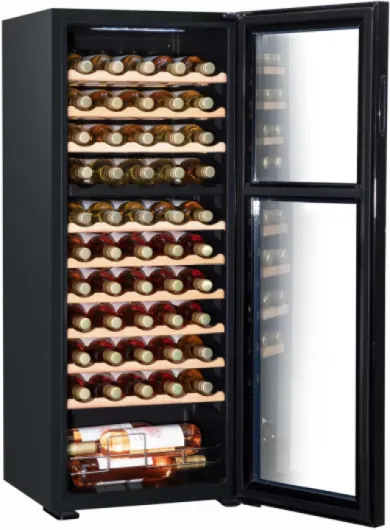
Design‑wise, I actually liked this fridge more than I expected. The tempered mirror glass door looks clean and modern, and it does reflect light in a way that hides the bottles a bit when the internal light is off. When you switch the LED on, you can see the contents clearly enough. The mirrored glass is also supposed to help block UV, which makes sense, but I can’t really measure that. It just looks decent and doesn’t scream “cheap plastic box” from across the room.
The cabinet is black with a matte finish, which blends in nicely with most kitchens or dining rooms. It’s not some bulky chrome monster. I’ve had it tucked into a corner near a sideboard and it looks like it belongs there, not like a random garage fridge dragged indoors. The door opens from one side only (not reversible as far as I can tell), so you do need to think about which way it swings before you commit to a spot. There’s also no separate handle to mount; it’s all integrated, which keeps it clean visually and means less fiddling during setup.
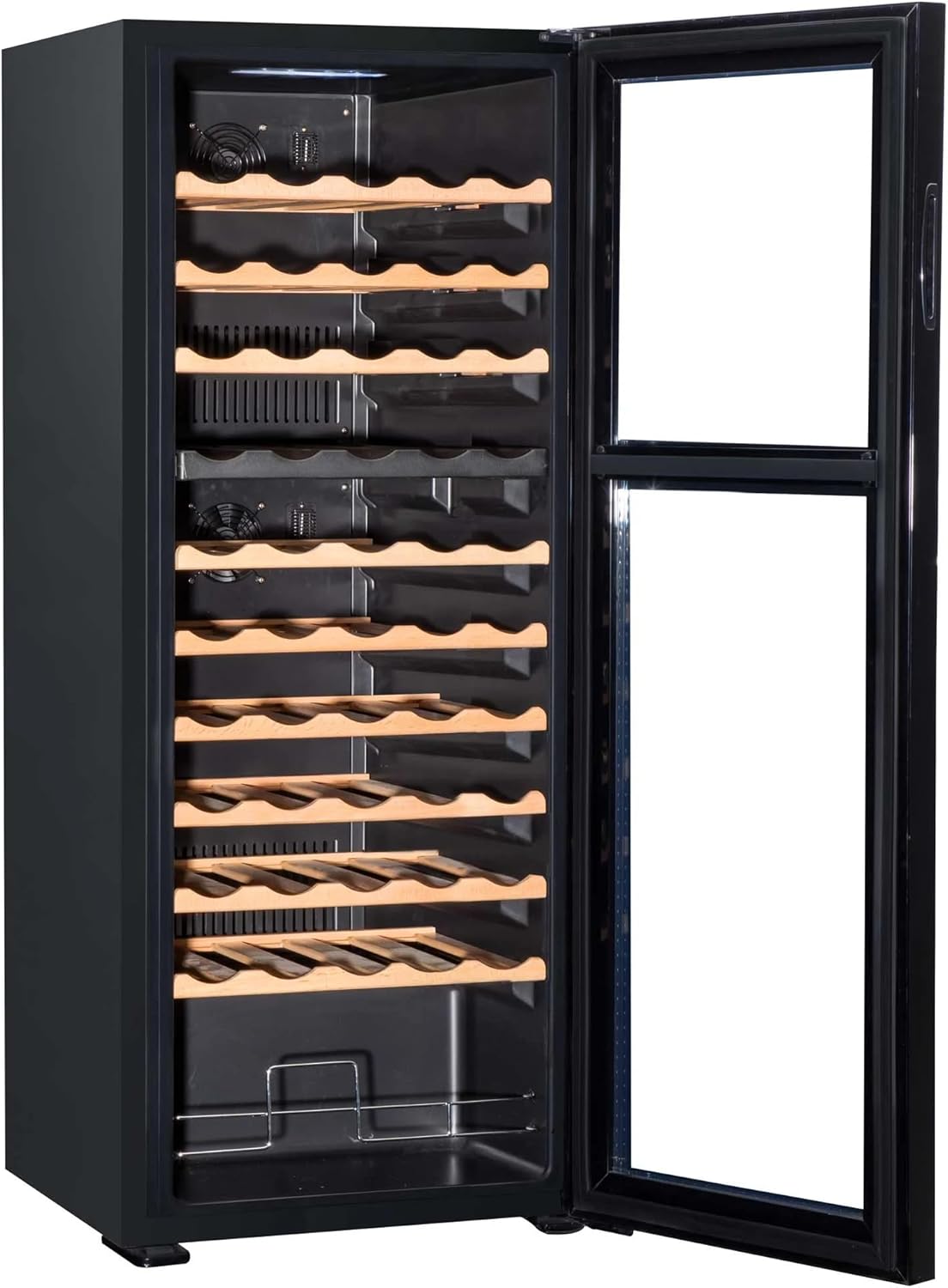
Inside, the layout is simple: wooden shelves on runners that you can slide out enough to grab bottles, plus a bit of extra space at the bottom for larger bottles. In theory, the bottom zone should hold champagne‑size bottles, but in practice it’s tight. I could fit two big bottles comfortably; trying to squeeze a third in there was just asking for clanking glass and swearing. Also, if you start moving shelves around to fit bigger bottles, you quickly lose some capacity, so don’t expect the layout to be super flexible without trade‑offs.
In terms of overall design, my takeaway is: it looks nicer than its price suggests, but it’s clearly designed around standard, slim bottles and a fairly open position in the room for ventilation. If you want something flush‑fitted into cabinetry, this isn’t it. As a freestanding piece that adds a bit of “wine corner” vibe to a room, it does the job well enough.
Materials feel decent for the price, but not premium
The materials are pretty much what you’d expect at this price point. The tempered glass door feels solid enough when you open and close it; it doesn’t flex or feel flimsy. The seal around the door is okay too – not the tightest I’ve ever seen, but it closes cleanly and I haven’t noticed any obvious condensation issues or warm air leaks around the edges. The cabinet walls are standard painted metal, nothing fancy, but they don’t feel thin or rattly when you knock on them.
Inside, the big talking point is the beech wood shelves. They look nicer than metal wire racks and slide in and out reasonably smoothly. They’re not heavy duty like you’d find in a high‑end cellar, but for normal use – sliding a few bottles in and out each week – they’re fine. The main limitation is width and spacing: the rails are clearly designed around standard Bordeaux bottles. If you have fatter bottles or a lot of sparkling wine, the shelves feel a bit cramped and you start playing Tetris to make things fit.
The plastic parts (interior sides, shelf runners, control panel surround) are what I’d call “budget but acceptable”. They don’t feel like they’ll snap instantly, but you’re also aware this is not some top‑tier appliance. The touch controls respond well enough; they’re not hypersensitive, but they register taps reliably. The LED light is basic but does its job, and it doesn’t get hot or anything odd like that.
Overall, if you’re expecting ultra‑premium materials, you’ll be disappointed. But for a mid‑range wine fridge, the mix of glass, metal cabinet and wood shelves is pretty solid for the money. My only real gripe is that the shelf design limits bottle shapes more than I’d like, which makes the claimed 55‑bottle capacity feel like a bit of a stretch in real life.
Build feels okay, but reliability reviews are a bit worrying
From handling it and using it day to day, the build quality feels decent enough. The door still closes properly, the shelves haven’t warped, and the controls work like they did on day one. I haven’t noticed any weird rattles or vibrations, and the compressor cycles sound consistent. So in terms of physical sturdiness in the first months, I don’t have major complaints. It feels like a typical mid‑range appliance, not something that’s going to fall apart if you look at it funny.
Where I do get a bit uneasy is after reading some of the user reviews, especially the ones mentioning that the unit died just after the 1‑year warranty, usually with a failed compressor. One reviewer was told the compressor was “not a replaceable part” and basically had to bin the whole fridge after about 56 weeks. That’s not exactly reassuring, and it tells me this isn’t built with long‑term repairability in mind. If the main cooling part goes, it’s game over rather than a simple repair job.
Another thing with durability is how optimistic the brand seems to be about capacity. When a product is advertised as 55 bottles but people struggle to get anywhere near that with normal wine bottles, it doesn’t scream honest engineering decisions. It feels like marketing pushed the number up based on lab‑perfect conditions. That doesn’t mean the fridge will physically break, but it does make me slightly less trusting about the rest of the promises.
So, my take: if you treat it as a 3–5 year appliance rather than something you’ll pass on to your kids, it’s probably fine. Just don’t expect commercial‑grade longevity, and be aware that if the compressor fails out of warranty, you’re likely buying a new unit, not repairing this one. For the price, that might be acceptable for some people, but if you’re storing expensive wine, I’d personally look at something with a better track record.
Cooling, noise and real-world capacity: where it works and where it annoys
On the performance side, the good news is that the dual-zone cooling actually works. I ran separate digital thermometers in both the upper and lower zones for a few days. Once the fridge had settled (give it a day or so after plugging in), the temperatures stayed pretty close to what I set on the panel – usually within about 1°C either way, which is fine for home use. I keep the top at around 17–18°C for reds and the bottom around 8–9°C for whites and beer, and they’ve been steady.
The compressor doesn’t run constantly, but when it kicks in you do notice it. The spec says 45 dB, and that feels about right. In a kitchen or open‑plan living area, you’ll hear a soft hum and some fan noise now and then. I wouldn’t put this in a bedroom or small quiet office, but in a typical kitchen/dining space it’s acceptable. Some reviewers call it noisy; I’d say it’s audible but not crazy. It’s also worth saying: if you wedge it in too tight without the recommended ventilation gaps, it will likely run harder and sound worse.
Capacity is where reality and marketing drift apart. The brand claims 55 bottles, but that’s clearly based on uniform, slim bottles, all lined up perfectly. In real life, with a mix of supermarket wines, a few chunkier reds and some fizz, I’m more in the 35–40 bottle range without serious juggling. You can double‑stack in a few places, but then it’s a pain to access anything at the back. Champagne bottles are the worst offenders: the bottom section can handle a couple, but three is pushing it, and you’ll sacrifice some space above if you try to cram more in.
Energy‑wise, 153 kWh/year and an energy class G rating aren’t great. You’re basically paying for the dual‑zone and glass style with higher running costs than a decent modern fridge. It’s not outrageous for a wine cooler, but if you’re very energy‑conscious, it’s something to think about. Also, there are a few worrying reports of units dying just after a year, with the compressor not being replaceable. Mine hasn’t failed yet, but that kind of feedback does make me a bit cautious about long‑term reliability. So performance is solid on temperature control and okay on noise, but durability is a question mark.
What you actually get with this 55-bottle Dellonda
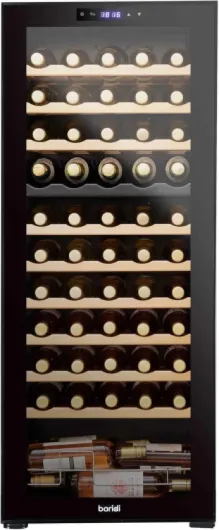
On paper, the Dellonda Baridi DH93 is a freestanding, dual‑zone wine fridge with space for up to 55 bottles and a 150L capacity. It’s about 126 cm high, 51 cm wide and 48 cm deep, so it’s tall and slim rather than a squat under‑counter style. That matters because you really need to plan where it’s going: it needs ventilation gaps at the back and sides (around 50 mm at the rear and 30 mm all around), so you can’t just cram it tight between two cabinets and hope for the best.
The layout inside is split into two zones: the upper zone and lower zone both adjustable between 5–18°C. Roughly speaking, the top is meant for reds (higher temps) and the bottom for whites, fizz, or beer (lower temps). The brand claims up to 20 bottles up top and 35 at the bottom using beech wood shelves. In reality, that only works if you use fairly standard Bordeaux‑type bottles and don’t mind a bit of shuffling. Anything with a fatter shoulder or champagne‑style bottles starts to mess up that theoretical capacity quickly.
The controls are all on the front, with a digital touch panel that lets you set each zone’s temperature, toggle the light, and lock the keypad. There’s a soft white LED inside, which is more than enough to see what’s where without lighting up the whole room. Cooling is handled by a compressor with automatic defrost, so you don’t have to faff around with manual defrosting. It’s rated at 153 kWh/year and sits in energy class G, which is pretty poor compared to modern kitchen fridges, but sadly common for cheap wine coolers.
Overall, in terms of what’s promised, it’s fairly clear: dual zones, mid‑range capacity, simple controls, and a budget‑friendly build. If you read the spec sheet expecting a high‑end cellar, you’ll be disappointed, but if you see it as a mid‑budget wine chiller that happens to look decent, the presentation is reasonably honest apart from the bottle count claim.
Pros
- Dual-zone cooling works well and holds temperatures close to the set points
- Looks pretty solid with mirrored glass door and wooden shelves for the price
- Simple touch controls and automatic defrost make it easy to use day to day
Cons
- Real-world bottle capacity is well below the claimed 55 bottles with mixed bottle shapes
- Energy efficiency is poor (class G) so running costs are higher
- Some reports of compressor failure just after warranty, with limited repair options
Conclusion
Editor's rating
If I had to sum up the Dellonda Baridi 55 bottle dual‑zone wine fridge in one line, I’d say: it looks good, cools well enough, but comes with some compromises you shouldn’t ignore. The dual‑zone feature works properly, the temperatures are fairly accurate, and it does a nice job of keeping reds and whites where they should be. The mirrored glass door and wooden shelves give it a nicer look than a lot of other budget wine fridges, and for a normal kitchen or dining room, it fits in fine.
On the flip side, the capacity is over‑sold unless you only use slim bottles, the energy efficiency is poor, and there are a few worrying reports about units dying just after the warranty period. Noise is acceptable but not silent, and the layout isn’t very flexible if you drink a lot of champagne or use chunky bottles. So it’s not a disaster, but it’s also not some miracle bargain.
I’d recommend this to someone who wants a reasonably priced, decent‑looking dual‑zone fridge mainly for everyday wines and beers, and who understands they’ll probably fit around 40 bottles comfortably, not 55. If you’re storing high‑value wine, want long‑term reliability, or are very picky about energy use and noise, I’d skip this and look at a higher‑end brand with a better track record and more honest capacity claims.