Summary
Editor's rating
Value for money: decent if you accept the bottle limits
Design: looks smart, but function is not perfect
Materials & build quality: decent, but not premium
Durability & daily use: some doubts, especially on shelves
Cooling performance & noise: does the job with a few limits
Specs vs reality: what you actually get
Pros
- Compact size that’s easy to place in most kitchens or living rooms
- Cools reliably with stable temperature and reasonable noise (around 40 dB)
- Nice look with glass door and wooden shelves, decent for visible placement
Cons
- Real usable capacity is well below the advertised 20 bottles with mixed bottle shapes
- Wooden shelves can be tight and feel fragile if you force them
- Minimum temperature of 5°C and only 1-year warranty

Specifications
View full product page →| Brand | HYE |
A compact wine fridge that looks good but has compromises
I’ve been using this HYE 20-bottle wine cooler for a bit now, and my feeling is pretty clear: it looks good, cools properly, but you have to accept some compromises. On paper it ticks a lot of boxes: 20 bottles, wooden shelves, digital temperature control, quiet compressor, and a compact size that actually fits in a normal kitchen without rearranging everything. In reality, it’s not as simple as “20 bottles and done”.
What hit me first is that the advertised capacity is very optimistic. If you mainly drink standard Bordeaux-style bottles or Champagne/Prosecco, forget the “20 bottles” claim. You can squeeze in fewer, and you need to play Tetris with the shelves. It’s not unusable, but if you’re expecting a small cellar for a growing collection, you’ll probably be a bit annoyed, like some of the Amazon reviewers.
On the positive side, it does what a wine fridge is supposed to do: it cools and keeps a stable temperature. The compressor isn’t ultra-silent, but at 40 dB it’s fine in a kitchen or dining area. You hear it when it kicks in, but it’s not the kind of noise that makes you crazy. For day-to-day use, it’s acceptable, especially compared to some cheap fridges that buzz constantly.
So overall, my first impression is: decent little wine cooler that looks pretty solid for the price, but with clear limits on capacity and bottle types. If you buy it thinking “stylish fridge for a small selection of regular bottles”, it’s fine. If you buy it thinking “proper mini-cellar for all my sparkling and big bottles”, you’re going to be disappointed.
Value for money: decent if you accept the bottle limits
When you look at the price bracket and what you get, I’d say the value is decent but not amazing. You get a compact compressor wine cooler, digital temperature control, wooden shelves, glass door, and reasonable noise and energy usage. For a small apartment or someone just starting a tiny wine collection, it ticks a lot of boxes without costing as much as high-end brands.
Where the value takes a hit is the real capacity. If you were counting on storing 20 mixed bottles (red, white, Champagne, Prosecco), you’re going to be disappointed. Several buyers complain about this, and I agree: the product page should be more honest about the type of bottles that fit. For me, that’s the main reason I wouldn’t give it a top score. It’s not useless, but it’s clearly more a 10–14 bottle practical capacity cooler if you drink a variety of wines.
On the other hand, the cooler does its main job well: it keeps wine at a stable temperature while looking presentable in a room. If you mostly drink standard, slimmer bottles and only keep the occasional Champagne in the bottom, you’ll probably feel you got good value for money. If your collection is heavy on sparkling or large-format bottles, you’ll feel squeezed and might regret not paying a bit more for a wider model.
So in terms of value, I’d say: fair price for what it is, with the clear condition that you accept its limits. There are better options if you need real 20-bottle flexibility, but for a compact, good-looking fridge for a small selection, it’s a reasonable deal.
Design: looks smart, but function is not perfect
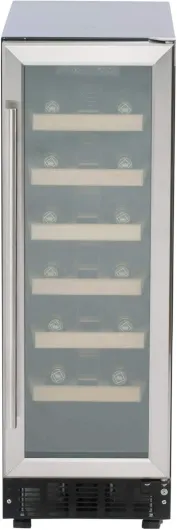
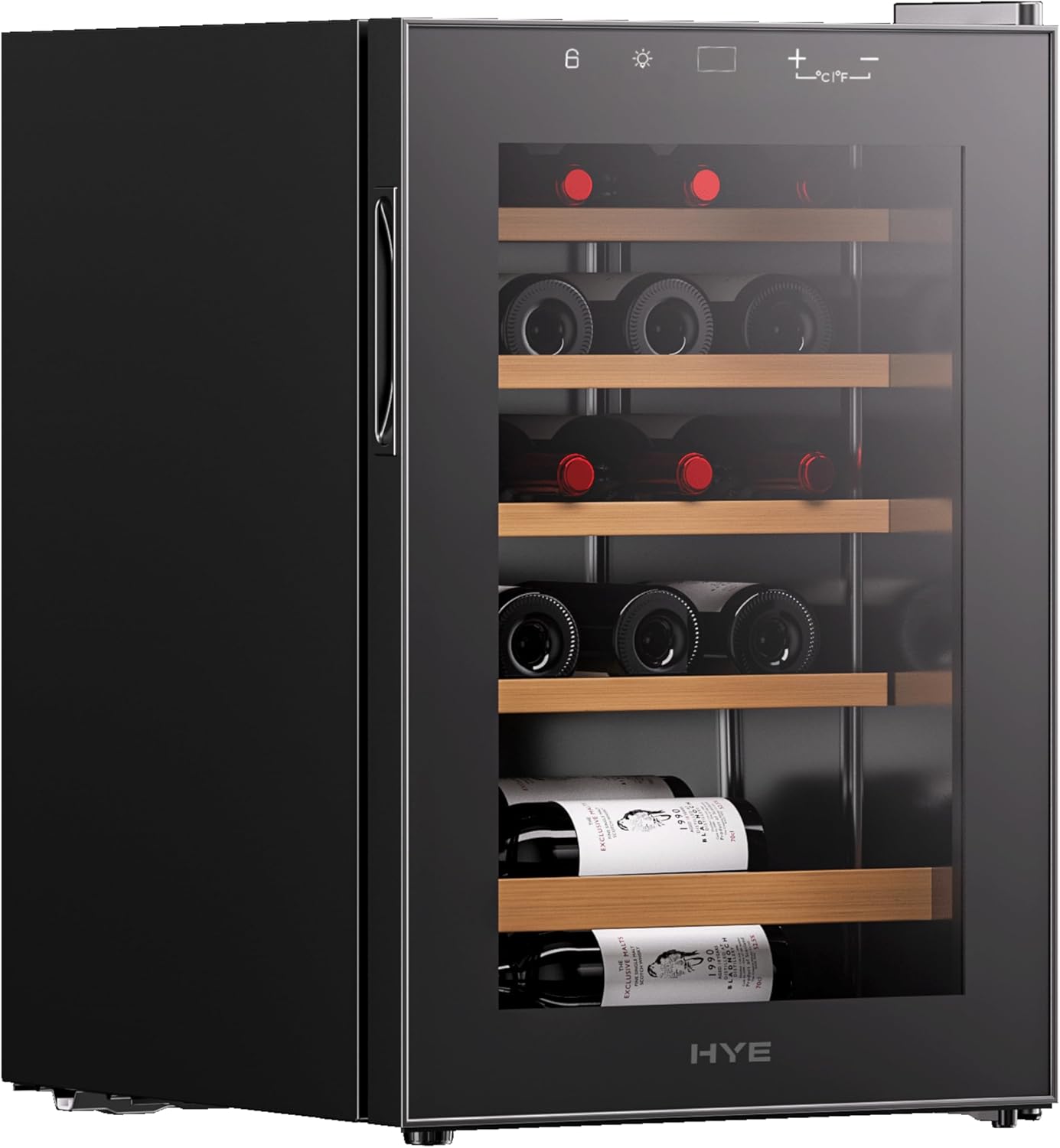
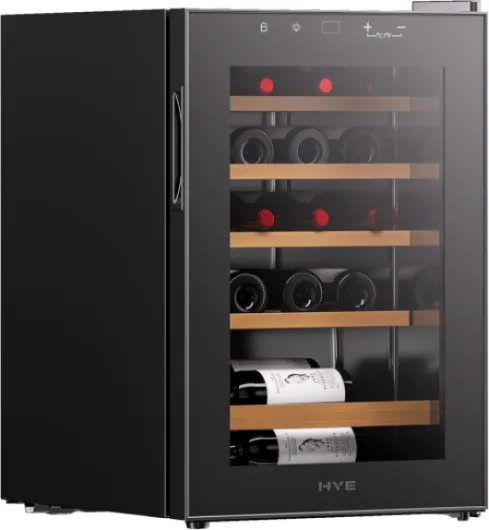
Visually, I have to admit, this cooler is pretty smart looking. The black exterior, glass door, and wooden shelves give it a clean, modern look that fits well in a kitchen or living room. It doesn’t scream “cheap appliance”, which is nice if you’re putting it somewhere visible. The frameless glass door gives a more premium vibe than those thick plastic-framed doors you often see on entry-level units.
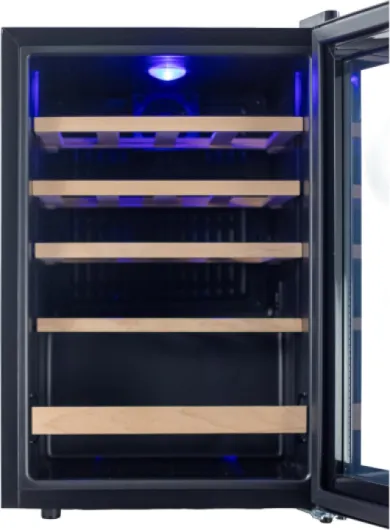
Inside, the layout is simple: several wooden shelves that slide, plus the bottom zone. In theory, this is practical. In practice, the spacing between shelves is tight, and with anything bulkier than a slim bottle, you end up fighting with it. I had the same issue as one of the reviewers: bottles can rub against the shelf above, and you have to pull shelves out fully to get a bottle in or out. That’s annoying when the fridge is full and you just want to grab one bottle for dinner without rearranging everything.
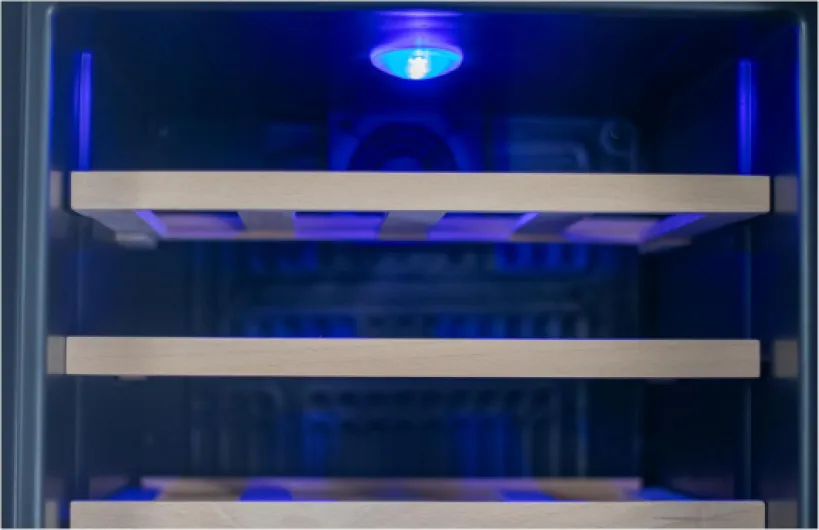
The LED lighting at the top is decent. It’s not nightclub-bright, but it’s enough to see labels and check what’s inside. I like that it doesn’t blast your eyes when you open the door in the evening. The digital control panel is also straightforward: a small screen and simple buttons, no weird menu tree. You set a temperature, and that’s it. For a basic wine fridge, that’s all you really need.
So in terms of design: looks good, feels coherent, but practicality is a bit compromised by the tight shelf spacing and the bottle shape limitations. If your main criteria is appearance and you don’t mind fiddling with bottles, it’s fine. If you want easy access and maximum flexibility for all bottle types, you’ll probably get frustrated pretty quickly.
Materials & build quality: decent, but not premium
Materials-wise, HYE went with a classic combo: metal body, glass door, and wooden shelves. The outside metal feels fine, not too thin, and the paint finish looks okay. It doesn’t feel like it’ll scratch just by brushing past it. The glass door is clear and gives a good view of the bottles. The handle and hinge feel reasonably solid; they don’t wobble or feel like they’ll fall off after three uses.
The wooden shelves are the part that divides opinion. On the one hand, they look nicer than wire racks and they hold the bottles more gently. On the other hand, one reviewer mentioned actually splitting two of them while trying to remove bottles. I didn’t break any, but I can see how it could happen: if the shelves are a bit tight in the rails and you force them while they’re loaded, the wood feels like it could crack. It’s not flimsy like cardboard, but it’s not heavy, dense wood either. You have to treat them with a bit of care.
Inside, the plastic and interior finishing are pretty standard for this price range. Nothing fancy, but nothing that screams “super cheap” either. The LED light and the control panel don’t feel loose. The door seal sits correctly and closes well, which is important for temperature stability. I didn’t see any weird gaps or warped parts on the unit I used.
Overall, I’d say the build quality is decent but not premium. It feels okay for the price point, as long as you’re not rough with it. If you’re the type to yank shelves in and out quickly or cram bottles in without thinking, you’ll probably damage something eventually. If you handle it with normal care, it feels like it should last a few years without drama.
Durability & daily use: some doubts, especially on shelves
For durability, I can’t pretend I’ve used it for years, but a few things stand out pretty quickly. First, the shelves. The fact that one user managed to split two wooden trays just by pulling bottles out is not reassuring. The shelves on my unit haven’t broken, but they do feel like the weak point. If you slide them out fully while loaded and they snag a bit in the rails, you can feel the flex. So, long term, I’d be careful there and not overload them or yank them too hard.
The compressor itself feels standard. This kind of basic compressor is usually pretty reliable if the ventilation is not blocked and you don’t move the fridge around constantly. There’s a 1-year warranty, which is honestly the bare minimum. For a product that’s meant to run 24/7, I’d have liked at least two years. That short warranty doesn’t scream confidence, but it’s unfortunately common in this price segment.
The door hinge and seal feel okay, and I didn’t notice any sign of poor alignment or air leaks. That’s important for durability, because if the seal fails, the compressor has to work harder and dies earlier. The cabinet itself is solid enough: no weird vibrations or rattling noises, even when the compressor kicks in. So structurally, it seems fine for normal home use.
In daily use, the biggest durability risk is honestly user frustration: fighting with shelves, forcing bottles in, and pulling too hard. If you treat it gently, I think it will hold up reasonably well. If you expect it to behave like a heavy-duty bar fridge and slam things around, the wooden shelves and rails may not appreciate it. So I’d rate durability as average: not rubbish, but not something I’d trust for very heavy or commercial use.
Cooling performance & noise: does the job with a few limits
On the performance side, this cooler does what it’s supposed to: it cools and keeps a stable temperature. The compressor system is more efficient than thermoelectric units, especially if your room gets warm in summer. I found that it reached the set temperature in a reasonable time after plugging it in and loading it with bottles that were already at room temperature. It doesn’t drop instantly, but for a small home wine cooler, it’s fine.
The temperature range starts at 5°C, which is okay for white and rosé, but if you like your drinks super cold, you might find that limit a bit frustrating. One reviewer even mentions they wish it went below 5°C, and I agree. For red wines, on the other hand, the range is more than enough. You can set it a bit higher and it keeps them at a nice, stable serving temperature, instead of having them swing with the room temperature.
In terms of noise, the 40 dB rating is about right. It’s not silent, but it’s not loud either. You hear the compressor kick in, especially in a quiet room, but it’s more of a background hum than a buzzing. One reviewer said it can be “a little bit noisy at times”, and that’s exactly it: not enough to be a problem in a kitchen or living room with normal activity, but if you put it in a bedroom or tiny studio, you’ll notice it when everything else is quiet.
Energy-wise, 136 kWh per year is pretty reasonable for a small fridge that runs all the time. It’s not going to ruin your electricity bill. The cooling is consistent and I didn’t notice big fluctuations once it had settled. So, overall performance: solid enough for home use, with the main drawbacks being the 5°C minimum temp and the occasional noise spike when the compressor starts.
Specs vs reality: what you actually get
On paper, this HYE RF01WC20B31 is a freestanding wine cooler with a 62 L capacity, advertised for 20 bottles. It’s 48 cm deep, 43 cm wide, and 63 cm high. So it’s quite compact and easy to place in a kitchen corner, under a counter (if you leave breathing room), or in a dining room. It runs on a compressor system, with manual defrost, and a temperature range that goes down to 5°C according to the specs. That’s enough for white and rosé, though personally I’d have liked to go a bit lower for some beers or very chilled whites.
The inside is laid out with 5 wooden shelves and a bottom space. There’s a digital control panel to set the temperature, and an LED light at the top. The door is glass, frameless look, with a handle on the right. It’s a simple setup, no dual zone, no Wi-Fi, no fancy features. Just a single-zone cooler to keep a small stock at a stable temperature. Annual energy consumption is listed at 136 kWh, which is pretty modest for a small compressor fridge.
Now, in real use, the famous “20 bottles” is only true if you mainly store slim bottles (Pinot style). One reviewer is very clear: Champagne and standard Bordeaux bottles don’t fit well on the shelves. I ran into the same thing: for Prosecco or Champagne, you’re basically limited to the bottom area, often neck-first as the manual suggests. So yes, technically 20 bottles is possible, but only with the right shapes. With normal mixed bottles, I’d say more like 10–14 in a comfortable, realistic layout.
In short, the spec sheet is honest about size, noise, and energy use, but the capacity is clearly the optimistic marketing number. If you buy it aware of that and plan around 12 bottles instead of 20, it feels more aligned with reality. If you need real 20-bottle flexibility (including Champagne), you should probably look one size up.
Pros
- Compact size that’s easy to place in most kitchens or living rooms
- Cools reliably with stable temperature and reasonable noise (around 40 dB)
- Nice look with glass door and wooden shelves, decent for visible placement
Cons
- Real usable capacity is well below the advertised 20 bottles with mixed bottle shapes
- Wooden shelves can be tight and feel fragile if you force them
- Minimum temperature of 5°C and only 1-year warranty
Conclusion
Editor's rating
Overall, the HYE RF01WC20B31 is a decent compact wine cooler that looks good and cools properly, but it comes with clear compromises. The design is clean, the glass door and wooden shelves give it a nice look, and the digital temperature control is simple to use. Noise and energy consumption are both reasonable for a small compressor fridge, so for a kitchen or dining room it fits in fine. If you just want a small, tidy place to keep a dozen bottles at the right temperature, it does the job.
The big catch is capacity and bottle compatibility. The advertised 20-bottle figure is only realistic with slim bottles. Standard Bordeaux and Champagne bottles quickly cause problems on the shelves, and you end up using the bottom space for anything bulky, often with the bottles neck-first. Add to that the shelves that can be a bit fragile if you force them, and a one-year warranty that doesn’t inspire huge confidence, and you get a product that’s clearly not perfect.
Who is it for? People with a small space, a modest collection, and mostly standard or slimmer bottles who care about looks and just want something that gets the job done without too many features. Who should skip it? Anyone who really needs a true 20-bottle capacity, stores a lot of Champagne/Prosecco, or wants robust shelves they can pull in and out all the time without thinking. In that case, it’s better to go for a slightly bigger, more flexible model.