Summary
Editor's rating
Value for Money: Worth It or Not?
Design: Nice Look, Some Practical Limits
Build Quality and Shelves: Decent but Not Premium
Durability and Long-Term Use: What to Expect
Cooling Performance and Noise: Does It Keep Your Wine Happy?
What You Actually Get with the Upstreman W41
Daily Use: How It Handles a Real Wine Collection
Pros
- Keeps a stable temperature between 5°C and 20°C with relatively low noise
- Compact size with decent real-world capacity for 30+ bottles
- Full glass door and LED lighting give it a clean, modern look suitable for living areas
Cons
- Manual is vague and first setup can be confusing for some users
- Advertised 41-bottle capacity is hard to reach with mixed bottle shapes
- Only 1-year warranty and mid-range build quality, especially on the shelves

Specifications
View full product page →| Brand | Upstreman |
A 41-Bottle Wine Fridge That Tries to Do It All
I picked up the Upstreman 41-bottle wine fridge because I wanted something a bit more serious than a tiny countertop cooler, but without going full cellar mode. On paper, it ticks a lot of boxes: 41-bottle capacity, adjustable from 5°C to 20°C, full glass door, and it can go under a counter or stand on its own. Basically, the kind of unit you buy when you’re starting to build a decent wine stash but you’re not a sommelier.
After using it for a while, I can say it does the core job: it cools wine and keeps the temperature fairly stable. It’s not magic, it’s not a disaster either. It sits somewhere in the middle: pretty solid for the price, with a few small annoyances you should know about before buying. If you expect a premium built-in cellar with perfect ergonomics, this isn’t it. If you want something that looks decent and keeps your bottles at the right temperature, it’s more interesting.
The first impression when I plugged it in was positive: the noise level is low, the compressor doesn’t scream, and the touch panel is straightforward once you figure it out. But I understand the negative Amazon review about the manual: the documentation is light and not super clear. If you’re not used to this kind of appliance, the first setup can be a bit confusing, especially with the temperature settings and the initial cooling time.
In short, it’s a wine fridge that does its job but is not perfect. The design is nice, the size is practical for a flat or small house, and the capacity is honest if you’re realistic about bottle sizes. On the other hand, the manual, the shelf layout, and a few finishing details remind you that we’re not in high-end territory. You just have to know what you’re getting into.
Value for Money: Worth It or Not?
From a value point of view, the Upstreman W41 sits in the mid-range of small wine fridges. You’re not paying budget-basement prices, but you’re far from the high-end brands too. For the money, you get a decent capacity, compressor cooling, a glass door that looks nice, and a relatively quiet unit. If your goal is to keep a few dozen bottles at a stable temperature in a flat or small house, it’s a pretty solid deal overall.
Where I think the value is good is on the combination of size and design. A lot of cheaper units either look very basic or have very limited capacity. Here you get something that you can actually show in your living room without it screaming “cheap appliance”. The LED lighting and wooden-trim shelves help a bit on that front. The energy consumption (around 140 kWh/year) is also reasonable, so it won’t blow up your electricity bill.
On the downside, you feel the cost-cutting in the manual, the finish details, and the shelf ergonomics. The 1-year warranty is also pretty short. For a device that’s supposed to run 24/7 for years, I would have liked at least 2 years as standard. That’s something to keep in mind: if you’re unlucky and get a faulty unit, dealing with support might be a bit of a hassle, especially seeing one review mentioning no answer from the seller.
So is it good value? If you compare it to super cheap thermoelectric coolers with tiny capacity, yes, it’s a clear step up. If you compare it to expensive multi-zone cellars with long warranties, of course it’s behind. For someone who wants a decent-looking, functional wine fridge without spending a fortune, I’d say the price/quality ratio is acceptable. Just don’t buy it thinking you’re getting a professional cellar: it’s a home appliance that gets the job done with a few compromises.
Design: Nice Look, Some Practical Limits
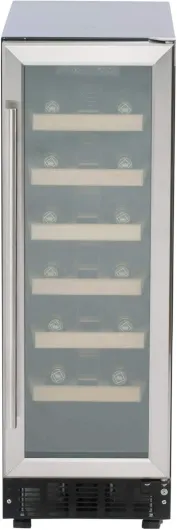
The thing that pushed me to this model instead of a cheaper plastic-looking one is the design. The full glass door with double glazing looks pretty good in a kitchen or living room. The black frame and the hidden handle give it a clean look, and the integrated LED lighting inside does the job to show off the bottles without being too bright. If you like having your wine visible rather than hidden in a cupboard, it’s a nice touch.
However, there are some trade-offs. The full glass door looks good, but it will show fingerprints and dust quickly. You’ll end up wiping it down fairly often if you’re picky. Also, even though it’s double-glazed and insulated, it’s still a glass door, so don’t expect the same thermal performance as a solid door cellar. For normal household use it’s fine, but if you live in a very hot place or put it in direct sunlight, that’s not ideal.
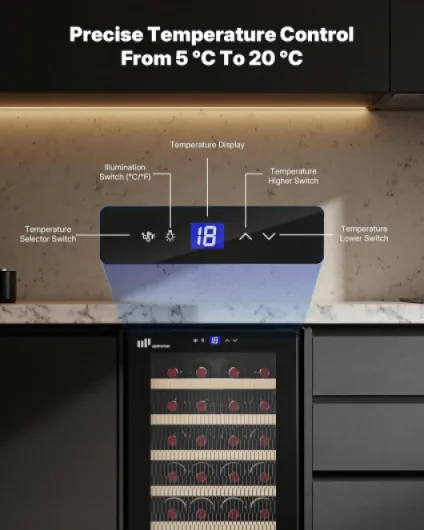
The touch control panel is placed inside at the top front, which is practical enough, but you have to open the door to change settings. Not a big deal, but if you like to tweak temperature often, that’s a small annoyance. The display is clear, you can see the current temperature easily. The controls themselves are basic: up/down for temperature, light on/off, that’s pretty much it. I didn’t need more, but don’t expect fancy multi-zone menus or anything like that.
One more thing: the door opens to the right and is not reversible from what I can see. So you need to plan where you’re going to put it. In my case it was fine, but in a tight kitchen layout it might be annoying. The overall build feels okay for the price, but you can tell it’s not a premium unit: the door closes properly, but the feel of the handle and the click of the door are a bit light. Nothing dramatic, but if you’re used to heavy, high-end appliances, you’ll notice the difference.
Build Quality and Shelves: Decent but Not Premium
For the materials, you can feel that Upstreman tried to keep costs under control while still giving a decent look. The outside is mostly black metal with the glass door at the front. The door itself feels okay: not super heavy, but not flimsy either. The double glazing does its job, and I didn’t notice any condensation issues on the glass in normal use. The seal around the door is fine; it closes properly and you don’t see obvious gaps.
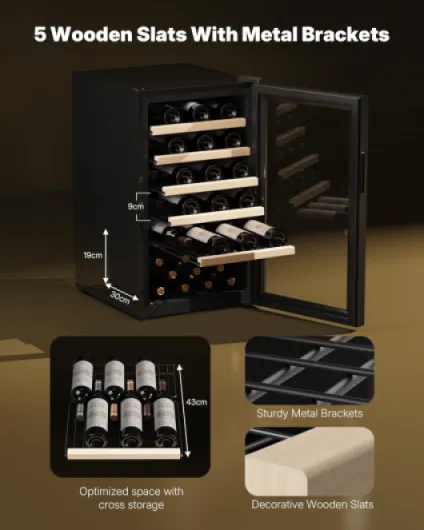
Inside, the 5 shelves are metal with wooden trims at the front. Visually, it’s nicer than bare metal racks, and it gives a slightly warmer look when the LED light is on. That said, don’t expect solid oak or anything fancy. The wood is mostly decorative, and the structure is metal. The shelves slide in and out, but not on rails like a drawer; you basically pull them out by hand. When fully loaded, they can feel a bit bendy, so I tend to support them with the other hand when pulling out a row of bottles.
The interior walls are standard plastic for this type of appliance. Easy to clean with a damp cloth, nothing special. I didn’t notice any strong plastic smell after the first day, which is good. I let it run empty for 24 hours before loading bottles, and the initial smell disappeared quickly. The LED light is fixed, not adjustable in position, but it’s bright enough to see the labels. It’s a cool white tone, not warm, which is fine but not very cozy if you care about ambiance.
Overall, I’d say the materials are in line with the price bracket. It doesn’t feel cheap to the point of worrying about durability, but it’s clearly not at the level of high-end wine cabinets that cost three or four times more. If you treat it normally, don’t overload the shelves like crazy, and avoid banging the door, it should hold up. Just don’t expect luxurious touches or heavy-duty rails.
Durability and Long-Term Use: What to Expect
I obviously haven’t had this fridge for ten years, so I can’t pretend to know how it will age long term, but there are a few signs you can look at. The compressor-based cooling is usually more durable than the tiny thermoelectric systems used in very cheap coolers. During my use, the compressor cycles felt normal: not too frequent, not overheating, and no strange noises. That’s usually a good sign that the basic hardware is okay.
The door hinges seem decent. I opened and closed the door a lot while loading and rearranging bottles, and I didn’t feel any play or misalignment building up. The seal is still tight, and there’s no visible deformation. The glass hasn’t fogged up or shown any condensation issues. If you don’t slam the door constantly, I don’t see an obvious weak point there in the short term. The cabinet itself is rigid enough; it doesn’t flex when you move it carefully.
The more questionable area for long-term durability is the shelves. Loaded with 6 bottles each, they hold up, but you can feel the metal flex slightly when you pull them out. It’s not catastrophic, but I wouldn’t overload them with heavier bottles or use them as a support surface. I think they’ll last if you’re a bit gentle, but if you’re rough and constantly dragging them out fully loaded, you might bend them over time.
The 1-year manufacturer warranty is what worries me the most for long-term use. For an appliance meant to run non-stop, that’s not a lot of coverage. The product comes from China, which is not a problem in itself, but it does mean that after the first year, you’re basically on your own if something fails. Considering the price, I personally accept that risk, but if you want real peace of mind for 5–10 years, this is not the most reassuring option. I’d treat it as a mid-term solution rather than a lifetime investment.
Cooling Performance and Noise: Does It Keep Your Wine Happy?
On the performance side, the Upstreman W41 is mostly solid. The compressor cooling keeps the temperature consistent once it settles. I set mine to 12°C for reds and tested with a simple fridge thermometer on different shelves. I was generally seeing between 11°C and 13°C depending on shelf level and how often I opened the door. That’s acceptable for a unit in this price range. It’s not lab-precise, but for home use it’s more than enough.
The temperature range from 5°C to 20°C gives you enough room to store both whites and reds. If you want to use it as a service fridge for ready-to-drink whites at 7–8°C and reds around 14–16°C, you’ll have to pick a compromise or adjust seasonally, because it’s a single-zone cooler. There’s no dual-zone or anything like that. Personally, I used it mostly for storage at 12°C and put a couple of bottles in the main fridge before serving if needed.
Noise-wise, Upstreman announces 41 dB, and that seems about right. In practice, you hear the compressor kick in, but it’s more like a background hum than an aggressive noise. In an open-plan living room/kitchen, I noticed it the first evening, then I forgot about it. If you’re very sensitive to noise and put it right next to a sofa, you’ll hear it when the room is very quiet, but it’s far from the worst I’ve heard. Compared to a cheap thermoelectric I had before, this one is more consistent and doesn’t whine.
The only thing to keep in mind: you need to give it some time on first start. When I plugged it in for the first time and set it to 12°C, it took a good few hours to reach the target, especially once I loaded it with room-temperature bottles. That’s normal, but the manual doesn’t really explain it clearly, which probably explains why some people think it’s not working at the start. Once it’s stabilised and not opened too often, it holds the temperature fairly well, even when the room gets warm.
What You Actually Get with the Upstreman W41
The Upstreman W41 is sold as a 41-bottle wine fridge, with a capacity of 95 litres and a temperature range from 5°C to 20°C. In reality, those 41 bottles assume mainly standard Bordeaux-style bottles and some cross-stacking. If you’re into champagne or chunky bottles, forget about hitting 41. In my case, with a mix of Bordeaux, Burgundy, and a few sparkling, I was more realistically around 30–34 bottles without playing Tetris too much.
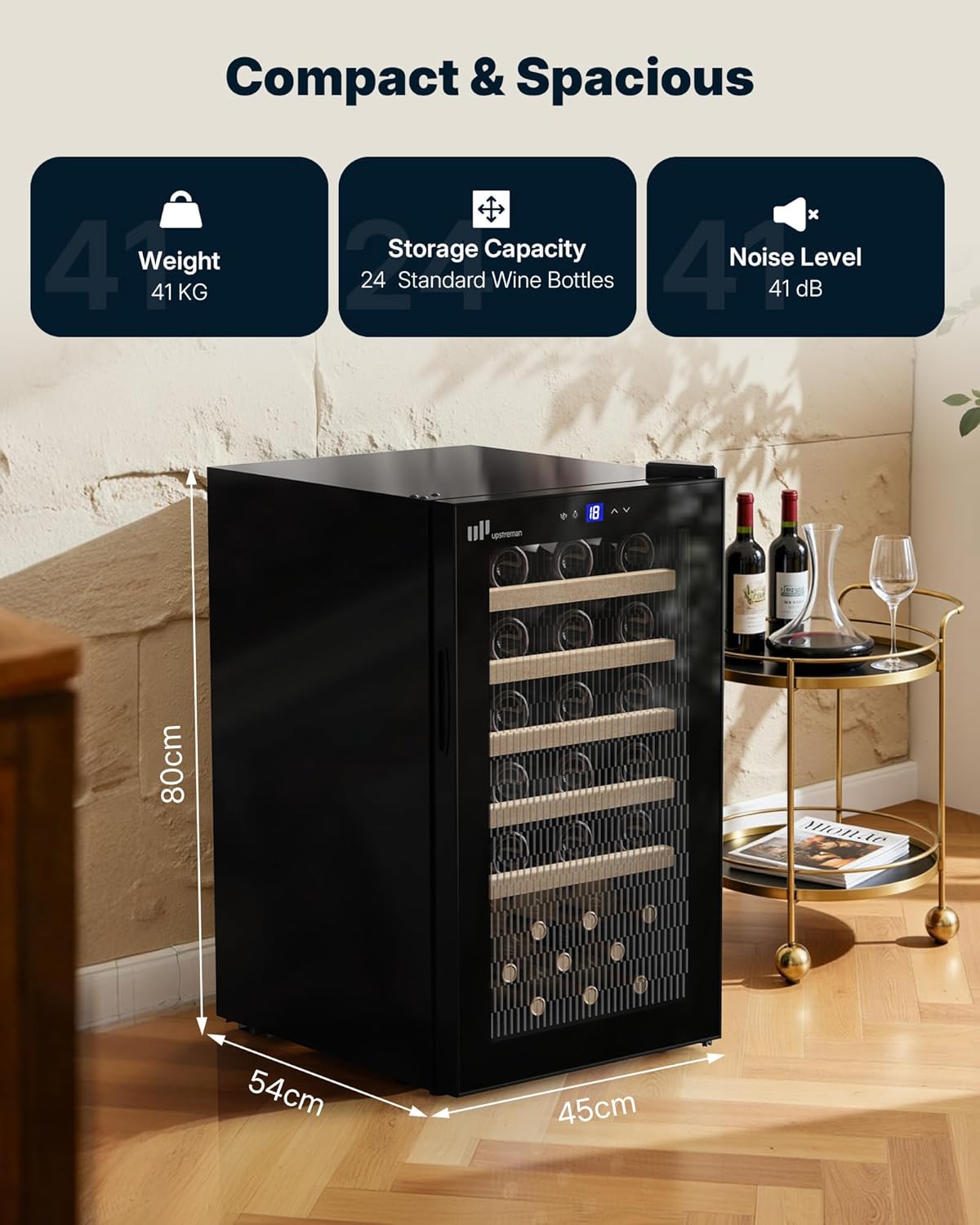
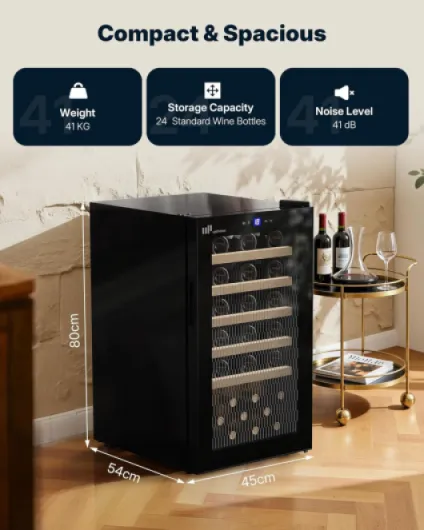
The unit measures about 54 cm deep, 45 cm wide, and 80 cm high. That’s relatively compact, and it fits nicely under a worktop or against a wall in a living room. It’s officially “freestanding”, but the design clearly encourages sliding it under a counter. Just keep some ventilation space at the back and sides, otherwise the compressor will work harder and you’ll hear it more often. It weighs around 25 kg, so you can move it with two people without killing your back.
Inside, you get 5 shelves with metal supports and wooden trims. Each shelf can hold around 6 standard bottles if you line them up correctly. The bottom area can take around 11 bottles if you cross-store. It’s not the most flexible layout I’ve seen, but you can adjust the shelf positions a bit to fit taller bottles. There’s no door storage, everything is on the main racks. Personally, I would have liked a bit more flexibility for champagne and magnums, but for everyday reds/whites it’s okay.
The fridge uses a compressor cooling system, not thermoelectric, which is better for keeping a stable temperature, especially if your room gets warm in summer. It’s rated at about 140 kWh per year, so it’s not an energy hog. There’s no fancy smart home stuff, no Wi-Fi, no app. You get a simple touch control panel, an LED display, and that’s it. Honestly, I prefer that: fewer things to break, and I don’t need to control my wine fridge from my phone.
Daily Use: How It Handles a Real Wine Collection
In day-to-day use, the Upstreman W41 does what you buy it for: it keeps your bottles cool and organised. Where it gets a bit more mixed is the practicality side. The advertised 41-bottle capacity is optimistic unless you have mostly standard Bordeaux bottles and don’t mind cross-stacking. Once you throw in some Burgundy-shaped bottles, a couple of sparkling wines, and odd-shaped bottles, you’ll quickly hit the limits of the layout.
I ended up using the bottom section for bigger bottles and leaving slightly more spacing on the shelves above. That means I sacrificed a bit of capacity for easier access and less bottle rattling every time I pulled a shelf. If you like to rotate bottles often, you’ll feel that the shelves aren’t on rails: you have to pull them carefully so you don’t jerk the whole row. For long-term storage where you don’t touch things often, it’s less of a problem.
Temperature stability is decent as long as you don’t open the door every 5 minutes. When I had guests and kept opening and closing to grab bottles, the internal thermometer showed a small jump, but it went back to normal after a while. There’s no fan to circulate air like in some higher-end models, so the air doesn’t mix perfectly. That’s why you can see 1–2°C difference between the top and bottom shelves. For casual use, it’s fine, but if you’re trying to age very sensitive bottles for years, I’d look at something more specialised.
One weak point is the manual and the initial setup explanation. The Amazon review that says “Impossible to put into operation, manual not explicit enough” doesn’t surprise me. The instructions are pretty minimal, and there’s no detailed troubleshooting section. If you’re not used to these appliances, you might think it’s not cooling properly at first. In my case, it worked, but I had to rely on common sense more than the manual. So, in terms of effectiveness, I’d say it’s good once it’s running, but the brand could clearly do better on user guidance.
Pros
- Keeps a stable temperature between 5°C and 20°C with relatively low noise
- Compact size with decent real-world capacity for 30+ bottles
- Full glass door and LED lighting give it a clean, modern look suitable for living areas
Cons
- Manual is vague and first setup can be confusing for some users
- Advertised 41-bottle capacity is hard to reach with mixed bottle shapes
- Only 1-year warranty and mid-range build quality, especially on the shelves
Conclusion
Editor's rating
The Upstreman W41 wine fridge is a decent choice if you want a compact, good-looking cooler that can store around thirty-odd bottles at a stable temperature. It cools properly, stays fairly quiet, and the glass door with LED lighting looks nice in a kitchen or living room. The temperature range from 5°C to 20°C covers most everyday needs, and the compressor-based system is more reliable than the tiny thermoelectric coolers you see at the very bottom of the market.
It’s not perfect, though. The advertised 41-bottle capacity is optimistic unless your collection is very standard in shape. The shelves flex a bit when fully loaded, and the lack of rails makes access less smooth. The manual is weak, and the 1-year warranty is short for a 24/7 appliance. You also have to accept small temperature variations between shelves and a single temperature zone.
Who is it for? People with a growing collection who want something nicer than a basic mini-fridge, without spending like crazy on a professional cellar. If you mostly drink your bottles within a few years and just want them stored correctly and ready to serve, it gets the job done. Who should skip it? Serious collectors looking to age expensive bottles for the long term, or anyone who wants perfect ergonomics and long warranty protection. For the price, it’s pretty solid, but it’s not a miracle machine.