Summary
Editor's rating
Value for money: who should actually buy this
Design: looks good in a normal kitchen, with a few quirks
Materials and build: solid enough, but not luxury
Performance: temperature control and noise in real life
What you actually get with this Haier wine cooler
Does it actually keep your wine in good shape?
Pros
- Stable dual temperature zones that keep reds and whites at sensible drinking temps
- Quiet operation (around 38 dB) and low vibration, fine for open-plan kitchens
- Integrated 60cm design with clean black front that fits well in modern cabinetry
Cons
- Real-world capacity is lower than the claimed 44 bottles if you use mixed bottle shapes
- Class F energy rating, so not the most efficient to run long-term
- Glass shelves and internal fittings feel mid-range rather than premium

Specifications
View full product page →| Brand | Haier |
A built-in wine fridge that actually feels made for real kitchens
I’ve been using the Haier HAKWBD 60 UK integrated wine cooler for a few weeks now, and I’ll be honest: I’m not a sommelier, I’m just someone who likes to keep a mix of supermarket wines and a few nicer bottles ready to drink. I wanted something built-in, 60cm wide, that wouldn’t sound like a tractor in the kitchen. This one ticked the boxes on paper: 44 bottles, dual temperature zone, Wi‑Fi app, black finish.
In day-to-day use, the main thing I noticed is that it’s actually pretty quiet. It’s rated 38 dB, and that matches what I hear: a low hum now and then, but nothing that bothers you during dinner. It sits under a counter next to standard cabinets, and it blends in fairly well. You forget it’s there most of the time, which is what I want from a built-in appliance.
The dual-zone thing isn’t just marketing either. I keep whites and sparkling at around 10–11°C in the top zone and reds around 15–16°C in the bottom. Compared to my old single-zone cooler where everything was roughly the same temperature, this is a clear upgrade. No more freezing-cold reds that need half an hour on the table to be drinkable. It’s not life-changing, but it’s practical and it works.
It’s not perfect though. The 44-bottle capacity is optimistic unless all your bottles are the same slim shape. Once you put in a few chunky Champagne bottles or some weird-shaped ones, you’re playing Tetris. Also, the energy rating is Class F, so it’s not exactly the most efficient unit out there. Overall, it gets the job done really well, but there are a few details you should know before buying.
Value for money: who should actually buy this
In terms of value, this Haier sits in that middle zone: not cheap, not premium. You’re paying for a proper built-in 60cm unit with dual zones, Wi‑Fi, low vibration, and a decent capacity. If you just want somewhere cold to dump a few bottles, you can definitely spend a lot less on a simple freestanding cooler. But if you care about an integrated look and you drink both red and white regularly, this feels like a reasonable investment rather than a toy.
Where it earns its keep is the combination of features: dual temperature zones that actually hold steady, quiet operation, and a design that blends into a modern kitchen. The app is a nice bonus if you like gadgets, but I wouldn’t base the purchase on that alone. It works, lets you tweak temperatures, and offers some tips, but after the first week the novelty wears off and you mostly just leave the settings alone. Still, it’s better than having no remote control at all, and it’s handy if the cooler is installed in a slightly awkward spot.
On the downside, you’re not getting ultra-efficient energy performance, and the materials are clearly mid-range, not luxury. The Class F energy rating means it’s not the cheapest thing to run over many years, and the internal layout isn’t as flexible as it could be once you throw in non-standard bottles. For the price, I would have liked slightly smoother shelves or at least a better way of handling Champagne bottles without sacrificing so much capacity.
Overall, I’d say the value is good if you’re a regular wine drinker who wants a neat built-in solution, not so great if you barely drink wine or if you’re an absolute wine nerd aiming for perfect ageing conditions. For most people with a fitted kitchen and a decent but not insane wine habit, it hits a nice balance: not cheap, but fair for what it actually delivers day to day.
Design: looks good in a normal kitchen, with a few quirks
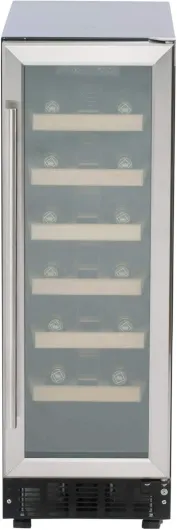
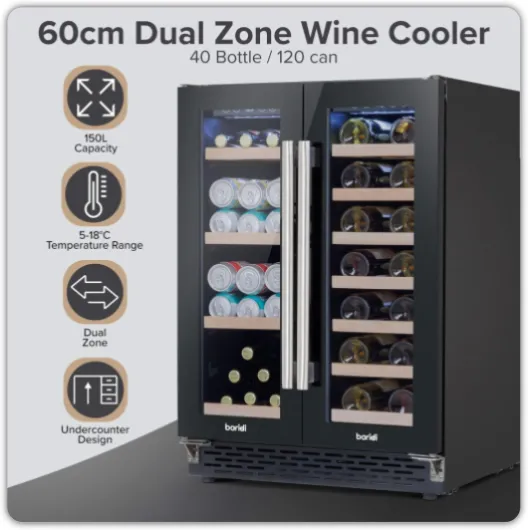
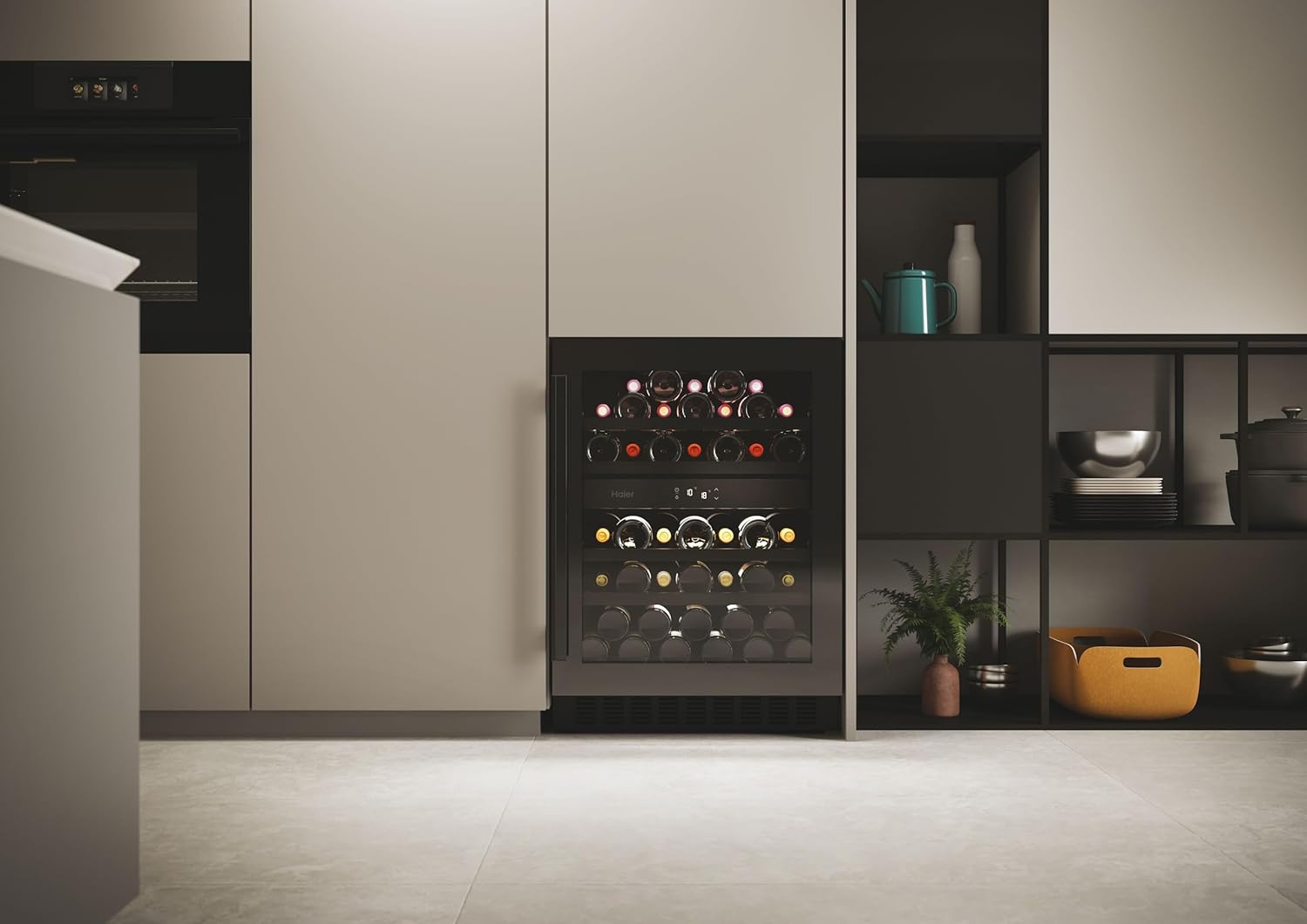
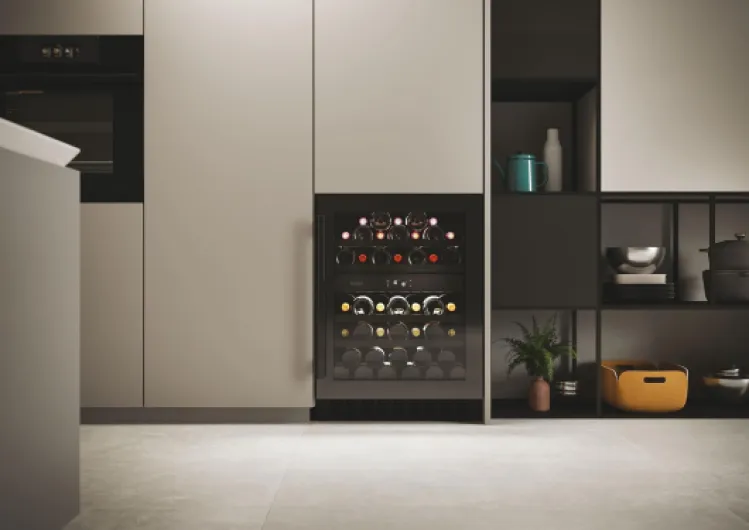
Design-wise, the Haier HAKWBD 60 UK is fairly simple: black frame, glass door, and LED lighting inside. It’s meant to be integrated, so most of what you see is the front door and glass panel. In my kitchen, it sits under the counter next to white units, and the black front doesn’t look out of place. It doesn’t scream for attention, which I like. The flush-mounted door does what it’s supposed to do – it lines up nicely with the neighbouring cabinets and doesn’t stick out in a weird way.
The LED lighting is actually useful. It lights the whole interior from top to bottom, so you can quickly see what’s where without pulling everything out. It’s not super bright like a shop display, but it’s enough to read labels through the glass if the room isn’t too bright. One thing I appreciated is that the lighting doesn’t heat up the inside, so it doesn’t mess with the temperature like some cheap fridges do. It’s a small detail, but in daily life it’s handy.
There are some design compromises though. The bottle layout is clearly optimised for standard Bordeaux-type bottles. As soon as you start mixing in Champagne, Prosecco, or slightly chunkier bottles, you lose capacity and it looks less tidy. The shelves are glass, so visually it looks clean, but they don’t slide out as smoothly as wooden shelves you see on pricier units. You can still get to your bottles, it’s just not super premium. For the price, I’d say it’s acceptable, but if you’re used to high-end wine cabinets, you’ll notice the difference immediately.
Overall, I’d describe the design as modern, simple, and functional, not flashy. It fits well into a contemporary kitchen, the black colour hides fingerprints better than stainless steel, and the glass door gives you a quick view of what’s inside. On the downside, Haier’s capacity claims are a bit optimistic once you use mixed bottle sizes, and the internal layout is more practical than stylish. If you want a showroom-style centrepiece, this isn’t it. If you just want something that looks neat and blends into your cabinets, it does the job.
Materials and build: solid enough, but not luxury
The cooler is mostly metal with glass shelves, and it feels reasonably sturdy for the price. The door has a decent weight to it, and the hinges don’t feel flimsy. When you open and close it, there’s no worrying flex or creaking. The black exterior finish looks good and seems fairly resistant to light scratches and fingerprints. After a few weeks of daily use, I don’t see any obvious marks or chips on the frame or handle area.
Inside, the 5 glass shelves look clean and modern, but you can tell this is where Haier kept things simple. They’re not soft-close or on fancy rails; they slide in and out in a basic way. If you overload them with heavy bottles, there is a tiny bit of flex, but nothing that feels like it’s about to snap. Still, if you’re used to wooden shelves with smooth runners on more expensive wine cabinets, this will feel a bit more budget. The plastic parts, like the inner trim and some of the supports, are functional but not particularly premium to the touch.
The seal around the door seems well made. It closes firmly without needing to slam it, and I haven’t noticed any condensation build-up on the door edges, which usually shows a bad seal. The glass door itself is clear, and so far there’s been no fogging or strange marks between the panes, which is a good sign. I can’t say how it’ll age over many years, but out of the box and after a few weeks, it feels like a decent, mid-range construction, not cheap junk.
Overall, I’d sum up the materials as good enough for a serious home user, but clearly not top-tier. It feels like something you can trust for daily use, but if you’re expecting the heavy, furniture-like feel of a high-end wine cellar with wooden racks and thick doors, this won’t hit that level. For the price bracket and the fact it’s an integrated 60cm unit, I think the balance between cost and build quality is acceptable, just not impressive.

Performance: temperature control and noise in real life
Performance is where this fridge matters, and overall it’s pretty solid. The dual zones actually hold their temperatures quite well. I set the top zone to 11°C and the bottom to 15°C, and after letting it stabilise for a day, a cheap fridge thermometer inside showed it was staying within about ±1°C of those numbers. For a home wine fridge, that’s perfectly fine. Bottles feel consistently cool, and I don’t get big swings when the door is opened briefly.
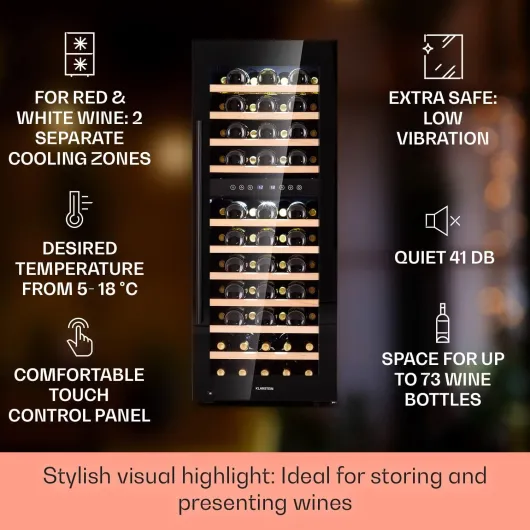
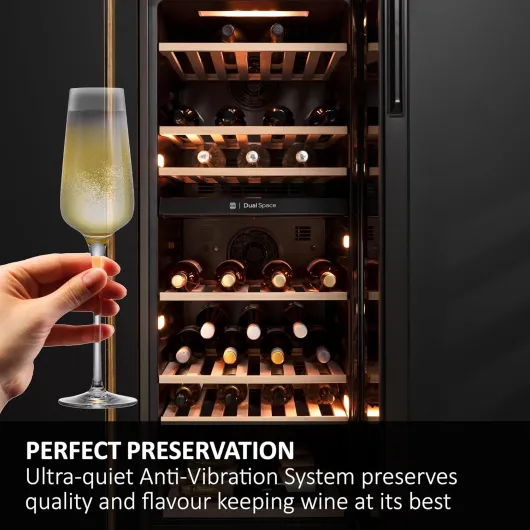
Noise-wise, the 38 dB rating seems accurate. In a quiet kitchen at night, you can hear a soft humming when the compressor kicks in, but it’s not intrusive. It’s definitely quieter than my old under-counter fridge. If your kitchen is open to your living room, you’ll notice it now and then, but it doesn’t dominate the room. The anti-vibration system seems to work too – when I tap the door or lightly touch the shelves, there’s no rattling, and the bottles sit steady. For long-term wine storage, that’s reassuring, even if I’m not storing super expensive bottles.
The active carbon filter is one of those features you can’t really “see” working, but you can notice there’s no weird fridge smell inside, even after a few weeks. I’ve had cheaper wine coolers where the inside starts to smell slightly plastic or stale. Here, when you open the door, it just smells like… nothing, which is exactly what you want so it doesn’t affect the wine. The frost-free system also means there’s no visible ice build-up, and I haven’t had to think about defrosting or wiping condensation from the back.
On the downside, the energy rating is Class F and annual consumption is around 103 kWh. It’s not shocking, but if you’re trying to build a very low-energy home, this is not the greenest appliance you’ll own. Also, the temperature adjustment isn’t lightning-fast: when I changed the set point by a couple of degrees, it took a good while to stabilise again. That’s not a big issue since you rarely change it, but don’t expect instant response. Overall, for everyday use, the performance is consistent and reliable, just not ultra-efficient or high-end in terms of fine-tuning.
What you actually get with this Haier wine cooler
On paper, the Haier HAKWBD 60 UK is a 60cm wide, built-in wine cooler with a 120L capacity and room for up to 44 bottles. It has two independent temperature zones, an active carbon filter, LED lighting, Wi‑Fi connection via the hOn app, and a right-hinged door. Dimensions are about 56.2 x 59.5 x 82 cm, and it weighs roughly 50 kg, so it’s not a light little gadget – it’s a proper appliance that needs a planned spot in your kitchen.
Inside, you get 5 glass shelves and space distributed between the two zones. It’s meant to be your standard 60cm built-in width, so it slots into the same kind of gap as a dishwasher or built-in fridge. The door is designed to be flush with your cabinets, so visually it should line up with a modern kitchen layout. There’s no fancy handleless push system here; it’s a straightforward door with a visible frame and glass front. You also get a basic user manual and a warranty card in the box, nothing fancy.
In terms of tech, the main selling points are the dual temperature zones and the smart features. The top and bottom zones can be set separately, and Haier suggests something like 10–12°C for whites and 15–16°C for reds, which is what I’ve been using. The hOn app lets you adjust temperatures, monitor the fridge, and supposedly manage your wine collection with tips and suggestions. It’s not mandatory to use the app, but it’s there if you want to geek out a bit.
Overall, the product is positioned as a mid-range built-in wine cooler: not the cheapest basic unit, but also not a luxury showpiece. You’re paying for the dual zones, the integrated look, the low vibration compressor, and the connected features. In practice, it’s a pretty solid package for someone who has a decent number of bottles and wants them stored properly, but it’s not some magical cellar replacement. It’s a well-equipped fridge for wine, and that’s about it.
Does it actually keep your wine in good shape?
In practice, the main question is simple: does this cooler keep your wine at a good, stable temperature and ready to drink? From my use, the answer is yes. I’ve kept a mix of red, white, and sparkling in it, including some basic supermarket bottles and a few slightly nicer ones I didn’t want to ruin. Reds at 15–16°C come out ready to drink without needing to sit on the table for ages. Whites at around 11°C are chilled but not ice-cold, which is ideal for most everyday drinking.
The anti-vibration compressor matters more than I expected. On my old cheap cooler, if you touched the unit, you could feel a faint buzzing and the bottles would sometimes rattle slightly. On this Haier, everything feels more stable. Whether that really changes the ageing of the wine in a huge way, I can’t prove, but at least it doesn’t feel like they’re sitting on a washing machine. For people who like to keep bottles for a few years, that’s reassuring, even if the rest of the setup is still just a fridge and not a buried cellar.
The clean airflow and carbon filter do their job quietly in the background. I haven’t had any odd smells inside, and there’s no sense that the fridge air is affecting corks or labels. Humidity isn’t really adjustable or clearly indicated, so if you’re obsessing over perfect ageing conditions, this might feel a bit basic. But for normal home use – keeping wine at a stable, sensible temperature and out of sunlight – it’s more than enough. I’d say it’s very effective for everyday storage and short to medium-term ageing, less so for someone building a collection worth thousands.
If I’m being picky, the one area where it’s less effective is bottle organisation. Once you start mixing bottle shapes, you lose the neat rows and the capacity drops. That doesn’t affect the actual cooling, but it does affect how easy it is to manage your collection. You end up moving things around to grab a specific bottle. So it’s effective as a cooler, a bit less effective as a perfectly organised “cellar”. For how most people actually use it, though, it gets the job done without fuss.
Pros
- Stable dual temperature zones that keep reds and whites at sensible drinking temps
- Quiet operation (around 38 dB) and low vibration, fine for open-plan kitchens
- Integrated 60cm design with clean black front that fits well in modern cabinetry
Cons
- Real-world capacity is lower than the claimed 44 bottles if you use mixed bottle shapes
- Class F energy rating, so not the most efficient to run long-term
- Glass shelves and internal fittings feel mid-range rather than premium
Conclusion
Editor's rating
After living with the Haier HAKWBD 60 UK for a bit, I’d describe it as a practical, mid-range wine cooler that does the important things right. It keeps two proper temperature zones stable, it’s quiet enough for an open kitchen, and it integrates cleanly into a standard 60cm slot. It’s not flashy, but it feels like a sensible choice if you actually drink wine regularly and want it at the right temperature without fuss.
It’s not perfect: the 44-bottle claim is optimistic if you use a lot of Champagne or unusual bottles, the shelves feel more functional than premium, and the Class F energy rating isn’t great if you’re trying to minimise running costs. The app is a nice extra but not essential, and the materials are solid but clearly not high-end. Still, for the price bracket, you’re getting a decent mix of performance, noise level, and design.
I’d recommend this to people who: have a fitted kitchen, drink both red and white fairly often, and want a cooler that just quietly does its job. If you only open a bottle once a month, a smaller or cheaper unit will do. If you’re building a serious collection and obsessing about humidity, perfect ageing, and wooden shelves, you should look higher up the range. For normal wine drinkers who want something reliable and tidy, this is a pretty solid option.