Summary
Editor's rating
Value for money: where it sits versus other options
Design: compact, decent-looking, but not premium
Build quality and materials: solid enough, with a few compromises
Durability and day-to-day reliability after regular use
Cooling performance and noise: good, with one or two quirks
What you actually get with the Subcold Viva28 LED
Pros
- Good temperature range (3–18°C) with stable cooling suitable for both wine and beer
- Compact, under-counter-friendly size with a glass door that looks decent in most kitchens
- Low noise and reasonable energy consumption for a 28-bottle compressor fridge
Cons
- Shelving and layout aren’t ideal for large Champagne or oddly shaped bottles
- Single-zone only, with no humidity control or advanced wine storage features

Specifications
View full product page →| Brand | Subcold |
A no-nonsense wine fridge for people who just want cold bottles
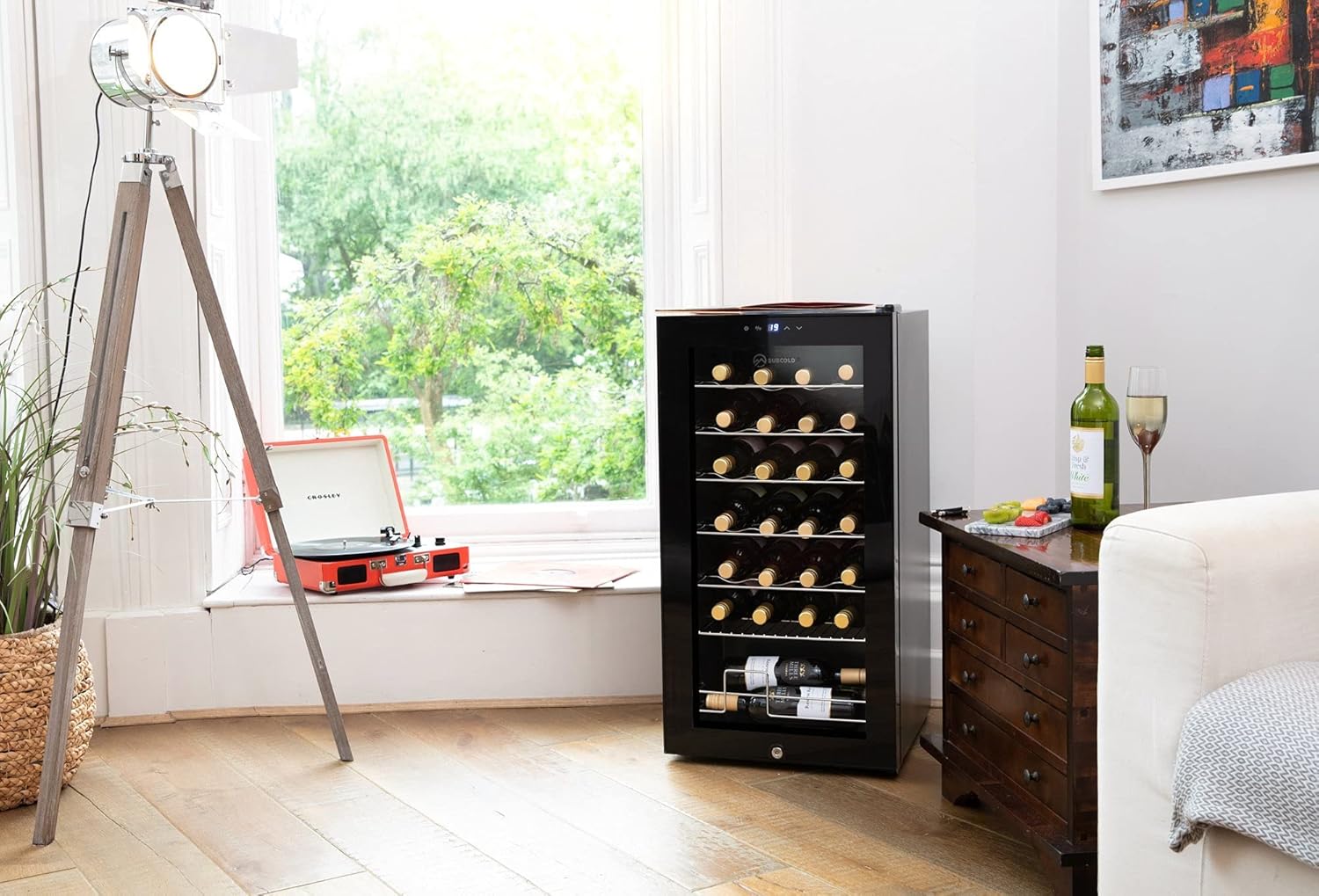
I’ve been using the Subcold Viva28 LED as a drinks and wine fridge for a while now, and the short version is: it’s a pretty solid under-counter cooler that does what it says on the tin. No fancy multi-zone stuff, no app, just a compressor fridge with a digital thermostat that holds temperature reasonably well between 3 and 18°C. I stuck it in the kitchen under a worktop, next to the main fridge, and filled it with a mix of wine, beer and soft drinks.
What pushed me to buy this one was the size and the price. I didn’t have space for a full-height wine cabinet, and most of the slimmer ones either had worse reviews or weird layouts that wasted space. The Viva28 sits at about 84 cm high, so it lines up roughly with standard kitchen counters, and the 43 cm width is handy if you’re tight on space. The advertised 28-bottle capacity is realistic if you’re mostly storing standard Bordeaux-style bottles.
In day-to-day use, I’ve treated it more like a drinks fridge than a serious collector’s cellar. I keep a few reds at the top, whites and fizz lower down, and the bottom area is basically beer and cans. It’s not perfect – the noise level is okay but not silent, and the shelves don’t love every bottle shape – but for the price bracket, it’s good value for money. It definitely freed up a lot of space in the main fridge.
If you’re expecting a professional-grade wine cabinet with separate humidity control and zones, this won’t be it. But if you want something that looks decent in a kitchen or office, keeps drinks properly cold, and doesn’t chew through electricity, it’s a practical choice. I’ll break down what’s good and where it falls short so you know exactly what you’re getting into.
Value for money: where it sits versus other options
In terms of value, I’d say the Subcold Viva28 LED is good bang for the buck if you’re after a straightforward wine/drinks fridge and not a collector’s toy. It usually sits in the mid-range price bracket for 28-bottle coolers, and compared to some cheaper models I looked at, you’re getting better temperature control, a quieter compressor, and a nicer-looking glass door. It’s not the cheapest out there, but it doesn’t feel overpriced either.
What you’re really paying for here is a mix of decent build quality, low noise, and flexible use. You can run it at 3–5°C and treat it like a beer fridge, or keep it around 10–14°C for wine. Many ultra-budget wine coolers struggle to get properly cold or are thermoelectric and fall apart in hot rooms. This one is compressor-based, so it handles warmer kitchens better. The running costs are reasonable, and it actually frees space in your main fridge, which is a big plus if you’ve got a busy household.
On the downside, you’re not getting fancy features: no dual zone, no humidity control, no reversible door, and the shelving isn’t optimised for big Champagne bottles. If you’re a serious wine nerd with a varied collection, you might prefer a more advanced cabinet and spend more. Also, if your main goal is the absolute quietest possible unit for a living room, there are some thermoelectric coolers that are even quieter, though they often sacrifice cooling power and capacity.
For most normal users, though – people who want chilled wine and drinks, a tidy look, and not too much hassle – the Viva28 hits a nice balance of price and performance. It’s the kind of purchase where you feel you got your money’s worth: no big thrills, but it does its job reliably and doesn’t feel like a toy. If you catch it at a discount, it’s an even better deal.
Design: compact, decent-looking, but not premium
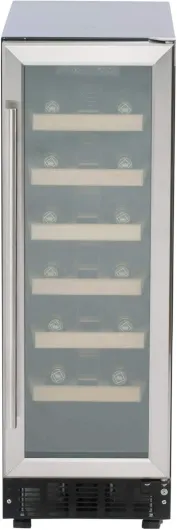
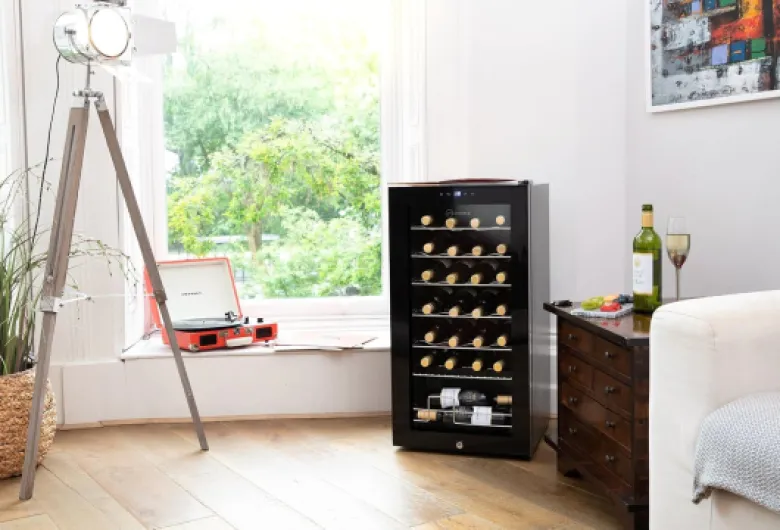
Design-wise, the Viva28 is pretty clean and simple. Black body, glass front door, and a frameless look that blends reasonably well with most modern kitchens. It doesn’t scream luxury, but it also doesn’t look cheap or plasticky from a normal viewing distance. The reflective glass and the internal LED make it look nicer at night, especially if you actually have a few bottles in there and not just random cans. It definitely looks better than a plain white mini-fridge.
The dimensions are 45D x 43W x 84.1H cm, so it’s tall and slim. That worked for me because I had a narrow gap under the worktop. If you’re planning to slide it under a counter, measure carefully: the height is close to standard worktop height, but you still need a little space for air circulation. The door is right-hinged and not reversible out of the box, so think about which way it will open in your kitchen. I didn’t see an obvious reversible hinge setup in the manual, so assume right-hand only unless you’re happy to tinker.
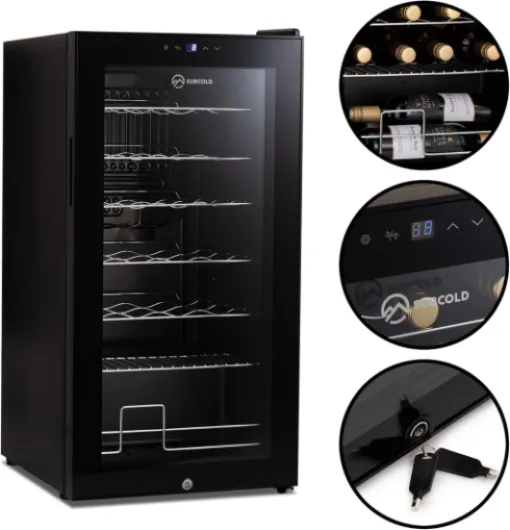
Inside, the layout is basic: chrome wire shelves that slide into fixed slots. They’re not on runners, they just sit in grooves, so they can feel a bit rattly when empty but it’s fine when loaded. You can remove shelves to fit bigger bottles, but there’s no special section for magnums or really tall bottles. The light is positioned at the top, so it highlights the top rows more than the bottom. It’s not a big deal, but the lower shelves can look a bit dark if the room is dim.
In terms of controls, it’s a simple digital panel with temperature up/down and a light button. No fancy modes, no Wi‑Fi, nothing like that. For me, that’s actually a plus: set it once and forget it. The only slight annoyance is that the display shows the set temperature, not always the actual internal one, so if you’re picky you’ll need a separate thermometer. Overall, the design is practical and tidy. It’s not going to impress hardcore design nerds, but for a normal kitchen or office it looks good enough and doesn’t draw weird attention.
Build quality and materials: solid enough, with a few compromises
On materials, I’d say the Viva28 feels sturdy but clearly mid-range. The cabinet is a high-density foam-injected body with a lacquered black finish. It doesn’t flex or feel flimsy when you move it, and at about 24.7 kg it’s got a bit of weight to it, which is reassuring. It’s still a one- or two-person job to move, but you’re not dealing with a massive heavy cellar unit. The finish wipes clean easily; fingerprints show a bit on the glass door but that’s normal.
The door itself is dual-glazed safety glass. It feels solid when you close it – not like thin plastic. The seal around the door is decent: I checked for drafts with a piece of paper and it grips fairly well all around. That said, I did notice a bit of condensation at the bottom of the door on more humid days, similar to what one of the reviewers mentioned. It’s not a flood, just a light misting. For me it’s not a deal-breaker, but if you’re obsessive about a totally dry door, that might bug you.
The shelves are chrome wire. They’re fine for standard bottles, but they’re not luxury racks. If you load them heavy and pull them out roughly, they flex a little. I wouldn’t put very heavy items right at the front edge. On the plus side, they’re removable and easy to clean. You get six shelves plus the bottom area, which you can treat like a small bin for cans or odd-shaped bottles. The interior walls are basic plastic, nothing fancy, but they don’t feel too thin.
Little details: the lock and key feel more like a light cabinet lock than a serious security feature. The keys are small and easy to misplace, so I’d suggest taping one inside a kitchen drawer. The feet are adjustable, which helps a lot with levelling on slightly uneven floors – worth doing, because an unlevel fridge can rattle more. Overall, the materials are in line with the price: not premium, but not cheap junk either. It’s built to be a practical appliance, not a showpiece, and it feels like it will handle normal home use without falling apart.
Durability and day-to-day reliability after regular use
On durability, I can’t pretend I’ve used it for ten years, but after several months of regular use, nothing has failed or loosened. The door still closes with the same resistance, the seal isn’t peeling, and the shelves haven’t bent out of shape despite being moved around and loaded with bottles and cans. The exterior hasn’t picked up any weird dents or scratches beyond the usual light marks you get from bumping it with shopping bags or boxes.
The compressor behaviour has stayed consistent. It still cools to the same temperatures it did when new, and I haven’t noticed any strange noises developing over time, which sometimes happens with cheaper fridges. The auto-defrost seems to be doing its job; I’ve not had to manually defrost anything, and there’s no big water puddle inside. I do a quick wipe of any condensation on the glass every now and then, but that’s about it for maintenance.
I also like that it comes with proper certifications (CE, ROHS, ERP, UKCA, REACH) and a 1-year warranty. That doesn’t guarantee it’ll last forever, but at least it’s not a no-name unit with no backing. For something made in China in this price range, it feels more reliable than some budget mini-fridges I’ve had before that started buzzing loudly or struggling to cool after a year.
Realistically, this isn’t a lifetime investment-grade wine cabinet, but for home use as a drinks/wine fridge, it feels like it will comfortably last several years if you treat it decently. Don’t slam the door, don’t overload the shelves with heavy stuff, leave some space around it for ventilation, and it should keep going. If you want a fridge you can forget about and not baby, this one seems to handle that kind of usage pretty well so far.
Cooling performance and noise: good, with one or two quirks
Performance is where this fridge does its main job properly. The temperature range of 3–18°C is accurate enough in real life. When I set it to 5°C and left a thermometer inside, it generally sat in the 4–6°C range, with small swings when the compressor kicked in. For wine, I settled around 10–12°C, and bottles came out consistently cool, not icy. It definitely gets colder than a lot of generic fridges that claim low temps but hover around 7–8°C at best.
Cool-down time from room temperature to a low setting is decent. From first plug-in at around 20°C room temp to 5°C internal took roughly 45–60 minutes in my case. That’s fine for a small compressor fridge. Once it’s at temperature, it maintains it pretty well, as long as you’re not constantly opening the door. If you cram it full of room-temperature drinks in one go, it will take a while to stabilise, and the compressor will run more often – that’s normal, but worth knowing if you’re stocking up for a party last minute.
Noise-wise, I’d call it low but noticeable. The spec says 39 dB, which sounds about right. When the compressor is off, it’s basically silent. When it kicks in, you can hear a gentle hum and a bit of vibration if you’re close. In a kitchen with other background noise, it blends in. In a very quiet open-plan living room, you’ll notice it more, but it’s not unbearable. I’ve had noisier standard fridges. Levelling the feet properly and making sure it’s not pressed hard against the wall helps reduce any extra rattling.
Energy consumption is listed as 137 kWh per year, which is pretty economical for a drinks fridge of this size. On my smart meter, I didn’t see a big spike after adding it. Obviously, if you run it at 3°C all year and open it constantly, it will use more, but for normal home use it’s reasonable. The auto-defrost system seems to work fine; I haven’t had ice build-up on the back wall. In short: it cools well, stays cold, and runs quietly enough for most people, with the usual caveats of any small compressor unit.
What you actually get with the Subcold Viva28 LED
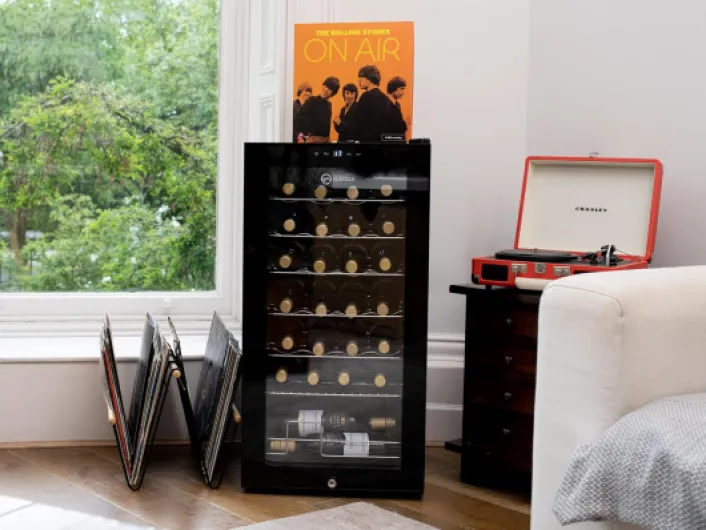
The Subcold Viva28 LED is basically a single-zone, 82L compressor fridge that’s tuned for wine and drinks. The spec sheet says 3–18°C with a digital thermostat, and in practice that’s about right. I set mine to 5°C for beers at first, then later to 10–12°C when I started using it more for wine. I checked with a separate fridge thermometer: it usually stays within about 1–2 degrees of the set temperature, which is fine for home use.
Capacity-wise, they say 28 bottles, and that’s roughly accurate if you’re using mostly straight Bordeaux-style bottles and you don’t mind stacking a bit. If you start mixing in chunky Champagne bottles or weird-shaped Prosecco and craft beer bottles, you’ll lose space. I ended up using the bottom area more like a small crate for odd shapes and cans. The six removable chrome wire shelves are useful because you can pull some out to adapt the layout, but it’s not a super flexible system; it’s still a narrow cabinet.
Out of the box, you get the fridge itself, the shelves, a pair of keys for the lock, the manual and that’s it. No nonsense, no extra plastic bits. The lock works, but I’d call it more of a child/office deterrent than real security. It’s fine if you just want to stop kids or colleagues raiding your good bottles. The internal LED light is white and stays on when you open the door, and you can switch it on/off manually if you want to show off the contents.
One thing to know: it’s sold as freestanding, not built-in. So even though it fits under a counter, it still needs some space at the back and sides for ventilation. If you try to wedge it tight into a cabinet with no airflow, expect it to run hotter and louder. That’s in the manual, but easy to skip if you just start unpacking and plugging it in. Overall, the presentation is straightforward: it’s clearly designed to be a simple home or office drinks fridge, not a high-end collector piece.
Pros
- Good temperature range (3–18°C) with stable cooling suitable for both wine and beer
- Compact, under-counter-friendly size with a glass door that looks decent in most kitchens
- Low noise and reasonable energy consumption for a 28-bottle compressor fridge
Cons
- Shelving and layout aren’t ideal for large Champagne or oddly shaped bottles
- Single-zone only, with no humidity control or advanced wine storage features
Conclusion
Editor's rating
The Subcold Viva28 LED is a practical under-counter wine and drinks fridge that does what most people need: it keeps bottles properly cold, looks decent in a kitchen, and doesn’t make a racket. The temperature range is wide enough for both beers and wines, and the 28-bottle capacity is realistic as long as you mainly use standard bottles. It’s not packed with advanced features, but the basics – cooling, noise level, and build – are handled well for the price.
It’s best suited for people who want to free up space in their main fridge, have a dedicated spot for drinks, and care more about function than fancy extras. If you’ve got a small kitchen or a narrow gap under a counter, the compact footprint is a big plus. The lock is a nice bonus if you’ve got kids or share an office. On the flip side, serious wine collectors or those wanting dual zones and precise humidity control should probably look higher up the range. Also, if you’re extremely sensitive to any noise at all, you might prefer a different cooling technology, even if it means weaker performance.
Overall, I’d rate it as a solid, no-drama choice. Not perfect, not high-end, but reliable and good value for money. If your expectations are realistic – a decent-looking, single-zone fridge that keeps drinks cold and doesn’t use loads of power – this one gets the job done without fuss.