Summary
Editor's rating
Value for money: who it makes sense for
Looks good on the outside, a bit cramped on the inside
Build quality and materials: decent, but not premium
How it holds up over time
Cooling performance: fine for storage, weak if you want ice-cold drinks
What you actually get out of the box
Pros
- Slim, modern design with mirror glass door that fits well under counters or in narrow gaps
- Quiet compressor operation (around 42 dB) with automatic defrost and reasonable energy use (120 kWh/year)
- Good for stable wine storage and light chilling, with removable wooden shelves and up to 18 standard bottles
Cons
- Struggles to reach the advertised 5°C in normal room conditions, often bottoming out around 10–12°C
- Interior is cramped for larger or non-standard bottles, making the real capacity lower than 18 in practice
- LED light is weak and manual only, doesn’t switch on with door opening and is more decorative than useful

Specifications
View full product page →| Brand | Dellonda |
A small wine fridge that does the job… with a few caveats
I’ve been using the Dellonda Baridi 18 Bottle Wine Cooler for a little while now, and I’ll be blunt: it’s a decent small wine fridge, but it’s not magic. If you’re dreaming of beer-ice-cold white wine at 5°C all the time, this isn’t it. If you just want your bottles out of the main fridge and kept at a stable, cooler temperature, it gets the job done. The product page sounds quite technical with compressor cooling, automatic defrost and all that, but in daily use it’s basically a compact, quiet-ish fridge with a glass door.
I put it in my kitchen, under a worktop gap that I was already using for a cheap mini fridge before. Install was simple: unbox, peel off the plastic, plug in, set the temperature on the touch panel and wait a few hours. No plumbing, no weird setup. The first thing I noticed was that it’s pretty slim front-on, so it doesn’t eat too much floor space, but it is fairly tall. It looks more like a narrow undercounter fridge than a tiny desktop unit.
From the first week, one thing stood out: the temperature numbers on the display are more of a target than a guarantee. A couple of other buyers mentioned it only getting down to around 10–12°C and that lines up with what I saw. Even set to the minimum, I wasn’t getting that sharp chill you get from a normal kitchen fridge at 4–5°C. For red wine and general storage, fine. For people who like very cold white or rosé, it’s borderline.
So overall, my first impression is: it’s a pretty solid storage cooler for someone who wants a tidy place for up to 18 bottles and likes the glass-door look. It’s not perfect, and for the price there are probably fridges that cool harder but look less nice. If you go in thinking “wine storage and light chilling” rather than “super cold drinks fridge”, you’ll be much closer to what it actually offers.
Value for money: who it makes sense for
On the value side, the Dellonda Baridi 18 Bottle sits in that middle ground: not the cheapest wine cooler out there, but far from the high-end built-in units. For the money, you’re getting a compressor-based fridge (which is usually better for consistent cooling than very cheap thermoelectric ones), a decent capacity, and a design that looks tidy in a modern kitchen. The annual energy consumption is 120 kWh, which is pretty reasonable for something that runs 24/7. It’s not going to blow up your electricity bill.
The catch is the real cooling performance. If you mainly want a place to store wine at a stable, cooler temperature than room temp, it’s good value. It keeps reds in a comfortable zone, stops whites from being too warm, and looks nicer than stacking bottles in a cupboard. If you’re expecting it to function as a full-on drinks fridge for super cold beers and soft drinks, you’ll likely be a bit disappointed. Some reviewers point this out: they like the size and look but complain that it doesn’t get down to the 5–6°C they want.
Compared to a basic undercounter fridge, you’re paying extra for the glass door, wooden shelves and wine-focused layout. If those things matter to you – you like seeing your bottles, you want them lying down, and you care about light protection – then the price makes sense. If you just want cold drinks, a normal small fridge might give you better raw cooling for less money, even if it looks uglier.
So in my opinion, the value is good but quite specific. It’s a sensible buy for someone who drinks wine regularly, wants a dedicated storage spot, and isn’t obsessed with ultra-low serving temperatures. For casual wine drinkers or people who only open a bottle every couple of weeks, it might feel like overkill. For serious collectors with expensive bottles, it might feel a bit basic. It sits nicely in that middle zone: decent, practical, not flashy, and fairly priced for what it actually does.
Looks good on the outside, a bit cramped on the inside
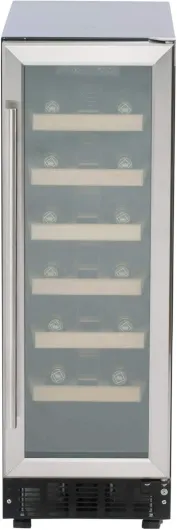
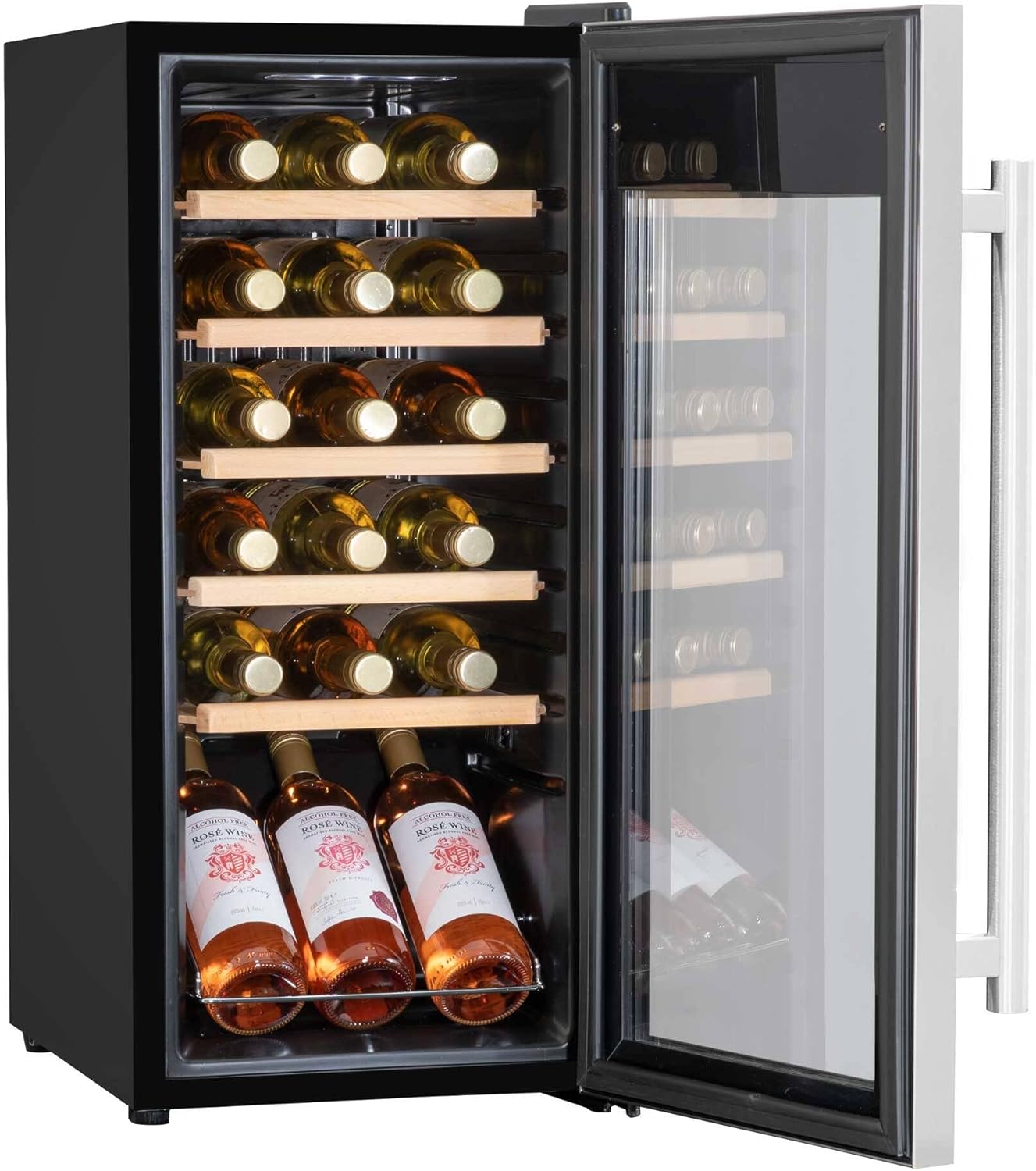
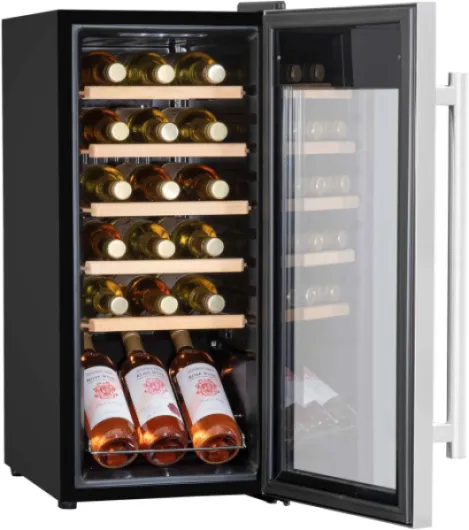
Design-wise, this cooler is actually one of the reasons I picked it. The tempered mirror glass door gives it a clean look, and it does a decent job of blocking direct light while still letting you see the bottles. In a kitchen or lounge, it looks more like a proper appliance than a cheap black box. The stainless-steel trim and glossy finish don’t scream luxury, but they look tidy and modern. I’ve wiped the door and frame a bunch of times; fingerprints show, but they clean off easily with a normal cloth.
The slim profile is a big plus if you’re short on width. At 34.5 cm wide, it slid neatly into a narrow gap between a cupboard and a wall where a normal undercounter fridge wouldn’t fit. The trade-off is internal width: shelves are not very deep from front to back, and you don’t have much headroom between them. If your bottles are taller than about 330 mm (as the specs say), you either have to angle them slightly or take a shelf out. I had to remove one shelf to fit a couple of taller sparkling bottles, which then reduced the total capacity.
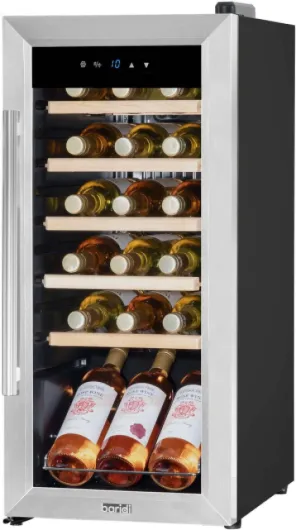
The touch controls on the front are simple but do the job. Tap up or down to set your target temperature, hold the light button to toggle the LED. The display is clear enough to read even from across the room, and it doesn’t blaze at night, which I appreciate. The downside is the light itself: it’s not very bright and it’s manual only. A few reviewers mentioned this, and I agree. It doesn’t switch on when you open the door, which feels a bit cheap, and the glow is more decorative than practical.
Overall, I’d say the design is practical with a nice front look but slightly compromised inside. If you mainly keep standard-size red and white bottles, it’s fine. If you’re into lots of odd-shaped bottles, big sparkling wines or magnums, you’re going to fight with the shelves. For my use (a mix of supermarket reds, whites and the odd bubbly), it works, but I definitely had to play Tetris to use the space well.
Build quality and materials: decent, but not premium
The materials on this Dellonda cooler feel solid enough for home use, but you can tell it’s built to a budget. The outer casing is standard appliance metal with a glossy finish, nothing fancy. The door is the main highlight: tempered mirror glass with a stainless-looking frame. It gives the impression of a more expensive unit than it is, and it should help with UV protection, which matters if you keep it in a bright kitchen or near a window.
Inside, the wooden shelves are beech, according to the specs. They’re light and look nicer than plain wire racks. They slide in and out without too much hassle, but they’re not on rails – they just rest in grooves, so you pull them out by hand. Loaded with bottles, they feel stable enough, but if you yank them quickly they can jerk a bit. I wouldn’t call them flimsy, but they’re not heavy-duty either. For the occasional rearrange and normal use, they’re fine.
The interior walls are basic plastic, easy to wipe down. There’s no fancy lining or extra insulation visible. The LED light is a small strip, and the switch is on the touch panel. As mentioned earlier, the light is pretty weak and more for show than for actual visibility. When the fridge is full, the bottles block most of it, so you end up using your room light anyway when picking a bottle at night.
At around 22.3 kg, it feels reasonably sturdy when you move it, not hollow or rattly. I didn’t notice any loose panels or weird vibrations in normal use. The door seal sits flush and closes properly; no issues with it popping open or anything. Overall, the materials feel like mid-range appliance quality: not luxury, but acceptable for the price. If you’re expecting something that feels like a built-in kitchen wine cabinet, this isn’t that. If you just want a decent-looking, practical cooler that doesn’t feel cheap to the touch, it’s okay.
How it holds up over time
Durability is always hard to judge without years of use, but I can at least talk about how it behaves after regular daily use and what other owners report. I’ve been using it as a secondary wine storage unit, opening it a few times a day on average. So far, no issues with the door hinge, no cracks in the glass, and the touch buttons still respond like day one. The compressor cycles normally; I haven’t noticed any change in noise or odd rattling. A few Amazon reviews mention having it for over a year and still being happy, which is a good sign for this kind of budget-friendly cooler.
The automatic defrost seems to do its job. There’s no ice build-up at the back, and I haven’t had to switch it off to clean frost, which is something I had to do on a cheaper thermoelectric unit I owned before. That old unit got noisy and weak after a year; this one, being compressor-based, feels a bit more robust. Time will tell, but so far it doesn’t feel like it’s struggling, even when fairly full.
The wooden shelves haven’t warped or bent with normal bottle weight. I’m not babying them, but I’m also not standing bottles on the very edge. If you’re rough with them, I could see the grooves wearing down over a few years, but that’s true of most similar designs. The door seal is still snug and hasn’t started to peel or crack. It’s a simple rubber gasket, and as long as you keep it clean, it should last.
Given that it’s made in China and sits in the mid-range price bracket, I wouldn’t expect it to last forever, but based on my use and the reviews, it seems reasonably reliable for home use. If you want something that will survive heavy commercial use or constant door opening in a busy bar, I’d look higher up the price ladder. For a home kitchen, dining room or lounge, used sensibly, I’d expect a few good years out of it without major drama.
Cooling performance: fine for storage, weak if you want ice-cold drinks
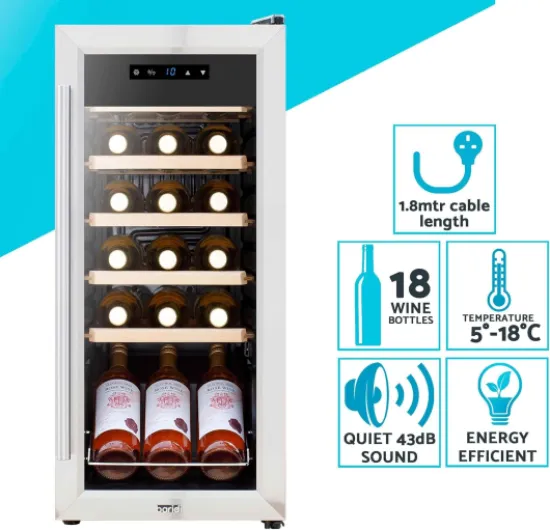
Let’s talk about the main point: how well it actually cools. On paper, it has a 5–18°C range and uses a compressor with automatic defrost. In real life, it behaves more like a 10–18°C unit unless your room is already pretty cool. The listing even hints at this by saying it won’t go lower than the ambient temperature of the room. In my kitchen, which sits around 20–22°C most of the time, setting it to 5°C on the panel gave me around 10–11°C inside based on a cheap fridge thermometer I put on the middle shelf.
For red wine storage and “cellar style” temps, that’s actually okay. Most reds are fine around 12–15°C, and whites around 8–12°C for serving, depending how picky you are. If you’re coming from room-temperature bottles, the cooler will bring them down nicely over a few hours. But if you’re used to shoving wine in a normal fridge that runs at 4°C and pouring it super chilled, this will feel a bit soft. The Amazon reviews mentioning it not being cold enough and only going down to 10–12°C line up with my experience.
The cooling is stable rather than aggressive. Once it settles, the temperature doesn’t swing wildly, which is good for storage. I didn’t notice any big hot spots, but the top shelf did feel a bit warmer than the bottom when loaded. Not a huge deal, but I kept my whites and rosés lower down and left the top shelf more for reds. The automatic defrost means you don’t get frost building up on the back wall, and I never had to manually defrost it, which is one less chore.
Noise-wise, at a claimed 42 dB, it’s pretty quiet. You do hear the compressor kick in now and then, but it’s more of a soft hum than a loud buzz. In the kitchen, it blends in with other background sounds. One reviewer said they had it in the lounge and barely noticed it; I can see that. If your space is completely silent, you’ll hear it, but it’s nowhere near as irritating as some cheap mini fridges I’ve owned. So in terms of performance: good for steady wine storage and mild chilling, not great if you want really cold drinks.
What you actually get out of the box
Out of the box, the Dellonda Baridi 18 Bottle Wine Cooler is pretty straightforward. You get the fridge, the removable wooden shelves already in place, some basic documentation, and that’s about it. No fancy accessories, no extra gadgets. It’s a 50-litre compressor wine fridge with a glass door, touch controls on the front, and an internal LED light. The ASIN is B08CZYDYVQ if you’re cross-checking, and it’s rated for up to 18 bottles, assuming standard wine bottle size and shape.
The footprint is 45 cm deep, 34.5 cm wide and 77 cm high, so it’s tall and slim. It’s sold as freestanding, not built-in, which matters if you’re planning to slide it into a tight cabinet. I just left a bit of space at the back and sides for airflow and called it a day. The controls are at the top of the door: you get up and down arrows for temperature and a button for the internal light. That’s it. No Wi‑Fi, no app, no dual zone. Honestly, I prefer it like this for something that just needs to keep bottles cool.
In practice, the 18-bottle claim is optimistic if you have a lot of chunky bottles (Prosecco, Champagne, some craft wine bottles). Standard Bordeaux-style bottles line up fine, but as soon as you mix shapes, you either skip a slot or remove a shelf. I ended up using it more like a 12–14 bottle cooler unless I carefully planned the layout. That’s not a tragedy, but it’s worth knowing if you’re stocking up heavily.
On the usage side, the user manual is basic but clear enough. It explains the 5–18°C range, though in real life the bottom end is closer to 10–12°C depending on the room. The fridge uses a compressor cooling system with automatic defrost, so you don’t get that annoying frost build-up you see in some cheap thermoelectric units. For someone who just wants to plug it in and forget about it, this is a plus. Overall, presentation is simple and functional, nothing fancy, but it matches the price point and the category.
Pros
- Slim, modern design with mirror glass door that fits well under counters or in narrow gaps
- Quiet compressor operation (around 42 dB) with automatic defrost and reasonable energy use (120 kWh/year)
- Good for stable wine storage and light chilling, with removable wooden shelves and up to 18 standard bottles
Cons
- Struggles to reach the advertised 5°C in normal room conditions, often bottoming out around 10–12°C
- Interior is cramped for larger or non-standard bottles, making the real capacity lower than 18 in practice
- LED light is weak and manual only, doesn’t switch on with door opening and is more decorative than useful
Conclusion
Editor's rating
After living with the Dellonda Baridi 18 Bottle Wine Cooler, I’d sum it up like this: a decent, compact wine fridge for storage and light chilling, as long as you’re realistic about the temperature. It looks good with its mirror glass door, fits neatly into narrow spaces, and runs quietly enough that it doesn’t dominate the room. The wooden shelves and glass front give it a nicer feel than a basic mini fridge, and the simple touch controls are easy to use day to day.
The main downside is cooling strength. In a normal room, it seems to sit more around 10–12°C at its lowest rather than the 5°C you might expect from the spec sheet. For red wine storage and moderate chilling of whites, that’s fine. For people who like their drinks really cold, it’s not ideal. The interior layout is also a bit tight if you have lots of chunky bottles, so I’d mentally treat it as a 12–14 bottle unit unless all your bottles are standard size.
If you’re a regular wine drinker who wants a separate, tidy place to keep bottles at a stable temperature, this cooler is a solid option for the price. If you mostly want an all-purpose drinks fridge or you’re very picky about precise serving temperatures, I’d look at either a more powerful undercounter fridge or a higher-end wine cabinet. It’s not perfect, but it does its job without fuss, and for many people that will be enough.