Summary
Editor's rating
Value for money: mainly worth it if you need the narrow size
Design: slim, clean look with some practical compromises
Everyday use: loading, accessing bottles, and living with it
Materials and build: feels solid, but the inside isn’t premium
Performance: stable temperature, but the noise is noticeable
What you actually get with this AEG wine cooler
Pros
- Very narrow 29.5 cm width fits tight undercounter spaces where most fridges won’t
- Stable single-zone temperature from 5–18 °C with simple controls
- Clean black glass design with wooden shelves and LED lighting that looks good in modern kitchens
Cons
- Noticeable fan/compressor noise in quiet or open-plan rooms despite the 40 dB spec
- Shelves are close together, so bulky bottles reduce the practical 20-bottle capacity
- Single cooling zone only, no separate temperatures for red and white wines

Specifications
View full product page →| Brand | AEG |
A compact wine fridge that looks high-end but isn’t perfect
I’ve been using this AEG 5000 Series integrated wine cooler (AWS4020B5B) for a little while now, and I’ll be honest: I mainly picked it because it fit the awkward 30 cm gap under my counter. There aren’t many narrow wine coolers from known brands, and this one ticked the basics: 20 bottles, 82 cm height, black glass door, single zone. On paper, it looked like a good fit for a modern kitchen without going into crazy prices.
In day-to-day use, it does what it’s supposed to do: it keeps wine at a stable temperature, it looks decent, and it integrates pretty cleanly into the kitchen layout. But it’s not perfect. The main thing that stands out is the noise level. It’s advertised at around 40 dB, and that sounds low, but in a quiet open-plan room you do notice the fan and compressor, especially if you’re sensitive to background hums.
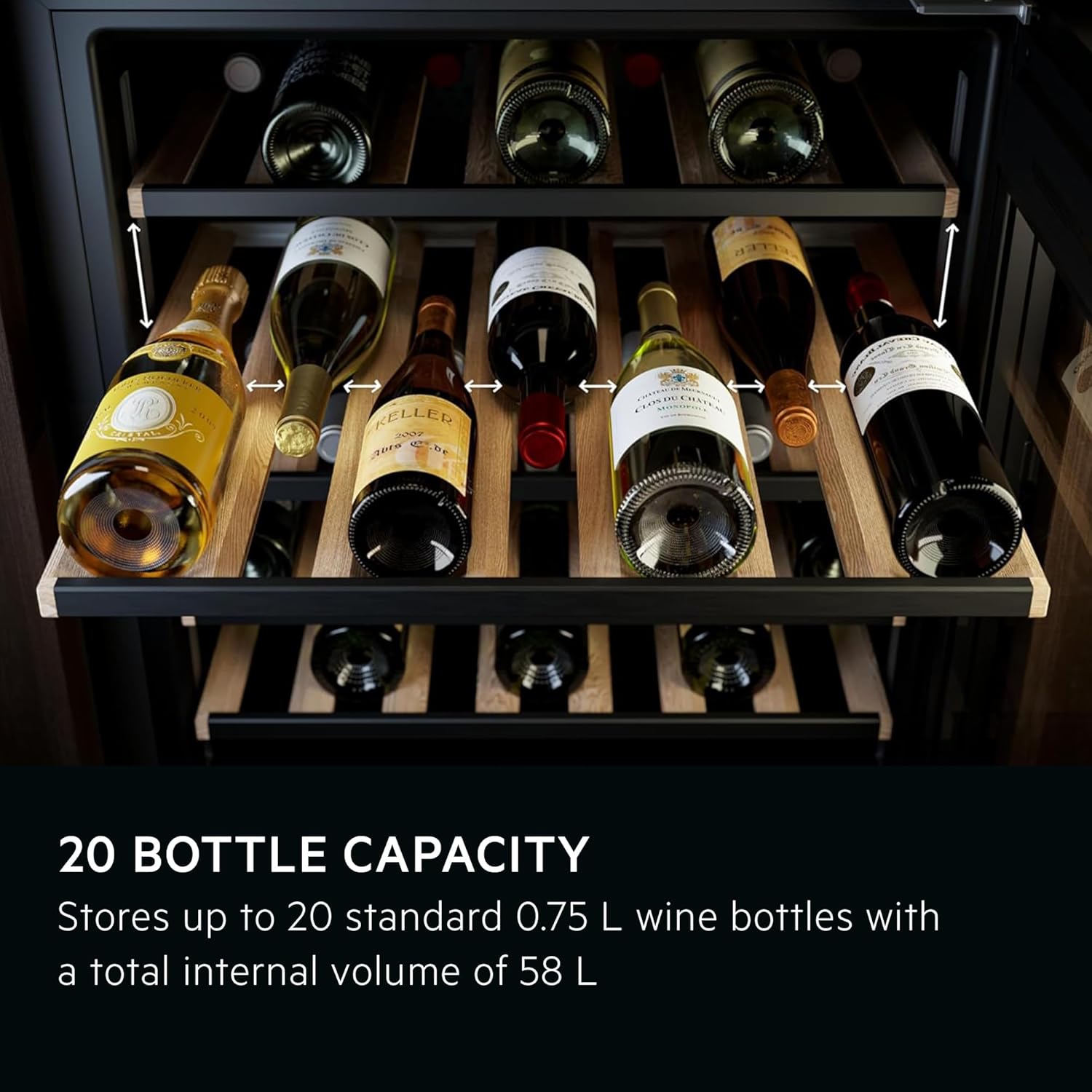
The other recurring theme is space. Yes, it says 20 bottles, and yes, you can fit 20 standard 0.75 L bottles, but like most wine coolers, the shelves are quite close together. If you have chunkier bottles (some reds, sparkling, or odd-shaped labels), you’ll quickly find yourself playing Tetris or removing a shelf. It’s not a disaster, but it’s not as flexible as you might hope.
So overall, my impression is: a pretty solid, compact wine fridge that looks good and keeps temperature steady, but with two clear trade-offs: it’s a bit louder than I’d like, and the internal layout is tight. If you can live with those, it gets the job done. If you want near-silence or you have lots of non-standard bottles, you might want to think twice.
Value for money: mainly worth it if you need the narrow size
On the value side, this cooler sits in that middle zone: not bargain-basement, not luxury. What you’re really paying for here is the AEG brand, the integrated undercounter format, and the narrow 29.5 cm width. If you have a standard 60 cm gap, you can probably find bigger, quieter, or dual-zone units for similar money. But if you have a tight space and want a known brand rather than a random label, this one starts to make more sense.
The features are pretty basic for the price: single zone, no smart features, no fancy display, just stable cooling, wooden shelves, and a decent-looking black glass door. For many people, that’s exactly what they need. The 2-year manufacturer warranty is standard but at least gives some peace of mind. Energy consumption at 137 kWh/year is okay; it won’t explode your bill, but it’s not ultra-efficient either. For a small appliance that runs 24/7, that’s acceptable but nothing to brag about.
Where the value takes a hit is the noise vs. price. At this level, I’d expect a bit better acoustic management. Reading the Amazon reviews, the pattern is clear: people like the look and fit, but several mention it being louder than their previous coolers. If you’re in a flat or have an open kitchen, that’s not a minor detail. Also, the practical capacity being lower if you mix bottle shapes means you’re effectively paying for a 20-bottle unit but using it more like a 14–16 bottle one.
So, is it good value for money? I’d say: it depends. If you specifically need a narrow, integrated wine fridge from a big brand and you can tolerate some noise, then yes, it’s a pretty solid option and it gets the job done. If you have more space or you’re very sensitive to sound, you’ll probably get better overall value from a wider, quieter model, even if it’s from a less known brand.
Design: slim, clean look with some practical compromises
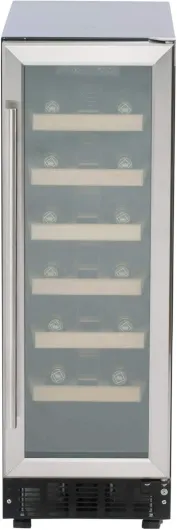
Design-wise, this cooler is clearly made for tight undercounter spaces. The 29.5 cm width is the main selling point. In my case, it slotted into a narrow gap between a cabinet and the dishwasher that would have been wasted otherwise. From the front, the black glass door gives a clean, uniform look. It doesn’t scream “appliance” as much as a stainless steel door would, and it matches darker kitchens pretty well. The door is reversible, which is useful if your layout forces you to open it from a specific side.
The LED lighting at the top is practical, not flashy. It lights the bottles enough so you can see labels without having to pull everything out. It’s more of a white/cool light than a warm bar-style glow, so it feels functional rather than decorative. Personally, I’m fine with that; I just want to see what I’m grabbing. The control panel is simple: temperature adjustment and basic indicators. No Wi-Fi, no touch screen circus, and frankly, that’s fine for this type of product.
Where the design shows its limits is inside. Because the unit is so narrow, the shelves are also narrow, and they’re stacked quite close together. With standard Bordeaux-style bottles, you can follow the “20 bottles” promise. As soon as you introduce bulkier bottles (Burgundy shapes, some Prosecco, Champagne), you’ll either struggle to slide shelves in and out or you’ll have to remove one shelf to create a bit more height. So the design looks good, but it’s optimized for standard bottles and not much else.
Another small detail: the ventilation grilles and sides are pretty plain. This doesn’t matter once it’s built-in, but if you plan to use it as a more free-standing unit, be aware it looks more like a built-in appliance than a showpiece. In short: nice front, clean integration, simple controls, but the compact format forces some compromises on internal spacing.
Everyday use: loading, accessing bottles, and living with it
In daily use, the comfort really comes down to how easy it is to load and grab bottles, and how much the fridge gets in your way. The extendable wooden shelves are a clear plus here. You can pull them out far enough to see the labels and grab a bottle without having to dig around blindly. For standard bottles, everything lines up well: they sit securely in the grooves, they don’t roll around, and you can organise by type or region without too much effort.
Where it becomes less comfortable is when real life kicks in and you start mixing bottle shapes. A couple of bulkier reds, a sparkling bottle or two, and suddenly the close spacing between shelves becomes annoying. You’ll catch labels on the shelf above, or you’ll have to angle bottles in and out. I ended up removing one shelf to create a bit more headroom for the top section, which solves the problem but obviously reduces capacity. So yes, it’s a 20-bottle unit on paper, but in practice, if you drink a variety of wines, expect a bit less.
The controls are straightforward and don’t require thinking. Set your temperature once and forget it. The LED light comes on when you open the door, which is enough to see what you’re doing. The door opens wide enough that access isn’t blocked, even in a tighter kitchen. The adjustable feet also help a lot: I had a slightly uneven floor, and after a bit of tweaking, the door no longer swung closed or open by itself, which is something that can get annoying fast if it’s not level.
Comfort downside is again the noise factor. If you’re standing at the counter above it, you will hear it cycle. It’s not a roar, more of a persistent hum. I got used to it after a while, but the first few days I noticed it a lot, especially in the evening. If your kitchen is your main living area, that’s something to think about. Overall, day-to-day use is decent but not perfect: easy to handle, easy to clean, but the combination of tight spacing and audible noise keeps it from being truly hassle-free.
Materials and build: feels solid, but the inside isn’t premium
On the outside, the build quality feels pretty solid. The door has a decent weight to it, the black glass doesn’t feel flimsy, and the handle area doesn’t flex when you open and close it. The hinge movement is smooth, and once installed under the counter, the unit doesn’t wobble or feel cheap. At around 33.5 kg, it has enough weight to feel stable, which is reassuring when you’re sliding shelves in and out with full bottles.
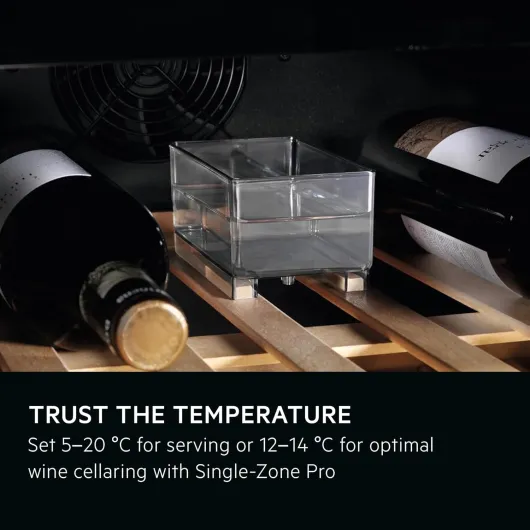
The wooden shelves are probably the nicest touch inside. They’re not luxury-level carpentry, but they’re proper wood, not plastic pretending to be wood. They slide reasonably well on their rails and hold the bottles securely. With six shelves, each one ends up pretty thin in terms of vertical spacing, which again is fine for standard bottles but not great for anything oversized. If you overload or force in bigger bottles, you can feel the shelves flex a bit, so it’s better to respect their intended use.
The interior walls and trim are more basic: standard appliance plastic and metal, nothing fancy. It’s easy to wipe and keep clean, but it doesn’t give that high-end cellar vibe. To be fair, at this price point and in this narrow format, I wasn’t expecting a luxury interior. The LED strip at the top is neatly integrated and doesn’t feel like it’s going to fall off or loosen over time.
In day-to-day handling, the materials feel good enough that you don’t worry about breaking something every time you pull a shelf. The only thing to watch is how you load the bottles: if you constantly cram in non-standard shapes or overfill, you’ll put stress on the rails and shelves. Used as intended, the materials and construction feel pretty solid and in line with what you’d expect from a mid-range brand like AEG.
Performance: stable temperature, but the noise is noticeable
In terms of cooling performance, the AEG does its job properly. I set mine to around 12–13 °C for a mix of reds and whites, and checked with an internal thermometer on a couple of shelves. The readings stayed within about ±1 °C once the unit had settled, which is fine for home use. It cools down from room temperature to target in a reasonable time (a few hours for a full load) and doesn’t fluctuate wildly when you open the door briefly to grab a bottle.
The single-zone setup is simple: one temperature for everything. If you’re picky about serving temperatures (e.g. white at 8 °C, red at 16 °C), this is not the fridge for that. You either compromise with a middle temperature or rotate a few bottles to the kitchen fridge before serving. For most people who just want their wine not sitting at 22 °C in the cupboard, it’s perfectly fine. The anti-shake aspect is hard to "feel" in daily use, but the fridge doesn’t rattle or vibrate the cabinet, so I’d say it’s reasonably stable.
Now, noise. Officially it’s around 40 dB, which sounds low on paper, but in practice you can hear it in a quiet room. The fan and compressor kick in regularly, and the sound is a constant hum rather than a short burst. In a separate kitchen with a door, it’s not a big deal. In an open-plan kitchen-living room, you will notice it when you’re sitting nearby, especially in the evening when everything else is quiet. Some Amazon reviews mentioned it being louder than their previous units, and I’d agree it’s on the noisier side for a small appliance.
Overall, performance is solid: it cools reliably, holds temperature, and doesn’t frost up thanks to automatic defrost. But if silence is a priority for you, this might be a sticking point. Personally, I can live with it, but if I’m working at the kitchen table or watching TV close by, I’m aware of the background hum. It’s not dramatic, just not as discreet as I hoped from the 40 dB spec.
What you actually get with this AEG wine cooler
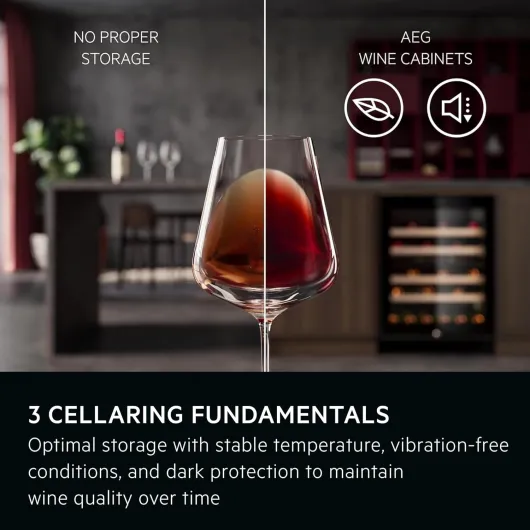
On the spec sheet, this AEG AWS4020B5B is a single-zone, undercounter wine cooler that fits under an 82 cm worktop. It’s 57.5 cm deep, 29.5 cm wide, and designed to slide into a narrow cabinet space. Capacity is advertised as 20 bottles with a 58 L internal volume. Temperature range is from 5 °C to 18 °C, which covers white, red, and sparkling, as long as you accept that everything is stored in one common zone.
Inside, you get six full-width wooden shelves, which are extendable. They’re basically slatted wood trays that slide out enough to grab bottles without wrestling them. The door is a black glass door that’s meant to help protect from light, and there’s top LED illumination that lights the bottles from above. It’s not a showpiece like some massive glass-door cellars, but it does look fairly modern and blends into a black/grey kitchen pretty well.
In terms of equipment, the box is simple: the wine cooler itself, the wooden shelves already installed, a user manual and the power cable with a Type G plug (UK style). No fancy accessories. The defrost system is automatic, which is good because you don’t have to think about it. It uses a compressor cooling method, not thermoelectric, which usually means better temperature stability but often a bit more noise.
Energy-wise, it’s rated at 137 kWh per year, which is decent for a small compressor wine fridge, not ultra-frugal but not crazy either. There’s also an anti-shake feature, basically meaning the compressor and internal layout are designed to limit vibrations, which is good if you plan to leave bottles for a while. Overall, the spec list is pretty straightforward: nothing fancy like dual zones or app control, but the basics are covered without gimmicks.
Pros
- Very narrow 29.5 cm width fits tight undercounter spaces where most fridges won’t
- Stable single-zone temperature from 5–18 °C with simple controls
- Clean black glass design with wooden shelves and LED lighting that looks good in modern kitchens
Cons
- Noticeable fan/compressor noise in quiet or open-plan rooms despite the 40 dB spec
- Shelves are close together, so bulky bottles reduce the practical 20-bottle capacity
- Single cooling zone only, no separate temperatures for red and white wines
Conclusion
Editor's rating
This AEG 5000 Series integrated wine cooler is a solid, compact option if you’re dealing with a narrow undercounter gap and want something that looks clean in a modern kitchen. It keeps wine at a stable temperature, the wooden shelves are practical, and the black glass door with LED lighting gives it a tidy, discreet look. For standard bottles and simple use (one temperature for everything), it does the job without fuss, and installation is straightforward thanks to the adjustable feet and reversible door.
However, it’s not for everyone. The two main drawbacks are noise and spacing. The fan/compressor hum is clearly audible in a quiet, open-plan room, and if you’re sensitive to background noise, that will annoy you over time. Inside, the shelves are close together, so as soon as you add a few larger bottles, you either lose capacity or start fighting with the layout. For the price, I think it’s decent but not outstanding: you’re mainly paying for the slim integrated format and the AEG badge.
If you have a tight 30 cm space and want a known-brand wine fridge that looks good and keeps your bottles at a steady temperature, this is a reasonable choice as long as you accept the noise. If you have more room under your counter, or if you care a lot about silence and flexible storage, I’d look at wider, quieter alternatives or possibly a dual-zone model instead.