Summary
Editor's rating
Value for money: decent, but there are strong alternatives
Nice built-in look, but some design choices are a bit annoying
Usability is okay, but loading bottles and controls could be better
Materials feel mixed: good door, mediocre interior
Cooling performance is acceptable, but not perfect
Specs look great on paper, with a few oddities
Smart features and app: more gimmick than daily tool
Pros
- Clean integrated 60cm design with black glass door that fits well under a counter
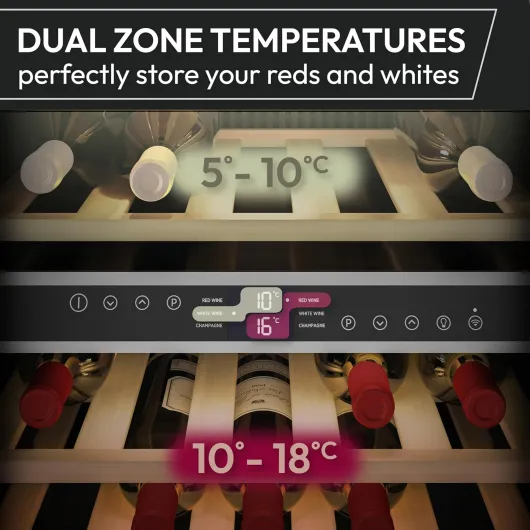
- Dual temperature zones (5–18°C) allow separate settings for reds and whites
- UV-protected glass and charcoal filter help protect bottles from light and odors
Cons
- Noticeable compressor noise, especially in quiet or open-plan spaces
- Shelves feel light and tight, real capacity is lower than the claimed 38 bottles with mixed bottle shapes
- G energy rating and average build quality for the price

Specifications
View full product page →| Brand | Hoover |
A slick-looking wine cooler that’s not as polished in real life
I’ve been using this Hoover HWCB 60D UK/1 integrated 60cm wine cooler for a few weeks now, built under the counter in my kitchen. On paper it ticks a lot of boxes: dual temperature zones, space for 38 bottles, smart app, UV glass, charcoal filter, the whole thing. In reality, it’s a bit more mixed. It does chill wine, but there are a few details that annoyed me pretty quickly.
First thing: I bought it because I wanted a neat, built-in look and the option to keep reds and whites at different temperatures. My old basic freestanding cooler was noisy and only had one temperature, so I thought I was upgrading properly. Out of the box, the Hoover looks the part, but once you start loading bottles and tweaking settings, some compromises become obvious.
Another point: the product page is full of specs and the app integration with Vivino sounds fancy, but day to day, what matters is noise, how stable the temperature is, how easy it is to fit different bottle shapes, and whether it just quietly does its job in the background. That’s where this model is a bit hit and miss. It’s not terrible, but it’s not the smooth experience I expected for this kind of price.
If you’re thinking about this as your first serious wine fridge, I’d say it’s decent if you mainly care about looks and basic dual-zone cooling. But if you’re picky about noise, exact temperatures, and build quality, you might end up feeling like I do: it works, but it’s not as solid or as user-friendly as I hoped.
Value for money: decent, but there are strong alternatives
Talking about value, I think this Hoover sits in an awkward middle spot. It’s not cheap, and for the money you do get dual zones, a nice-looking integrated design, and some smart features. But when you look at the overall experience – the slightly noisy compressor, the average shelf quality, the G energy rating, and the not-quite-38-bottle realistic capacity – it doesn’t feel like a great deal. It’s okay, but not something I’d rave about.
Compared to some other 60cm dual-zone wine coolers I’ve seen and used (from brands like Candy or Beko), the Hoover doesn’t clearly stand out. The price is often similar, but the build doesn’t feel clearly better. In some cases, competitors have quieter operation or smoother shelves at roughly the same price point. If you’re not locked into Hoover for some reason, it’s worth checking those before you decide.
Running costs are another part of the value equation. With a G energy rating, it’s not the most efficient unit out there. Over several years, a more efficient cooler could easily save you some money on electricity, especially if it’s running 24/7. That doesn’t kill the product, but it’s something to factor in if you’re hesitating between two models.
Would I say it’s bad value? Not exactly. You do get a proper dual-zone integrated cooler that looks smart in a modern kitchen and keeps your wine at roughly the right temperature. But considering the small frustrations and the fact that there are a lot of options in this category, I’d call it average value. If you find it at a discount, it makes more sense. At full price, I’d personally shop around and compare carefully before committing.
Nice built-in look, but some design choices are a bit annoying
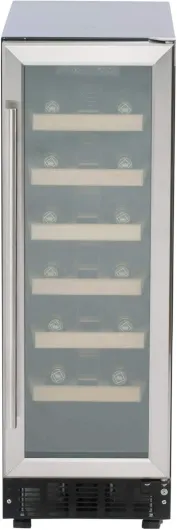
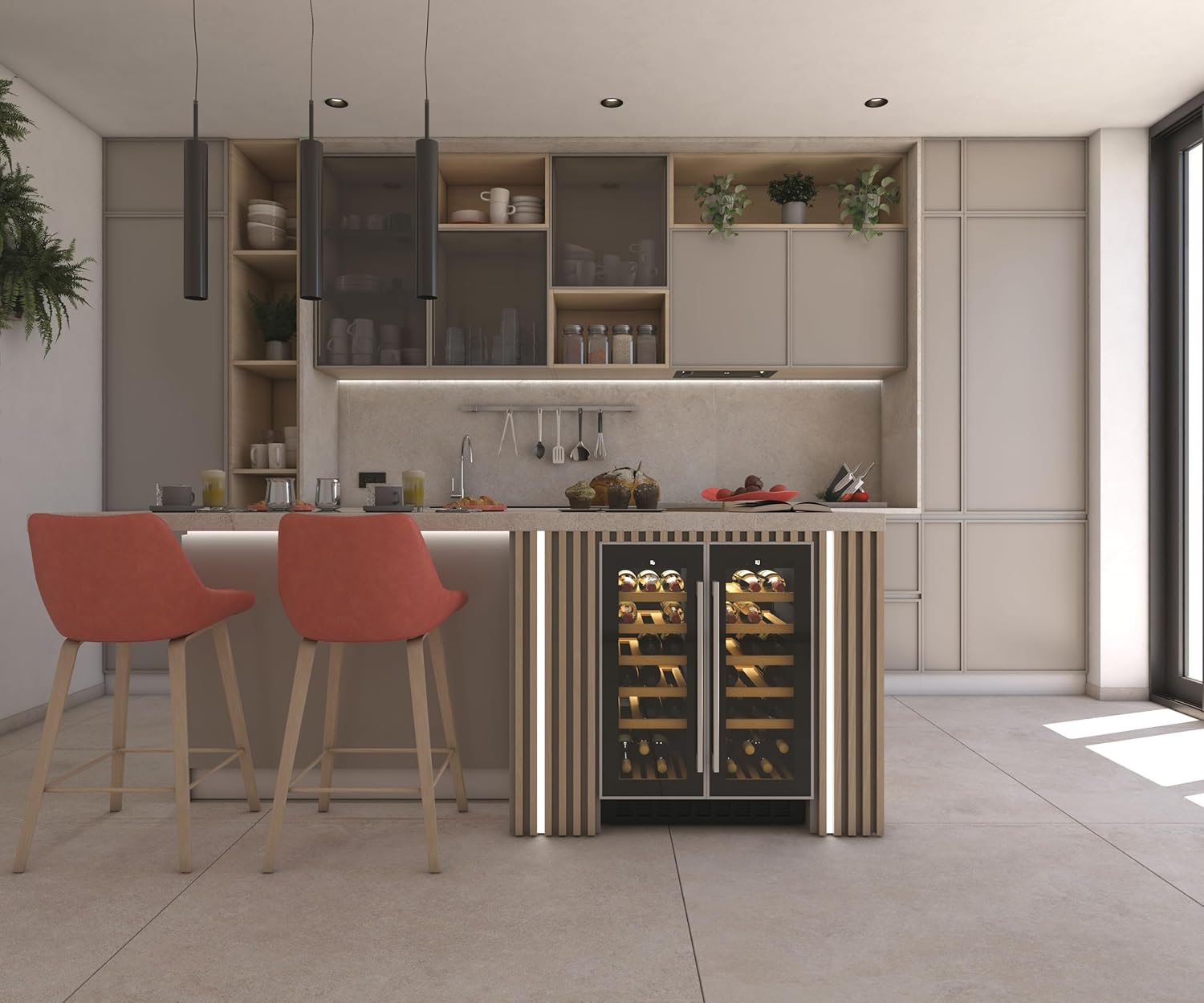
The design is probably the main reason you’d pick this model. Installed under the counter, the black glass door and clean lines blend well with modern kitchens. The door has a solid, heavy feel and the UV-protected glass looks good. When the interior LED lights are on, the bottles are nicely visible without blasting the room with light. From a few steps back, it looks like an expensive piece of kit, which I do like.
Up close, a few things could be better. The control panel is simple but a bit basic. The touch buttons respond, but not always on the first tap, and the temperature display isn’t super bright, so in daylight you sometimes squint to see the numbers. The dual-zone layout is vertical: top and bottom sections, each with its own setting. That’s fine, but the temperature difference between the two zones isn’t always as sharp as advertised, especially if you open the door a couple of times in a row during an evening.
Another small annoyance: the door swing and handle area are not reversible on my unit, so you need to plan carefully which side of the kitchen you put it on. If your layout isn’t ideal, you might end up with the door opening the wrong way, which is irritating when you’re trying to grab bottles while cooking or serving guests. The adjustable feet are handy though; I managed to level it even on a slightly uneven floor without much hassle.
Overall, in terms of pure looks, it’s a win. It fits nicely under the counter, the black finish hides fingerprints fairly well, and the glass door gives it that built-in bar vibe. But some design details – the slightly awkward controls, the non-reversible door (on my version), and the not-so-sharp separation between zones – remind you this is not a top-tier model, just a decent-looking one with a few compromises.
Usability is okay, but loading bottles and controls could be better
In terms of comfort and day-to-day use, this wine cooler is a mix of good and annoying. The basic stuff is fine: you open the door, grab a bottle, close it, done. The handle is easy to grip, and the door doesn’t feel too heavy. The interior lighting is enough to quickly spot what you want without fumbling around. So if you only use it occasionally, you probably won’t complain much.
The issues show up when you actually try to use the full “38 bottle” capacity and organise things properly. The shelves are quite close together, which is good for fitting more bottles, but it means that any slightly wider or taller bottle can rub against the shelf above. I had to remove one shelf to fit a couple of Champagne bottles comfortably. That kills the advertised capacity and forces you to play Tetris with your collection. Pulling shelves out when fully loaded isn’t super smooth either, so you end up holding the bottles with one hand and guiding the shelf with the other to avoid jerks.
The controls are not hard to understand, but they’re not exactly intuitive either. Changing the temperature is a bit slow, as you have to tap through each degree, and there’s a small delay before the display updates. Nothing dramatic, just slightly clunky. Also, there’s no physical on/off button on the front for the lights; they’re tied to the door opening and some settings, so you don’t have full manual control unless you dig through the instructions or app.
From a comfort point of view, it’s usable, but it never feels truly user-friendly. If you’re the kind of person who likes to rearrange bottles, check vintages, and play around with your collection, the tight spacing and average shelf glide will start to bother you. If you just want a chilled stash and don’t overthink it, you’ll probably accept the quirks and move on.
Materials feel mixed: good door, mediocre interior
Material-wise, you can tell Hoover spent money on what you see first: the door and the outer shell. The glass door feels sturdy, the black finish is clean, and the overall cabinet doesn’t flex or rattle when you open and close it. The UV-protected glass is a plus if your kitchen gets a lot of light; it at least gives you the sense that your bottles aren’t getting cooked by the sun. The hinge action is firm and the seal seems decent – I didn’t notice any obvious cold air leaks around the edges.
Inside, it’s more basic. The shelves are supposed to be wooden, and they are, but they feel thin and a bit light. When you pull a shelf out with several bottles on it, there’s a bit of flex, and you don’t get that solid, smooth glide you might expect. They don’t feel like they’re going to break immediately, but they don’t scream long-term durability either. If you’re constantly moving bottles around, you’ll notice the slightly flimsy feel quite quickly.
The interior walls and trim are standard plastic and metal, nothing fancy. No sharp edges, but also nothing that feels premium. The LED lighting is fine, but the way it’s positioned means the top rows are lit better than the bottom ones. It’s not a big deal, but if you like to show off labels, the bottom zone looks a bit darker unless the room is well lit.
For the price, I expected slightly better rails on the shelves and a more solid feel when pulling them in and out. The charcoal filter is a nice touch on paper, but it’s hidden away and you just have to trust it’s doing something. Overall, the materials are okay – they get the job done – but they lean more towards mid-range budget than high-end, so set your expectations accordingly.
Cooling performance is acceptable, but not perfect
Performance-wise, the Hoover HWCB 60D UK/1 does what it’s supposed to do: it cools wine. I set the top zone to 7°C for whites and the bottom to around 14–15°C for reds. Using a separate thermometer, I checked a few times over the first week. The readings were usually within 1–2 degrees of what I set, which is fine for casual drinking, but if you’re very picky about exact temperatures, that might annoy you. The temperatures also take a while to stabilise after you load a lot of room-temperature bottles.
The dual-zone feature works, but it’s not a perfectly sealed separation. If you open the door often, especially during a dinner party, the zones drift a bit and the cooler needs time to catch up. I wouldn’t call that a deal-breaker, but it’s something to know: don’t expect lab-grade precision. For day-to-day use, the wine comes out at a nice drinking temperature, so for me it’s acceptable, just not impressive.
Noise is where I’m a bit more critical. The compressor kicks in with a noticeable hum. It’s not insanely loud, but in a quiet kitchen or open-plan living room, you do hear it. Compared to my old cheap freestanding unit, the noise level is similar, maybe slightly better, but I was hoping for quieter. At night, when the house is silent, you’re aware of it cycling on and off. If your kitchen is far from your living space, that’s less of a problem; in a flat with open space, it might get on your nerves.
On the positive side, it recovers temperature reasonably quickly after opening the door, and I haven’t noticed any serious hot spots or areas that are way off. Bottles at the back and front feel roughly the same temperature. So overall, the performance is decent but nothing more. It cools fairly consistently, but the combination of slight temperature drift and audible compressor noise keeps it from feeling like a really polished unit.

Specs look great on paper, with a few oddities
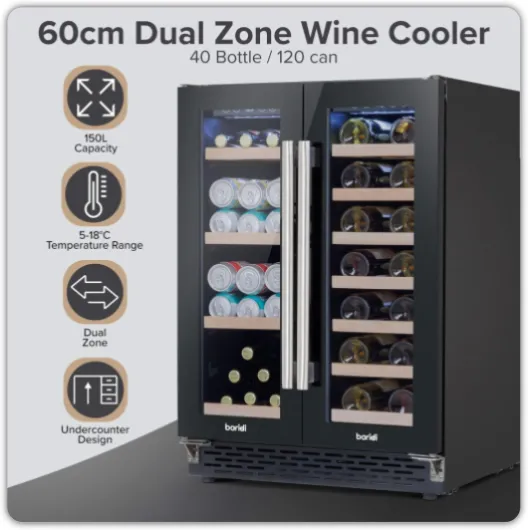
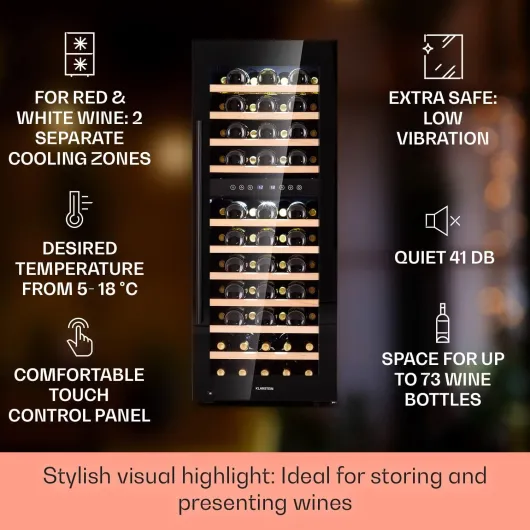
On the spec sheet, the Hoover HWCB 60D UK/1 looks pretty solid. It’s a 60cm wide, undercounter wine cooler, about 595mm wide, 575mm deep and 865mm high, so it fits in a standard 60cm cabinet gap. It claims a 38-bottle capacity, dual temperature zones from 5°C to 18°C, UV-protected glass door, charcoal filter, 10 shelves, LED lighting, and it’s smart-home compatible via the hOn app with Vivino integration. So far, so good. This is exactly the kind of setup I was after for a mixed red/white collection.
In practice, some of the numbers feel a bit optimistic. The 38-bottle capacity is basically for standard Bordeaux-style bottles. As soon as you add fatter Champagne bottles, Burgundy shapes, or anything with a slightly longer neck, you start losing capacity or fighting with the shelves. I’d say realistically, if you have a mixed collection, you’re closer to 28–32 bottles without it feeling cramped or scraping labels on the shelf above.
The energy rating is G, which is not great. You can see that on the label, and if you care about running costs or being efficient, that’s a bit of a downside. It’s not a power-hungry monster, but compared to newer A–E rated appliances, it’s behind. The automatic defrost and compressor cooling are standard stuff, nothing special, but at least you don’t have to manually defrost anything.
There’s also some confusion in the listed specs online (like ridiculous dimensions in metres and a huge “refrigerator net capacity” figure that clearly doesn’t match a 60cm wine cooler). That doesn’t affect how it works, but it doesn’t inspire confidence. Overall, the feature list is attractive, but once you actually load bottles and use it daily, you realise it’s a mid-range product with a couple of rough edges rather than a carefully thought-out premium unit.
Smart features and app: more gimmick than daily tool
There’s no battery here, but the “smart” side deserves its own look because Hoover pushes it quite a bit. The cooler is compatible with the hOn app, and it hooks into Vivino so you can scan labels and manage your collection. On paper, that sounds quite handy if you like to track what you have and get suggestions. In practice, I found it more of a novelty than something I’ll use regularly.
Setting up the app and connecting the cooler took a bit longer than I’d like. The pairing process worked eventually, but it wasn’t totally smooth – a couple of retries, some waiting, and then it finally appeared in the app. Once connected, you can see the temperatures of both zones and adjust them from your phone, which is mildly useful if you’re on the sofa and don’t want to get up, but not exactly life-changing.
The Vivino integration is kind of fun the first evening. You scan a few bottles, read some info, maybe save a couple of ratings. But after that, I honestly forgot about it. When I’m grabbing a bottle for dinner, I don’t feel like opening an app and scanning things. It’s more something you play with when you first set it up and then mostly ignore. It doesn’t really improve the core experience of having chilled wine ready to drink.
So, the smart features technically work, but they don’t add much real comfort. If you’re already a heavy Vivino user, you might enjoy having everything in one place. If not, it’s just another app on your phone. I wouldn’t buy this model specifically for the connectivity – it’s a nice extra at best, but not a strong selling point once the novelty wears off.
Pros
- Clean integrated 60cm design with black glass door that fits well under a counter
- Dual temperature zones (5–18°C) allow separate settings for reds and whites
- UV-protected glass and charcoal filter help protect bottles from light and odors
Cons
- Noticeable compressor noise, especially in quiet or open-plan spaces
- Shelves feel light and tight, real capacity is lower than the claimed 38 bottles with mixed bottle shapes
- G energy rating and average build quality for the price
Conclusion
Editor's rating
After living with the Hoover HWCB 60D UK/1 for a bit, my feeling is pretty straightforward: it looks good, it cools wine reasonably well, but it’s not as polished as I hoped. The integrated 60cm format and black glass door give a clean, built-in look that fits nicely in a modern kitchen. The dual temperature zones are genuinely useful if you keep both reds and whites, and the basic cooling performance is fine for everyday drinking. If your expectations stop there, you’ll probably be satisfied enough.
Where it falls short is in the details. The shelves feel a bit flimsy and tight, the real capacity is lower than the 38 bottles claimed if you have varied bottle shapes, and the compressor noise is noticeable in a quiet room. The G energy rating isn’t great, and the smart app integration is more of a toy than a real daily tool. For the price, you can find alternatives that are quieter or feel more solid, even if they don’t have all the same features on paper.
I’d say this cooler suits someone who mainly wants a decent-looking built-in wine fridge for a medium-sized collection, isn’t obsessed with perfect temperature accuracy, and doesn’t mind a bit of background hum. If you’re more demanding about build quality, noise levels, or long-term running costs, or if you really plan to push the capacity to the limit, I’d look at other brands and compare carefully before choosing this one.