Summary
Editor's rating
Value: what you really get for your money
Design: clean look, not flashy, fits a normal kitchen
Materials and build: decent quality, not luxury
Durability and reliability feeling after ongoing use
Performance: cooling, noise, and daily use
What this Hoover wine cooler actually offers
Pros
- Dual temperature zones that are easy to set and stay reasonably stable
- Built-in 60cm format with a clean black glass design that fits modern kitchens
- Wooden shelves and solid door/seals give a sturdy, decent-quality feel
Cons
- Real-world capacity is lower than the claimed 46 bottles if you have mixed bottle shapes
- G energy rating means higher running costs than more efficient alternatives

Specifications
View full product page →| Brand | Hoover |
A proper wine fridge for real-world kitchens
I’ve had the Hoover HWCB 60 UK/1 integrated wine cooler in my kitchen for a bit now, built into a 60cm slot under the counter. I’m not a sommelier, just someone who likes to keep a mix of supermarket bottles and a few nicer ones at a steady temperature instead of shoving them next to the milk. I wanted something dual-zone, built-in, and not insanely expensive. This Hoover ticked those boxes on paper, so I gave it a go.
What struck me first is that it’s a pretty straightforward appliance. No fancy gimmicks in daily use: you open the door, put bottles in, set the temps, and that’s it. The app and Vivino stuff are there, but in practice you can ignore all that and just use the front controls. For a built-in unit, it went into a standard 60cm gap without drama, which was important for me because I didn’t want to start cutting cabinets.
Over the first week, I mainly paid attention to three things: how loud it was, how stable the temperature stayed, and whether the claimed capacity was realistic. Noise-wise, it’s present but not annoying in an open-plan kitchen-living room; you hear a hum when the compressor kicks in, but it’s not the kind that makes you regret the purchase. Temperature stability is decent: once it’s cooled down, both zones stay close to what you set, with minor fluctuations when you open the door a lot.
Bottom line for this intro: it’s not some fancy showpiece, but it does what it says. It has its flaws, especially on energy rating and how tight the 46-bottle claim is, but if you want a built-in dual-zone cooler that just quietly keeps your wine in a reasonable range, it gets the job done without feeling cheap.
Value: what you really get for your money
In terms of value for money, this Hoover sits in that middle ground: not bargain-basement cheap, but also not in the luxury bracket. For the price, you get a 60cm built-in wine cooler, dual zones, wooden shelves, LED lighting, and some smart features. If you actually use both zones and keep more than 20–25 bottles at home, it starts to make sense. If you’re only chilling the occasional bottle, this is overkill and you’re better off with a normal fridge or a smaller countertop unit.
The 46-bottle capacity is a bit optimistic in real life unless all your bottles are the same standard shape. Once you throw in a few larger bottles, the effective capacity feels more like 35–40 if you want easy access. For me, that’s still plenty, but it’s worth knowing before you buy. On the positive side, you’re paying for a proper built-in look and dual-zone flexibility, which are usually the features that bump the price up compared to a basic single-zone freestanding cooler.
The downsides on value are mainly the G energy rating and the fact that the app features are nice but not essential. If you don’t care about Vivino integration or scanning labels, you’re technically paying for stuff you may never touch. On the other hand, the long parts warranty and the overall solid build soften that a bit. You’re not just buying a pretty glass door; you’re getting something that feels like it will last a while under normal use.
So, is it good value? For someone who wants a built-in, dual-zone, decent-looking cooler in a modern kitchen, I’d say yes, it’s fair. Not a bargain, not overpriced, just reasonable for what it offers. If you’re super price-sensitive or don’t care about dual zones, you can definitely find cheaper options. But if you want this exact combo of features and integrated look, the price makes sense.
Design: clean look, not flashy, fits a normal kitchen
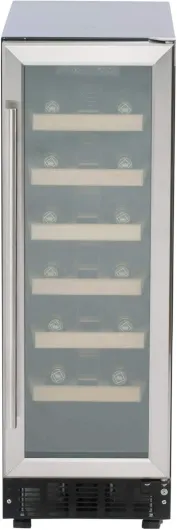
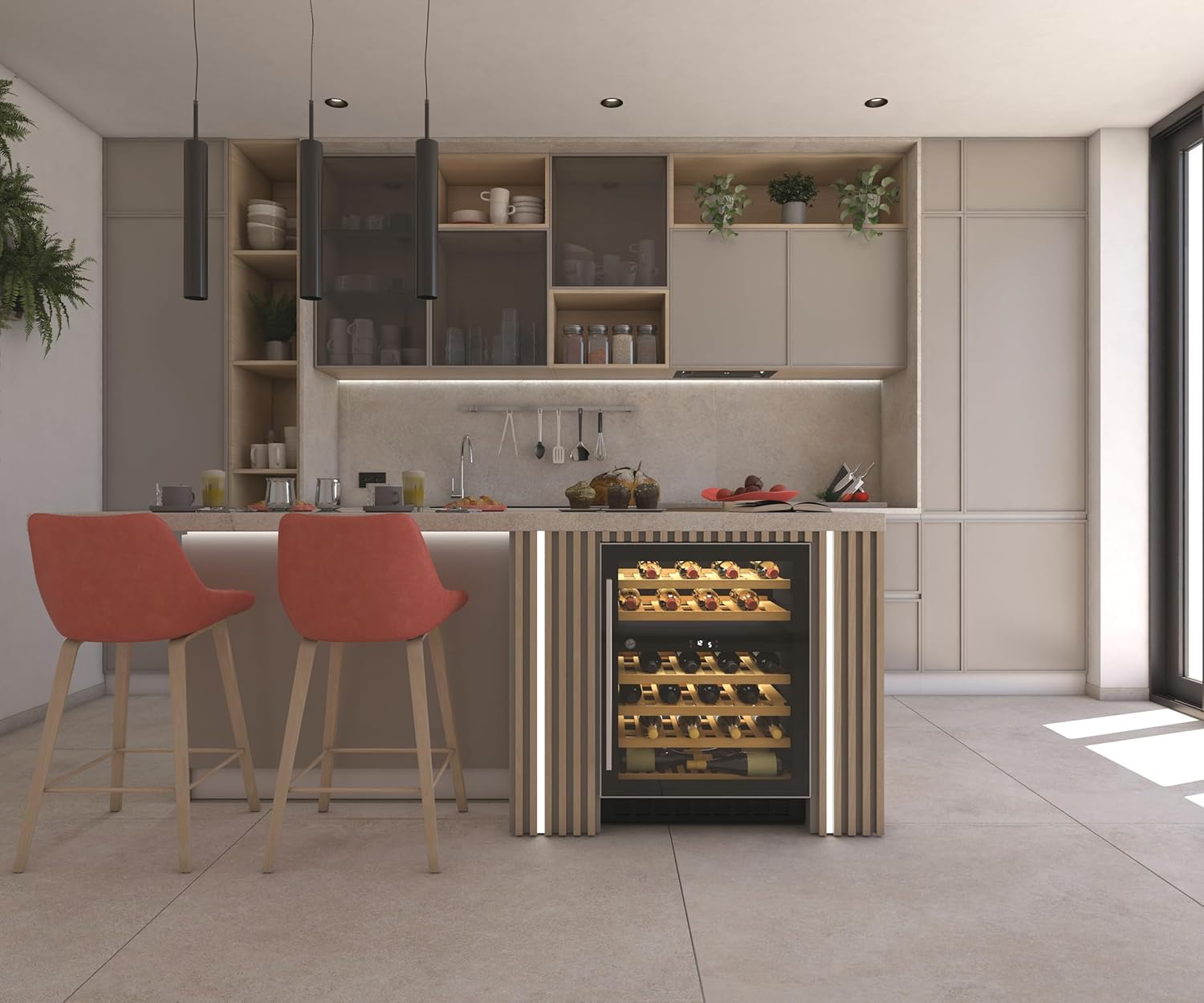
Design-wise, this Hoover goes for a simple black and glass look. The door is mostly glass with a black frame and a glossy finish. It doesn’t scream luxury, but it doesn’t look cheap either. In my kitchen next to a black oven and a stainless steel dishwasher, it blends in fine. If you’ve got a mix of black and steel appliances, it won’t look out of place. The LED lighting inside is white, not blue nightclub style, and you can see all the bottles clearly when the light is on.
The layout inside is straightforward: a stack of wooden shelves that slide out enough to grab bottles without wrestling. They’re not super smooth like premium telescopic rails, but they don’t jam either. The 46-bottle claim is based on standard Bordeaux-style bottles. If you have chunky champagne bottles or odd-shaped ones, that capacity drops fast. In my case, mixing regular reds, slim whites, and a few sparkling bottles, I’m closer to the mid-30s realistically if I don’t want to play Tetris.
One design detail I did appreciate is the reversible door. Mine came hinged on one side, but you can swap the hinge over. If your kitchen layout forces you to open it the other way, that’s handy. The handle is integrated into the door, so there’s no big metal bar sticking out to catch your hip. The control panel is inside at the top and is easy to reach without having to bend all the way down, which sounds minor but matters when you’re tweaking temperatures.
In daily life, the design is just practical. It’s not a show-off piece, but it looks tidy, and the glass door lets you see what you’ve got without opening it every time. If you were hoping for some designer centerpiece, this isn’t that. But if you want a clean, modern, neutral built-in cooler that disappears into a run of cabinets, it does that job well enough.
Materials and build: decent quality, not luxury
The build quality is what I’d call “pretty solid but not premium”. The cabinet itself feels sturdy and heavy – it’s about 50.9 kg – so once it’s in place, it doesn’t feel flimsy at all. The door has a nice weight to it when you open and close it, and the glass seems thick enough that you don’t worry about knocking it lightly with a bottle. The black frame has a glossy finish, which looks nice but does show fingerprints, so be ready to wipe it now and then.
Inside, the wooden shelves are a plus compared to metal wire racks. They hold the bottles in the right position to keep the cork in contact with the wine, and they don’t rattle around. The wood doesn’t feel high-end, but it’s stable and does its job. I moved them in and out a few times to adjust spacing, and they didn’t warp or feel like they’d break. The plastic parts inside (side trims, control panel, etc.) are clearly plastic, but nothing feels like it’s about to snap if you’re not super gentle.
The seals around the door seem good: when the door closes, you feel it grab a bit, and there’s no obvious cold air leak. The hinges hold the door alignment correctly, so it doesn’t sag or scrape. After some use, the door still lines up fine with the cabinet next to it, which is something that can get annoying on cheaper units. The compressor and back panel are standard for this kind of appliance – nothing fancy, but no weird noises or vibrations that make you think it’s cutting corners too hard.
Overall, the materials feel in line with the price range: solid casing, decent glass, functional wood shelves, average plastic. If you’re coming from a basic under-counter fridge, this will feel like a step up. If you’ve used high-end wine cabinets before, you’ll notice the difference, but you’re also not paying those prices here.
Durability and reliability feeling after ongoing use
Obviously I haven’t had this thing for ten years, but after regular use, you start to get a feel for whether an appliance is flimsy or solid. With the Hoover HWCB 60 UK/1, the overall impression is that it’s built to handle normal home use, not abuse, but it doesn’t feel fragile. The door still closes cleanly, the shelves haven’t warped, and the controls respond the same as on day one. No random error beeps, no weird temperature spikes, and no condensation problems on the glass so far.
The compressor-based cooling is standard tech, nothing experimental, which I actually like. Simpler usually means fewer surprises. The automatic defrost has been doing its job quietly; I haven’t seen frost building up or water pooling anywhere. The cabinet doesn’t flex or creak when you slide shelves in and out with full bottles, which is a good sign that the internal structure is decent.
One thing I do keep in mind is the energy rating (G class). That doesn’t mean it’s going to break; it just means it’s not the most efficient. Long term, you’ll pay a bit more on your electricity bill compared to a higher-rated unit. Hoover does offer 1 year labour and 10 years parts warranty, which at least suggests they expect the core components to last. Obviously you’d still pay labour after the first year, but it’s better than nothing.
In short, while I can’t pretend I’ve stress-tested it for years, the early signs are positive: no rattles, no misaligned door, no failing LEDs, and no random shutdowns. It gives off that feeling of “this will probably just chug along quietly” rather than “handle with care or it’ll fall apart”. There’s better out there if you’re ready to pay premium prices, but for a mid-range built-in, durability seems acceptable.
Performance: cooling, noise, and daily use
On performance, the key points for me were how well it cools, how stable it stays, and how noisy it is. From first switch-on, it took a couple of hours to bring both zones down to their set temperatures with a half-full load of room-temperature bottles. That’s normal for this kind of appliance. Once it settled, both zones stayed within about 1°C of the target most of the time, with small bumps when I opened the door a lot. For normal home use, that’s perfectly fine.
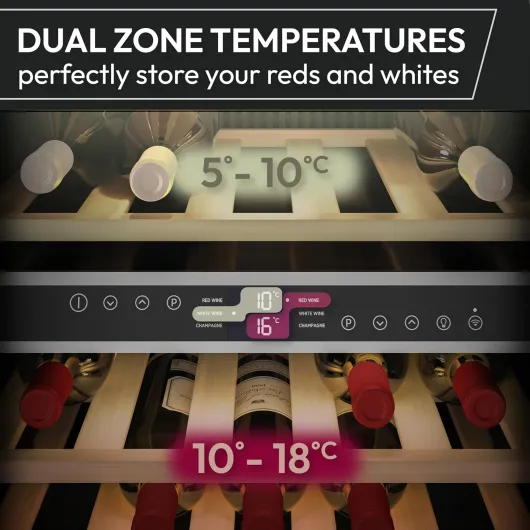
The dual-zone setup works as advertised. I ran the top zone around 8°C for whites and the bottom around 13°C for reds. Bottles come out at a temperature that actually makes sense for drinking, not ice cold or lukewarm. If you’re picky, you might still decant reds for a bit, but for everyday drinking, it’s good. The automatic defrost means I didn’t see ice buildup on the back panel, and humidity seemed reasonable – corks didn’t look dried out after a few weeks.
Noise-wise, I’d call it moderate. When the compressor kicks in, you hear a low hum. In an open-plan kitchen-living room, you’re aware of it if the room is quiet, but once there’s normal background noise (TV, conversation), it fades into the background. It’s not dead silent, but it’s less annoying than a lot of cheap under-counter fridges I’ve had. There’s no high-pitched whine, which is usually what drives me mad.
In everyday use, the performance is basically: it cools reliably, doesn’t fluctuate wildly, and doesn’t drown out the room. The app features don’t change the core performance – they’re just extras. For someone who actually opens the door a few times a day and rotates bottles, this cooler handles that routine without fuss. It’s not perfect, but it’s steady, and that’s what matters for keeping a small home collection in decent shape.

What this Hoover wine cooler actually offers
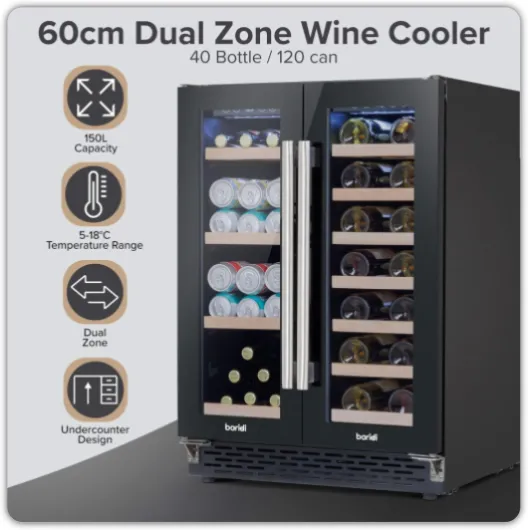
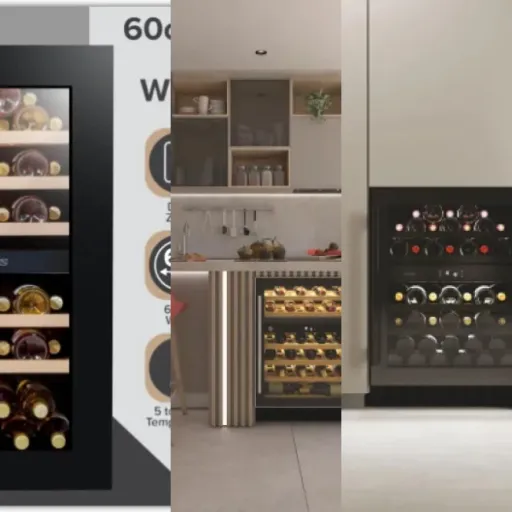
On paper, the Hoover HWCB 60 UK/1 (also referenced as HWCB 60 UK/N in some places) is a 60cm built-in wine cooler with dual temperature zones and space for up to 46 bottles. It’s 86.5 cm high, 59.5 cm wide, and 57.5 cm deep, so it lines up pretty well with standard under-counter appliances. Inside you get wooden shelves, LED lighting, and a glass door with a black frame. It runs off a standard Type G plug and uses a compressor cooling system with automatic defrost.
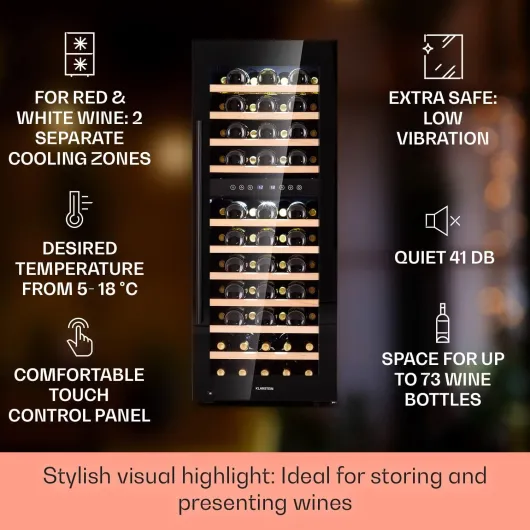
The dual-zone setup means you can set the top and bottom sections to different temperatures – for example, whites at around 7–9°C and reds at 12–14°C. The controls are at the front inside the door, with a simple digital display. No weird menu trees, just up/down buttons and zone selection. It’s rated G class for energy under the new label, so it’s not the most efficient thing in the world, but the annual consumption of 145 kWh is acceptable if you’re not counting every kilowatt-hour.
You also get some “smart” features through the hOn app, which connects to Vivino. In practice, that means you can scan labels, see ratings, and log your bottles. It’s a nice extra if you’re into tracking your collection, but you don’t need it to actually run the cooler. It works fine as a dumb fridge if you never pair it to Wi‑Fi. For everyday use, I mainly just glance at the front display and ignore the app unless I’m bored and scanning bottles.
Overall, the presentation is: mid-range wine cooler, not entry-level junk, but also not some high-end boutique unit. It’s aimed at people who want proper storage for a decent collection at home, care about having two zones, and want it integrated into the kitchen rather than a random freestanding unit in the hallway. If that’s where you are, the spec sheet lines up pretty well with real needs.
Pros
- Dual temperature zones that are easy to set and stay reasonably stable
- Built-in 60cm format with a clean black glass design that fits modern kitchens
- Wooden shelves and solid door/seals give a sturdy, decent-quality feel
Cons
- Real-world capacity is lower than the claimed 46 bottles if you have mixed bottle shapes
- G energy rating means higher running costs than more efficient alternatives
Conclusion
Editor's rating
The Hoover HWCB 60 UK/1 is a no-nonsense built-in wine cooler that does what most people actually need: it keeps a decent number of bottles at sensible temperatures, in two separate zones, without taking over your whole kitchen. It’s not trying to be a luxury showpiece, and that’s fine. The design is clean, the wooden shelves are practical, and the dual-zone control is simple enough that you don’t need a manual every time you want to change a setting.
Where it falls short is mostly on the realistic capacity and the energy rating. The 46-bottle claim is optimistic once you mix in larger bottles, and the G class efficiency isn’t great if you’re trying to minimise running costs. The app and Vivino integration are nice extras but not essential; they won’t matter to everyone. That said, the build feels solid, noise levels are acceptable in an open-plan space, and the long parts warranty gives a bit of peace of mind.
If you’re someone who keeps a regular stock of reds and whites, cares about serving temperature, and wants a built-in 60cm unit that looks tidy and just works, this Hoover is a good fit. If you only drink wine occasionally, are short on budget, or want ultra-low energy consumption, you should probably skip it and look at smaller or more efficient models. Overall, it’s a solid, practical choice for everyday wine drinkers who want their bottles stored properly without going into high-end collector territory.