Summary
Editor's rating
Is it good value for money?
Slim, simple design that blends in, not showy
Everyday usability: fitting bottles, loading, and living with it
Build quality and reliability concerns after reading other users’ reviews
Cooling, temperature control and noise in day-to-day use
What you actually get with this 18-bottle cooler
Pros
- Slim 29.5 cm width fits tight undercounter gaps where normal fridges won’t
- Stable cooling with simple 5–18°C control and easy-to-read LED display
- Reversible door and adjustable feet make installation flexible in most kitchens
Cons
- Real-world capacity is less than 18 bottles if you use larger or mixed bottle shapes
- Some reports of faults just after 1 year raise questions about long-term reliability

Specifications
View full product page →| Brand | Russell Hobbs |
A slim wine fridge that actually fits under the counter
I picked up the Russell Hobbs RHBI18WC1 wine cooler because I wanted something to fill a slim 30 cm gap under the counter and free up some space in the main fridge. I’m not a wine snob, I just wanted bottles cold and ready without juggling shelves every time the supermarket has a deal. This model kept coming up because of the 18-bottle capacity and the fact it can be built-in or used freestanding.
After living with it for a bit, my overall feeling is: it’s a pretty solid, no-nonsense chiller, with a few quirks you should know about before buying. Nothing fancy, nothing high-end, but it does what it says most of the time. The Amazon score of around 4.1/5 feels about right to me – not perfect, not rubbish, just decent.
What pushed me to try this one versus some of the cheaper unknown brands was the Russell Hobbs name and the fact it’s one of the more popular built-in wine coolers on Amazon. That usually means at least the basics are sorted: temperature, noise, and build. I also liked that it has a stated range of 5–18°C, which is fine for both white wine and beer.
It’s not all good news though. You’ve got some noise to live with, some questions about long-term reliability based on a few reviews, and the capacity is a bit optimistic if you mostly buy chunky bottles. But if you’ve got a 30 cm gap and you want a simple drinks fridge, it’s worth a look, as long as you go in with realistic expectations.
Is it good value for money?
Value-wise, I’d put the Russell Hobbs RHBI18WC1 in the “good but not unbeatable” category. You’re paying for a known brand, a slim built-in design, and a half-decent build. There are cheaper 18-bottle coolers out there from random brands, but a lot of them look and feel flimsier, and some don’t offer proper undercounter integration or a reversible door. If you specifically need a 30 cm integrated unit, your options are limited, and this one ends up looking fairly reasonable.
On the plus side, you get: a usable temperature range (5–18°C), wooden shelves, a glass door, an LED display, and the ability to go freestanding or built-in. Energy use at 137 kWh/year is acceptable for a small drinks fridge – it’s not ultra-efficient, but it’s not a power hog either. Noise is manageable, and most buyers seem happy enough with performance and look, judging by the 4.1/5 rating.
On the downside, you don’t get long warranty coverage out of the box (just the 1 year + extra on registration), and there are some reports of faults just after a year. That always knocks the value score a bit for me. Also, if you don’t actually need a built-in unit and you’re fine with freestanding, you can probably find a cheaper drinks fridge with similar capacity and features, just not as narrow.
So for me, the value is pretty solid if you specifically need the narrow, undercounter format and like the clean black/glass look. If you’re more flexible on size and style, you might save money or get more capacity by looking at slightly wider freestanding models. It’s not a rip-off, but it’s also not some bargain of the century – it’s a fair deal for what it offers.
Slim, simple design that blends in, not showy
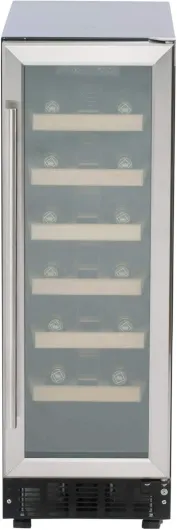
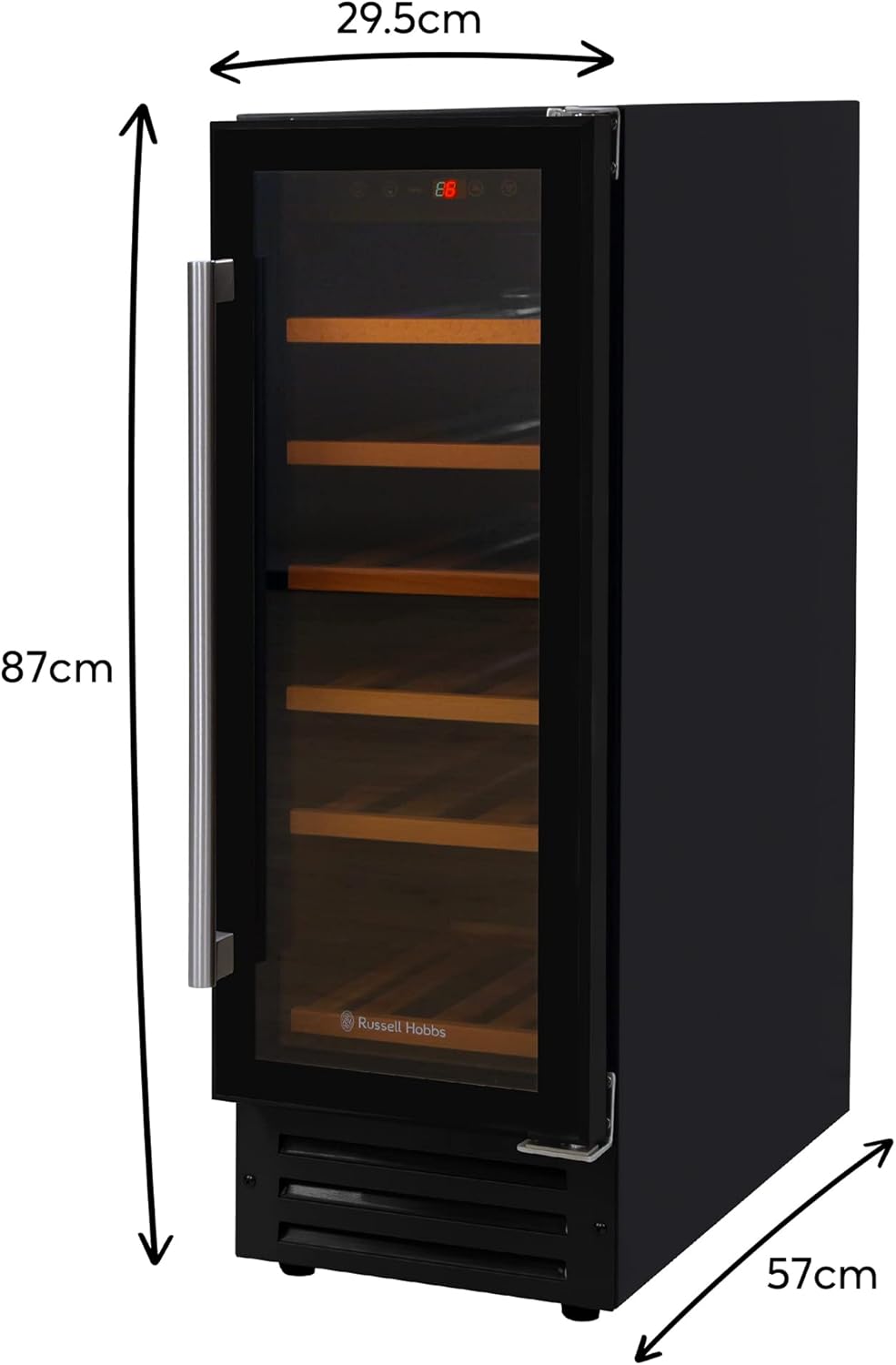
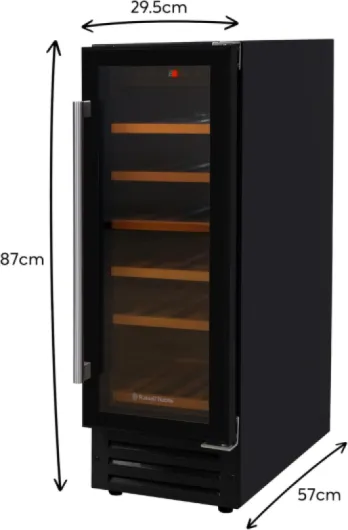
Design-wise, this wine cooler is very straightforward. It’s a tall, narrow black box with a glass door. No chrome accents, no flashy lighting, just a clean look that blends in with most modern kitchens. If you’re expecting something that’s going to be a centerpiece, this isn’t it; it’s more like a practical appliance that quietly fills a gap under the counter.
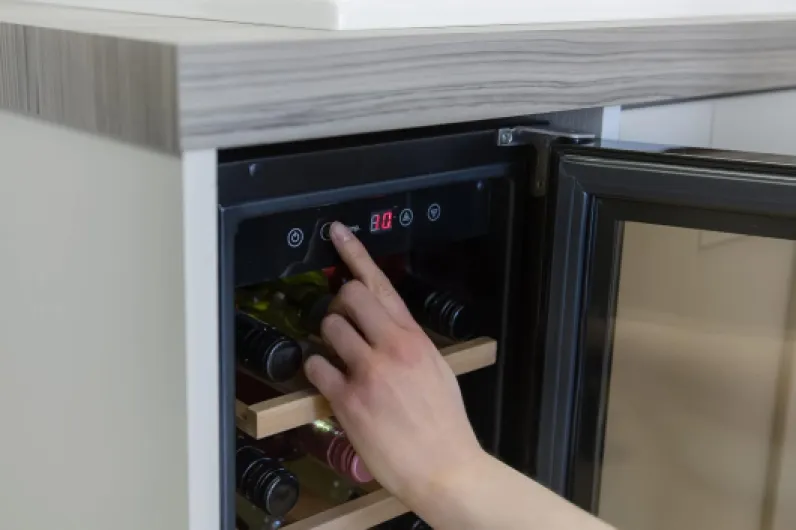
The glass door is useful because you can see what’s inside without opening it all the time, and it does make it look a bit smarter than a plain metal door. The black frame around the glass hides fingerprints reasonably well, so you’re not constantly wiping it. The LED display on the front is small and functional – it shows the temperature clearly, and the buttons are simple enough that you don’t need the manual after the first day.
The wooden shelves are probably the nicest visual detail. They break up the all-black interior and make it look less cheap. Practical note though: they’re fixed in position for the most part, and they’re clearly designed around standard wine bottles. If you’re putting in champagne, prosecco, or random craft beer bottles, it can start to look a bit cramped and messy. But if you mainly buy standard 750 ml bottles, it lines up pretty well.
The other design point that matters is the reversible door and adjustable feet. In practice, being able to switch the hinge was a big plus for me. It took a bit of faffing with screws, but nothing complicated. The adjustable feet helped level it under a slightly uneven counter. Overall, the design is nothing special but effective: it looks neat, it doesn’t scream for attention, and it fits into tight spaces without drama. For a utility appliance, that’s about what I want.
Everyday usability: fitting bottles, loading, and living with it
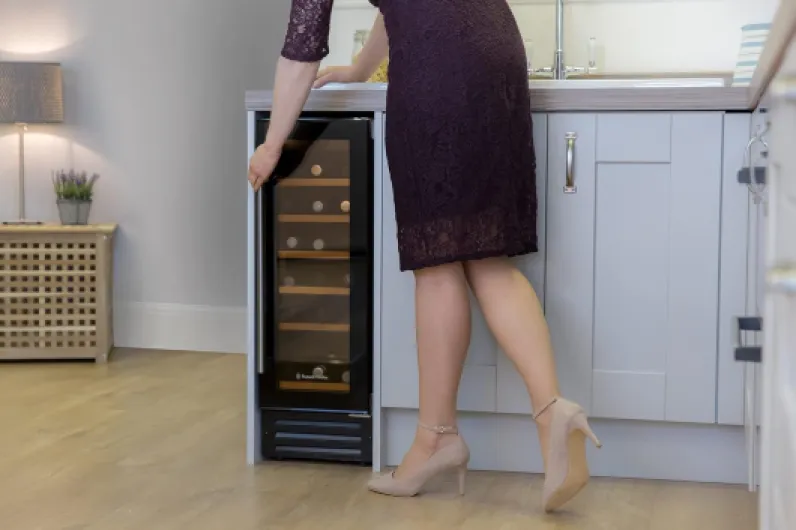
When I say “comfort” here, I mean how easy it is to live with day to day. First thing: the 29.5 cm width is a lifesaver if you’ve got a narrow gap. It slid into my space with a bit of wiggle room, and the adjustable feet made levelling it pretty painless. Swapping the door hinge over took maybe 20–30 minutes with a screwdriver – not hard, but you need a bit of patience.
The 18-bottle capacity is accurate only if you mostly use standard, slim wine bottles. Once you start mixing in bulkier bottles (prosecco, champagne, some craft beers), the real capacity is a bit less. You can still get a decent mix of bottles and cans in there, but don’t expect to cram 18 random bottles with no compromise. The wooden shelves are fixed enough that you can’t do crazy custom layouts, but they’re fine for normal use.
Access is straightforward: open door, pull shelf, grab bottle. The shelves slide out enough to see what’s on them without having to dig around. The internal light is okay – bright enough for quick checks, not so bright that it lights up the whole room. The glass door means you often don’t even need to open it to see what’s left, which helps keep the temperature a bit more stable.
In terms of daily annoyance level, it’s low. You hear the compressor occasionally, but it’s not intrusive. There’s no awkward control menu, just simple buttons. The main “comfort” drawback is the noise if you’re sensitive to hums, and the slightly optimistic capacity if you have a lot of odd-shaped bottles. Apart from that, it’s a simple, fairly user-friendly appliance that doesn’t require much thought once installed.
Build quality and reliability concerns after reading other users’ reviews
In terms of build quality, the first impression is actually positive. The unit feels heavy for its size at 27.4 kg, which gives a bit of confidence that it’s not made of paper-thin metal. The door closes with a solid feel, the handle doesn’t flex, and the wooden shelves slide in and out without wobbling. The plastics inside don’t feel premium, but they’re not flimsy either. For the price bracket, I’d say the physical build is pretty solid.
Where it gets a bit worrying is long-term reliability. One of the Amazon reviews mentions getting an “Et” error code after about one year and two weeks, basically right after the standard guarantee. That kind of timing is frustrating, and it does raise questions about how long the electronics or the compressor will last. To be fair, there are also quite a few reviews from people saying they’ve had it running quietly and happily, but you can’t ignore the negative ones when they mention faults just after the warranty window.
My own time with it so far hasn’t shown any obvious issues – no weird noises, no sudden temperature spikes, no condensation problems. But I haven’t had it for five years, so I can’t pretend to know how it will age. Given the mix of reviews, I’d treat this as a mid-range appliance that might last several years, but I wouldn’t be shocked if something failed around the 3–5 year mark. This is pretty standard for cheaper wine coolers, to be honest.
If you do buy it, I’d definitely register for the extra year of guarantee right away, and if you’re the cautious type, maybe consider plugging it into a surge-protected extension just to be safe with the electronics. Overall, durability looks okay but not bulletproof. It doesn’t feel cheap in the hand, but the odd failure story is enough to keep expectations realistic.
Cooling, temperature control and noise in day-to-day use
On performance, the main thing: it cools properly, but it’s not perfect. Once I set it to around 7–8°C for beer and white wine, it took a few hours to get down to temperature when fully loaded. After that, it stayed fairly stable. I checked with a cheap fridge thermometer and the reading was usually within 1–2 degrees of what the display said, which is good enough for home use. I never had a bottle come out warm, and it doesn’t seem to struggle unless you keep opening the door repeatedly.
The 5–18°C range covers most needs. 5°C is fine for beers and very cold whites, 10–12°C is fine for reds. I ended up leaving mine at a middle setting and not touching it. There’s no dual-zone function, so if you want different temperatures for red and white at the same time, this isn’t for you. This is more of a single-temperature drinks fridge than a serious "wine cellar".
Noise-wise, it’s pretty much in line with the specs. It’s rated at 42 dB, and in reality it’s quiet but not silent. When the compressor kicks in, you can hear a low hum. In an open-plan kitchen/living area, you’ll notice it if the room is totally silent, but it quickly becomes background noise. Some reviewers say it’s “very quiet”, others say “a little noisy” – I’m somewhere in the middle. It’s quieter than my main fridge, but if you’re super sensitive to noise, it might bother you.
In everyday use, the LED display and controls are simple: set the temperature, forget it. The internal light is handy but not very bright; it’s enough to see what’s what, but if the kitchen is dark you won’t get a showroom vibe out of it. Overall, performance is decent but nothing more. It keeps drinks cold, doesn’t swing wildly in temperature, and the noise level is manageable. If you expect lab-level precision or total silence, you’ll be disappointed, but for normal home use it gets the job done.
What you actually get with this 18-bottle cooler
On paper, the Russell Hobbs RHBI18WC1 is a 58-litre, 18-bottle wine cooler that can be either freestanding or integrated under a counter. The external dimensions are roughly 87 cm high, 29.5 cm wide, and 57 cm deep, so it’s basically designed for those narrow under-counter gaps that normal fridges don’t fit. The aperture size they quote (87.5 x 30 x 59 cm) is handy if you’re planning a new kitchen or replacing an old unit.
Inside, you’ve got wooden shelves (a nice touch) and a glass door on the front. The door is reversible, which is actually practical – I swapped mine to open the other way to match the main fridge, and it was straightforward. There’s a simple LED display on the front for temperature control and a small internal light. No Wi‑Fi, no app, nothing fancy – it’s very basic, which I honestly prefer for this kind of appliance.
The manufacturer says it runs between 5°C and 18°C, and it’s rated at 137 kWh per year for energy use, which is okay for a small dedicated fridge. Noise level is listed at 42 dB, which on paper is "quiet-ish" but not silent. Weight is around 27.4 kg, and you do feel it when you move it – it’s heavier than it looks for such a slim unit, which at least makes it feel a bit more solid than some flimsy budget coolers.
In the box, you basically get the cooler and not much else: no fancy accessories, no spare shelves, just the unit. There’s a 1-year guarantee plus an extra year if you register, which is decent but not generous. Given some reviews mention faults just after a year, I’d strongly recommend doing the registration immediately. Overall, the spec sheet lines up pretty well with reality, but the “18-bottle” claim is a bit optimistic if your bottles aren’t all the standard slim Bordeaux shape.
Pros
- Slim 29.5 cm width fits tight undercounter gaps where normal fridges won’t
- Stable cooling with simple 5–18°C control and easy-to-read LED display
- Reversible door and adjustable feet make installation flexible in most kitchens
Cons
- Real-world capacity is less than 18 bottles if you use larger or mixed bottle shapes
- Some reports of faults just after 1 year raise questions about long-term reliability
Conclusion
Editor's rating
Overall, the Russell Hobbs RHBI18WC1 is a decent narrow wine and drinks cooler that does what most people need: it keeps bottles cold, fits into a 30 cm gap, and looks tidy with its glass door and wooden shelves. The cooling performance is stable enough, the noise level is acceptable for most kitchens, and installation is straightforward thanks to the adjustable feet and reversible door. For everyday use as a beer and wine chiller, it’s hard to complain too much.
It’s not perfect though. The 18-bottle capacity is a bit optimistic if you like bulky bottles, and there are a few worrying reviews about faults just after the first year, so I wouldn’t buy it expecting it to last forever. The warranty is okay but not generous, so registering for the extra year is a must in my view. Also, if you don’t specifically need a narrow built-in unit, you can probably find better value in standard-width freestanding coolers.
I’d say this is a good fit for someone who has a 30 cm undercounter gap, wants a simple, clean-looking drinks fridge, and values a known brand over the absolute cheapest option. If you’re very picky about noise, expect ultra-long lifespan, or want advanced wine features like dual zones, I’d look elsewhere or be ready to spend more. For most casual wine and beer drinkers who just want more cold storage in a tight space, it’s a pretty solid, no-fuss choice.