Summary
Editor's rating
Value for money: good if you need the 30cm format
Design: looks the part, with a couple of small annoyances
Materials & build: front looks good, inside is more basic
Durability & daily use: feels decent, but time will tell
Performance: keeps wine at the set temp, with minor quirks
What you actually get with this 30cm Cookology cooler
Pros
- Slim 30cm width fits into narrow built-under gaps while still holding up to 18 bottles
- Compressor cooling keeps temperature stable between 5–18°C, even in a warm kitchen
- Low noise level (around 38 dB) makes it fine for open-plan spaces
Cons
- Interior and wooden shelves feel basic and can be tight for larger or chunky bottles
- Single-zone cooling only, despite the "dual zone style" wording in the description

Specifications
View full product page →| Brand | Cookology |
A skinny wine fridge for normal kitchens
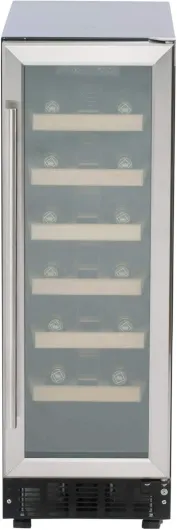
I’ve had the Cookology Essentials 30cm built-under wine cooler in my kitchen for a few weeks now. I’m not a sommelier, I just like having a few bottles of red and white ready to go without filling the main fridge. I picked this one mainly because of the 30cm width – my kitchen has one skinny gap under the worktop, and this pretty much fits that requirement and holds more than just a couple of bottles.
My expectations were simple: I wanted something that actually keeps wine at a stable temperature, doesn’t sound like a tractor, and doesn’t look cheap next to the rest of the units. I wasn’t looking for fancy features, just a small fridge that does its job. On paper this one ticked a lot of boxes: 18-bottle capacity, 5–18°C range, compressor cooling, 38 dB noise level – all the usual stuff for this kind of product.
After installing it and using it day to day, I’d say it’s pretty solid overall but not perfect. It does what it says: it cools wine, it looks decent, and it fits under a standard worktop. But there are a couple of practical quirks that you only notice once you start loading it with real bottles, not the perfectly identical ones they show in the photos.
If you’re thinking about it for a small kitchen or you just want a dedicated spot for wine without going full "wine cellar", this review will give you the straight story: what works well, what’s a bit annoying, and whether I think it’s good value for the price it usually sells at.
Value for money: good if you need the 30cm format
Value really depends on two things: what price you find it at, and whether you actually need the 30cm width. In my case, the narrow gap under the worktop basically forced me into this size, and for that situation, it’s good value. You get proper compressor cooling, a decent-looking stainless and glass front, and space for up to 18 bottles without taking over half the kitchen.
Compared to some cheaper thermoelectric coolers, this one holds temperature better and deals with warmer room conditions more reliably. Those smaller tabletop units are fine for a few bottles, but they often struggle in summer and don’t integrate into the kitchen in the same way. On the flip side, if your kitchen can take a wider 40–60cm wine cooler, there are models in a similar price range that give you more space and sometimes nicer sliding shelves. So you’re basically paying a bit of a premium for the slim format and built-under design.
Running costs should be fairly modest: 75W max load, and the compressor doesn’t run constantly. You’re not going to notice this much on the electricity bill compared to a full-size fridge. There’s no fancy smart feature or dual-zone control, but for the price I don’t really expect that. What you’re paying for is the combination of compact size, integrated look, and stable cooling rather than bells and whistles.
So, in plain terms: if you specifically need a 30cm built-under wine fridge, this Cookology model is pretty solid value for money and gets the job done. If you’ve got more space or want premium-feel shelves and multi-zone control, you might be better off spending more or going for a bigger unit from another brand.
Design: looks the part, with a couple of small annoyances
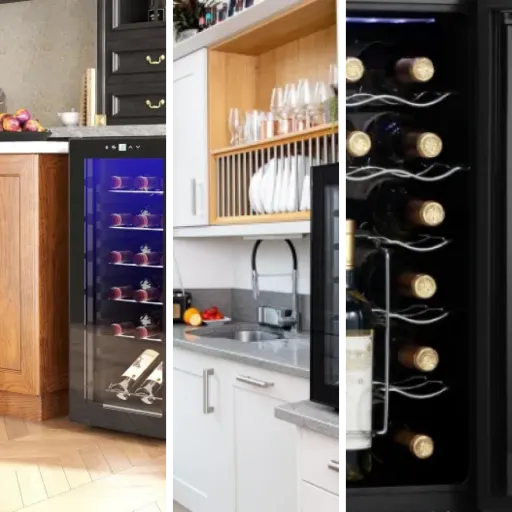
From the front, the stainless steel frame and black accents actually look decent. It doesn’t scream "budget" from a distance. The glass door gives you a clear view of the bottles, and the interior white LED light is bright enough to see labels without being blinding. I liked that the handle is integrated into the door frame, so you don’t have a big bar sticking out – it keeps that slim, clean line next to other cabinets.
The blue LED display and touch controls at the top of the door are easy enough to use. It’s literally just temperature up/down and light on/off. The blue light is a bit bright in a dark room, but you stop noticing after a few days. It looks a bit "appliance showroom" but for a kitchen it’s fine. The touch buttons work reliably; I didn’t have any issues with them not registering presses.
One thing to flag: the 30cm width is both the selling point and the limitation. It looks neat in a narrow gap, but you do feel that tightness inside when you’re loading bottles. Long bottles or chunky sparkling wine bottles are a squeeze. If your kitchen has the space for a 40cm or 60cm unit, those will obviously feel more comfortable. But if you only have that skinny space free, this one does make good use of it visually and practically.
In daily use, the door opens smoothly and closes with a decent seal – no feeling of wobble or flimsiness. The only design thing that bugged me a bit is the contrast between the nice front and the fairly basic interior: the shelves look good but they don’t slide out on rails, and the plastic bits inside feel a bit cheaper than the front suggests. Not a deal-breaker, but you’re reminded this is more of a mid-range, practical unit than a high-end showpiece.
Materials & build: front looks good, inside is more basic
The materials are a mix of stainless steel, glass, wood, and plastic. The stainless steel on the frame of the door feels decent – not paper thin, and it doesn’t flex when you pull on the handle. The glass door is double-glazed and feels solid when you tap it. It doesn’t feel like it would crack from a light knock, which is reassuring if you’ve got kids or clumsy friends around.
Inside, the wooden shelves look nicer than basic wire racks, and they do hold the bottles in place properly. That said, they’re not heavy-duty hardwood or anything fancy. They’re good enough for the job, but you wouldn’t want to stand on one. They slide in and out with a bit of resistance because they’re just sitting in grooves, not on proper runners. It’s fine for occasional access, but if you’re constantly rearranging bottles, you’ll notice the difference compared to higher-end units with smooth sliding shelves.
The rest of the interior is mostly plastic liners and trim. It’s not glamorous, but it’s easy to wipe down. The plastic doesn’t feel like it will crumble, but it also doesn’t have that premium feel. For the price point, I think it’s acceptable. The seals around the door seem well-fitted; mine didn’t have any gaps or weird bends. After a couple of weeks of use, there’s no condensation build-up on the outside of the glass, so the insulation and seal are doing their job.
Overall, I’d say the materials are pretty solid for a mid-range wine cooler, with the money clearly spent on the visible front and the compressor rather than fancy internals. If you’re expecting heavy, luxury-feel wood and thick metal everywhere, you’ll be disappointed. If you just want something that looks decent at the front and doesn’t feel flimsy, this hits that middle ground.
Durability & daily use: feels decent, but time will tell
I haven’t had this cooler for years obviously, but after a few weeks of normal use, there are some clues about how it might hold up. The door hinges feel sturdy – no sagging, no creaking, and the door lines up properly with the frame. You don’t feel like you have to baby it when you pull it open. The door seal is still tight, and you get that slight resistance when closing, which usually means the gasket is doing its job.
The wooden shelves are the part I’m slightly more cautious about long term. They’re fine for regular 750ml bottles, but if you cram in heavier sparkling bottles or stack things awkwardly, they flex a little. I wouldn’t expect them to snap under normal use, but they don’t feel bulletproof either. If you’re rough with them, sliding them in and out while fully loaded, I could see them wearing at the edges over a few years. On the plus side, because they’re simple pieces of wood, they’d be relatively easy to replace or even DIY if you had to.
The compressor itself is from the "reliable compressor technology" line in the spec, which basically means it’s a standard, no-frills unit. That’s not a bad thing – fewer fancy parts usually means less to go wrong. During my time with it, there were no strange noises, no random shutdowns, and no temperature swings that would suggest a problem. The auto defrost also reduces the chance of ice build-up causing issues later.
Overall, I’d rate durability as reasonable for the price bracket. It doesn’t feel like a tank, but it also doesn’t feel fragile. If you treat it like a normal appliance and don’t overload the shelves with weird-shaped bottles, I don’t see a big red flag here. Just don’t expect the kind of "lasts 20 years" build you’d get from far more expensive brands.
Performance: keeps wine at the set temp, with minor quirks
On the performance side, the main thing: it cools properly and stays roughly where you set it. I ran it at 7–8°C for whites and fizz and around 12–13°C for reds, and a basic fridge thermometer inside was usually within about 1°C of the display reading. That’s totally fine for home use. The compressor cooling kicks in for short bursts, brings it back down quickly after you’ve had the door open, and doesn’t seem to struggle even when the kitchen is warm.
The 5–18°C range is wide enough for most people. If you’re really picky about serving temps you’ll probably own something more serious anyway. For regular wine drinkers, this range covers everything from sparkling to heavier reds. One thing to note: like most single-zone coolers, the temperature is generally a bit cooler near the bottom and slightly warmer at the top. It’s not a huge difference, but if you’re fussy, keep whites lower and reds higher.
Noise-wise, the 38 dB rating feels accurate. When the compressor runs, you hear a low hum, but it’s not intrusive. In an open-plan kitchen/living room, it just blends into the background. At night, if you’re sitting in complete silence, you’ll hear it cycle on and off, but it’s not annoying. I’ve had louder main fridges. There are no odd rattles or vibrations as long as it’s level – I did have to adjust the feet a bit at first to stop a slight buzz when the compressor kicked in.
Day to day, the auto defrost means there’s no frost building up at the back, which is one less thing to think about. The internal fan keeps air moving so you don’t end up with one shelf freezing and another warm. Overall, performance is nothing flashy but effective: it keeps bottles at the right sort of temperature, recovers quickly after opening, and doesn’t draw attention to itself with noise or weird behaviour.
What you actually get with this 30cm Cookology cooler
In simple terms, this is a slim, built-under wine fridge that’s meant to slide into a 30cm cabinet space under your worktop. Dimensions are roughly 295 x 575 x 870 mm (W x D x H), so height-wise it lines up with normal kitchen units once you fiddle with the adjustable feet. Capacity is advertised as 18 bottles, with 6 wooden shelves and a glass door. Temperature range is 5–18°C, controlled by a touch panel with a blue LED display on the front.
Inside, you’ve got those wooden slats for the bottles and a white LED interior light that you can switch on to see what’s in there. Cooling is done by a compressor, not a thermoelectric system, which usually means better stability, especially in warmer rooms. Noise level is quoted at 38 dB, which is on the lower side for a compressor unit. It also has auto defrost, so you’re not scraping ice off the back every few months.
In practice, the layout is pretty straightforward. Bottles lie horizontally, two rows stacked vertically on each of the shelves. The door has integrated handle design, so nothing sticking out to catch on clothes when you walk past. Power consumption is not flashy or highlighted, but it’s a 75W max load, so it’s not an energy hog compared to a full-size fridge. There’s no fancy dual-zone temperature control – the "dual zone style" wording in the description is more about the look and layout than actually having two different temperature sections.
Overall, as a product, it’s basically: a narrow, single-zone, under-counter wine fridge with a glass door and wooden shelves. No app, no Wi‑Fi, no silly gimmicks. If you want something simple that just cools wine and looks like it belongs in a modern kitchen, that’s what this is built for.
Pros
- Slim 30cm width fits into narrow built-under gaps while still holding up to 18 bottles
- Compressor cooling keeps temperature stable between 5–18°C, even in a warm kitchen
- Low noise level (around 38 dB) makes it fine for open-plan spaces
Cons
- Interior and wooden shelves feel basic and can be tight for larger or chunky bottles
- Single-zone cooling only, despite the "dual zone style" wording in the description
Conclusion
Editor's rating
The Cookology Essentials 30cm built-under wine cooler is a practical choice if you’re working with a narrow gap in your kitchen and just want somewhere sensible to keep up to 18 bottles at a steady temperature. It looks decent from the front, the compressor cooling holds the temperature well, and the noise level is low enough that it doesn’t dominate an open-plan room. In day-to-day use, it basically disappears into the background and does what it’s supposed to do.
It’s not perfect. The interior feels a bit basic, the wooden shelves are fine but not luxurious, and the tight 30cm width means chunky bottles can be awkward. There’s no real dual-zone control despite the "dual zone style" wording, so if you want precise temperatures for different types of wine at the same time, this isn’t the right product. But if you’re a regular wine drinker rather than a hardcore collector, and you mainly care about having chilled whites and sensibly stored reds ready to go, it’s good enough and fairly priced for what it offers.
I’d say this cooler is for people who have limited space, want a built-in look, and care more about practicality than luxury features. If you’ve got a bigger kitchen, a larger unit with better shelves and maybe dual-zone control might suit you better. For compact kitchens and straightforward needs, though, this Cookology does the job without much fuss.