Summary
Editor's rating
Is it really quiet enough for a living space?
Is the KLARSTEIN Shiraz 12 worth the money?
Looks, layout and that glass door in real life
Build quality, long‑term feel and some warning signs
Cooling, noise and day‑to‑day behaviour
What you actually get: size, capacity and daily use
Pros
- Slim 25 cm width fits into tight spaces while still holding around 10–12 bottles
- Reliable cooling with simple digital temperature control between 5–18°C
- Glass door and interior light give it a decent look for a dining room or home bar
Cons
- Comes with a European plug and adapter, so it sticks out from the wall more than a standard UK plug
- Realistic capacity is closer to 10 bottles if you have larger or odd‑shaped bottles
- Customer service and returns can be painful if bought through some third‑party sellers

Specifications
View full product page →| Brand | KLARSTEIN |
A small wine fridge for people who just want cold bottles, not a mini wine cellar
I’ve been using this KLARSTEIN Shiraz 12-bottle wine cooler as a simple drinks fridge at home, not as some serious collector’s cellar. I stuck it in the corner of the dining room to keep a mix of reds, whites and a few beers at a stable temperature. I wasn’t looking for something fancy, just a compact unit that fits in a narrow space and doesn’t sound like a jet engine.
Out of the box, it feels like a normal small appliance: not luxury, not cheap junk either. It’s a 32L single-zone fridge, so you set one temperature for everything and that’s it. No app, no Wi‑Fi, no smart features. In practice, that’s fine for most people who just want wine at 10–14°C and don’t care about micro‑managing every bottle.
During the first week I mainly watched three things: noise, temperature stability and how many bottles I can realistically fit, including odd shapes. The brand says 12 bottles, which is true if you mostly use standard 750 ml bottles, but once you add chunky prosecco or large shoulders, you start playing Tetris on the shelves. It’s usable, but the 12‑bottle claim is optimistic in real life.
Overall first impression: it gets the job done as a compact wine and drinks fridge. It’s not perfect: the plug situation is annoying (Euro plug + adapter) and temperature does fluctuate a bit like other users said. But if you go in with realistic expectations and you’re not building a high‑end wine room, it’s a pretty solid little unit.
Is it really quiet enough for a living space?
Noise is a big point for a lot of people with these small fridges, especially if you’re putting it in a living room or open‑plan kitchen. The product page talks about a "quiet motor" and some reviewers call it silent, but I’d say it’s quiet, not dead silent. When the compressor is off, you basically hear nothing. When it kicks in, there’s a clear but soft humming sound plus a bit of air movement.
In my dining room, you only really notice it in total silence. With normal background noise – people talking, TV on, dishwasher running in the kitchen – it just blends in. One reviewer said theirs was "a little noisy", and that matches my experience: if you’re very sensitive to hums, you’ll notice it, but it’s not the sort of sound that dominates the room. I’d put it in the same category as a modern full‑size fridge on a low setting.
Where I would not put it is right next to a bed. In a bedroom at night, when everything else is off, the compressor cycles would probably annoy light sleepers. For a home bar, dining room, hallway, or utility room, I think it’s perfectly acceptable. The vibration level is low – glasses on a nearby shelf didn’t rattle or anything – and the unit doesn’t seem to buzz against the floor. I put small felt pads under the feet just in case and that might have helped.
Overall, if you’re expecting total silence, you’ll be disappointed. If you’re expecting normal fridge noise but toned down a bit, that’s exactly what you get. For me, the noise level is totally fine for everyday use, but I wouldn’t buy this specifically for a bedroom or a meditation room where you want absolute quiet.

Is the KLARSTEIN Shiraz 12 worth the money?
Price‑wise, this sits in the mid‑range for small wine fridges. It’s not the cheapest 12‑bottle unit on the market, but it’s also nowhere near the price of serious wine cabinets. For what you pay, you get a slim footprint, glass door, digital temperature control, interior light, and a compressor system that actually cools reliably. For a casual drinker or small household, that’s a decent package.
When I compare it to cheaper thermo‑electric wine coolers I’ve used before, the big plus here is that the compressor handles higher ambient temperatures better and can reach lower temps. The trade‑off is slightly more noise. Personally, I’d rather have this than a very quiet cooler that struggles to keep drinks properly cold in summer. The build quality also feels a notch above the very budget models with rattly doors and thin plastic.
On the downside, the Euro plug with adapter is a bit cheap for a product clearly aimed at the UK market, and that does affect how cleanly it sits against the wall. Also, the "12 bottles" claim is a bit optimistic if you regularly buy odd‑shaped bottles. In real life, I’d call it a comfortable 10‑bottle fridge with occasional room for 12 if you play around with the layout. You’re paying partly for the slim form factor and the glass‑door look, not pure storage capacity.
Taking everything into account – performance, design, noise, and the Amazon rating around 4.1/5 – I’d say value is pretty solid if you specifically need a narrow, decent‑looking wine fridge for a small space. If you have more room and don’t care about looks, you could probably get a bulkier drinks fridge with more capacity for similar money. So it’s good value for the right use case, not a universal bargain for everyone.
Looks, layout and that glass door in real life
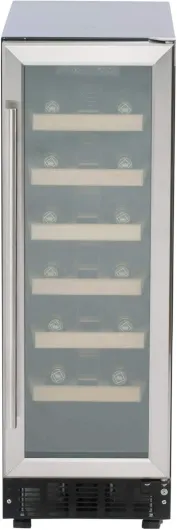
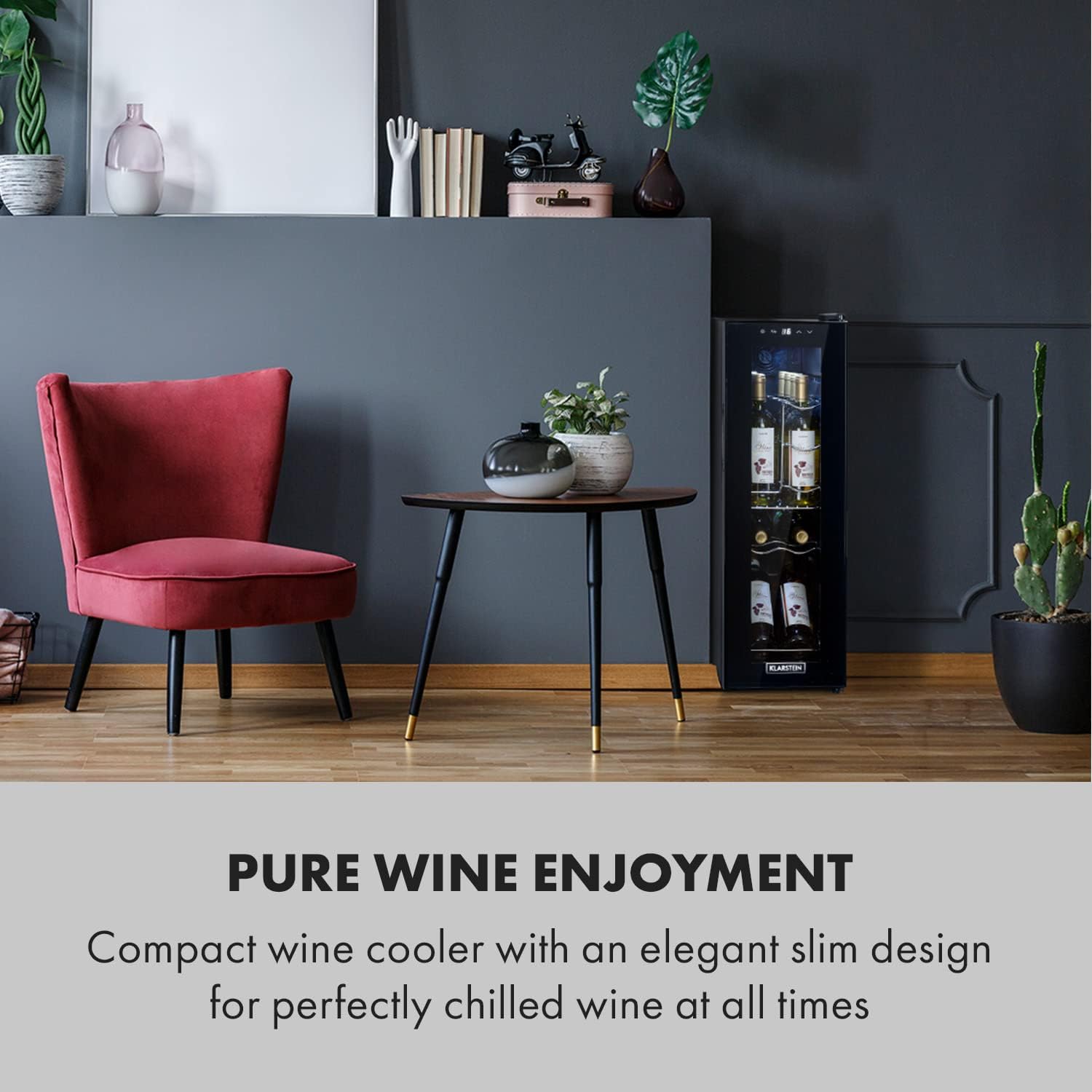
Design‑wise, it’s black, slim and pretty neutral. No retro look, no flashy colors. The glass door with the stainless steel frame gives it a slightly more "bar" feel than a normal mini fridge, which is nice if it’s going in a living room or dining room and not hidden in a utility room. It doesn’t scream for attention, but it doesn’t look cheap either. For the price, I’d call the look decent and practical.
The glass door is the main visual element. You can see all your bottles at a glance, which is handy for guests and also just satisfying if you like to keep a small collection on display. There’s an interior light that you can switch on, and it does give a bit of a "wow" factor when the room is dim. It’s more for looks than function, but it’s not over the top. I usually leave it off and only turn it on when people are over.
Inside, the layout is simple: horizontal shelves plus a vertical section. The horizontal shelves are fine for standard bottles, but if you have a lot of weird‑shaped bottles, you’ll be pulling shelves out and re‑arranging. That’s not a defect, it’s just how compact fridges are. The glass shelves themselves are easy to wipe down and feel strong enough for the weight they’re holding. I didn’t feel any flex or wobble when fully loaded with 10–11 bottles.
One thing to note: the door opens to the right and isn’t reversible out of the box, so you need to plan where you place it. Also, because it’s tall and narrow, it can feel a bit top‑heavy when empty, but once you load bottles in the lower positions it’s stable. I wouldn’t put it somewhere where kids are likely to hang off the door, but in normal adult use it’s fine. Overall, the design is simple, functional and fits in well in a home bar or dining area without looking out of place.
Build quality, long‑term feel and some warning signs
The fridge weighs about 17 kg, which gives it a decent, solid feel when you move it. It doesn’t feel hollow or flimsy like some very cheap mini fridges. The glass door is reasonably thick, the hinge feels okay, and the door closes with a proper seal. After repeated opening and closing over several weeks, I didn’t notice any loosening or misalignment. The cabinet itself is matte black and doesn’t mark too easily – fingerprints on the glass, yes, but that’s expected.
Inside, the glass shelves feel sturdy enough. I loaded them with heavy bottles and there was no bending or scary noises. They slide in and out without catching. The plastic trim and interior walls are basic but fine. This is not a high‑end built‑in unit, so you can see cost‑cutting in some of the plastics, but nothing that screams "this will fall apart in a year". As long as you’re not slamming bottles around, it should hold up.
Where I do have some concern is quality control and after‑sales, based on that 1‑star review you shared. Someone received a damaged unit and had a nightmare with returns via a third‑party seller and DPD. That kind of story always makes me a bit cautious. My own unit arrived without damage, so I didn’t have to deal with support, but it’s clear that if something goes wrong, you really want to buy this direct from Amazon or a reliable seller, not some random marketplace vendor. The brand itself isn’t top‑tier for service in my experience, more "okay if you don’t need them".
So in terms of durability, I’d say build: decent; support: mixed. The fridge feels like it will last several years under normal home use. Just don’t expect premium service if something goes wrong, and check the unit carefully when it arrives. If you get a good one out of the box, it feels robust enough for what it is.
Cooling, noise and day‑to‑day behaviour
On cooling performance, it does what it says. From room temperature (around 21–22°C), it took roughly 2–3 hours to bring a full load of bottles down to 11–12°C. That’s normal for a small compressor fridge. Once it reached the set temperature, it cycled on and off through the day. Like one reviewer mentioned, the temperature does fluctuate by 1–2°C sometimes. I checked with a separate fridge thermometer and saw the same thing. For normal drinking, that’s totally fine. If you’re storing very expensive bottles long term and want rock‑solid stability, you’d be looking at a different class of wine cabinet anyway.
Noise is where people worry with these things. The brand highlights it as "silent", but in reality it’s quiet, not totally silent. When the compressor kicks in, you hear a soft humming. In my dining room, sitting a couple of meters away, I can hear it if the room is dead quiet, but it’s not annoying. It’s less noisy than a standard kitchen fridge I have. If you’re putting it in a bedroom, I personally wouldn’t, but for a living room, kitchen, bar area or utility room, it’s absolutely fine.
The single-zone setup is basic but works. I mainly used it in three modes: 10–11°C when we had guests and I wanted whites and fizz ready; 13–14°C for mixed reds/whites; and 6–7°C when I filled it with beers for a barbecue. It handled all three use cases with no drama. Just remember it’s not a blast chiller: if you throw in warm bottles an hour before dinner, they won’t be ice cold. Plan ahead a bit.
In terms of energy use, it’s rated at about 120 kWh per year, which is moderate for a small compressor fridge. In real life, running it constantly didn’t move my power bill in any noticeable way. I’d say performance is solid for the price: keeps bottles within a reasonable range, doesn’t roar like crazy, and doesn’t guzzle power. Not perfect, but it does the core job well.

What you actually get: size, capacity and daily use
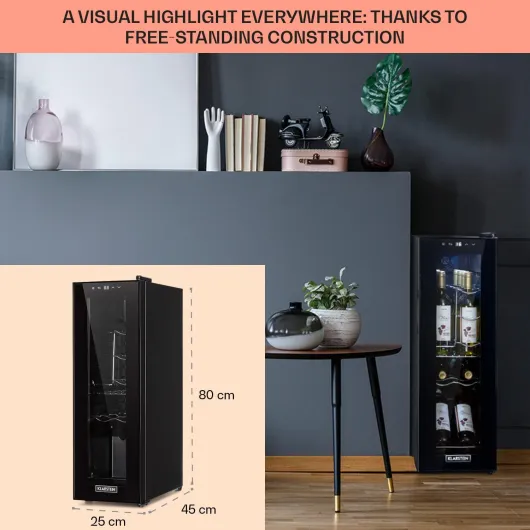
This is a 32L, 12‑bottle, single-zone compressor wine fridge. The size is 45 cm deep, 25 cm wide and 80 cm high, so it’s tall and narrow. That slim width is the main selling point: it slips into gaps where a normal under‑counter fridge just doesn’t fit. I put mine between a sideboard and a wall where I had about 30 cm to play with, and it slid in with a bit of room to spare.
Inside you get 3 glass shelves plus some vertical storage, and it’s advertised for 12 bottles. In practice, here’s what I could fit comfortably:
- 8–10 standard Bordeaux/Burgundy bottles with no effort
- 1–2 fatter prosecco/cava bottles if I rearranged things
- A few cans or small beers in the gaps if I wasn’t at full wine capacity
The control panel is very simple: two digital buttons to set the temperature, and a small LCD that shows the current temperature. You can set it between 5–18°C. I ran it mostly around 11–12°C for whites and fizz, and around 14–15°C when I had more reds inside. It’s single zone, so if you mix reds and whites you just have to pick a middle ground and live with it.
Day to day, it’s easy: you plug it in, set the temperature once and forget it. No water to add, no filters, no defrosting (it’s frost‑free). The only thing that might catch people off guard is the European 2‑pin plug. Mine came with an adapter, but like one Amazon reviewer said, the adapter makes it stick out from the wall more than I like. I ended up using a low‑profile adapter so the fridge sits closer to the socket. It’s a small thing, but worth knowing before you buy.
Pros
- Slim 25 cm width fits into tight spaces while still holding around 10–12 bottles
- Reliable cooling with simple digital temperature control between 5–18°C
- Glass door and interior light give it a decent look for a dining room or home bar
Cons
- Comes with a European plug and adapter, so it sticks out from the wall more than a standard UK plug
- Realistic capacity is closer to 10 bottles if you have larger or odd‑shaped bottles
- Customer service and returns can be painful if bought through some third‑party sellers
Conclusion
Editor's rating
The KLARSTEIN Shiraz 12‑bottle wine cooler is a practical, mid‑range option if you want a slim fridge to keep a small collection of wine and drinks at a steady temperature. It cools reliably, the noise level is low enough for most living spaces, and the glass door with interior light makes it look decent in a dining room or home bar. It’s not packed with features and it’s not a serious collector’s cabinet, but for everyday use it gets the basics right.
Where it falls short is in the details: the European plug + adapter is a bit lazy for the UK market, the 12‑bottle capacity is realistic only with mostly standard bottles, and customer service can be hit‑or‑miss if you buy through third‑party sellers. The temperature can drift by a degree or two, but for normal drinking that’s not a real problem. If you go in expecting a compact, no‑nonsense wine fridge with a decent look and you buy it from a seller with solid return support, it’s a good match.
If you’re a casual wine drinker with limited space who wants bottles ready at a sensible temperature and you care a bit about how the fridge looks, this is a good fit. If you need more capacity, ultra‑precise storage for expensive wines, or absolute silence in a bedroom, you should look at other options. Overall, I’d rate it as a solid, everyday wine cooler that does its job without being fancy.