Summary
Editor's rating
Value for money: who this makes sense for
Slim, discreet design that fits in tight spaces
Build quality and materials: decent but not premium
Durability and long-term use expectations
Cooling performance and noise in real life
What you actually get with the Barcool VINO12
How well it actually stores and organises 12 bottles
Pros
- Very slim footprint (25.8 cm wide), easy to fit in tight spaces
- Quiet operation (~41 dB), suitable for open‑plan rooms or living areas
- Simple digital temperature control with a practical 5–18°C range
- Low annual energy consumption (around 74–75 kWh/year)
- UV‑tempered glass door and internal LED lighting for visibility and basic protection
Cons
- Single-zone only, no separate temperatures for reds and whites
- Real‑world 12‑bottle capacity depends on using mostly standard-shaped bottles
- Wire shelves feel basic and less premium than wooden alternatives
- Door hinge is not reversible, which can limit placement in some layouts

Specifications
View full product page →| Brand | Barcool |
A compact wine fridge for people who don’t have a cellar
I’ve been using the Barcool VINO12 slim wine cooler for a few weeks, and I’ll be honest: I bought it mainly because I was sick of wine bottles hogging space in my normal fridge door. I don’t have a cellar, I don’t have a big utility room, so a small, tabletop wine fridge sounded like a decent compromise. The VINO12 caught my eye because it’s really narrow and supposedly quiet, which is important when it’s going in a living space and not hidden in a garage.
In day-to-day use, it feels like a pretty straightforward bit of kit. It cools bottles, it doesn’t make a racket, and it doesn’t look cheap from a distance. If you’re expecting some high-end sommelier-style machine with loads of zones and smart features, that’s not what this is. It’s more of a practical, plug‑it‑in-and-forget option for regular wine drinkers who just want bottles at the right temperature.
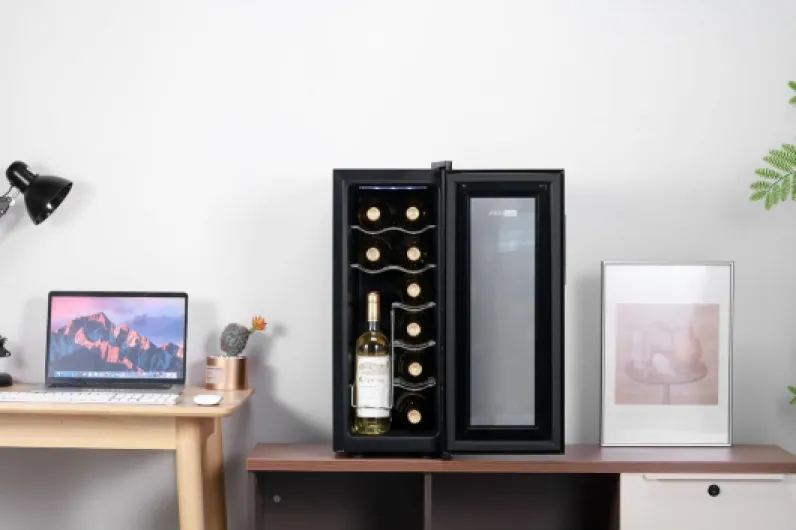
The main thing I noticed is how little space it actually takes. At roughly 25.8 cm wide and 50 cm deep, it slots into places where a normal undercounter fridge just wouldn’t fit. Mine is on a sideboard next to a coffee machine, and it doesn’t feel like it dominates the room. That was a big point for me, because I hate appliances that visually take over a small kitchen.
It’s not perfect though. The temperature range printed (5–18°C) is fine, but you’re not getting lab‑grade precision, and fitting 12 bottles inside is possible only if you’re mostly using standard 75 cl bottles. If you drink a lot of chunky Champagne bottles or oddly shaped ones, you’ll have to play Tetris a bit. Overall, it gets the job done, but there are a few things you should know before buying, which I’ll break down in the next sections.
Value for money: who this makes sense for
On value, I’d say the Barcool VINO12 sits in a good price-to-features balance for what it offers: slim footprint, quiet running, digital temperature control, UV‑tempered glass, and room for up to 12 bottles. It’s not the cheapest tiny fridge you can buy, but it’s also far from the pricey wine cabinets you see in high-end kitchens. For someone who drinks wine regularly and wants better storage than a random kitchen shelf or a too‑cold main fridge, it feels like a sensible investment rather than a luxury toy.
The relatively low annual energy consumption (around 74–75 kWh/year) also plays into the value side. It’s not going to hammer your electricity bill, which matters if you’re leaving it on 24/7 all year. If you break it down over a couple of years of use, the cost per month to own and run it is pretty reasonable, especially compared to what people happily spend on a few bottles of wine.
Where the value is slightly less strong is if you’re a serious wine collector or very picky about serving temperatures for different styles. There’s only one zone, the shelves are wire rather than wood, and the interior space is limited. If you’re thinking of expanding to 30–40 bottles in the future, you might be better off jumping straight to a bigger unit instead of buying this now and upgrading later. Also, if you mostly drink beer and soft drinks, a general mini fridge might give you more flexibility for a similar price.
For a typical user who wants a compact, quiet, decent-looking wine fridge that keeps a dozen bottles roughly at the right temperature without eating half the kitchen, the value is pretty good. It’s not a bargain basement steal, but it feels fairly priced for what it delivers: solid performance, small footprint, and low fuss. If you know you’ll use it regularly and you’re tight on space, it’s money reasonably well spent.
Slim, discreet design that fits in tight spaces
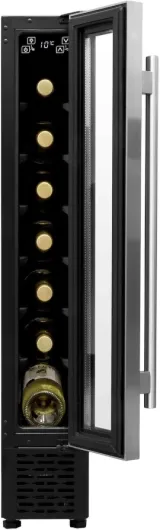
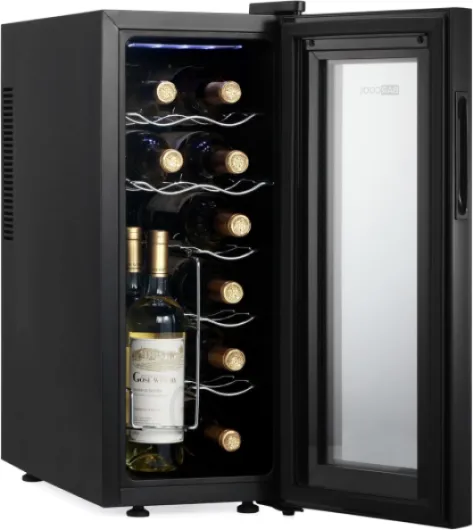
The main selling point for me is the slim design. At just 25.8 cm wide, it’s genuinely narrow. I slotted it next to a standard kitchen unit where nothing else would fit, and it looks like it belongs there. Height-wise (around 63.5 cm), it’s about the size of a small cabinet or a medium microwave stacked on something. That makes it usable on a countertop, on a sideboard, or even on the floor without it looking odd. The depth at 50 cm is similar to most kitchen counters, so it doesn’t stick out too much.
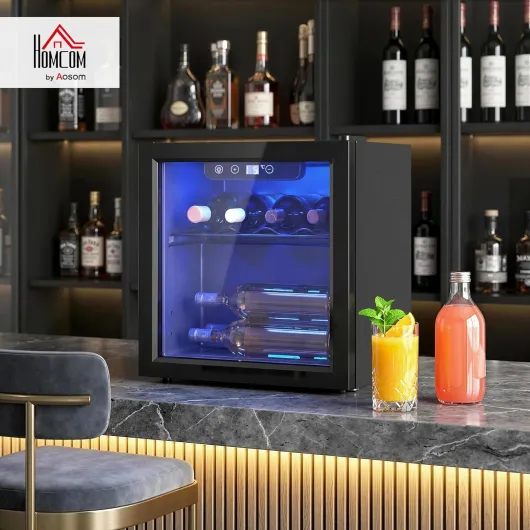
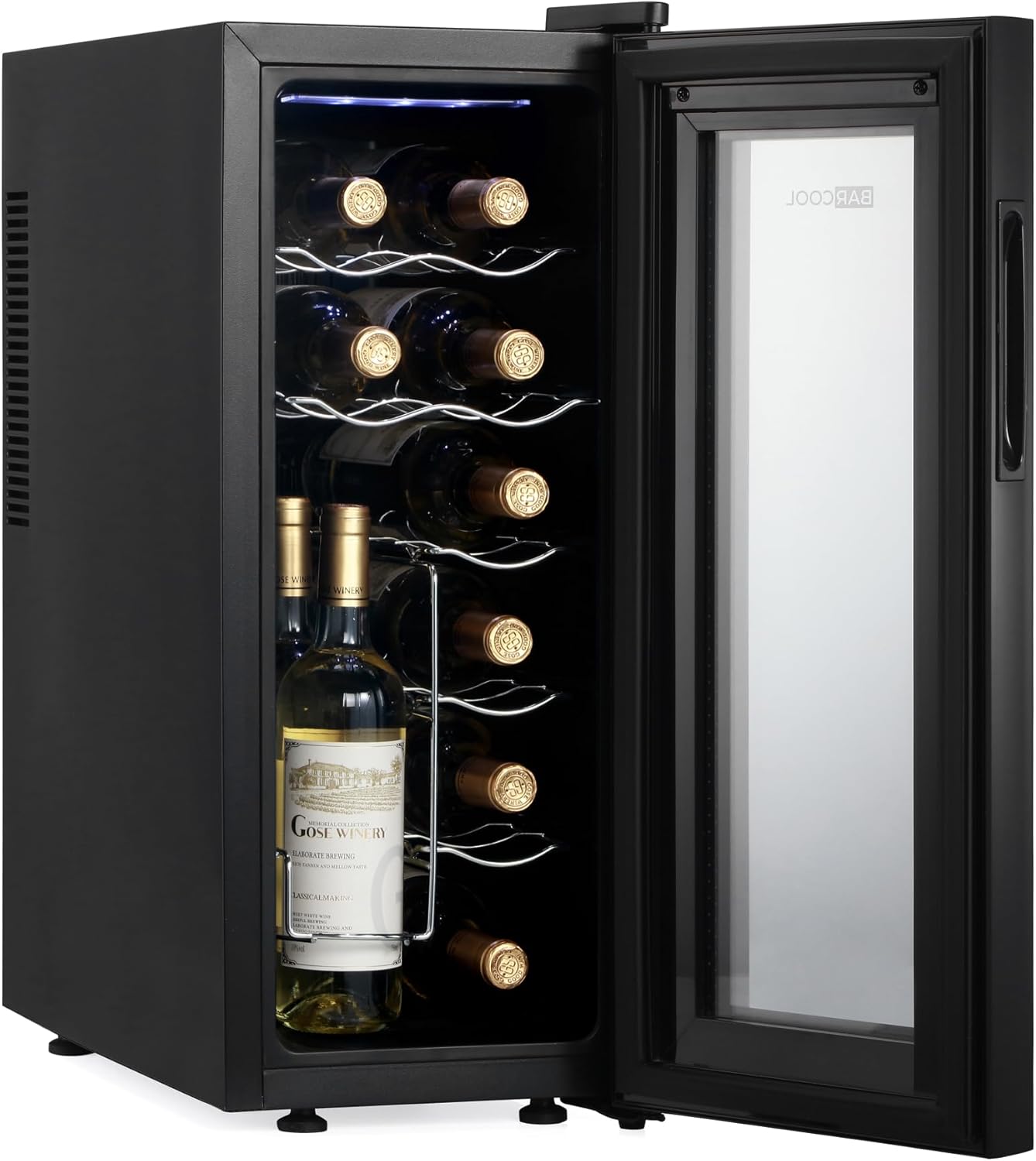
Visually, it’s pretty low-key: black matte body, mirrored glass door, and a small digital display. From a couple of metres away, it looks neat and modern enough. Up close, you can tell it’s not a premium piece of furniture, but it doesn’t scream “cheap plastic” either. The blue LED light inside is more of a mood thing than a necessity, but I’ll admit it looks nice when you’ve got guests and you leave it on. You can turn it off if you find it annoying.
The door is left-hinged and not reversible, which might bother some people depending on their layout. In my case, it worked fine, but if your only free spot is in a corner where a right-hand door would be better, that’s something to think about. The handle is integrated into the side of the door rather than being a separate bar, so there’s nothing sticking out to catch on clothes.
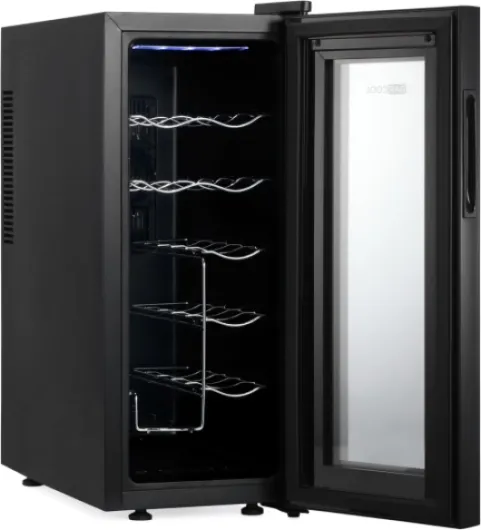
Inside, the layout is simple: four wire shelves that slide out, and room at the bottom if you want to stack or stand bottles. It’s designed for horizontal storage, but you can fiddle around if you have open bottles or bigger Champagne shapes. Overall, the design is practical and discreet. It’s not going to be the centrepiece of your room, but it blends in well, which is what I wanted. If you’re after a showpiece with wooden shelves and fancy trims, this isn’t it, but as a slim, functional unit, it does the job well.
Build quality and materials: decent but not premium
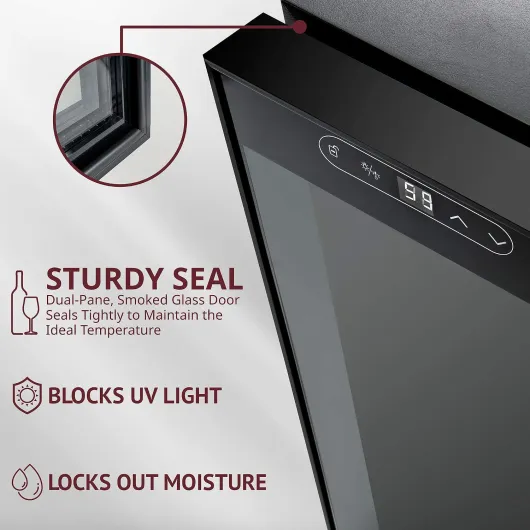
On materials, this is clearly built to a budget, but it doesn’t feel flimsy. The body is a standard painted metal shell in black with a matte finish. It doesn’t flex when you move it, and at around 15 kg it has enough weight to feel stable on a counter. The door is where most of the nicer touches are: dual‑glazed UV‑tempered glass with a mirrored effect. It looks good and should help a bit with insulation and protection from light, which is important if you keep it in a bright room.
Inside, the shelves are simple wire racks. They slide in and out easily enough, but they’re not heavy‑duty. If you’re loading it with a mix of heavier bottles (sparkling, big reds), I’d avoid yanking them out too roughly. That said, once the bottles are in, they hold them fine and don’t feel wobbly. You can remove shelves to fit larger bottles or stand one or two upright, which is handy for opened bottles with stoppers or slightly odd shapes.
The control panel and buttons feel okay but a bit “appliance‑grade” rather than anything fancy. The touch controls work reliably, but the plastic around the display doesn’t scream high-end. It’s functional, that’s it. The blue LED lighting inside looks decent and isn’t blinding, and you can switch it off if you prefer not to see it or if you’re worried about any extra light exposure (even though it’s quite soft).
Overall, the materials are fine for the price range. It’s not luxury furniture, but it doesn’t feel like a toy either. If you’re expecting wooden shelves, brushed metal handles, and thick insulation like on a high-end wine cabinet, you’re in the wrong bracket. For a small, freestanding, under‑£200‑type unit (prices move, but roughly that area), I’d say the build quality is acceptable and should hold up to normal home use if you don’t abuse it.
Durability and long-term use expectations
I haven’t owned it for years obviously, but based on a few weeks of use and the general build, I’d rate the durability as reasonable for a mid-range appliance. The door closes with a firm seal and doesn’t feel loose. The hinge action is smooth and doesn’t grind or feel cheap. The rubber seal around the door sits flat all the way around, so there’s no obvious air leak. These are small things, but they usually tell you whether a fridge will age badly or not.
The thermoelectric cooling system is generally simpler mechanically than a compressor, which can be a plus for durability (fewer moving parts), but it also means it depends a lot on proper ventilation. The back and sides need space to breathe. If you cram it into a tight cupboard with no airflow, you’ll stress the system and probably shorten its life. The manual makes this clear, and I’d say it’s worth respecting. I left a few centimetres around mine and haven’t noticed any overheating or odd noises.
The shelves and interior coating are basic but decent. The wire shelves might bend if you abuse them or overload them with heavy bottles in a weird way, but used normally they should be fine. The interior walls are easy to wipe down, and there’s no obvious area where dirt accumulates or feels fragile. The automatic defrost is handy, as you don’t end up with ice buildup, which can sometimes happen in cheap fridges.
The 2‑year manufacturer warranty is a good safety net and better than the bare minimum you get with some low-end brands. That doesn’t guarantee it will last forever, but at least you’re not completely on your own if something fails early. Based on the build and the way it runs so far, I’d expect it to last several years under normal home use. Just don’t treat it like a commercial unit or block the vents, and it should hold up reasonably well.
Cooling performance and noise in real life
On performance, I’d say the VINO12 is pretty solid for the size and price, as long as your expectations are realistic. It uses thermoelectric cooling, which is generally quieter but not as aggressive as a compressor. From room temperature (around 21–22°C), it took roughly a couple of hours to bring a full load of bottles down to around 8–9°C when I set it to 7°C. So don’t expect instant chilling if you throw in warm bottles right before a party. It’s more of a storage and steady‑chill device than a last‑minute blast chiller.
In terms of temperature stability, once it reaches the target, it holds it reasonably well. I checked with a simple fridge thermometer, and it was usually within 1–2 degrees of what I set on the panel, which for wine is absolutely fine. The 5–18°C range covers everything I need: I use 7–9°C for whites and fizz, around 11–12°C for rosé, and 14–16°C for reds. You obviously can’t have different zones for different wines at the same time, so you either compromise or group your bottles by type when you stock it.
Noise-wise, I was pleasantly surprised. The spec says about 41 dB, and subjectively it’s very quiet. There’s a soft hum when the cooling is active, but it’s way less intrusive than a normal fridge. Mine is in an open‑plan living/kitchen area, and I don’t notice it during normal conversation or while watching TV. If you’re very sensitive to noise and sit right next to it in a silent room, you’ll hear it, but it’s not the kind of constant buzzing that drives you mad.
One limitation: in very hot rooms, thermoelectric coolers generally struggle more than compressor ones. I haven’t tested it in a 30°C heatwave yet, but I wouldn’t expect it to keep things at 5°C in those conditions. For a normal UK/European indoor environment though, it performs well enough. In short, it cools reliably, it’s quiet, and it’s stable, but it’s not a power fridge for extreme conditions or massive temperature drops in record time.
What you actually get with the Barcool VINO12
Out of the box, the Barcool VINO12 is pretty simple: the fridge itself, four wire shelves, a small manual, and that’s about it. No fancy accessories, no app, no extras. It’s a 33‑litre, single‑zone wine fridge with a claimed capacity of up to 12 standard 75 cl bottles. The official dimensions are 50 cm deep, 25.8 cm wide, and 63.5 cm high, so think of it as a tall, slim rectangle rather than a squat mini fridge. It’s freestanding only, so you’re not building this into a cabinet.
The front has a UV‑tempered dual‑glazed glass door with a mirror effect and a simple handle integrated in the side. On the top section, you’ve got a small digital display and touch buttons to set the temperature, turn the light on/off, and that’s basically it. No Wi‑Fi, no app, no fancy modes. It runs on thermoelectric cooling, which usually means quieter operation but slightly slower cooling compared to proper compressor fridges, especially if the room is hot.
The manual claims a temperature range from 5°C to 18°C, which covers most typical wine needs: lower end for sparkling and whites, mid‑range for rosé, and higher for reds. In practice, I found it sits reasonably close to what you set, but you shouldn’t treat it like a lab fridge. It’s more than accurate enough for home use though. Inside, the four wire racks slide out and can be removed if you want to stand bottles upright or fit larger shapes.
In terms of position in the market, it’s basically a compact, budget‑friendly wine fridge aimed at people who care more about space and noise than advanced features. It has CE certification, automatic defrost, and a 2‑year manufacturer warranty, which is reassuring. But you’re not getting dual zones, wooden shelves, or anything fancy. It’s a simple appliance that promises low noise (around 41 dB) and low energy consumption (around 74–75 kWh per year), and that’s exactly how you should look at it: a practical storage and chilling box, not a luxury object.
How well it actually stores and organises 12 bottles
The big question: does it really hold 12 bottles in a practical way? The answer is yes, but with some conditions. If you mostly buy standard 75 cl bottles with normal shapes (typical supermarket wines), you can fit 12 of them without too much hassle using the four wire shelves plus the bottom area. Once you start adding bulkier Champagne bottles or fancy shaped bottles, you’ll need to shuffle shelves or accept that you’ll lose a slot or two.
On the top shelf, I managed to fit two typical sparkling wine bottles lying down without them feeling squeezed. The user reviews mention this and I had a similar experience. The stand section and lower shelves also accept slightly longer bottles, but you have to watch for labels catching on the shelf above when you slide them in and out. It’s not a big drama, but you do end up thinking a bit about how you arrange things rather than just chucking bottles in randomly.
For day-to-day use, I like to keep a mix: a couple of whites and rosés on the colder setting, plus a few reds that I prefer slightly cooler than room temperature. Since it’s a single-zone fridge, you have to pick a compromise temperature. I usually set it around 11–12°C and then just take reds out a bit earlier if I want them slightly warmer. It’s not perfect, but for a small household that doesn’t go through 10 different styles of wine at once, it’s workable.
In terms of practicality, the removable shelves are useful. If you host a dinner and want to chill a couple of tall bottles or even some beer bottles upright at the bottom, you can just remove one rack and adapt the space. So as a flexible, small drinks fridge, not just for wine, it works quite well. Just don’t take the “12 bottles” claim as a guarantee for any random bottle shape; it’s more like “up to 12 standard bottles” in real life.
Pros
- Very slim footprint (25.8 cm wide), easy to fit in tight spaces
- Quiet operation (~41 dB), suitable for open‑plan rooms or living areas
- Simple digital temperature control with a practical 5–18°C range
- Low annual energy consumption (around 74–75 kWh/year)
- UV‑tempered glass door and internal LED lighting for visibility and basic protection
Cons
- Single-zone only, no separate temperatures for reds and whites
- Real‑world 12‑bottle capacity depends on using mostly standard-shaped bottles
- Wire shelves feel basic and less premium than wooden alternatives
- Door hinge is not reversible, which can limit placement in some layouts
Conclusion
Editor's rating
The Barcool VINO12 is basically a no‑nonsense, slim wine fridge that does what most people actually need: it keeps up to 12 bottles cool, it doesn’t take much space, and it runs quietly in the background. The design is discreet, the mirrored glass door looks decent, and the digital temperature control is simple to use. Cooling performance is stable enough for everyday wine drinking, and the noise level is low enough for open‑plan spaces, which is a big plus.
It’s not aimed at hardcore collectors. There’s only one temperature zone, the shelves are simple wire racks, and the "12 bottle" capacity assumes mostly standard bottles. If you want dual zones, wooden shelves, or storage for dozens of bottles, this isn’t the right product. But if your reality is a small kitchen, a few bottles on rotation, and a desire to free up space in your main fridge, it fits that role well. The energy consumption is modest and the 2‑year warranty adds a bit of peace of mind.
So, who should buy it? People with limited space who want a neat place to keep wine at a reasonable temperature all year, and who care about low noise more than fancy features. Who should skip it? Serious collectors, anyone needing dual-zone control, or those planning to store a big, growing collection. For everyone else, it’s a solid, practical choice that gets the job done without trying to be more than it is.