Summary
Editor's rating
Is it worth the money for what it offers?
Looks good from the front, more functional everywhere else
Build quality and shelves: decent but not premium
How solid does it feel and what to expect long term
Cooling, temperature accuracy and day-to-day noise
What you actually get with the DH203
Pros
- Very slim 30 cm width fits into tight under-counter gaps
- Dual-zone cooling with independent temperature control from 5–22°C
- Looks clean and modern with glass door, LED light, and beech wood shelves
Cons
- Noticeably noisy when the compressor runs, especially in open-plan rooms
- Temperature display tends to be 1–2°C off, needs manual adjustment to hit target

Specifications
View full product page →| Brand | Dellonda |
A narrow wine cooler for tight kitchens
I picked up the Dellonda Baridi DH203 because I only had a 30 cm gap left in my kitchen and I wanted somewhere to keep a few bottles of white and red at decent drinking temperature. Most wine fridges are 40 cm or 60 cm wide, so this one stood out simply because it would actually fit. I’m not a collector with hundreds of bottles, I just wanted something practical that looked decent under the counter and didn’t cost a fortune.
After a few weeks of use, my main takeaway is pretty clear: it’s all about the size and the dual zone. If you need something narrow and you like having red and white at different temperatures, it does the job. If you’re sensitive to noise or you were hoping for something almost silent, you might be a bit disappointed, especially in an open-plan room where you sit close to it.
In day-to-day use, it behaves more like a small fridge that’s sometimes a bit loud than a quiet wine cellar you forget about. It cools properly, the bottles are actually cold, and the temperature doesn’t seem to swing wildly once it has stabilised. But you do hear it when the compressor kicks in, and that lines up with what several other buyers mentioned. It’s not unbearable, just not discreet.
Overall, my feeling is: practical, not perfect. It looks good enough in a modern kitchen, the touch controls are simple, and the price is fairly reasonable for a dual-zone built-under unit. On the other hand, the noise level and the slightly optimistic bottle capacity mean you should go in with realistic expectations. If you treat it as a compact cooler rather than a high-end wine cabinet, you’ll probably be satisfied.
Is it worth the money for what it offers?
On the value side, I’d say the DH203 is good but not mind-blowing. Its biggest selling point is the 30 cm width combined with dual zones. If you need those two things together, there really aren’t many alternatives, and that alone makes it attractive. In that context, the price feels reasonable: you’re paying for a specific format and the ability to keep reds and whites at different temperatures in a tight space.
If you compare purely on capacity and features to a wider 60 cm wine cooler at a similar or slightly higher price, then it looks less impressive. For the same money, you could often get more bottles and sometimes better noise performance with a bigger unit. So if space isn’t an issue in your kitchen, I’d honestly look at something wider that runs quieter and holds more. This one is clearly aimed at people who are limited by a narrow gap in their cabinets.
In daily use, you do feel that it’s decent value for money when you focus on the basics: it cools well, looks decent, the dual zone works, and the running costs are acceptable for a small appliance. The main thing that drags its perceived value down a bit is the noise. When you spend this kind of money on a dedicated wine cooler, you kind of hope it will fade into the background, and this one doesn’t completely do that. It’s not outrageously loud, but it’s not whisper-quiet either.
So for me, the conclusion on value is pretty simple: if you specifically need a narrow, built-under, dual-zone cooler, this is a solid option and the price makes sense. If your space is flexible, you can probably get something quieter or more spacious for similar money. It’s good value in its niche, average value if you compare it to the whole wine cooler market without the size constraint.
Looks good from the front, more functional everywhere else
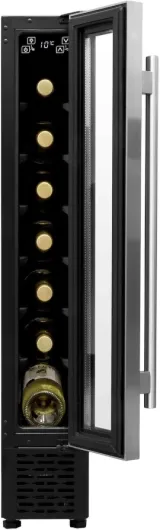
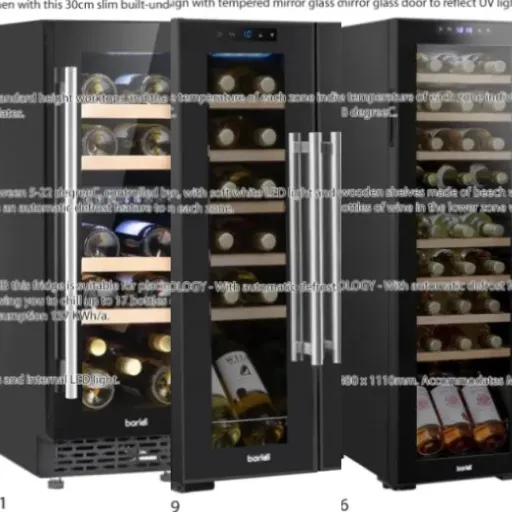
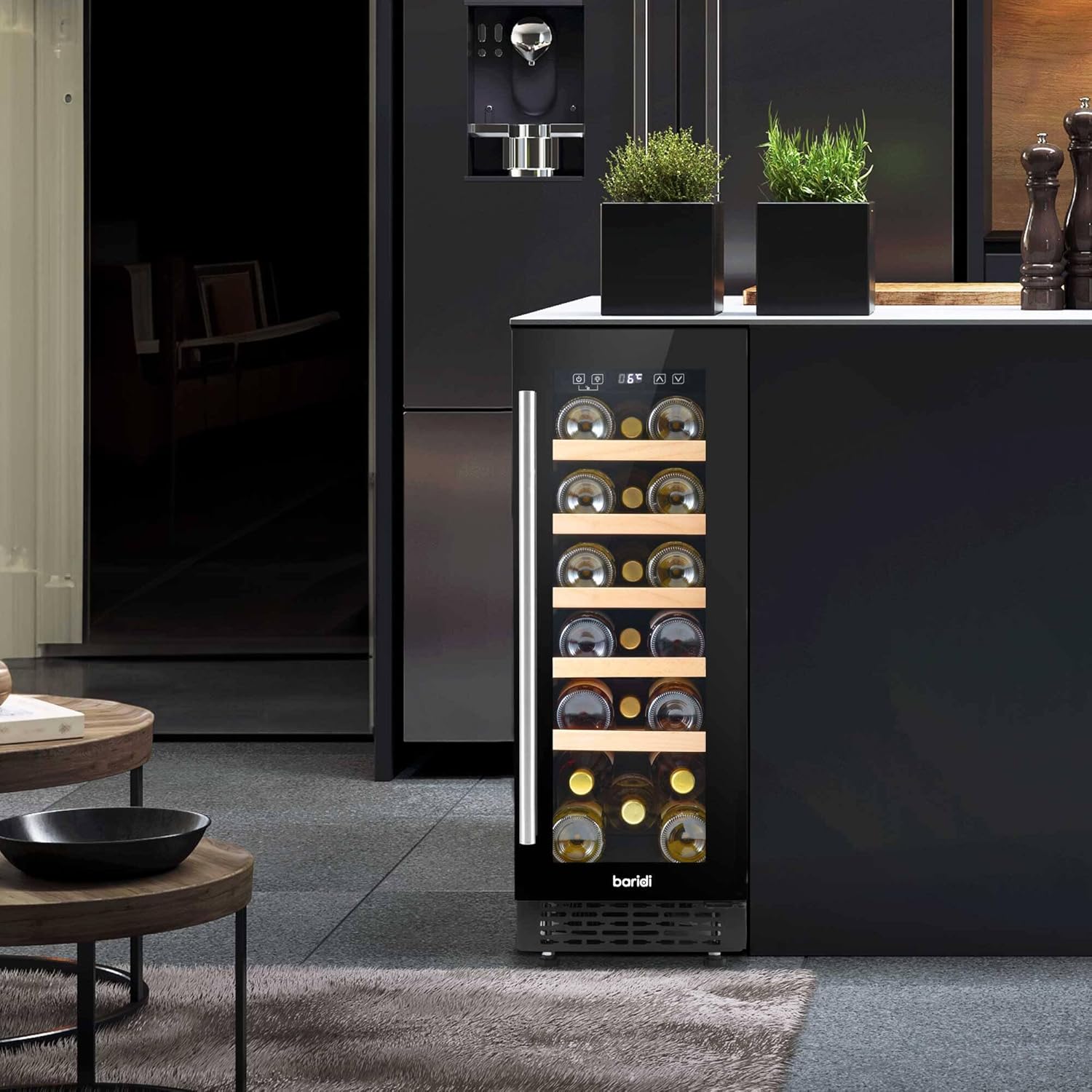
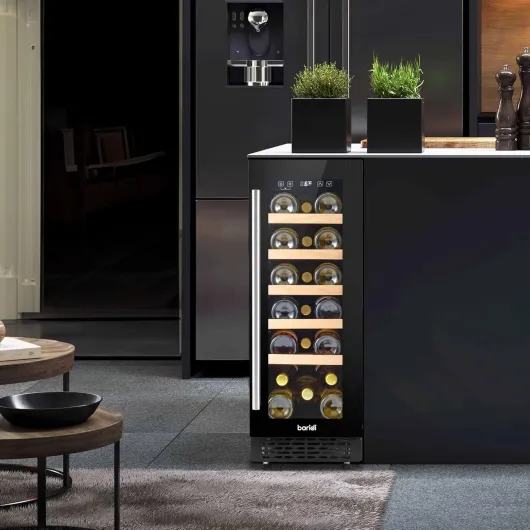
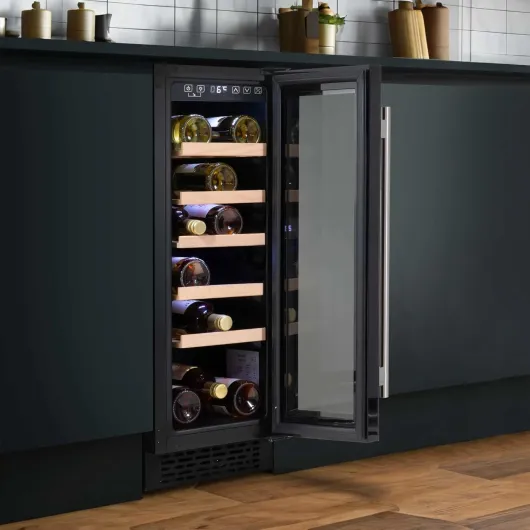
Visually, the DH203 is pretty straightforward: black body, glass door, and a clean front. Once it’s built under the counter, what you mainly see is the glass door and the handle area, and that part does look good. With the internal LED light on, the bottles are nicely visible and it gives a tidy, slightly premium feel, especially in the evening. It’s not luxury-level, but for this price range, it looks modern and doesn’t clash with most kitchens.
The cooler is only 30 cm wide, and that’s honestly its main design strength. In my case, I had a narrow gap between cupboards, and this slid in without any weird DIY. It also fits nicely under a standard worktop with the door sitting just above the kickboard, as advertised. That detail is actually quite handy, because you don’t end up with a door that scrapes or looks out of place compared to neighbouring units. The depth is typical fridge depth, so it lines up with standard counters pretty well.
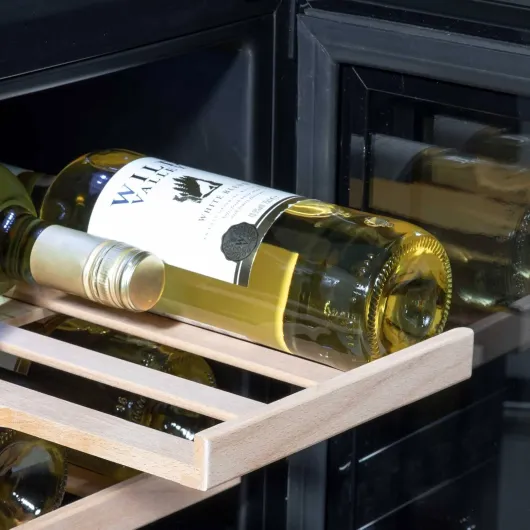
Inside, the layout is simple: a few beech wood shelves that slide out enough to grab bottles, plus space at the bottom. The shelves are not heavy-duty drawer slides; they’re more like basic runners, so they move but not super smoothly when fully loaded. For normal use (taking a bottle now and then), it’s fine. If you’re opening and closing it constantly, you’ll notice the slightly cheap feel of the mechanics. The LED light is bright enough to see what you’re doing, but not blinding.
One thing I liked is that the front glass with the black frame hides fingerprints reasonably well. You’ll still want to wipe it sometimes, but it doesn’t instantly look dirty like some stainless-steel doors. On the flip side, the sides and top are just standard black appliance metal, so if you plan to have it free-standing and very visible, it looks more like a normal fridge than a design object. Built-in: looks good. Free-standing in the middle of the room: more average.
Build quality and shelves: decent but not premium
On the materials front, the DH203 sits in the middle: better than really cheap stuff, but you can feel where they saved money. The outer shell is standard appliance metal, nothing fancy, but it feels sturdy enough when you move it. The glass door has a good weight to it, and the hinge feels solid; it doesn’t wobble or sag when you open it fully, even with bottles on the door side adding weight. The seal around the door closes properly and doesn’t feel flimsy.
The shelves are probably the part where you most clearly see the price point. They’re made of beech wood, which looks nice and warmer than metal racks, but they’re quite thin. They hold the weight of fully loaded rows without bending, so structurally they’re okay, but the sliding action is a bit rough. There are no ball-bearing rails; it’s just wood-on-runner. So when you pull out a shelf with 4–5 bottles, you feel a bit of friction and sometimes a small jerk as it comes out. Not a safety issue, just not very smooth or luxurious.
Inside, the plastic trim and interior walls are basic but clean. No weird smells out of the box beyond the usual new-appliance scent that disappears after a couple of days. The LED light is integrated at the top and doesn’t feel like it’s about to fall off or anything. The internal layout is simple: a few shelf levels and some space at the bottom for bigger bottles or stacking. You’re not getting adjustable fancy racks or special holders for magnums here.
Overall, I’d say the materials are perfectly acceptable for a mid-range wine cooler. Nothing screams cheap, but nothing feels particularly high-end either. If you open it every single day and shuffle bottles constantly, you’ll notice the limitations of the shelf system. If you mostly use it to store a small rotation of bottles and only open it occasionally, it’s more than fine. You get the visual bonus of wood shelves without paying for real premium hardware behind them.
How solid does it feel and what to expect long term
I haven’t had the DH203 for years obviously, but after a few weeks of living with it and looking at how it’s built, I can give a realistic idea of what to expect. The general structure feels solid enough. The door closes with a consistent resistance, the hinges don’t flex, and the cabinet doesn’t twist when you nudge it into place. At around 31.6 kg empty, it has enough weight that it doesn’t feel flimsy, but you can still handle it with two people without breaking your back.
The parts that worry me a bit more long-term are the shelves and the touch controls. As mentioned earlier, the beech shelves are on basic runners, and if someone in your household is heavy-handed, I can easily see them getting a bit worn or misaligned over time. They’re fine if you pull them straight, but if you yank on one side, they can catch slightly. It’s not a design disaster, just something where I wouldn’t expect 10+ years of smooth operation like on a really high-end unit.
The digital control panel on the front is simple and works fine so far. The touch buttons respond reliably, and the display is bright enough to read even in daylight. But like with most touch panels, if something electronic is going to fail in five years, it will probably be that. There’s no physical knob backup, so if the electronics go, you’re stuck. That’s pretty standard for this type of appliance though, not unique to this brand.
In terms of the compressor and cooling system, there’s nothing unusual here: it’s a standard compressor-based cooler. If you give it decent ventilation space around the back and don’t box it in too tight, it should last a normal length of time. I wouldn’t abuse it by constantly loading it with warm bottles every day, because that means more cycles and more stress on the system. Overall, my expectation is: it should last several years with normal use, but don’t expect bulletproof restaurant-grade durability. For the price and category, that’s fair enough.
Cooling, temperature accuracy and day-to-day noise
In terms of performance, the DH203 does the main job: it cools the bottles to roughly what you set, and it doesn’t struggle to keep them cold once it’s settled. When I first installed it, it took a few hours to pull down to the target temperatures, which is normal. After that, both zones stayed fairly stable. However, just like one Amazon reviewer mentioned, I also noticed you need to set the temperature a couple of degrees off to get what you really want inside the bottle.
For example, when I wanted whites at around 8°C, I had to set the upper zone to 6°C. With a simple fridge thermometer placed on the middle shelf, the reading was usually 2 degrees higher than the display. Same thing for the reds: if I wanted 14°C inside, I set the lower zone to 16°C. It’s not a disaster, but the display is a bit optimistic. Once you know that, you just adjust and forget about it. If you’re picky about serving temperatures, definitely use a cheap thermometer at the beginning to calibrate your expectations.
On the noise side, it matches what multiple buyers said: it’s not very quiet when the compressor kicks in. I wouldn’t call it outrageously loud, but in an open-plan living room/kitchen, you will hear it if the TV is off or if you’re sitting nearby. With normal background noise or the TV on, it fades into the background. Compared to my main fridge-freezer, I’d say the tone of the noise is a bit sharper, so you notice it more, even if the volume is similar. It’s not a constant roar, more like cycles of humming and a bit of vibration.
Once the cooler reaches its temperatures, the cycles are less frequent, and it’s calmer. But if you load it with a lot of room-temperature bottles at once, expect it to work harder and be more present sound-wise for a few hours. There’s no fancy inverter or soft-start system here; it’s a basic compressor. So from a performance point of view: cooling is solid for the size and price, precision is okay once adjusted, noise is the main compromise.
What you actually get with the DH203
On paper, the Dellonda Baridi DH203 is a 30 cm wide, dual-zone wine cooler that can take up to around 17–20 standard bottles, depending how you arrange them. The manufacturer talks about 20 bottles, but in practice if you have a lot of chunky champagne bottles or odd shapes, you won’t hit the full number. For normal Bordeaux-style bottles, it’s close, but you do need to play Tetris a bit. Dimensions are roughly 57 cm deep, 30 cm wide, and 82 cm high, so it fits under standard worktops without having to butcher your kitchen units.
The dual zone means the upper and lower compartments can be set between 5–22°C independently. So you can do whites and rosés around 6–9°C on top, and reds around 12–16°C at the bottom, for example. The controls are a simple digital touchscreen on the front, and there’s an internal LED light that gives a soft glow. It’s not a fancy app-connected product, just a straightforward control panel with up/down buttons and zone selectors.
Energy-wise, it’s listed at about 137 kWh per year. That’s not ultra-frugal but for a small dedicated cooler that runs all the time, it’s acceptable. Weight is just over 31 kg, so you can move it with two people fairly easily, but it’s not something you want to drag around alone, especially when it’s full. Noise rating is given as 41 dB, which sounds low on paper, but in real life it’s a bit more noticeable than the number suggests, especially in a quiet room.
In short, the spec sheet matches what I experienced: compact footprint, separate top/bottom temperatures, decent capacity for a small collection, and a basic but usable interface. No fancy features, no Wi‑Fi, no smart nonsense. It’s just a narrow cooler that tries to maximise space and flexibility. If that’s what you’re after, it’s aligned with the description. Just don’t expect miracles in terms of noise and precision straight out of the box without a bit of trial and error on the temperature settings.
Pros
- Very slim 30 cm width fits into tight under-counter gaps
- Dual-zone cooling with independent temperature control from 5–22°C
- Looks clean and modern with glass door, LED light, and beech wood shelves
Cons
- Noticeably noisy when the compressor runs, especially in open-plan rooms
- Temperature display tends to be 1–2°C off, needs manual adjustment to hit target
Conclusion
Editor's rating
The Dellonda Baridi DH203 is a practical choice if your kitchen layout forces you into a 30 cm-wide gap and you still want separate temperatures for reds and whites. It looks tidy built under a counter, the glass door and LED light give it a clean modern look, and the dual-zone setup does exactly what it’s supposed to do once you’ve learned to set it a couple of degrees off from your target. Cooling performance is solid for its size, and the internal layout works fine for a small rotation of bottles, even if the advertised maximum capacity is a bit optimistic in real life.
The main downside is noise. The 41 dB spec doesn’t tell the full story: when the compressor kicks in, you hear it, especially in a quiet open-plan room. It’s not unbearable, but if you’re very sensitive to sound or you wanted something almost silent next to your sofa, this isn’t it. The shelves and materials are decent but clearly mid-range, and long-term I’d treat it as a solid household appliance, not a lifetime investment piece. It gets the job done without feeling cheap, but it doesn’t feel luxury either.
In short, this cooler makes sense for people who have limited space, care about having reds and whites at different temperatures, and can live with some background hum. If you’ve got more room and noise is a big concern, you should probably look at wider or higher-end models. If your priority is squeezing a functional dual-zone wine fridge into a narrow gap at a fair price, this one is a pretty solid bet.