Summary
Editor's rating
Value for money: solid for what it does, with a few compromises
Design: compact, black box with a glass door – looks decent on a counter
Build quality and materials: decent for the price, not luxury
Durability and daily use: feels robust, but time will tell
Performance: actually cold, fairly stable, and not too loud
What you actually get with the Viva20
Pros
- Genuinely reaches and maintains low temperatures (around 3–4°C) for properly cold drinks
- Compact footprint with glass door and LED light that looks good on a countertop
- Reasonable energy consumption and noise level for a compressor-based mini fridge
Cons
- Real-world capacity is lower than the advertised 20 bottles when mixing different bottle shapes
- Single-zone only, so no separate temperature for reds and whites
- Some condensation can appear at the bottom of the glass door in certain conditions

Specifications
View full product page →| Brand | Subcold |
A small wine fridge that actually gets down to 3°C
I’ve been using the Subcold Viva20 LED as a beer and wine fridge in the kitchen for a few weeks, and I’ll be straight: it’s not perfect, but it does the basic job well. I bought it mainly to free up space in my main fridge and to have drinks properly cold for evenings and weekends. No fancy expectations, just something that cools fast, stays at the set temperature, and doesn’t sound like a tractor.
The first thing I noticed after plugging it in is that the compressor kicks in fairly quickly and the temperature drops in a reasonable time. I set it to 4°C for beers at the start, and after a couple of hours it was already much colder than the overfilled main fridge. Over a few days, the temperature stayed pretty stable according to a cheap thermometer I stuck inside, with minor variations when I opened the door a lot.
Noise-wise, it’s not dead silent, but it’s not annoying either. In an open-plan kitchen/living space, you can hear a low hum when the compressor runs, but it’s more of a background sound than anything that will drive you mad. If you’re super sensitive to noise and want total silence, you might notice it. For normal use in a kitchen, it’s fine.
Overall, my first impression is that it’s a fairly practical little unit: compact, genuinely cold, simple controls. It looks decent on a countertop and doesn’t feel cheap to the touch. There are a couple of small annoyances like bottle layout and a bit of condensation, but nothing dramatic. If you just want a small drinks fridge that works without too much fuss, this one gets the job done.
Value for money: solid for what it does, with a few compromises
In terms of price, the Subcold Viva20 usually sits in the mid-range for mini wine fridges. It’s not the cheapest basic cooler out there, but it’s also far from the high-end units. For the money, you get a compressor-based fridge that can actually reach 3°C, a glass door, LED light, adjustable shelves, and a lock. When you compare it to cheaper thermoelectric coolers that struggle to go more than 10–12°C below room temperature, this one is clearly more capable if you want genuinely cold drinks.
The energy consumption of around 132–133 kWh/year is reasonable, so it shouldn’t destroy your electricity bill, especially if you keep it in a cooler room and don’t open it constantly. For what it offers, I’d call the running cost acceptable. Some mini fridges are more efficient, but they also often have smaller capacities or weaker cooling. Here, you get a good balance between size, power, and consumption.
On the downside, there are a few trade-offs. The 20-bottle capacity is a bit optimistic once you start mixing bottle types, so if you really need to store exactly 20 wine bottles of different shapes, you might get frustrated with the layout. The single-zone design also limits you if you’re serious about storing reds and whites at different temps. And there’s that minor condensation issue at the bottom of the door in some conditions, which doesn’t break the deal but is a small annoyance.
Overall, for someone who wants a compact drinks fridge that looks decent, cools properly, and doesn’t cost a fortune, the Viva20 offers good value for money. It’s not the best on the market, but at this price, it’s pretty solid. If you want fancy features, dual zones, or a totally silent unit, you’ll have to pay quite a bit more. If your goal is just to keep beer, wine, and soft drinks cold and free up your main fridge, this one is a sensible choice.
Design: compact, black box with a glass door – looks decent on a counter
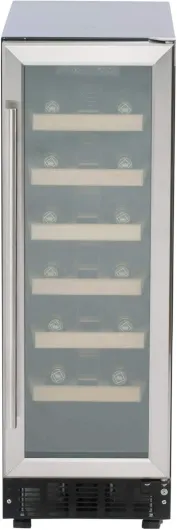
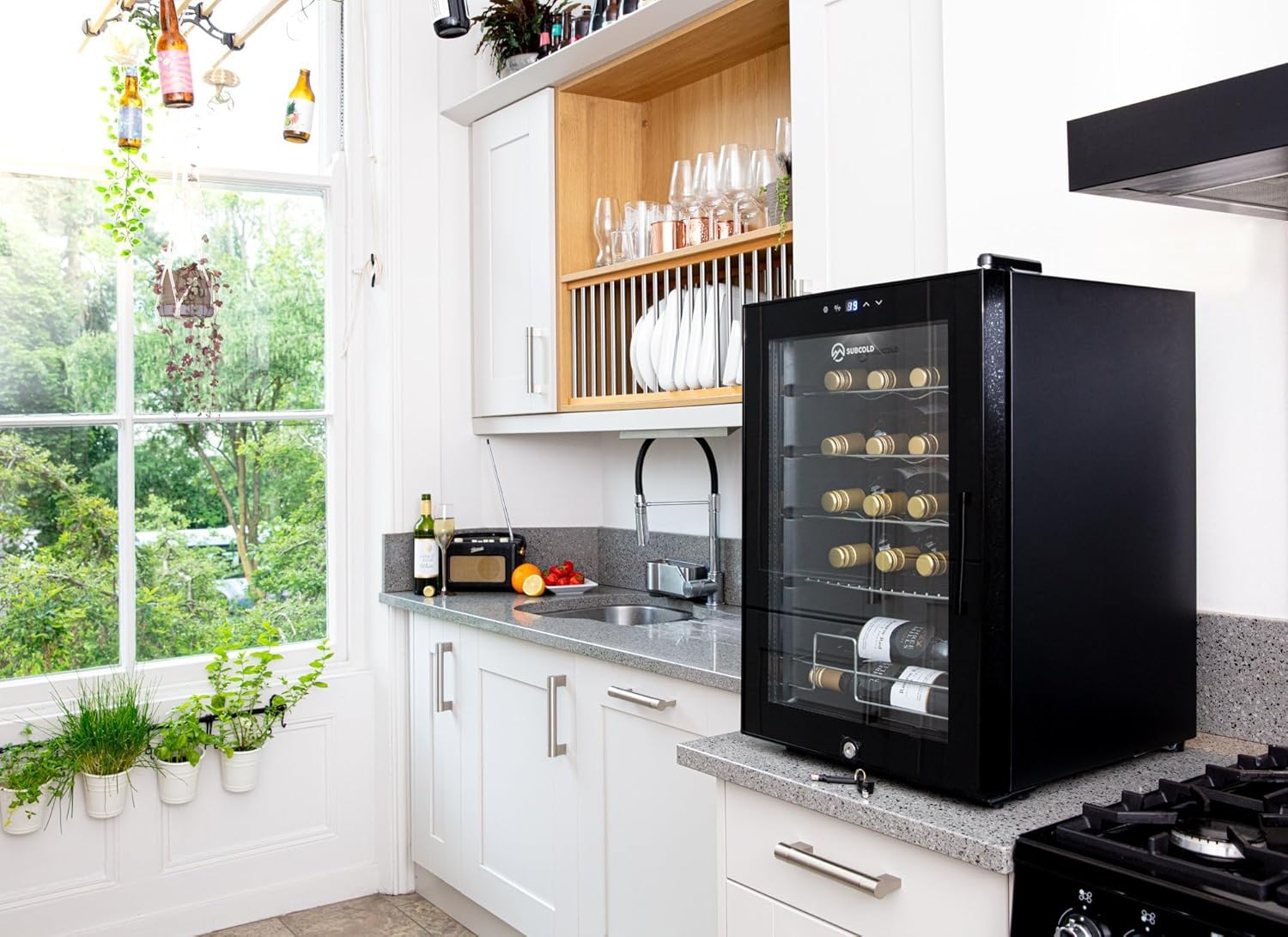
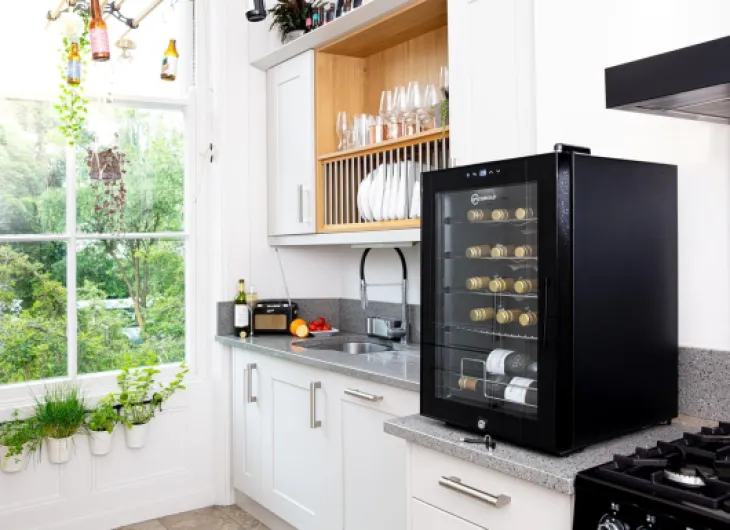
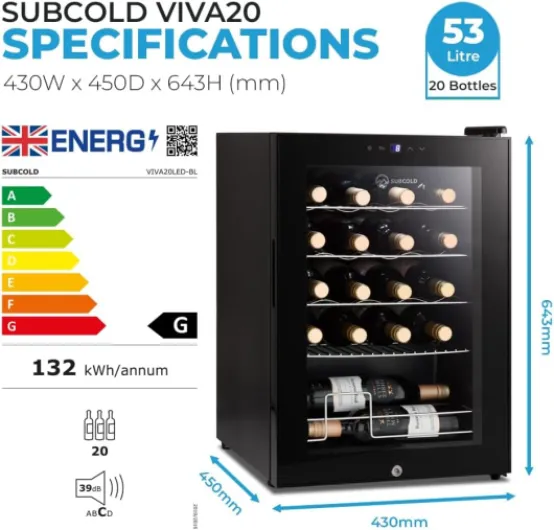
Design-wise, the Viva20 is pretty straightforward: a black matte cabinet with a frameless-style glass door. Dimensions are roughly 43 cm wide, 45 cm deep, and 63.8 cm high, so it’s small enough to sit on a countertop or under an island, but it’s not tiny. You need to measure your space properly; it’s heavier and bulkier than it looks in photos. I put it on top of a sturdy chest of drawers, like one of the reviewers mentioned, and I wouldn’t put it on anything flimsy – it weighs around 18 kg empty.
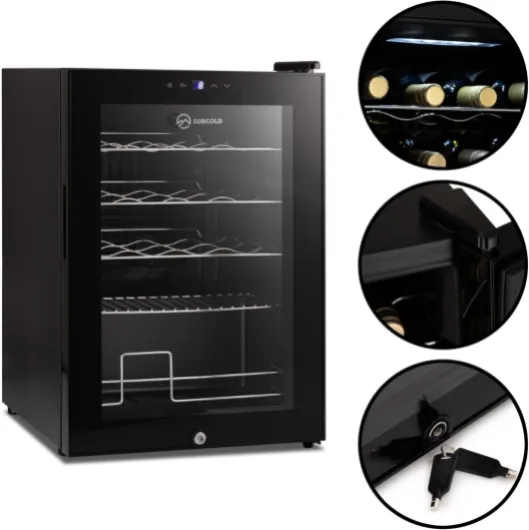
The glass door gives it a cleaner look than a solid mini fridge. With the internal LED on, the bottles are visible and it actually looks quite neat, especially in the evening. The glass is dual-glazed and slightly tinted, which is good for insulation and also hides fingerprints a bit. You’ll still see smudges, but not as badly as on a mirror finish door. The handle is integrated into the side of the door frame, so there’s nothing sticking out to catch on clothes or bags.
Inside, the layout is simple: four chrome wire shelves that you can slide out or remove. They feel reasonably sturdy, but they’re still wire racks, so narrow bottle bases can wobble a bit if you’re not careful. You can adjust the height by moving them between pre-set slots, but there’s not infinite flexibility – you basically choose between wine-focused stacking or more open spacing for mixed drinks and cans.
One small design detail I noticed: the LED light placement is at the top inside, so it lights the upper shelves more than the bottom. If you pack it full, the bottom row looks a bit darker. Not a big deal, but worth mentioning. Also, the door opens to the right and is not reversible, so if your space needs a left-hinged door, this model won’t help. Overall, the design is pretty solid: not flashy, not cheap-looking, just a compact black box that blends nicely into a kitchen or home bar.
Build quality and materials: decent for the price, not luxury
The cabinet is made from a high-density foam injection body with a metal outer shell, and it feels solid when you tap it. It doesn’t flex or feel flimsy. The finish is a matte black, which hides small scratches and dust better than glossy surfaces. Around the door, you’ve got a dual-glazed safety glass panel that feels thicker than cheap single-pane glass you see on some bargain coolers. The door closes with a firm pull, and the seal seems to sit properly all the way around.
The wire shelves are chrome-coated metal. They’re not luxury, but they’re okay. If you overload one with heavy bottles in the middle, you can see a slight bend, but nothing dramatic. For normal use with 4–5 bottles per shelf, they hold up fine. You can slide them out to rearrange bottles, though they’re not on rails, so it’s more of a pull-and-lift movement. Over time, with moisture, chrome shelves on any fridge can get small rust spots if scratched, so it’s something I’d keep an eye on, but out of the box they look clean and sturdy enough.
Inside, the plastic walls are basic white, easy to wipe down. There’s no fancy moulded bottle holders or anything, just a simple rectangular space with shelf slots. This makes it more flexible if you want to store odd shapes, but it also means bottles can roll a bit if you’re rough when loading. The internal LED light is a small strip that doesn’t heat up, so no issue there. The lock and key system is basic – more to stop kids from randomly opening it or to stop casual access if you’ve got it in a shared space. It’s not a high-security lock, more of a deterrent.
Overall, the materials feel in line with the price bracket: solid enough, not premium. The door glass and the general sturdiness of the cabinet are the strong points. The shelves and interior are more functional than fancy. If you’re expecting heavy-duty stainless steel and premium finishes, this isn’t it. But for a countertop drinks fridge used at home, the build quality feels acceptable and should hold up if you don’t abuse it.
Durability and daily use: feels robust, but time will tell
I haven’t had this fridge for years, so I can’t pretend I know exactly how it will age, but after a few weeks of regular use, nothing suggests it’s fragile. The door hinge feels solid, with no wobble when fully open, and it doesn’t sag under the weight of a loaded door because the bottles sit on shelves, not the door. Opening and closing several times a day, the seal is still tight and doesn’t show any early signs of wear.
The compressor is a rotary scroll type with R-600A refrigerant, which is pretty standard nowadays for small efficient fridges. No weird rattling, no sudden loud start-ups so far. The unit has a frost-free system, so you don’t get heavy icing on the back wall, which is good for long-term performance. I haven’t had to defrost anything manually, and the inside stays dry enough apart from minor condensation on the glass door in certain conditions.
One potential weak point on these types of fridges is usually the shelves and their supports. On the Viva20, the metal rails inside the cabinet where the shelves rest are moulded into the side walls. They don’t look like they’ll snap easily unless you really overload them or bang them around. I’ve shuffled shelves up and down a few times to test configurations, and nothing bent or broke. Just don’t expect to store heavy cast-iron pots in there – it’s made for bottles and cans.
There’s also the 1-year warranty, which is pretty standard. It’s not super generous, but at least there is some coverage if the compressor or electronics fail early. Given the number of positive long-term Amazon reviews (some people mention having it for months without issues), it doesn’t look like a model that dies immediately. Still, I’d treat it as a home appliance you use normally, not something you drag around or move every week. For a fixed spot in a kitchen, home bar, or office, it feels durable enough for the price range.
Performance: actually cold, fairly stable, and not too loud
On performance, this fridge does what it says: it gets cold and stays cold. I ran it mostly between 3°C and 6°C depending on whether I was focusing on beer or wine. With a small thermometer inside, I saw that it usually stayed within about 1–2 degrees of the set point, which is fine for home use. If you load it up with room-temperature bottles all at once, it takes a couple of hours to pull everything down to target temperature, but that’s normal for this size and power.
For beer and soft drinks, I’d say 3–4°C feels properly chilled, much colder than my main fridge when it’s overloaded. For red wine, you just bump it up to around 12–14°C and it holds that reasonably well too. Keep in mind it’s a single-zone unit, so you can’t keep reds and whites at different temperatures at the same time. If you want that kind of setup, you need a dual-zone model, which usually costs more and takes more space.
Noise-wise, the spec says 39 dB, and that lines up with my impression. When the compressor is off, it’s basically silent. When it kicks in, you hear a low hum and a faint vibration, but it’s not aggressive. In a quiet room at night, you’ll notice it if you’re sitting nearby, but it’s not the kind of noise that keeps you awake in another room. One Amazon reviewer did say it’s “a little noisy but not unbearable,” and I’d agree with that. It’s fine for a kitchen, hallway, or home bar corner. For a bedroom, I’d probably skip it.
I did notice a bit of condensation at the bottom of the door on more humid days, which another reviewer also mentioned. It’s not puddling water on the floor, but you’ll sometimes see a slight fogging or small droplets near the lower edge. Wiping it now and then solves it, but it shows that it’s still a glass-door fridge in a normal home, not a fully sealed cellar room. In short: cooling performance is pretty solid, temperature is stable enough, and the noise level is acceptable for most home setups.
What you actually get with the Viva20
The Subcold Viva20 is basically a compact, single-zone tabletop fridge with a glass door. Capacity is advertised as 20 bottles / 57L, but that’s based on standard 750 ml wine bottles. In real life, if you mix wine, prosecco, beer bottles and cans, the layout becomes more like a puzzle. It comes with 4 removable chrome wire shelves, a glass front door, an internal LED light, and a small lock with two keys. Temperature range is 3–18°C with a digital control on the front.
In practice, the 20-bottle claim is realistic only if you stick to regular Bordeaux-type bottles and follow the standard stacking pattern. If you have a lot of chunky champagne bottles or craft beer bottles with odd shapes, you’ll lose some capacity and need to remove or move shelves. I ended up running it with three shelves instead of four to fit taller bottles and a couple of 1.5L water bottles at the bottom. For mixed drinks, I’d say it’s more like 14–16 wine bottles plus some cans, not a full 20.
The controls are basic but clear. There’s a small digital display and up/down buttons to set the temperature. No Wi‑Fi, no app, no fancy modes – which honestly I prefer. You turn it on, pick a temperature, and it just runs. The internal LED light is white and bright enough to see everything, but not so strong that it lights up the whole room at night. You can leave it on or off depending on your preference.
On paper, the energy consumption is around 132–133 kWh/year, which is decent for a compressor-based mini fridge of this size. I don’t have exact meter readings just for this unit, but on a smart plug it didn’t spike like crazy, even in warmer days. For a secondary fridge, it feels reasonable. Overall, the presentation is simple: no gimmicks, basic features, and it focuses on cooling performance more than anything else.
Pros
- Genuinely reaches and maintains low temperatures (around 3–4°C) for properly cold drinks
- Compact footprint with glass door and LED light that looks good on a countertop
- Reasonable energy consumption and noise level for a compressor-based mini fridge
Cons
- Real-world capacity is lower than the advertised 20 bottles when mixing different bottle shapes
- Single-zone only, so no separate temperature for reds and whites
- Some condensation can appear at the bottom of the glass door in certain conditions
Conclusion
Editor's rating
The Subcold Viva20 LED is a straightforward, compact wine and drinks fridge that does its main job properly: it cools quickly, holds a stable temperature between 3–18°C, and fits nicely on a countertop or under an island. The glass door and LED light give it a clean look, and the noise level is low enough for most kitchens or home bars. It’s not totally silent, but it’s far from loud. Build quality is decent for the price, with a solid cabinet, dual-glazed door, and shelves that are fine for normal use.
It’s not without flaws. The claimed 20-bottle capacity is realistic only with standard wine bottles and careful stacking, and the single-zone design limits you if you want different temperatures for reds and whites at the same time. There can be a bit of condensation at the bottom of the door in humid conditions, and the lock is more cosmetic than serious security. But for someone who just wants to free up space in the main fridge and keep drinks genuinely cold without spending a fortune, it’s a pretty solid option.
If you’re a hardcore wine collector looking for long-term ageing conditions, multi-zone control, and ultra-quiet operation, you should probably look higher up the range. If you’re a casual wine drinker, beer fan, or just want a neat drinks fridge for the kitchen, office, or man cave, the Subcold Viva20 offers good value, practical performance, and a compact footprint that’s easy to fit into most homes.