Summary
Editor's rating
Is it worth the money for a 12-bottle fridge?
Slim, mirror-door design: looks good, with a couple of quirks
Build quality and shelves: decent, but you feel the budget
Daily use, reliability and little annoyances
Cooling, noise and real capacity: how it actually behaves
What this Dellonda wine fridge actually offers
Pros
- Very slim design fits into narrow kitchen gaps most fridges can’t use
- Quiet thermoelectric cooling, suitable for open-plan rooms
- Looks clean and modern with mirror glass door and simple controls
Cons
- Real capacity lower than the advertised 12 bottles, especially with champagne/prosecco
- Limited temperature range (12–18°C) and depends heavily on room temperature
- G energy rating and budget-feeling shelves/materials

Specifications
View full product page →| Brand | Dellonda |
A small wine fridge that actually fits in tight gaps
I picked up the Dellonda Baridi 12 Bottle Wine Fridge mainly because I had a narrow gap in the kitchen that was basically useless for normal appliances. This one is really slim (about 27 cm wide), so it was one of the few that actually fit without ripping out cabinets. I’m not a wine pro, I just wanted bottles to be at a steady temperature instead of rolling around on top of the fridge or in the hallway.
After a few weeks of use, my first impression is that it’s a pretty solid little unit if you know what you’re getting and you accept its limits. It’s not some high-end cellar, and it doesn’t pretend to be. It keeps bottles cool, looks neat, and doesn’t roar like a jet engine in the background. For a basic home setup, that’s already not bad.
Where it gets a bit more mixed is on the details: the temperature range is limited (12–18°C), the capacity is a bit optimistic depending on bottle shape, and the energy rating is G, which isn’t great if you’re really watching your bills. So you sort of trade compact size and low noise for less flexibility and not-so-great efficiency on paper.
Overall, if you’re expecting a small, quiet fridge for a handful of standard bottles, it does the job. If you’re dreaming of perfectly chilled prosecco magnums and total control down to the degree, you’ll probably be annoyed. I’ll break down what worked for me and what didn’t in more detail below.
Is it worth the money for a 12-bottle fridge?
On the value side, I’d say this Dellonda is good value for a specific type of buyer. If you need a very slim wine fridge, want something quiet, and you’re not obsessed with perfect temperature control or premium materials, it’s a solid pick. The price usually sits in the lower range for wine coolers, and for that you get a proper dedicated unit that looks decent and does what it’s supposed to do.
Where the value is a bit weaker is on energy efficiency and flexibility. It’s rated G, which isn’t great if you’re comparing it to newer, more efficient fridges. If you plan to run it 24/7 all year, that’s something to factor in. Also, the 12-bottle capacity is optimistic, so if you thought you’d replace a proper wine rack with this, you might find yourself still storing extra bottles somewhere else. It’s really a compact helper, not a full wine storage solution.
Compared to other small thermoelectric wine fridges I’ve seen or used, this one holds its own mainly thanks to the slim width and low noise. Some competitors are bulkier or louder, even if they’re similar in price. You’re basically paying for the form factor and the mirror-door look more than for top-tier performance. If you don’t care about the design, you could probably find a slightly more spacious unit for similar money, but it might not fit as nicely in a tight spot.
So in simple terms: if space is tight and you just want a neat, quiet wine corner, the money feels well spent. If you have more room and want better energy rating and more flexible capacity, it’s worth checking other options. It’s not a rip-off, but it’s not the best deal on the market for every situation either.
Slim, mirror-door design: looks good, with a couple of quirks
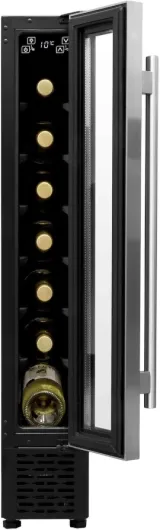
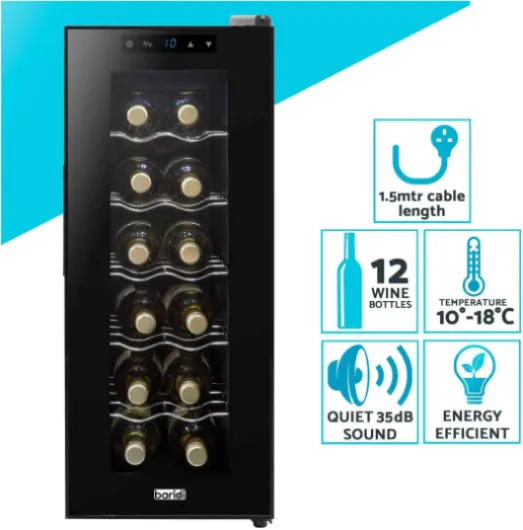
Design-wise, the big selling point is the slim footprint. At about 27 cm wide, it slid neatly into a narrow gap in my kitchen that nothing else would use. Depth and height (roughly 55 x 74 cm) are pretty standard for a small appliance, but that narrow width is what makes it handy if your kitchen layout is awkward. It looks more like a narrow tower than a mini-fridge box.
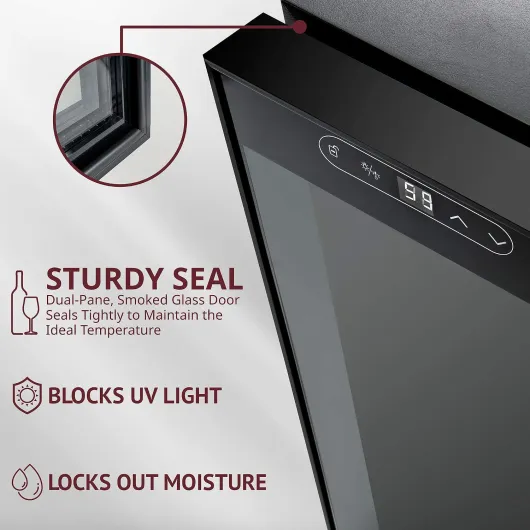
The front door is tempered mirror glass, which does two things. First, it looks fairly modern and hides fingerprints better than plain black plastic. Second, it reflects light and helps reduce UV exposure for the bottles, which is always a plus if it’s near a window. When the internal LED is on, you can see the bottles through the door, but it’s still darker than a clear glass door. Personally, I like that you can’t see every label from across the room; it looks cleaner.
The digital touch controls are on the top of the door frame. You can set the temperature and toggle the light. One annoyance: as some reviewers said, you can’t see the temperature screen when the door is fully shut because it’s behind the mirror tint and angle. You basically press the buttons and trust it, or open the door briefly to check. Not a deal breaker, but slightly silly design-wise. It would have been better to have a small visible display on the outside.
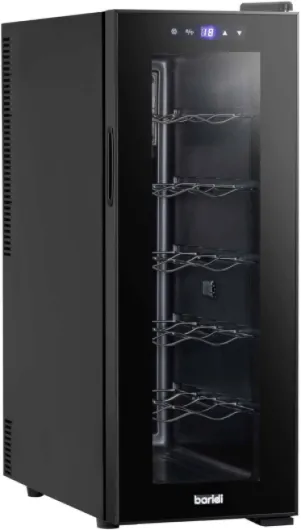
Overall, the design is pretty straightforward: black sides, mirror door, simple interior with waved shelves. It doesn’t scream for attention, but it looks tidy next to other black or stainless appliances. For a basic home bar or under-counter slot, it blends in well. Just don’t expect fancy handle finishes or premium feeling buttons; it’s clearly built to hit a price point rather than to impress on close inspection.
Build quality and shelves: decent, but you feel the budget
In terms of materials, this is very much a budget-friendly appliance. The body is light, the door feels okay but not heavy-duty, and the shelves are functional rather than premium. The tempered glass on the front is probably the nicest bit; it feels solid enough and doesn’t flex or creak when you open and close the door. The rest is standard painted metal and plastic trim that you’d expect at this price.
The shelves are waved metal, which hold bottles in a slightly cradled position. They slide in and out, but they’re not on rails like a high-end cooler, so you’re basically pulling light metal racks out of grooves. They do the job, but don’t feel expensive. A few reviews mention the shelves feeling a bit cheap, and I agree: they’re fine, but you won’t be raving about them. If you load heavier or odd-shaped bottles, you sometimes have to wiggle them in so they don’t catch.
Inside, everything is simple: white/neutral plastic, the LED light, and the cooling module at the back. There’s a bend or raised area at the bottom back, which some users called out because it steals space from the last bottle position. That’s where the “12 bottles” spec becomes theoretical if you’re using anything but slim bottles. You can tell they squeezed the interior around the thermoelectric system rather than designing a perfect rectangular box.
For the price, I’d say the materials are good enough but not impressive. Nothing felt like it would fall apart immediately, but it also doesn’t give that chunky, solid feel you get from a more expensive compressor wine cooler. If you’re gentle with it and you’re not constantly yanking shelves in and out, it should hold up fine for typical home use.
Daily use, reliability and little annoyances
In terms of durability, I obviously haven’t had it for years, but after a decent period of daily use, nothing has gone wrong so far. The door still seals properly, the handle is firmly attached, and the temperature control behaves consistently. It’s light enough that you can slide it out to clean behind it without feeling like you’ll break something, which is handy if it’s under a counter or in a tight spot.
The door seal is decent, but you do need to make sure it’s properly aligned when you first set it up. One user mentioned adding a bit of olive oil to refit the seal around the handle installation, which gives you an idea of the sort of little tweaks you might end up doing. It’s not badly built, but it doesn’t feel like a tank either. Treat it as a small appliance, not as a commercial fridge you slam all day long.
Inside, the shelves haven’t warped or bent, but they are thin, so I wouldn’t overload them or lean on them when pulling bottles out. The LED light still works fine, and the touch controls haven’t started misbehaving, which is usually one of the first weak points on cheap gear. The thermoelectric module has been consistent; no random shutoffs or weird temperature jumps beyond what you’d expect from room temperature changes.
Long-term, the biggest concern is probably the thermoelectric system in a hot environment. If you plan to run this in a very warm room or next to an oven, you’re basically pushing it harder all the time, which might shorten its life. In a normal kitchen at normal temperatures, I don’t see any obvious red flags. It feels like one of those products that will last fine if you leave it mostly alone and don’t constantly move or overstuff it.
Cooling, noise and real capacity: how it actually behaves
Performance-wise, the cooling is decent as long as the room isn’t too hot. With my kitchen around 20–22°C, setting the fridge around 13–14°C worked fine. Bottles felt nicely cool after a few hours and stayed consistent. The thermoelectric system doesn’t chill as aggressively as a compressor, so don’t expect super-fast cooling from room temperature; it’s more about keeping already cool bottles steady. If you want to slam in warm bottles and have them ready in an hour, this isn’t ideal.
The advertised range is 12–18°C, and that matches what I saw. You can tweak the temperature on the touch panel, but there’s no point trying to go below 12°C. Also, as Dellonda warns, it can’t go cooler than the ambient room beyond a certain gap. On a warmer day, the inside temperature drifted a bit higher than what I set, which is typical for thermoelectric units. For red and white wines that you just don’t want sitting at 25°C, it’s absolutely fine. For beer that you like near fridge-cold, you’ll probably find it a bit too warm.
Noise level is where it’s actually pretty good. The 25 dB claim feels realistic. There’s a faint hum when the cooling kicks in, but compared to a normal under-counter fridge, it’s much quieter. After the first day, I stopped noticing it unless the room was totally silent. For open-plan living rooms or home offices, that’s a big plus. One reviewer mentioned it being a bit loud when it kicks in, but mine was more of a soft fan sound, nothing dramatic.
Capacity is where marketing and reality don’t fully line up. The 12-bottle claim works only with standard, slim bottles and careful stacking. Chunky champagne and some prosecco bottles mess things up. You can remove a shelf to fit taller bottles (up to about 330 mm), but then you lose a row. Practically, I’d say think of it as 8–10 bottles comfortably if you mix shapes, and 12 only if you’re disciplined with bottle types. Not a disaster, but good to know before buying.
What this Dellonda wine fridge actually offers
On paper, the Dellonda Baridi is a 12-bottle thermoelectric wine fridge with a temperature range of 12–18°C, a slim 27.3 cm width, and touch controls on the front. It’s freestanding, so no built-in fancy integration, just plug it into a normal socket and you’re done. Annual energy consumption is listed around 92 kWh, and the noise level is advertised at 25 dB, which is very quiet compared to a normal kitchen fridge.
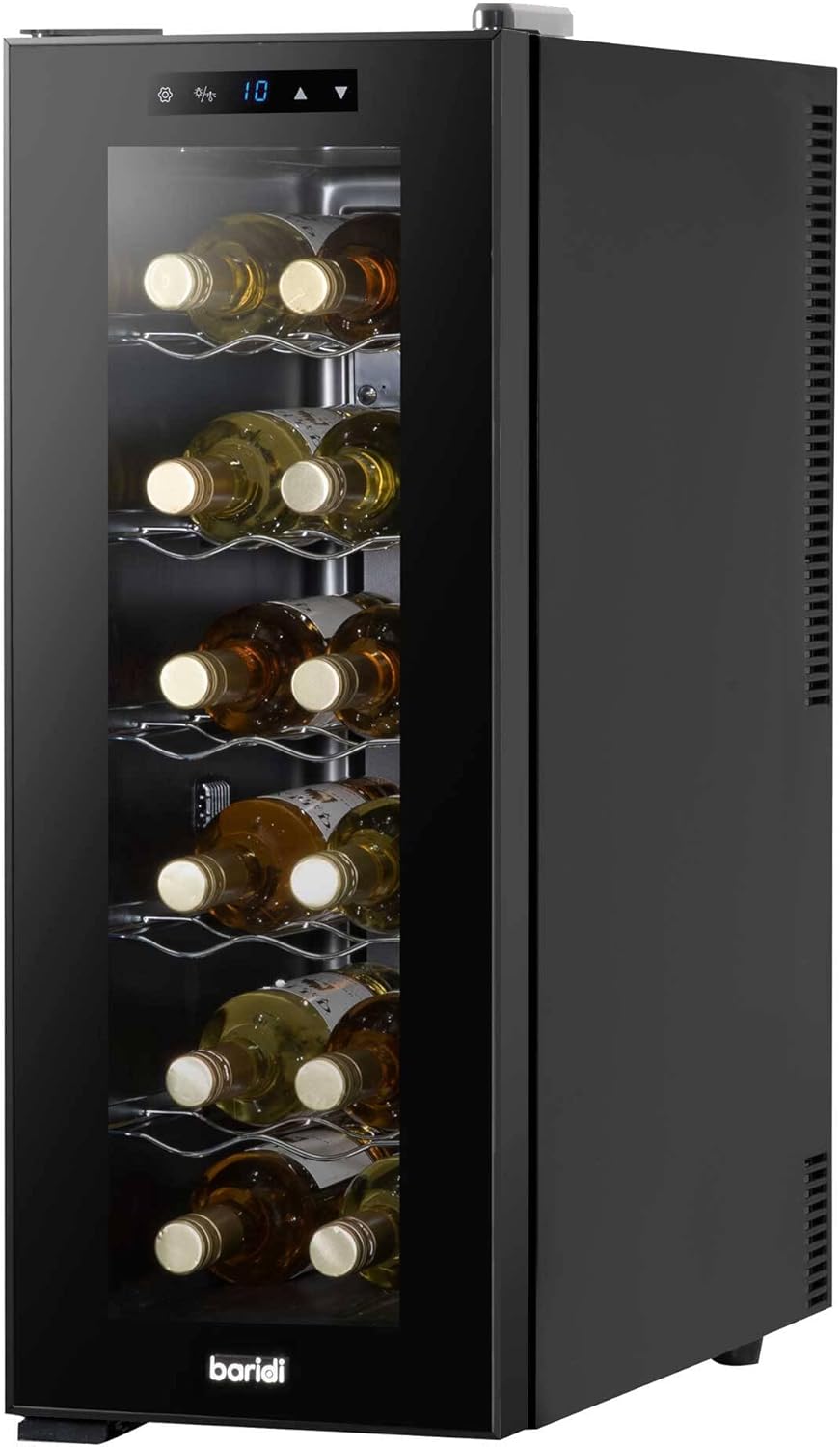
In real life, it’s basically a tall, narrow black box with a mirror-style glass door and a simple digital panel. You’ve got removable waved metal shelves inside that are meant to hold standard 750 ml wine bottles lying horizontally. The brand claims 12 bottles, but like with most wine coolers, that’s assuming pretty standard Bordeaux-style bottles. Chunky prosecco or champagne bottles can be more of a puzzle, and you’ll likely lose a space or two if you mix shapes.
The cooling system is thermoelectric, not compressor-based. That means: less vibration, usually less noise, and lighter weight, but also less raw cooling power. The fridge won’t go below the room temperature by a massive margin, and Dellonda clearly says it won’t reach a lower temperature than the ambient room allows. So if your kitchen is boiling at 28°C in summer, don’t expect your wine to sit happily at 12°C; it will struggle and hover higher.
So in practice, you’re getting a quiet, compact chiller aimed at people who want their red and white at a decent serving temperature, not ice-cold beer or cellar-grade storage. If that’s your use case, the feature set makes sense. If you wanted something for hot conservatories or garages, this is probably not the right tool.
Pros
- Very slim design fits into narrow kitchen gaps most fridges can’t use
- Quiet thermoelectric cooling, suitable for open-plan rooms
- Looks clean and modern with mirror glass door and simple controls
Cons
- Real capacity lower than the advertised 12 bottles, especially with champagne/prosecco
- Limited temperature range (12–18°C) and depends heavily on room temperature
- G energy rating and budget-feeling shelves/materials
Conclusion
Editor's rating
Overall, the Dellonda Baridi 12 Bottle Wine Fridge is a practical, no-frills choice if you’re short on space and just want your wine at a decent drinking temperature. The slim design is genuinely useful, the mirror glass door looks tidy in a modern kitchen, and the noise level is low enough that you forget it’s there. For casual wine drinkers who want to free up space in the main fridge and avoid room-temperature bottles, it gets the job done without drama.
On the downside, you have to be realistic: the true capacity is closer to 8–10 bottles if you mix shapes, the temperature range is limited (12–18°C), and the G energy rating isn’t great if you’re very focused on efficiency. The materials and shelves feel budget, and the fact that you can’t clearly see the temperature display with the door shut is a bit annoying. It’s not a premium product and doesn’t feel like one.
I’d recommend this to people who: have a narrow gap or small flat, want a quiet wine chiller, and mainly store standard bottles at moderate room temperatures. If you’re more serious about wine, need colder settings, or you want to store a lot of odd-shaped bottles, I’d look at a larger, compressor-based unit instead. For what it is, it’s good value and fairly hassle-free, as long as you go in with the right expectations.