Summary
Editor's rating
Value for money: who should actually buy this
Retro cream look: nice, but not for every kitchen
Materials and build: decent quality, not luxury
Durability and long-term feel (so far)
Temperature control and noise: how it performs day-to-day
What you actually get with this wine fridge
Pros
- Attractive cream retro design that integrates nicely into many kitchens
- Dual temperature zones (5–22°C) with simple touch controls and stable temps for home use
- Relatively quiet (around 41 dB) with decent UV protection and wooden shelves
Cons
- Real-world capacity is lower than the advertised 36 bottles if you use a lot of wide bottles
- Shelves are basic slides, not high-end rails, so they need a bit of gentle handling

Specifications
View full product page →| Brand | KLARSTEIN |
A retro wine fridge that doesn't try too hard
I’ve been using the Klarstein Vinsider Victoria 36 for a little while now, and I’ll be honest: I bought it mainly because of the look. I wanted a built-in wine fridge that didn’t scream “shiny stainless box” in the middle of the kitchen. The cream color and retro vibe caught my eye, and the 36-bottle dual-zone setup looked like a good middle ground between capacity and not taking over the room.
In day-to-day use, it’s basically a quiet box that keeps bottles cold, which is what you want. But there are a few details that you only notice once it’s installed: how loud it really is, how the shelves slide, how realistic the 36-bottle capacity is, and whether the temperature is actually stable or just for show. That’s the stuff I was looking for before buying, and most product pages don’t really say it clearly.
I’m not a sommelier, just someone who likes to have a small stock of reds and whites ready to go, plus a few sparkling bottles. So this review is from that angle: normal home use, not a restaurant cellar. I’ve loaded it close to full, played with both zones, and paid attention to noise, temperature and the little annoyances that come up after a few weeks.
Overall, it does the job pretty solidly, but it’s not perfect. If you expect to fit 36 big Burgundy bottles and magnums, you’ll be disappointed. If you want a quiet built-in unit with a vintage look and decent control over two zones, it’s pretty convincing. I’ll walk through the good parts and the bits that bug me so you know what you’re getting into before dropping the cash.
Value for money: who should actually buy this
On value, I judge it mainly on three things: capacity, features (dual zone, built-in, UV, noise), and how it looks in a real kitchen. For a 36-bottle dual-zone built-in with wooden shelves and a specific cream retro design, the price is in the mid-range. You can find cheaper wine coolers, but often they’re single zone, noisier, uglier, or freestanding only. You can also find pricier ones with better rails, more precise temperature control, and fancier finishes. This sits somewhere in the middle.
One thing to keep in mind: the 36-bottle capacity is optimistic if you have a lot of wide bottles (Burgundy, Champagne, fancy labels). With standard Bordeaux-style bottles, you can get close to the advertised number. Once you start mixing shapes, you either have to play Tetris or accept that you’ll be more around 28–32 bottles in practice. That’s normal for this size, but it’s worth knowing up front so you don’t plan a 36-bottle collection and then get annoyed when it doesn’t fit comfortably.
Where it makes sense is if you specifically want:
- a built-in model that integrates into cabinets, not a freestanding black box
- two temperature zones so you can keep reds and whites ready to serve
- a cream / vintage look instead of the usual stainless or black
- relatively quiet operation for an open kitchen
If you just want the cheapest way to keep a few bottles cold, you can absolutely find lower-priced single-zone units that will do the job. If you don’t care about design and only want maximum bottle count, a taller 50+ bottle fridge might be better value per bottle. Here, you’re paying partly for the look and the built-in format, not just raw storage volume.
Overall, I’d call the value pretty solid for someone who cares about both appearance and function. It’s not a bargain basement deal, but it doesn’t feel overpriced either. You get a decent mix of style, low noise, and dual-zone practicality. If those are your priorities, it makes sense. If your only goal is to store as many bottles as cheaply as possible, there are better options.
Retro cream look: nice, but not for every kitchen
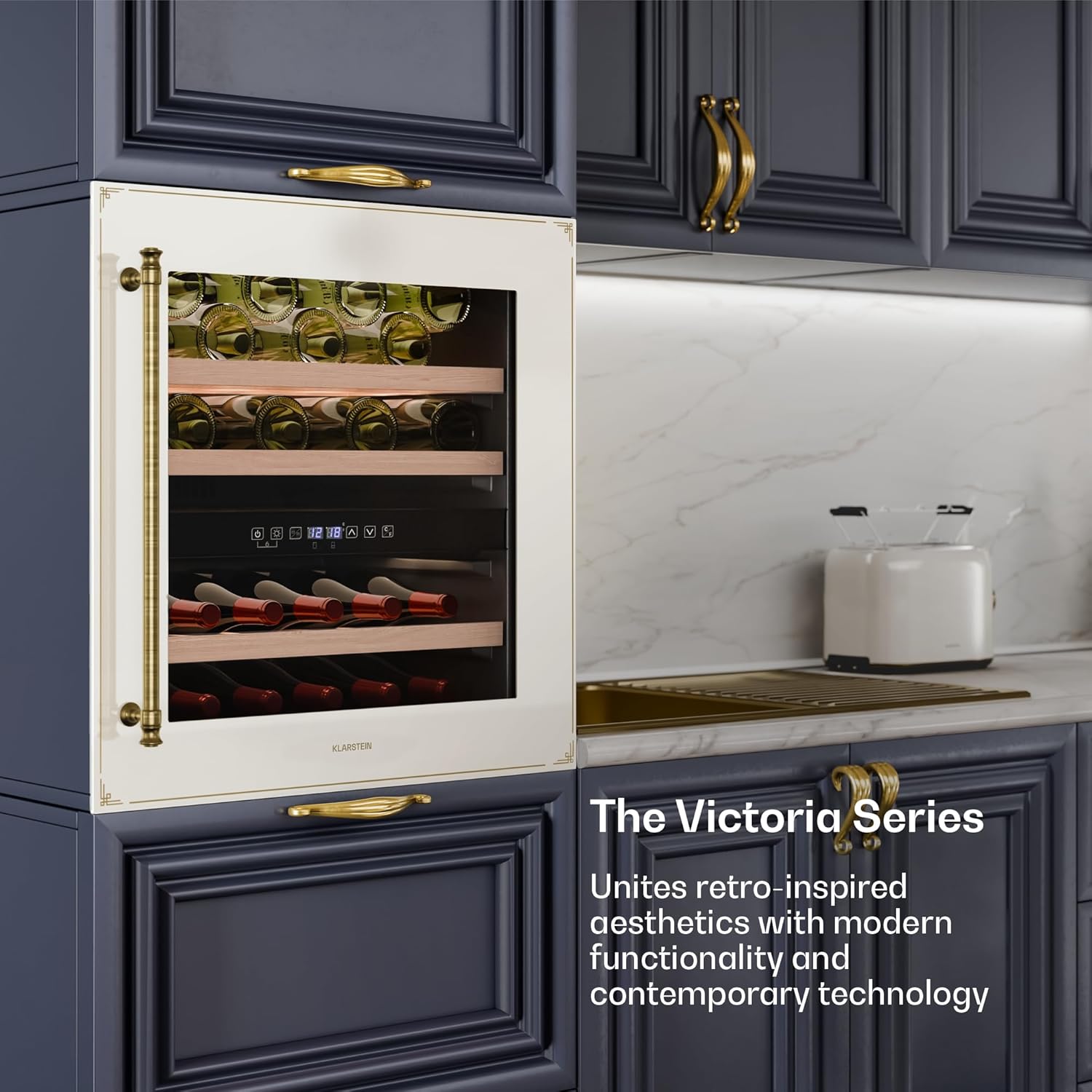
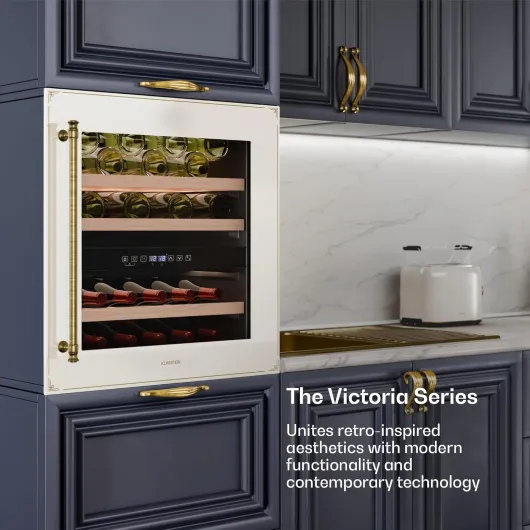
The design is clearly aimed at people who like a vintage or slightly classic kitchen style. The cream color is the main point: it’s warmer than stainless steel, and it blends better with wood or off-white cabinets. In my kitchen with light wood fronts and black worktop, it actually fits pretty well and doesn’t look out of place. If your kitchen is super modern, full of black glass and sharp edges, this might look a bit old-school, but that’s kind of the point.
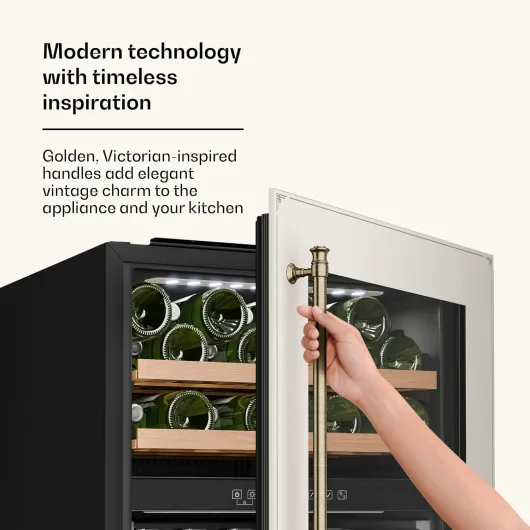
The front door has a glass window that shows the bottles and the internal LED lighting. The glass is tinted enough that it doesn’t look like a shop display, but you still see your labels. The frame around the glass and the handle match the cream tone, so it feels like one piece, not a random glass door stuck in the middle. The LED lighting is decent – not nightclub bright, more of a soft light that lets you see what’s inside when you open the kitchen lights off. You can leave it on for effect, but I mostly just use it when grabbing a bottle.
One thing I liked is that the touch control panel is integrated into the top part of the inside, visible through the glass. It keeps the front clean, no big plastic buttons. The interface is simple: temperature up/down for each zone, light on/off, and that’s about it. No useless smart features, no app, nothing over-complicated. The flip side is: if you like super high-tech gear with Wi-Fi and graphs, this will feel basic. Personally, I prefer basic and reliable to a buggy app I’ll never open.
In terms of overall look and feel, I’d say it’s pretty solid for the price range. It doesn’t look cheap, the proportions are good, and it doesn’t scream “budget appliance” when you integrate it into cabinets. It’s obviously not the same finish level as a high-end built-in from premium brands, but you’re not paying that price either. If you’re specifically hunting for a cream / retro built-in wine fridge, this one ticks that box without looking tacky. If you just want the most neutral and invisible option, you might be better off with a plain black or stainless model.
Materials and build: decent quality, not luxury
On the materials side, it’s a mix of metal, glass, and wood that feels decent in the hand but not high-end luxury. The wooden shelves are the main thing you notice when you open the door. They’re light wood, removable, and slide out enough to grab bottles without too much juggling. They don’t glide like a drawer on rails; it’s more of a simple slide on support rails. It works, but if you overload them or pull too quickly, they can tilt a bit. So you end up handling them with a bit of care once you get used to it.
The door feels solid enough. The hinge action is smooth, and the seal is firm. It doesn’t feel like it’s going to warp or go loose after a few months. The glass has that UV-protection tint, which is basically a slightly darker look. You can still see your bottles clearly, but it doesn’t look like clear window glass. No weird plastic smell from the inside after a few days either, which is something I pay attention to with fridges and coolers.
Inside, the plastic liner is pretty standard for this type of appliance. It’s not super thick or reinforced, but it doesn’t feel flimsy either. You can wipe it down easily, and the corners aren’t full of awkward angles, so cleaning is straightforward. The LED light strip feels basic but fine. There’s no metal trim or extra fancy finishes inside; it’s functional. The compressor and fan noise are low, and I didn’t notice any big vibrations on the shelves once loaded.
Overall, I’d say the build quality is mid-range: better than cheap no-name units, not at the level of very expensive built-in cellar brands. For the price point and the feature set (dual zone, built-in, UV glass, wood shelves), it feels fair. If you tend to be rough with your appliances, you might wish the shelves had smoother rails. If you handle things normally and don’t yank them out, it should hold up fine in a regular home kitchen for years.
Durability and long-term feel (so far)
For durability, I obviously can’t simulate five years of use in a few weeks, but there are some signs you can look at. The door mechanism feels reasonably solid: no wobble, no misalignment when closing, and the gasket seals all around without having to slam it. That’s usually a good sign for long-term use. The weight of the unit (36 kg) also tells you there’s at least some decent internal structure, not ultra-thin metal walls.
The wooden shelves are the part I’m slightly more cautious about. They’re fine for regular 0.75L bottles, but if you start stacking or loading them with heavy champagne bottles on each level, I wouldn’t go crazy yanking them out at full extension. They didn’t bend or crack on me, but you can feel they’re made to be light, not industrial-strength. For normal use, taking a couple of bottles out here and there, they should hold up. If you’re constantly rearranging your cellar and sliding shelves in and out every day, you might find their limits faster.
Inside, the plastic walls and fittings don’t feel fragile. I’ve bumped bottles against the interior a few times and didn’t see any marks or cracks. The LED light hasn’t flickered or failed. The compressor noise stayed consistent – no strange rattles after a few weeks. Also, the unit didn’t develop any weird smells or condensation issues, which can happen with cheaper coolers if they’re not sealed well or the drainage is badly designed.
In terms of brand trust, Klarstein is not some random unknown name, but it’s also not one of the ultra-premium cellar brands. I’d put it in the “decent mid-range” bucket. Based on the feel and finish, I’d expect it to last several years in a normal household if you treat it sensibly. Just don’t expect the same tank-like build as a professional cellar unit that costs double or triple. For the price segment, the durability looks reasonable and in line with expectations.
Temperature control and noise: how it performs day-to-day
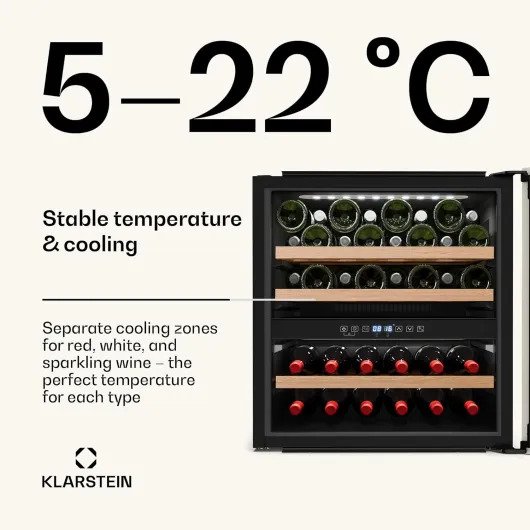
On performance, the two big questions for me were: does it actually hold the set temperature, and is it really as quiet as advertised. I set the lower zone to 6–7°C for whites and sparkling, and the upper zone around 12–14°C for reds. With a basic fridge thermometer placed on a shelf in each zone, the readings were usually within 1–2°C of what I set, which is fine for home use. It’s not laboratory precise, but nothing crazy. It cycles a bit: goes slightly below, then slightly above, like any compressor-based cooler.
One thing to note: when you first load it up or change the temperature a lot, it takes a while to stabilize, especially if you fill it with room-temperature bottles. I’d say give it a good 24 hours to settle before judging. Once it was running for a few days with a stable number of bottles, I didn’t see big swings. Bottles at the back stay a bit cooler than those right by the door, which is normal. If you’re fussy, put the bottles you care most about towards the back.
As for noise, the 41 dB spec matches what I hear: it’s a low hum that comes on and off, but in a normal kitchen it blends in with the regular fridge. In the evening, when everything is quiet, you notice it start up, but it’s not whiny or rattly. No strong vibration either – I put a glass of water on the top surface as a test, and it didn’t ripple like crazy. So on that front, the promises of “vibration-free storage” are reasonably accurate for a domestic unit.
Daily use is pretty straightforward: you open the door, grab a bottle, close it. The touch controls respond quickly, and the display is readable even through the glass. There’s no complicated menu. On the downside, there’s no fancy feature like door-open alarms or child lock on the controls, so if you have kids who like pressing buttons, they could mess with the temps. For a normal adult household, it’s fine. In short, for keeping reds and whites at sensible serving temperature with low noise, it gets the job done without drama.
What you actually get with this wine fridge
The Klarstein Vinsider Victoria 36 is a built-in wine cooler with two temperature zones and a claimed capacity of 36 bottles. It runs between 5 and 22°C, so you can set one zone colder for whites and bubbly and the other a bit warmer for reds. Control is done via a touch panel behind the glass door. It comes in this cream color, which is basically off-white with a slight retro feel, not bright white like a fridge.
Physically, it’s 56 x 59 x 60 cm and weighs around 36 kg, so it’s not tiny but still manageable with two people. It’s designed for integration into kitchen cabinetry, not as a freestanding tower in the living room. Inside, you get several removable wooden shelves and LED lighting. The brand pushes the “UV protection” from the glass and “low vibration” storage – in practice that just means the compressor isn’t shaking the bottles like crazy and the glass is tinted enough that they’re not in direct light all day.
Noise-wise, the spec says 41 dB, which is basically low background hum level. In a normal kitchen with a dishwasher and a standard fridge, it doesn’t stand out. You’ll hear it kick in if the room is silent, but it’s not the type of unit that will drive you mad in an open-plan living room, at least in my experience. Power use isn’t detailed in the data you gave, but based on similar units, I’d say it’s in the average range for a 36-bottle cooler – not crazy efficient, not terrible.
In terms of what it’s actually good for: if you regularly keep around 20–30 bottles in rotation and want them at proper serving temperature rather than just room temp or regular fridge cold, it fits the brief. If you’re expecting pro-level cellar control, humidity management, and perfectly even temperatures to the degree, this is more of a serious home appliance than a specialist cellar tool. It’s practical, looks nice, and doesn’t overcomplicate things, which for a home setup is often what you want.
Pros
- Attractive cream retro design that integrates nicely into many kitchens
- Dual temperature zones (5–22°C) with simple touch controls and stable temps for home use
- Relatively quiet (around 41 dB) with decent UV protection and wooden shelves
Cons
- Real-world capacity is lower than the advertised 36 bottles if you use a lot of wide bottles
- Shelves are basic slides, not high-end rails, so they need a bit of gentle handling
Conclusion
Editor's rating
The Klarstein Vinsider Victoria 36 is a solid mid-range wine fridge for people who want something that looks good in a kitchen and keeps both reds and whites at sensible temperatures. The cream retro design is the main hook here, and if that matches your cabinets or your style, it does its job visually. The dual-zone setup works well, the temperature is reasonably stable, and the noise level is low enough for open-plan living without being annoying.
It’s not perfect: the shelves are fine but not luxury, the 36-bottle figure is optimistic if you have lots of chunky bottles, and there are no fancy extras like Wi-Fi or humidity control. But in daily use, it’s straightforward, reliable enough, and easy to live with. If you’re a casual to semi-serious wine drinker who wants a built-in cooler that looks nicer than the usual black or stainless boxes, this is a good fit. If you’re a hardcore collector, want very precise climate control, or only care about maximum capacity for the money, you should probably look at larger or more specialized cellar units.