Summary
Editor's rating
Is it good value or should you save your money?
Design and build: looks nice, but not flawless
Ease of use and bottle handling: fine, but capacity is optimistic
Build quality, reliability and long‑term feel
Cooling, noise and daily use: the good and the annoying
What you actually get with this 17‑bottle dual‑zone fridge
Pros
- Very slim format (29.5 cm) with front ventilation, good for small kitchens and built‑in use
- Dual temperature zones for separating reds and whites between 5–22°C
- Nice cream/vintage design with glass door and white LED lighting
Cons
- Noticeable noise in real life, louder and harsher than the spec suggests
- Actual usable capacity closer to 12–14 bottles, especially with champagne/cava
- Temperature in white wine zone can fluctuate several degrees during the day

Specifications
View full product page →| Brand | KLARSTEIN |
A compact wine fridge that looks great… but is it worth it?
I’ve been using the Klarstein Vinovilla Victoria 17 for a little while in a small flat kitchen, under the counter, where every centimetre counts. On paper, it ticked all my boxes: dual zone for reds and whites, only 29.5 cm wide, and a look that doesn’t scream “cheap appliance”. I mainly wanted something to keep 10–15 bottles ready to drink without having to stack them in my normal fridge like Tetris.
In day‑to‑day use, the fridge does what it’s supposed to do: it cools wine correctly, the two zones work, and the LED controls are simple enough that you don’t need the manual after the first day. But it’s not perfect. The noise and the claimed capacity are the two points where reality doesn’t totally match the product page. If you expect something completely silent and super spacious, you’re going to be a bit disappointed.
I installed it in a built‑in niche under the worktop with enough space around the front vent, and I also tested it free‑standing for a few days to compare the noise and heat. That helped me see how it behaves in a normal kitchen versus in a more closed space. I also compared it to my standard fridge which has a similar dB rating, just like one of the Italian reviewers mentioned.
Overall, my feeling is: pretty solid for a small collection, nice design, but it’s not the miracle solution if you’re very sensitive to noise or if you want perfect temperature stability like a pro cellar. It’s fine for most casual wine drinkers, but you need to know its limits before buying.
Is it good value or should you save your money?
In terms of value, the Klarstein Vinovilla Victoria 17 sits in a kind of middle zone. It’s not the cheapest 12–18 bottle wine fridge you can buy, but you’re paying a bit extra for the dual‑zone feature, the slim format and the more stylish cream design. If all you want is cold wine and you don’t care about looks or two zones, you can find cheaper single‑zone models that will do the job just as well, or even better in terms of noise.
Where it earns points is the combination of compact size + dual zone + built‑in friendly front vent. That combo is not so common in this price range. If you live in a flat with a small kitchen and you want something that fits in a narrow gap, looks decent, and lets you keep reds and whites at different temperatures, then the value starts to make sense. You’re basically paying for practicality and design more than for pro‑level performance.
On the other hand, you have to factor in the noise and temperature fluctuations. If you’re sensitive to noise or you want very stable temperatures for ageing wine, you might quickly regret not spending a bit more for a quieter, more stable brand. Also, since the real usable capacity is closer to 12–14 bottles, the cost per bottle space is not amazing. For the same budget, some competitors offer 20+ bottle units, but usually with a bigger footprint and sometimes only one temperature zone.
For me, the value is okay but not impressive. If the design and narrow width are exactly what you need, it’s a reasonable purchase. If you have more space or you don’t care about the cream vintage look, I’d compare prices carefully and maybe aim for a bigger or quieter model from Klarstein or another brand. There’s better out there if you’re willing to compromise on size or style.

Design and build: looks nice, but not flawless
Visually, this fridge is one of the reasons I picked it. The cream colour and the slightly vintage vibe are a nice change from the usual black or stainless steel boxes. The glass door with interior lighting makes the bottles visible without looking tacky. When the LED light is on in the evening, it actually looks pretty nice in the kitchen, and guests notice it in a good way. It’s definitely more of a “show piece” than a basic appliance you hide in a corner.
The format is really practical: only 29.5 cm wide, so it slides into narrow gaps where a standard 60 cm unit wouldn’t fit. That’s perfect for small kitchens or if you’re retrofitting an existing layout. The front ventilation also means you can push it under a countertop without cooking the worktop, as one Spanish reviewer mentioned. The heat output is reasonable at the front; it doesn’t feel like a heater blowing into your legs.
On the downside, the build quality is not luxury level. One user reported the front door having small damage points, and I noticed similar small imperfections: tiny marks on the frame and the feeling that the door seal could be better finished. It’s nothing that stops it working, but you can tell it’s not top‑tier hardware. The shelves are basic but functional; they slide, but not super smoothly. You need two hands sometimes to avoid shaking the bottles.
Overall, I’d say the design is nice to look at but mid‑range in finish. If you’re picky about perfect paint and flawless door alignment, you might grumble a bit. If you just want something that looks decent in the kitchen and shows off your bottles, it does the job pretty well. Just don’t expect luxury build at this price point.
Ease of use and bottle handling: fine, but capacity is optimistic
In terms of everyday comfort, the fridge is generally easy to live with, but there are a few quirks. Loading standard 0.75 L bottles is straightforward: they slide into the wooden/metal shelves and sit securely enough. The problem starts when you add champagne or cava bottles. Like one Spanish reviewer said, cava bottles don’t fit well on the top shelf, and even on the others they go in but quite tight. If you drink a lot of sparkling, this is not the most convenient unit.
The advertised 17‑bottle capacity is, like usual, a best‑case scenario. If you line up only slim Bordeaux bottles and don’t care about easy access, you can get close. In real life, with a mix of shapes and wanting to actually grab a bottle without playing Jenga, you’re more around 12–14 bottles. If your collection is bigger than that, you’ll outgrow this fridge quickly. Also, once it’s quite full, pulling out one bottle can make the others move a bit, because the shelves don’t glide super smoothly.
The controls are straightforward: a small touch panel on the front with temperature up/down and light on/off. You don’t have to bend down forever to figure it out, and there are no complicated menus. That part is well thought out. The interior light is white, not blue nightclub style, and bright enough to read labels without being aggressive at night.
For installation, the weight (around 15 kg) means one person can move it, but aligning it under a counter is easier with two. The front vent is a strong point for comfort because you don’t have to worry about leaving a huge gap behind it. Overall, comfort is good if you have a small, mixed collection and don’t obsess over the theoretical 17 bottles. If you want to store lots of champagne or big bottles, it’s going to be annoying quite fast.
Build quality, reliability and long‑term feel
I haven’t had this fridge for years, so I can’t pretend to give a full long‑term durability verdict, but there are a few things you can already feel. The general structure is light but not flimsy. At 15 kg, it’s not a tank, which is good for moving it but also means it doesn’t have that super solid feel of heavier, more premium units. The door hinges feel okay, but I wouldn’t slam it hard all the time; it’s more of a “treat it gently” appliance.
The reports of door defects (small spots or marks on the front) suggest quality control is not perfect. That’s cosmetic, but when you buy a fridge partly for its look, it’s annoying. On my unit, the finish is mostly fine, but you can see tiny imperfections if you look closely. The seal around the door seems decent, but not ultra thick, so I’m curious how it will age with constant temperature changes and opening/closing.
From a technical point of view, the compressor and cooling system behave like a typical mid‑range wine fridge. No weird vibrations, no random shutdowns, but also not the quietest or most stable. One Italian user mentioned big temperature swings and worrying about high electricity bills; that kind of fluctuation can also mean the compressor works more than necessary in some setups, which isn’t great for long‑term life. Proper ventilation around the front and not cramming it into a closed cabinet should help.
Overall, I’d say the durability feels average for the price: not junk, but also not built like a professional cellar. If you treat it decently, don’t overload the shelves with heavy bottles, and give it some space to breathe, it should last a few years without drama. If you want something to last 10+ years with daily use and perfect stability, you’ll probably need to look at a higher price bracket.
Cooling, noise and daily use: the good and the annoying
Let’s start with the main point: does it cool properly? Yes, it cools. The dual zones work, and you can clearly feel the difference between the upper and lower sections. Whites and rosés come out nicely chilled, reds stay at a decent serving temperature instead of room‑temperature soup. One reviewer said “kühlen tut das Gerät schon gut” and I agree: cooling performance for normal home use is fine.
However, the temperature stability is not perfect, especially in the white wine zone. One Italian reviewer complained that even with the white zone set to 5°C, it sometimes jumps up to 13°C without anyone opening the door. I’ve seen similar behaviour, though not always that extreme: the display can fluctuate several degrees during the day. For casual drinking, it’s acceptable, but if you’re very strict about constant temperature or you keep sensitive bottles, it’s not ideal. It also probably doesn’t help with energy consumption if the compressor cycles a lot.
Now, the noise. The official spec says around 41 dB, which sounds low, but in reality it’s a bit louder than I expected. It’s not a jet engine, but in a quiet room you clearly hear when the compressor kicks in. Some reviewers say it’s very quiet, others say it’s much louder than the stated dB. I’m closer to the second group: compared to my main fridge with a similar dB rating, this one sounds a bit harsher, more noticeable. If your kitchen is open to the living room and you’re sensitive to constant background noise, it can get on your nerves, especially in the evening.
Day to day, the controls are easy: touch panel, simple temperature setting, quick to understand. The interior LED light is practical enough to see labels without having to pull everything out. The compressor cycles are regular, nothing weird like constant on/off, but you do notice them. So overall: performance is good enough for casual use, but the noise and temperature swings put it more in the “decent mid‑range gadget” category than in the serious wine storage category.
What you actually get with this 17‑bottle dual‑zone fridge
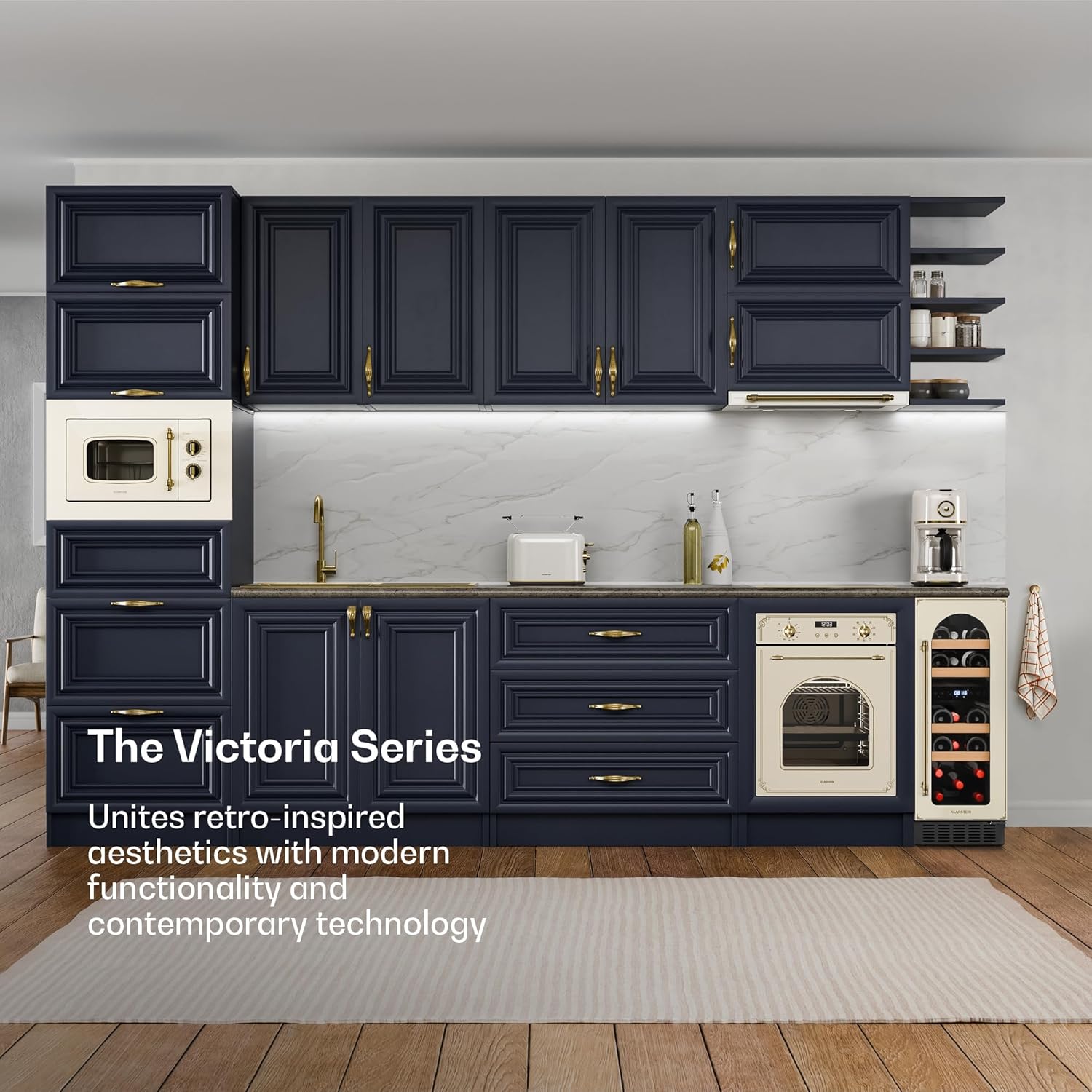
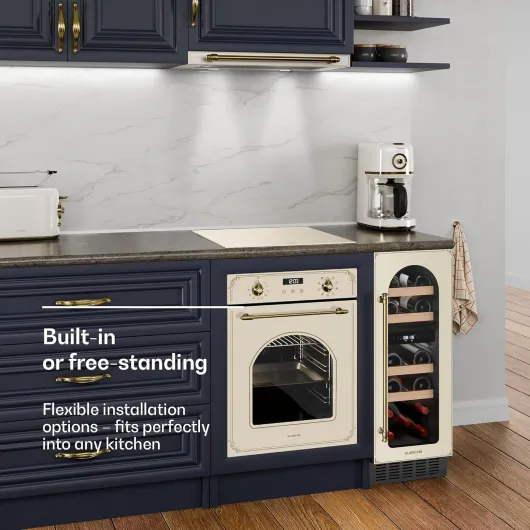
The Klarstein Vinovilla Victoria 17 is a slim dual‑zone wine fridge with a stated capacity of 17 bottles and about 52 litres. It’s 60 x 29.5 x 82 cm and weighs around 15 kg, so you can move it with one other person without breaking your back. The colour I had is cream, which looks a bit retro and fits well in a more classic kitchen, not just modern black/steel setups. It can work as a built‑in under a counter thanks to the front ventilation, or you can leave it free‑standing.
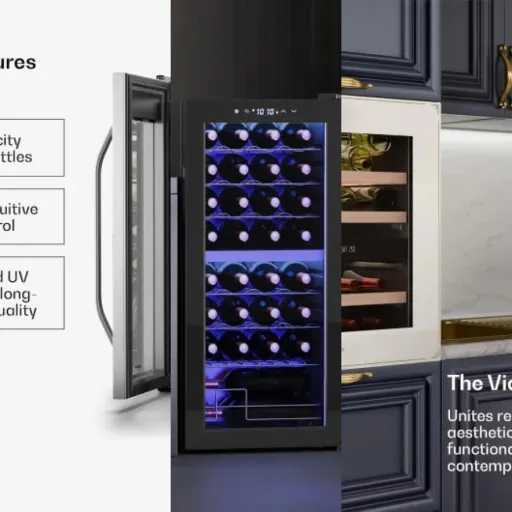
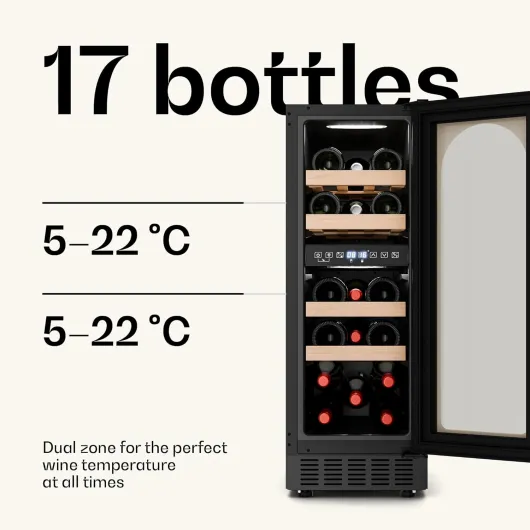
You’ve got two temperature zones controlled by a touch LED panel: one for white/rosé (down to 5°C) and one for red (up to 22°C). The door is glass with UV protection and there’s white LED interior lighting. Inside, there are several shelves for standard 0.75 L bottles. The brand talks about 17 bottles, but like most wine fridges, that’s in theory with standard Bordeaux bottles, perfectly aligned, no cava, no magnums, nothing fancy.
In practice, once you start mixing bottle shapes, the capacity drops. If you like cava, champagne or chunkier bottles, you’ll need to play around with the shelves, and you’ll quickly see that 17 is optimistic. One Amazon review even jokes about the capacity claims, and I kind of agree: it’s more realistic to count around 12–14 bottles if you don’t want to fight with it every time you add a new bottle.
The main idea of this fridge is pretty clear: a small, good‑looking unit for people who don’t have room for a big cellar but still want to keep some reds and whites at decent serving temperature. It’s not a pro storage solution for ageing wines for 10 years. It’s more of a “kitchen helper” so you’ve always got something ready to pour without thinking too much.
Pros
- Very slim format (29.5 cm) with front ventilation, good for small kitchens and built‑in use
- Dual temperature zones for separating reds and whites between 5–22°C
- Nice cream/vintage design with glass door and white LED lighting
Cons
- Noticeable noise in real life, louder and harsher than the spec suggests
- Actual usable capacity closer to 12–14 bottles, especially with champagne/cava
- Temperature in white wine zone can fluctuate several degrees during the day
Conclusion
Editor's rating
The Klarstein Vinovilla Victoria 17 is a decent compact wine fridge for people who want something narrow, fairly nice‑looking, and with two temperature zones in a small kitchen. It cools correctly, the dual‑zone function works, and the LED touch controls are simple. The cream colour and glass door give it a nicer presence than a basic black box, and the front ventilation makes it practical for built‑in use under a counter. For a small mixed collection of reds, whites and a bit of sparkling, it gets the job done.
But it’s not perfect. The real capacity is lower than the advertised 17 bottles once you mix bottle shapes, the noise level is higher in practice than what the numbers suggest, and the white wine zone can show noticeable temperature swings. Build quality is acceptable but not premium, with some reports of small cosmetic flaws. If you’re picky about silence, absolute temperature stability, or you want to age valuable bottles for years, this is not the right tool. If you’re more of an everyday drinker who wants their wine at roughly the right temperature and likes the look of a small wine fridge in the kitchen, it’s a reasonable, mid‑range choice.