Summary
Editor's rating
Value for money: where it makes sense and where it doesn’t
Design: compact, black, and simple enough to blend in
Build quality and materials: solid enough, with a few quirks
Durability and reliability after regular use
Performance: cooling, noise, and everyday use
What you actually get with the Subcold Viva16
Pros
- Compact size that fits easily on countertops or under islands while still holding up to around 16 standard bottles
- Compressor cooling with 3–18°C range, so drinks actually get properly cold and stay consistent
- Decent build quality with glass door, adjustable shelves, and relatively low noise for everyday use
Cons
- Single-zone and limited capacity make it less suitable for serious wine collectors or large households
- Some condensation can appear at the bottom of the glass door, especially in humid environments

Specifications
View full product page →| Brand | Subcold |
A compact wine fridge that actually fits real life
I’ve been using the Subcold Viva16 LED wine fridge for a while now, mainly for beer, white wine and soft drinks. I bought it because my main fridge was always packed with food and my drinks were never properly cold. I didn’t want a huge under-counter unit, just something that could sit on a worktop or under an island and not take over the room. On paper, this one ticked the boxes: 16 bottles, 3–18°C range, lock, light, and supposedly low noise.
In everyday use, what struck me first is that it’s basically a small, simple fridge that happens to be sized for wine bottles. No fancy smart features, no app, no multi-zone stuff. You plug it in, set the temperature on the digital panel, and that’s it. In my case, I mostly keep it between 4°C and 6°C for beers and soft drinks, and sometimes bump it up a bit when I know I’ll have more wine inside. It’s more practical than glamorous, which I actually prefer.
Compared to just shoving bottles into a normal fridge, the main difference is organisation and consistency. The shelves are spaced for bottles, you don’t have food in the way, and the temperature actually stays where you set it. My main fridge door is opened all the time, so drinks there are always a bit hit and miss. With the Viva16, once it’s cooled down, it keeps things steady unless you stand there with the door open for ages.
It’s not perfect though. It’s not totally silent, the inside space is a bit optimistic if you regularly buy weirdly shaped bottles, and the condensation at the bottom of the glass can be slightly annoying. But overall, as a small tabletop wine and drinks fridge for normal home use, it gets the job done pretty well without costing a fortune or eating half your kitchen.
Value for money: where it makes sense and where it doesn’t
On value, I’d put the Subcold Viva16 in the “good value but not unbeatable” category. For the price, you get a proper compressor-based wine and drinks fridge with adjustable temperature from 3–18°C, a glass door, internal light, and a lock. It’s not loaded with features, but the basics are done correctly. If your goal is to free up space in your main fridge and have drinks consistently chilled, it does that without fuss. Compared to some cheaper thermoelectric coolers that struggle to get very cold, this one is clearly more capable.
Where it shines for value is if you specifically need a compact tabletop or worktop unit. A lot of under-counter wine fridges have bigger capacity and sometimes dual zones, but they’re more expensive and require a dedicated built-in space. Here you’re paying for a smaller footprint and the flexibility to move it around – kitchen, home bar, office, or even a caravan if you have the space and power. If you don’t have room for a full-height drinks fridge, this fills that gap quite well.
On the downside, if you’re a serious wine collector and want perfect long-term storage with humidity control, multiple zones and specific shelving for different bottle types, this is too basic. You’d be better off spending more on a specialist wine cabinet. Also, the single zone and relatively small capacity mean that if you regularly host big gatherings and need to cool a lot of drinks at once, you might outgrow it pretty quickly. In that case, a bigger under-counter unit or a tall drinks fridge might give you more value per litre.
For an average household, though, I’d say the price-to-utility ratio is good. It keeps drinks cold, looks decent, doesn’t use loads of electricity, and doesn’t take up too much space. It’s not the cheapest thing you can buy, but given its performance and build, I don’t feel like I overpaid. If you find it on a small discount, it becomes an even easier yes. If it’s at full price and you only need it occasionally, you might think twice and see if a bigger regular fridge upgrade would make more sense instead.
Design: compact, black, and simple enough to blend in
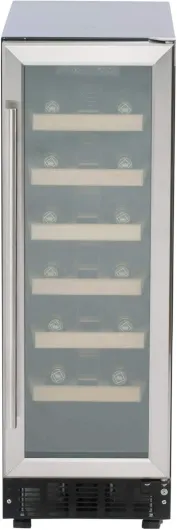
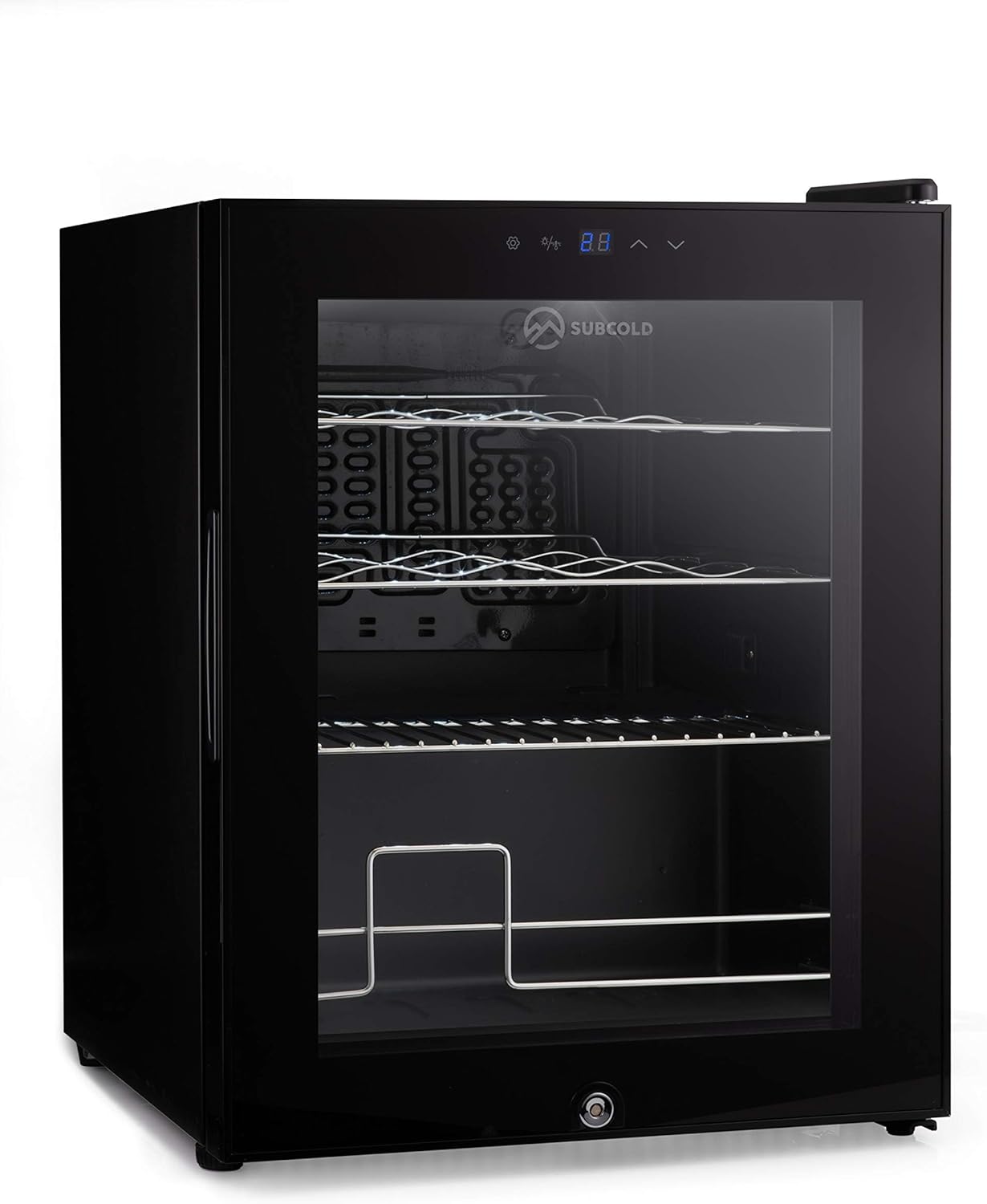
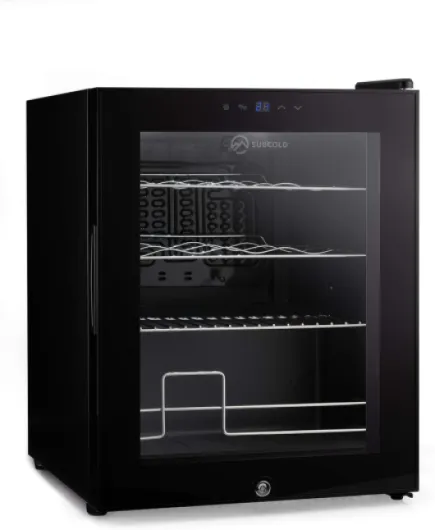
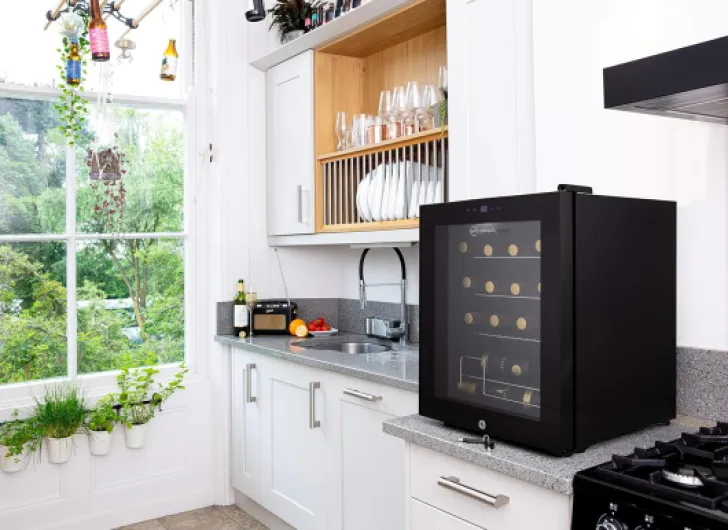
Design-wise, the Viva16 is pretty straightforward. It’s a black box with a glass front door, and that’s not a criticism. The black lacquered finish doesn’t scream for attention, and the frameless dual-glazed glass door gives it a slightly more modern look than those fridges with chunky plastic frames. In my kitchen, it sits under a worktop and kind of disappears until you switch the light on. When the internal LED is on, your bottles are visible but not overexposed – it’s more of a soft display than a bright showroom light.
The door is right-hinged and opens wide enough to easily slide shelves in and out. The handle is integrated into the side of the door frame, so there’s no big handle sticking out that you bump into. I find that handy in tighter spaces. The digital temperature display is small but readable from a normal distance. It doesn’t light up the whole room at night, which is good if you keep it in an open-plan living area. The control buttons aren’t premium or anything, but they work and don’t feel flimsy.
In terms of layout, the internal design is clearly optimised for wine bottles, but it doesn’t force you to only use it for wine. I’ve had rows of beer bottles lying down, cans stacked at the bottom, and a couple of odd-shaped bottles (prosecco, craft gin, etc.). You do have to play Tetris a bit if you mix shapes, and if you mainly drink champagne or big 750 ml craft beers, you’ll probably need to remove or adjust a shelf. The fact that the shelves are removable and adjustable helps a lot here.
One thing that’s worth noting: the ventilation clearance. Because it’s a compressor fridge, you can’t jam it against a wall or completely enclose it in a tight cabinet without leaving some space for air to circulate. I left a few centimetres at the back and on the sides, and it’s been fine – the sides get slightly warm, which is normal. Overall, the design is simple, functional, and neutral. It won’t win design awards, but it doesn’t look cheap or out of place either, especially for the price bracket.
Build quality and materials: solid enough, with a few quirks
The overall build of the Viva16 feels pretty solid for the price, but you can tell it’s a mid-range appliance, not a premium one. The cabinet is a high-density foam-injected body with a metal outer shell and a lacquered black finish. It doesn’t flex when you move it, and at around 19 kg, it’s got enough weight to feel stable on a worktop or sideboard. The dual-glazed glass door is the nicest part: it feels sturdier than those thin plastic-fronted doors you see on some cheaper coolers, and it closes with a decent seal. The magnetic door seal does its job and doesn’t feel like it’s going to fall off.
Inside, the chrome wire shelves are basic but functional. They slide in and out easily, and they don’t bend under the weight of 5–6 bottles per shelf. They’re not luxury thick wire, but they’re not flimsy either. I like that you can remove them completely if you want to store tall bottles upright at the bottom. The internal walls are plain plastic – nothing fancy – but easy to wipe down with a cloth if you spill something. The LED light is small and tucked at the top, so it doesn’t get in the way or blind you.
The lock mechanism is probably the least premium-feeling part. It works, but it’s a simple key lock at the bottom of the door. It’s fine for casual use, but you can tell it’s not designed to resist serious attempts to break in. For me, it’s mainly a way to stop kids or guests from helping themselves when I’m not around, and for that it’s okay. The keys are standard, nothing special, and you get two of them in the box.
Over time, I haven’t noticed any rattles or weird vibrations coming from the cabinet or shelves, which is a good sign. As long as you level the feet properly and don’t cram bottles against the back wall, it stays quiet. The paint hasn’t chipped, and the glass hasn’t scratched under normal use. So overall, the materials and build quality feel decent: not premium, not cheap junk either, just in line with what you’d expect from a compact fridge in this budget range.
Durability and reliability after regular use
In terms of durability, I can’t speak for 10 years of use, but after several months of running almost constantly, the Viva16 has held up well. It’s been on pretty much 24/7, with the temperature set low for beers and soft drinks, and I haven’t had any breakdowns or weird behaviour. The compressor still cycles normally, the temperature display works, and the door seal hasn’t started to sag or warp. For a compact fridge in this price bracket, that’s already a good sign.
The parts that usually show wear first – like the shelves, door hinge, and handle area – are still in good shape. I open and close the door a lot when we have people over, and there’s no looseness in the hinge or wobble in the door. The shelves haven’t bent, and they still slide in and out without catching. The internal plastic surfaces don’t have any cracks or warping, even after running it at colder settings for long stretches.
The only mild concern I had at first was the condensation at the bottom of the glass door, especially on humid days. I was worried it might eventually affect the seal or cause moisture buildup. So far, it hasn’t turned into a real problem – I just wipe the glass now and then. It seems to be more of a cosmetic thing than a structural issue. Still, if you live in a very humid house or you keep it in a room with poor ventilation, it’s something to watch.
Subcold offers a 1-year warranty, which is fairly standard. I haven’t had to use it, so I can’t comment on their customer service. But based on how it’s been running, I don’t have the feeling it’s about to fail. In short, it feels like a fridge that will last a few years of normal household use without drama, as long as you treat it like an appliance and not a piece of furniture to sit on or stack heavy stuff on top of. It’s not bulletproof, but for what it costs, the durability so far seems pretty solid.
Performance: cooling, noise, and everyday use
On performance, this fridge does what it’s supposed to: it cools drinks to the set temperature and keeps them there reasonably well. I’ve mostly run it between 4°C and 7°C. With the thermostat at 4°C, my beers come out properly cold – noticeably colder and more consistent than in my overstuffed main fridge. I did test the lower end, around 3°C, and it got there without much drama. You just need to give it time after loading it with room-temperature bottles. If you load it full of warm drinks in one go, expect a few hours before everything is evenly chilled.
Temperature stability is decent. I stuck a cheap fridge thermometer on a shelf, and it stayed within 1–2 degrees of the set value once everything had cooled down. Opening the door obviously makes the temperature jump up, but it recovers fairly quickly. It’s a single-zone fridge, so you can’t have different temperatures for red and white at the same time. If you want that kind of setup, this is not the right product. But for all whites and beers, or as a mixed drinks fridge, it’s fine.
Noise-wise, it’s not silent, but it’s not loud either. The 39 dB spec matches what I hear: you notice the compressor when it kicks in, a soft humming sound, but it’s not intrusive. In an open-plan living room, you’ll hear it if the room is very quiet, but it blends into background noise pretty quickly. In a bedroom, I’d probably find it a bit too present at night, but in a kitchen, home office or living area, it’s acceptable. Compared to a big kitchen fridge, it’s about the same or slightly quieter, just with shorter cycles.
As for energy use, I haven’t measured it with a smart plug, but based on the rated consumption and my electricity bill, it doesn’t seem to be a big cost. It’s also frost free, so you don’t have to defrost it. The only small annoyance I’ve had is a bit of condensation at the bottom of the door on humid days, which some other users mention too. It’s not dripping everywhere, just a light misting that sometimes collects a little at the bottom edge. Wiping it occasionally solves it, but it’s something to be aware of if you’re picky about a perfectly clear door all the time.
What you actually get with the Subcold Viva16
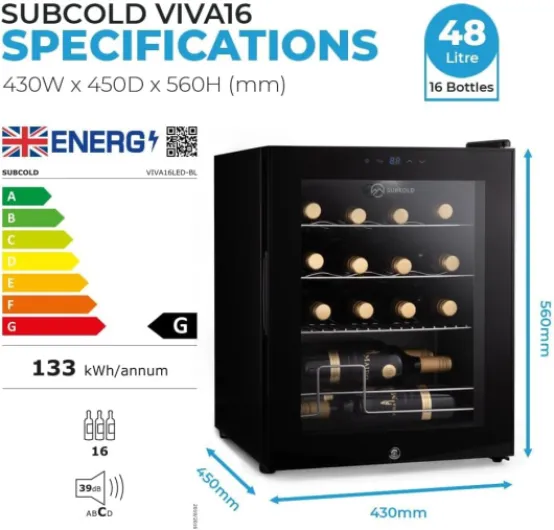
On paper, the Subcold Viva16 is a 42–43L single-zone wine fridge that can hold up to 16 standard bottles. In reality, that “16 bottles” figure is realistic if you’re mostly using standard Bordeaux-style bottles and you don’t mix in lots of big champagne or craft beer bottles. Inside you get 3 removable chrome wire shelves, plus some usable space at the bottom. The control panel is digital, with buttons to adjust the temperature between 3°C and 18°C, and there’s an internal LED light you can switch on to show off what’s inside.
The unit is tabletop and standalone, so you don’t need to build it into a cabinet. The dimensions are roughly 45 cm deep, 43 cm wide, and 56.5 cm high. For me, that meant it fit neatly on a sturdy sideboard and later under a kitchen island without sticking out like a sore thumb. It uses a compressor cooling system (not a thermoelectric one), which is good if you actually want to hit lower temperatures like 3–5°C for beers and soft drinks. It’s rated at about 133 kWh per year and 39 dB noise, so it’s not a power-hungry monster.
You also get a lock and two keys. I’ll be honest: the lock feels more like a deterrent than a security system. It’s fine if you just want to stop kids or housemates from raiding your stock, but it’s not a safe. Still, it’s better than nothing and it does work as intended. The fridge comes with the standard UK plug (Type G), no smart home stuff, no Wi-Fi, nothing fancy. Just an on/off, temperature control, and light button.
Out of the box, setup is straightforward: unpack, remove the protective tape, let it sit upright for a few hours so the compressor oil settles (this is important), then plug it in and set your temperature. It cools down in under an hour to a mid-range setting in my case. No complicated menus, no weird beeps, no manual you need to study. It’s very much a plug-and-play appliance, which I appreciated. If you want a simple, compact drinks fridge, that’s basically what this is.
Pros
- Compact size that fits easily on countertops or under islands while still holding up to around 16 standard bottles
- Compressor cooling with 3–18°C range, so drinks actually get properly cold and stay consistent
- Decent build quality with glass door, adjustable shelves, and relatively low noise for everyday use
Cons
- Single-zone and limited capacity make it less suitable for serious wine collectors or large households
- Some condensation can appear at the bottom of the glass door, especially in humid environments
Conclusion
Editor's rating
Overall, the Subcold Viva16 LED is a practical small wine and drinks fridge that fits real-life use pretty well. It cools reliably down to fridge-like temperatures, holds a decent amount for its size, and doesn’t look cheap on the counter. The noise level is acceptable, the glass door and LED light give you a clear view of what’s inside, and the adjustable shelves make it flexible enough for wine, beer, cans and the odd taller bottle. It’s not trying to be a high-end wine cabinet, and that’s fine – it just quietly does its job.
It’s not flawless. The capacity is realistic only if you mainly use standard bottles, the single temperature zone limits how you manage reds vs whites, and the light condensation on the door can be slightly annoying in humid conditions. The lock feels more like a basic deterrent than real security. But none of these are deal-breakers for normal home use. If you want a compact, plug-and-play drinks fridge to free up space in your main fridge and keep your drinks consistently chilled, this is a solid option for the money.
I’d recommend it to people with limited space – small kitchens, flats, home bars, garden rooms, or offices – who want a simple, reliable cooler without getting into specialist wine storage territory. If you’re building a serious wine collection, need dual zones, or want to store dozens of bottles for the long term, you should skip this and look at larger, more advanced wine cabinets. For everyone else who just wants cold drinks in a neat little unit, the Viva16 is a sensible, good-value choice.